
Amateur acting, low-budget special effects, and an post-apocalyptic plot? Yeah, it’s got all of that. Although it will likely draw mixed reviews, we find this short oddly fascinating.
Tag Archives: Camp
80. SHOCK CORRIDOR (1963)
“My title became Shock Corridor. It had the subtlety of a sledgehammer. I was dealing with insanity, racism, patriotism, nuclear warfare, and sexual perversion. How could I have been light with those topics? I purposefully wanted to provoke the audience. The situations I’d portray were shocking and scary. This was going to be a crazy film, ranging from the absurd to the unbearable and tragic.”–Sam Fuller, “A Third Face: My Tale of Writing, Fighting and Filmmaking 

DIRECTED BY: Samuel Fuller
FEATURING: Peter Breck, Constance Towers, Hari Rhodes, Larry Tucker
PLOT: Johnny Barrett is a journalist obsessed with reaching the pinnacle of his profession—winning a Pulitzer Prize—and convinced that an unsolved murder at a mental institution will provide him the investigative opportunity his career needs. Barrett arranges to have himself committed so he can interview the three patients who witnessed the crime, over the objections of his stripper girlfriend, who fears that he will lose his mind if he enters the asylum. Once inside, Barrett tries to pry the information he needs out of the three witnesses during their rare lucid moments, but his constant intercourse with madmen, electric shock treatments, and a traumatic incident in the nympho ward take a toll on his own sanity.

BACKGROUND:
- Samuel Fuller, who had made successful and stylish B-pictures like I Shot Jesse James (1949), The Steel Helmet (1951) and Pickup on South Street (1953) for Twentieth Century Fox, began producing his films independently in 1956 to escape studio control.
- Fuller’s script was inspired by journalist Nellie Bly, who deliberately had herself committed to the Women’s Lunatic Asylum in 1887 in order to write a piece exposing conditions there.
- Fuller’s first career was as a journalist; he was a crime beat reporter for the New York Evening Graphic at the age of 17.
- Shock Corridor was made back-to-back with The Naked Kiss (1964), also starring Constance Towers and also dealing with potentially exploitative, shocking subject matter (in Kiss, prostitution and pedophilia). The two films are usually considered to be spiritual siblings and are often screened together.
- The corridor set (the “street”) ended in a painted backdrop meant to give the illusion of stretching off to infinity. Dwarfs were hired as extras to mill about at the end of the hallway to create a false perspective.
- Cinematographer Stanley Cortez had previously shot The Magnificent Ambersons (1942) and The Night of the Hunter (1955), but ended his career lensing schlock like Madmen of Mandoras, Ghost in the Invisible Bikini and Navy vs. the Night Monsters.
- The film was shot in about ten days; Fuller friend John Ford dropped by to visit the set and asked, “Sammy, why are you shooting on this two-bit set?” to which Fuller replied, “No major would touch my yarn, Jack. It’s warped.”
- The color scenes are composed of unused Japanese location-scouting footage from Fuller’s House of Bamboo, from an unreleased documentary on the Karaja tribe of Brazil, and home movies from a vacation.
- Fuller claimed that producer Samuel Firks never gave him his promised share of the profits, but was nonetheless happy with the arrangement because the producer allowed the director complete creative control.
- When Shock Corridor was awarded a special Humanitarian Award at the San Sebastian Film Festival, Fuller reportedly declined with the words “this isn’t a goddamn humanitarian film, it’s a hard-hitting, action-packed melodrama. Give your award to Ingmar Bergman.”
- Shock Corridor was selected for the National Film Registry in 1996 (the prestigious list of films preserved because of their cultural significance stands at only 550 titles as of 2010).
INDELIBLE IMAGE: Though it’s hard to beat the thunderstorm in the corridor, it’s the scenes of Constance Towers as a naughty angel doing her hoochie-coochie dance in a feather boa on Peter Breck’s shoulder while he tries to grab some shuteye that make the biggest impression.
WHAT MAKES IT WEIRD: Though it features its fair share of stormy strum und drang hallucinations, Shock Corridor would be a weird movie even without the schizoid interludes. Fuller’s film imprisons us inside a mental hospital full of patients who act nothing like normal people—but the uncanny thing is that they don’t act anything like lunatics, either. They act like symbols. Drenching the film with melodramatic performances, expressionist visuals, outlandish dialogue, and blatant sensationalism, Fuller (consciously or unconsciously) constructs a uniquely nightmarish vision of Cold War America as a hyperreal asylum.
Trailers from Hell on Shock Corridor
COMMENTS:After nearly 50 years, Shock Corridor has lost much of its power to shock Continue reading 80. SHOCK CORRIDOR (1963)
CAPSULE: WILD ZERO (2000)
DIRECTED BY: Tetsuro Takeuchi
FEATURING: Masashi Endô, Kwancharu Shitichai, Guitar Wolf, Makoto Inamiya
PLOT: Guitar Wolf (frontman of the pistol-packing punk outfit Guitar Wolf) makes Ace a blood brother when the would-be greaser is injured during a showdown between the band and an evil club owner; the rock star gives him a whistle he can use to summon the band in times of need, which comes in useful when Ace finds himself trapped in a town overrun by zombies.

WHY IT WON’T MAKE THE LIST: It’s more “wild” than “weird,” and more “awesome” than “great.” The surrealism sometimes seems to result from carelessness—as if the director is thinking, “no one’s going to care if this character suddenly shoots lasers from his eyes, as long as something blows up and the soundtrack’s loud”—rather than an ideological dedication to absurdity. It’s a crazy, fluffy pop confection made from zombies, punk rock and flying saucers, fun but totally non-nutritious; the younger, or the drunker, you are, the more likely you are to fall in love with it.
COMMENTS: When Wild Zero‘s advertising proclaims it a “super rock and roll jet movie!,” it reminds us that Westerners are as fascinated and amused by the way the Japanese absorb and alter American pop culture, chewing up and spitting our entertainment idioms back at us in twisted forms. Wild Zero is a fairly obvious mashup of Rock and Roll High School and Night of the Living Dead, but when seasoned with casual Oriental surrealism, it turns into something that feels unique and unclassifiable: a “super rock and roll jet movie!” The band Guitar Wolf, with their leather jackets, shades, shared surname (frontman Guitar Wolf shares the stage with sidekicks Bass Wolf and Drum Wolf), and fast and furious odes to teen rebellion, shamelessly crib from the Ramones. However, they add their own flavor to the recipe. The Ramones never had magical powers, arsenals of munitions, or flames shooting from their microphones, and to my knowledge they never went so far as to act as superheroes for their most dedicated fans, explode zombie heads with glowing guitar picks, or use samurai blades hidden in guitar necks to gut alien motherships. Superhumanly cool and macho, like Clint Eastwood if he Continue reading CAPSULE: WILD ZERO (2000)
78. ZARDOZ (1974)
“When I see the film now, I’m astonished at my hubris in making this extraordinary farrago.”–John Boorman in his 2001 director’s commentary for Zardoz
DIRECTED BY: John Boorman
FEATURING: Sean Connery, Charlotte Rampling, John Alderton, Sara Kestleman, Niall Buggy
PLOT: Zed is an Enforcer, a warrior and slaver who pillages the countryside and takes commands from Zardoz, a floating stone head, in a distant barbaric future. One day Zed sneaks into the head and is carried away with it to Vortex 4, a land filled with technologically advanced people who never seem to age. Zed is a curiosity to them and becomes both a slave and an object of scientific study, but his presence disrupts their society in profound ways.

BACKGROUND:
- Zardoz was John Boorman’s first film after being nominated for an Oscar for Deliverance. Boorman had been trying to get an adaptation of “The Lord of the Rings” off the ground, but the project fell through.
- This was Sean Connery’s second role after completing his run as James Bond with Diamonds Are Forever in 1971 (although he would return to the role for a one off in 1983’s Never Say Never Again).
- Burt Reynolds was originally slated to play Zed but fell ill.
- According to Boorman the film’s budget was one million dollars, $200,000 of which went to Connery’s salary.
- Cinematographer Geoffrey Unsworth also lensed 2001: A Space Odyssey, among many other films.
- Boorman later co-wrote a novelization of the film.
INDELIBLE IMAGE: Try as he might to fill his film with unforgettable visions of giant floating stone heads vomiting firearms and of humanity’s entire cultural heritage projected onto the half-nude bodies of immortal hippies, the one image that adorns almost every review of Boorman’s Zardoz is a simple one: Sean Connery standing in the desert, pistol in hand, ponytail insouciantly thrown over one shoulder, dressed in thigh high leather boots and a red diaper with matching suspenders.
WHAT MAKES IT WEIRD: This sci-fi spectacle starts with serious ideas and weighty themes, but gets weighed down under an avalanche of self-indulgent dialogue, a confused script, low-budget psychedelics, and consistently bizarre directorial choices. Fill a talented young director’s head full of anticipation of adapting Tolkien, then pull that opportunity out from under him but instead give him Sean Connery and carte blanche to make whatever film he wants, and the result, apparently, is Zardoz. (Oh, and LSD might have had something to do with it, too).
Original trailer for Zardoz
COMMENTS: Zardoz is introduced by a floating head weaving through a void, slowly Continue reading 78. ZARDOZ (1974)
CAPSULE: JESUS CHRIST VAMPIRE HUNTER (2001)
DIRECTED BY: Lee Demarbre
FEATURING: Phil Caracas, Maria Moulton, Murielle Varhelyi
PLOT: The Son of God recruits retired Mexican wrestler “Santos” to help him defeat the
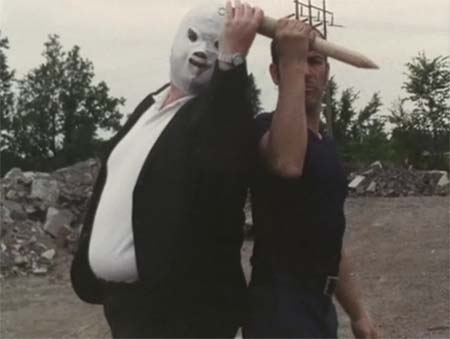
vampires who are preying on Ottawa’s lesbian population.
WHY IT WON’T MAKE THE LIST: It’s defiantly odd, but not consistently funny or entertaining enough to rank among the all-time greats. If you saw any two-minute stretch of JCVH selected at random, you might be convinced that this was a work of camp genius; but string 45 such segments together, and the comedy value runs a little thin. It’s a hard movie to peg: in its own way, given its low budget, its a sort of masterpiece, and at the same time it’s sort of a disaster. I think that if it had offered us one less overlong kung fu battle, and one more song and dance number, it might have had a shot at exalted weirdness. Ultimately, though, just as the tone is more irreverent than blasphemous, the style is more zany than weird, and that should keep it off this particular List.
COMMENTS: Jesus Christ Vampire Hunter is a stew of pop-cinema leftovers, mixing kung fu with horror, Mexican wrestling and even scraps of blaxploitation, all seasoned with a hint of sacrilege. Like all peasant cuisine, it will be comfort food for many, but offend some refined palates—it’s definitely an acquired taste. The technical aspects effectively evoke the feel of late seventies/early eighties exploitation movies, with drab urban cinematography, sound obviously added in post-production, and even a cheesy “waka-waka” funk theme as the heroes cruise down the highway. The action scenes are a problem here: for one thing, there are too many, and they’re too long. They’re just competent enough to remind us that they’re not quite up to snuff; Phil Caracas’ Jesus shows reasonable high-kicking athleticism, but he’s no action hero, and it would have been funnier and more endearing if he’d been clumsier. At any rate, the movie can’t be accused of false advertising. The campy/sacrilegious title scares off the squares and the fundies (though it’s obvious the filmmakers are clearly fans of JC’s philosophy of love and tolerance, if not proponents of his divinity). More to the Continue reading CAPSULE: JESUS CHRIST VAMPIRE HUNTER (2001)