An elderly man pulls a tooth from his mouth to lay on a railroad track, and then shakes in anticipation.
Content Warning: This short contains some disturbing imagery.

An elderly man pulls a tooth from his mouth to lay on a railroad track, and then shakes in anticipation.
Content Warning: This short contains some disturbing imagery.
366 Weird Movies may earn commissions from purchases made through product links.
DIRECTED BY: Dušan Makavejev
FEATURING: Eric Roberts, Greta Scacchi, Bill Kerr, Chris Haywood, Rebecca Smart
PLOT: A Coca-Cola executive travels to Australia to find out why the signature product has failed to penetrate one remote outpost in the country; Along the way, he crosses swords with an unexpectedly fierce competitor, adapts to down-under culture shock, and tries to cope with his distractingly quirky secretary.

COMMENTS: Eric Roberts was young once. I mean, so were we all, but the lies we tell ourselves about the aging process are revealed more starkly in the cinema. So here he is: young, blond, rosy-cheeked, oozing alright-alright charm and boasting a Georgia accent you can spread on toast. So even though his mononymous character Becker is an ex-Marine who is called upon to be the face of all-consuming American capitalism, exploiting local culture and obliterating competitiveness for the benefit of a rapacious corporation, the thought that kept coming back to me was, “My goodness, who knew Eric Roberts was pretty?”
The gorgeousness of Eric Roberts is undoubtedly a strategy. If Satan is, as some contend, actually a ravishing beauty who lures the weak and unsuspecting, then the Coca-Cola Company is clearly cast here in the role of Satan, parlaying their sweet acidity, bold red branding scheme, and co-option of Santa Claus into world dominance. So it’s tempting at the outset to expect an Outback-themed take on Local Hero, in which our protagonist is confronted by an idyllic way of life that is literally foreign to his make-a-buck existence.
But The Coca-Cola Kid really isn’t into Becker, or even Coke, as avatars of our consumer culture. Far from embodying the worst traits of the faceless money monster, Becker is confused and aimless. He goes through the motions of using the latest marketing techniques to bring down his competitors, but his heart really isn’t in it. He barely seems to be into anything: he doesn’t particularly enjoy his own product any further than its saleable qualities, his approach to the alien landscape in which he has landed is purely functional, and his proto-manic pixie secretary Terri only manages to irritate him until she finally lures him into bed. (Even Becker’s sexuality is uncommitted; he seems equally baffled by Terri’s entreaties and by a series of aggressive same-sex come-ons at a party.) Aside from Terri’s grammar-school-aged daughter, the only person Becker seems to understand at all is his opponent.
Cue Becker’s foe: T. George McDowell, the biggest fish in a very small pond and a man with an oversized sense of his ability to compete with an industry juggernaut. He has steadfastly resisted Coke’s incursion into the region in favor of his own line of sodas, and it emerges that the whole enterprise is borne out of an “if you can’t join ‘em, beat ‘em” brand of revenge for the loss of his wife, a Mississippi-born Coke ad model whom he married and lost over his obsessions. (“She never understood the ice,” he reminisces.) Far from being a wide-eyed innocent from the sticks, McDowell fancies himself a global tycoon and Coke’s equal. It leads to an inevitable showdown between a man who thinks he has all the power and a man who knows he does.
The result is ultimately tragic. McDowell is utterly out of his league. There’s no competing with a behemoth, and the contrast is best dramatized in their marketing strategies. A trio of homely cheerleaders can’t hold a candle to pop of half-a-dozen Coke-bearing Santas, and McDowell’s homespun musical ditty is blown out of the room by the absolute banger of a jingle that Tim Finn has concocted.
But all the while, there’s this strange effort to graft a love story onto the film, and while everyone is slowly being crushed by capitalism’s iron boot, it’s in the romance where Dušan Makavejev seems to be trying the hardest to be Dušan Makavejev. The mix of rapacious capitalism and cheeky eroticism feels a little like he was trying to make a more audience-friendly version of his own Sweet Movie. (A genuinely well-crafted sex scene on a feather bed is a first cousin to the earlier film’s romp in sugar.) But he doesn’t seem any more focused than his characters. It’s a mark of how clueless Becker is that the stunningly sexy Greta Scacchi has to work so hard to get his attention, but it’s also curious how haphazard and clumsy Terri’s advances are. She holds a deep (and plotty) secret, but its revelation ultimately doesn’t have much impact on the choices characters must make. It’s just sort of there.
The Coca-Cola Kid has a very Australian soul, exuding a powerful “don’t worry, mate” vibe. Perhaps that’s the weirdest thing about it: in the face of themes like conquering capitalism, cultural homogeneity, and the overwhelming nature of love, the approach it settles on is, “Relax and go with it.” Maybe it’s a sensible approach, but it robs the film of immediacy and power. It just doesn’t feel like the real thing.
Fun City Editions released The Coca-Cola Kid to Blu-ray for the first time in June 2022.
WHAT THE CRITICS SAY:
366 Weird Movies may earn commissions from purchases made through product links.
Severin Films. 15 disc set.

“Folk Horror” is a buzzword that has blossomed over the past decade to become a marketing phrase. It brings to mind things British, pagan and ancient/medieval, usually in that order. This makes for a nice narrow niche to categorize and sell to the audience; if a film has certain elements that are on the checklist checked off, it’s officially Folk Horror®. The genre even has its Unholy Trinity: The Wicker Man, Blood on Satan’s Claw, Witchfinder General. Of course, with some digging, we find that there’s a lot more to the subject to beyond those tentpoles.
It’s a massive subject tackle, and we’re fortunate that the person taking it on is Kier-la Janisse (film-programmer/editor; founder of The Miskatonic Institute of Horror Stories; author of “House of Psychotic Women“) with Woodlands Dark and Days Bewitched (2021), a 192 minute documentary serving as a primer/immersion into Folk Horror. It’s the foundation for “All The Haunts Be Ours,” a massive boxs et with 19 feature films (some making their debut on Blu-ray) and tons of bonus material. In short, this is a college semester course compressed into 15 discs; and although it’s pricey, it’s a lot less than what one would be paying for an actual college class. This is the most ambitious box set that Severin Films has done to date—and they’ve done collections of Al Adamson, Christopher Lee’s European Films, and Andy Milligan in just the past three years!

Woodlands (the first disc in the set, also available as a standalone release) comprehensively examines Folk Horror, beginning with its roots in folklore and literature and moving into film, starting with that Unholy Trinity and other British films, plus television programs like “The Owl Service,” “Children of the Stones,” “Doctor Who,” and the work of Nigel Kneale. The documentary then shifts to North America, examining it by region: New England (Washington Irving, H.P. Lovecraft, Stephen King); the South (influences of folk music and Evangelicalism), and the West (Native American lore). After that, the film goes global, focusing on horror in Eastern Europe, Australia, Japan, and Brazil, addressing a lot of films you’ve heard of (Viy, Valerie and Her Week of Wonders, and the Coffin Joe movies, to name just a few), along with many more that you probably haven’t.
For a 3+ hour documentary, you don’t feel the time drag, and you’ll spend a lot of time afterwards Google-searching availability of titles. Even though it’s a deep dive into the subject, it also feels like it’s just scratching the surface and not even close to being the Last Word in Folk Horror. The subject is thoroughly examined, and even though you could walk away with some sort of definition, “Folk Horror” doesn’t seem “defined” in a way that traps it in a box. It’s a fluid term Continue reading ALL THE HAUNTS BE OURS: A COMPENDIUM OF FOLK HORROR
366 Weird Movies may earn commissions from purchases made through product links.
DIRECTED BY: Brian Trenchard-Smith
FEATURING: Steve Railsback, Olivia Hussey, Michael Craig
PLOT: Hapless free-thinkers are hunted for sport by a merciless regime in a dystopian future.
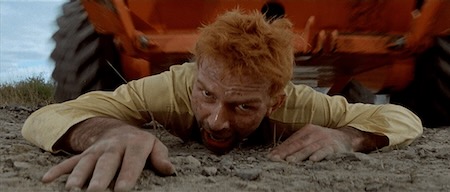
COMMENTS: Newsreel footage of chaotic societal collapse sets the backstory. The sanitized opulence of a knick-knack shop shows the good life. A helpless reprobate crashes onto the scene, pursued by fascist goons, to introduce the conflict. And the whaaaamming tones of the synth score let you know: this is Dystopian ’80s Country—in the bleak future year of 1995.
“Freedom is Obedience; Obedience is Work; and Work is Life”: remember that. And “the Program has been devised for your own good.” The re-education camps are bursting to full, as deviants continue to rebel against the benevolent authorities. Charles Thatcher (no relation) oversees his patch with effete tyranny, making life hard to hellish for his wards, particularly defiant manly-man Paul Anders and confused gentlewoman Chris Walters. But it’s not all bad at the camp: “promiscuity among deviants, while not encouraged, is permitted within reason.” But “Unbreakable” Anders won’t be taking his punishment lying down.
The man at the film’s helm is good, as evidenced by his snappy introduction to the world within and throughout. In the space of a few minutes he builds tension with style when the Radio Freedom DJ is surrounded, then apprehended, by the police state’s state police: a medium shot on a man with the microphone, speechifying on the abuses by the authorities, interspersed with low-height camera shots of the weapons and waistlines of the approaching enforcers, utterly dehumanizing the villains. The director fleshes out the world he has built with incidental dialogue, such as details concerning the oddly egalitarian punishment for pregnancy amongst the inmates: both responsible parties are sterilized. An odd touch that suggests this dystopia is at least gender-equitable.
Trenchard-Smith would go on to direct the better (and odder) Dead End Drive-In (which actually uses footage from Turkey Shoot), recycling the premise to craft a far more compelling and nuanced experience. Of course, he’d also go on to direct a fair number of straight-to-video movies of highly questionable quality. (*Ahem*, Leprechaun 3 and Leprechaun 4: In Space.) Above all else, Trenchard-Smith’s career is the story of a man who can ably execute whatever project is thrown his way, and bring it in under budget. In this case, it managed both to recoup its outlay and become something of a cult favorite. It treads a fine line: campy premise with commendable execution, alongside hammy acting interspersed with suave performances. I recommend you dig in, as this movie ain’t no turkey.
WHAT THE CRITICS SAY:
366 Weird Movies may earn commissions from purchases made through product links.
DIRECTED BY: Brian Trenchard-Smith
FEATURING: Ned Manning, Natalie McCurry, Peter Whitford
PLOT: After two of his tires are jacked at a drive-in theatre, Jimmy finds himself trapped in the car lot with his girlfriend and hundreds of society’s rejects.

COMMENTS: It’s a glorious thing to randomly stumble into a movie and find out that it’s Australian. This pleasant surprise was augmented by an error on the part of the video streaming service, which claimed that Dead End Drive-In was from 2011. I was awed at how the filmmakers had captured everything about New Wave dystopian aesthetics a quarter century after the fact. When I saw the copyright date at the end of the credits I was somewhat disappointed, but also relieved. (“That makes a whole lot more sense,” my brain acknowledged.) Still and all, it Brian Trenchard-Smith’s “ozploitation” picture is a helluva lotta fun.
Trenchard-Smith was the brains behind Turkey Shoot, another “society collapses, and here’s a mess of violence” film, set in the post-apocalyptic year 1995. It hasn’t gotten as bad by the time Dead End Drive-In takes place, but it’s getting there. Jimmy (Ned Manning) is a wiry weenie of a guy who wishes his rough, tough brother would let him in on his lucrative towing business. Car parts are a hot commodity, so whenever a car gets smashed up, the first wrecker on the scene gets the bounty. Jimmy borrows his brother’s ’57 Chevy to take his sheila to the Star Drive-In for a movie and sex, during which the passenger-side wheels are swiped. Jimmy is informed by the fatherly drive-in operator that, no, he’s not going anywhere. Ever.
The misfit milieu found within this open-air prison (which doubles, nightly, as a drive-in theatre) is everything one could hope for from a mid-’80s assemblage of the best deadbeats society has on offer. Transvestites, drug users, vandals, welfare bums… I put these all in the same list not to cast any particular judgment or insinuate moral comparability, but because they all fit in the slot that button-down 80s traditionalists would consider “undesirable.” However, they’ve formed a raucous-but-welcoming society within this prison. There are occasional brawls, sure, but there’s a camaraderie, as evidenced by the freely intermingling coteries and the pick-up games of cricket.
Dead End Drive-In‘s camera work is worlds better than should be expected for a B-movie actioner. An early foreshadowing shot of a jogging Jimmy beautifully frames him behind a chainlink fence, the center demarcated by two perfectly placed tail-fin cars. The “Star Drive-In” first appears in a postcard-worthy frame. And a low shot of a police van approaching a cockerel on the lot captures the startled bird as it is flanked by the moving vehicle tires.
My one criticism of the film would be its strangely shoe-horned social commentary. When a convoy of Asian prisoners arrives at the drive-in, the locals immediately get riled up and speechify about the intruders. Obviously the director is trying to say something, but it’s both a little unclear (is all “white trash” racist?) and over-the-top (everyone but our hero immediately goes from zero to vicious in their racist mania). Regardless, Dead End Drive-In is a wonderful diversion filled with New Wave classics, gratifying camerawork, and Australians.
WHAT THE CRITICS SAY:
(This movie was nominated for review by “dirty_score.” Suggest a weird movie of your own here.)