Tag Archives: Arthouse

192. LEOLO (1992)

“Parce que moi je rêve, je ne le suis pas.” (“Because I dream, I am not.”)–Léolo

DIRECTED BY: Jean-Claude Lauzon

FEATURING: Maxime Collin, Yves Montmarquette, Pierre Bourgault, Ginette Reno, Giuditta Del Vecchio, Julien Guiomar

PLOT: Young Léo Lauzon lives in Montreal with his dysfunctional family; he has an active imagination which he uses to escape from his squalid surroundings. He insists that his name is actually Léolo and that he is Italian, inventing a story that his mother was impregnated by a tomato contaminated with semen. He lusts after a neighbor girl (as does his grandfather) and tags along on salvage operations with his bodybuilding older brother in-between trips to the mental hospital to visit other family members; the entire time a mysterious old man hangs around the edges of the story.

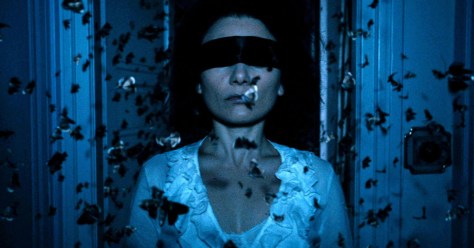
Still from Leolo (1992)
BACKGROUND:

  • This was writer/director Jean-Claude Lauzon’s second feature film. He died in a plane crash in 1995 while working on his third.
  • Lauzon said the film was semi-autobiographical. Leo’s last name is also Lauzon, which he Italianizes to “Lozone” when he decides he is really Léolo.
  • The “Word Tamer” (or possibly “worm tamer”—“dompteur de vers” in the French may be a pun meaning both “worm” and “verse”) is played by Pierre Bourgault, a Quebecois separatist and professor. Lauzon was once a student of Bourgault’s.
  • Named one of “Time” magazines “All-TIME 100 Movies.“

INDELIBLE IMAGE: The “contaminated” tomato, the film’s most deranged comic invention.

WHAT MAKES IT WEIRD: Immaculate conception via imported produce, underwater hallucinations, and bizarre sexual practices reign in the world of Léolo’s imagination. He uses these inventions to escape from an almost equally strange, but far less pleasant, reality.


U.S. release trailer for Léolo

COMMENTS: “Because I dream, I am not,” Léolo‘s young protagonist Continue reading 192. LEOLO (1992) →

CAPSULE: THE DUKE OF BURGUNDY (2014)

DIRECTED BY: Peter Strickland

FEATURING: Sidse Babett Knudsen, Chiara D’Anna, , Eugenia Caruso

PLOT: An entomology professor and her student are very much in love, but their romance is threatened by the latter’s preference for BDSM practices in the bedroom.

18BURGUNDY2-facebookJumbo

WHY IT WON’T MAKE THE LIST: Though the subject matter might seem strange or unusual to some viewers, the film itself is simply an examination of two women who are going through a trial in their relationship. There is some bizarre dream imagery and a choppy narrative style, but nothing truly Weird.

COMMENTS: The Duke of Burgundy opens with a drawn-out sexual role play as the wide-eyed Evelyn (Chiara D’Anna) enters the house of domineering mistress Cynthia (Sidse Babett Knudsen) to act as housekeeper. Evelyn scrubs and shines and soaks as Cynthia thinks of more demeaning tasks for her to do, ending the day with punishment for unsatisfactory work in the form of urination into Evelyn’s mouth. This scene returns in multiple forms later, as we see different perspectives and points in time, serving as an anchor for our understanding of their relationship. The film unfolds over a semester at the isolated women’s school where Cynthia lectures and Evelyn studies, but most of the focus is on their private moments at home. As the persistent Evelyn comes up with new ways to be dominated, she believes she’s found the perfect partner in Cynthia, who is willing to act the dominatrix if it makes her lover happy. However, it soon becomes clear that the older woman is uncomfortable with the parts Evelyn creates for her, struggling to emotionally and physically abuse her lover even in the context of role playing, and then growing to resent her for her increasing demands.

Strickland made waves two years ago with his stunning, unnerving ode to giallo, Berberian Sound Studio, in which a British sound technician sinks into a paranoid fever dream while shooting a gory horror in Italy. Here, the director again treats the eyes to a sultry palette, ornate settings, and thoughtful camerawork, matched by an effective soundtrack that pairs fuzzy synths with the hum of insects. The opening credits use freeze-frame and oversaturation to reference vintage softcore film, but thanks to the soundtrack and visceral color choices, other moments are more reminiscent of a slasher. The retro vibe is heightened by the somewhat ambiguous setting and time period. Fashions and hairstyles suggest the 1950s or 60s, the aesthetic is more 70s, the landscape and architecture is classical, evoking rural Italy (though filmed in Hungary), and everyone speaks English with different European accents. He clearly devotes much of his time to mixing and matching different film references, from art house to grindhouse, but ultimately the focus is on the characters. Even the weirder touches, including frequent close-ups of insects and stark shots of architecture, are meant to communicate the sense of dread that is hanging over Cynthia and Evelyn’s relationship as they move into darker sexual territory. There is a palpable feeling of intimacy in Strickland’s approach, utilizing close-ups and lingering shots to effect a kind of quietude over most of the proceedings. It is easily to believe in this relationship, though the world around them is often hazy.

On paper The Duke of Burgundy sounds like it should be a sleazy straight male fantasy about lesbian kink, and yet Strickland forgoes all sensationalism—there isn’t that much (explicit) sex or even nudity shown. Evelyn’s mental stimulation is highlighted, as she derives pleasure from being locked in a chest, verbally berated, and sat on by Cynthia. The BDSM scenes are often treated with humor, not to make fun of those practices but to reveal the kind of goofy accidents or strange conversations that might come with it, and to break the tension for an unfamiliar audience. At other times they are presented in a cold, almost sterile manner, with Cynthia eventually injecting a form of revenge into their role play. What is both wonderful and striking about this film is its undertone of normalcy, its relatable and honestly touching portrayal of a romantic struggle, despite its apparently sexploitative premise. The basic story could easily be rewritten with different conflicts, with different genders, with different settings; the BDSM elements are both central to the narrative and secondary to the overarching theme. The film asks if sexual preferences can damage an otherwise strong relationship, and if personal contentment can exist without complete sexual fulfillment. It allows us to peek into something extremely personal, but universal, intermingling with our own insights and experiences, with a dreamlike style so lush and distinctive we still walk away feeling like we’ve left behind a world of fantasy. It might not be List-worthy, but it is certainly worth seeing.

WHAT THE CRITICS SAY:

“…the question of who’s really in charge of these scenarios is complicated. Exactly the same deceptive quality can be found in the dreamlike artifice of Strickland’s film itself, set in a lush and aristocratic European fantasyland that’s entirely nonspecific as to geography and chronology… But while Strickland’s films already aren’t like anyone else’s, his real secret is that even in this strange constructed world, his characters feel like real people struggling with issues that aren’t exotic at all.”–Andrew O’Hehir, “Salon” (contemporaneous)

CAPSULE: WINTER IN THE BLOOD (2013)

DIRECTED BY: Alex Smith, Andrew J. Smith

FEATURING: Chaske Spenser, , Saginaw Grant, , Casey Camp-Horinek, Julia Jones

PLOT: Virgil First Raise, an alcoholic half-breed Blackfoot, wakes up from a blackout and is told that his wife has left him, taking his rifle and electric razor with her and setting him off on a boozy, hallucinatory quest to recover the items.

Still from Winter in the Blood (2013)
WHY IT WON’T MAKE THE LIST: A vision quest seems like the perfect plot structure for a weird movie, but although there is a lot to enjoy in this slightly surreal, unusual Indian-themed movie, it isn’t strange enough to overcome its narrative shortcomings.

COMMENTS: Waking up from a bender in a ditch, seeing visions of his dead father, Virgil First Raise complains he is “caught in an in-between place… vulnerable to the spirits.” Though not entirely successful as cinematic psychoanalysis, Winter in the Blood does capture Virgil’s physical and psychological tipsiness and vulnerability to the spirit world, which bleeds into reality. Flashbacks frequently interrupt the present-day action, often introduced in interesting ways; for example, Virgil fishes in a river and sees his childhood self and his (now absent) brother frolicking on the opposite bank. The movie also incorporates the rhythms of hard drinking; we see Virgil tippling in a bar, following up on a lead, and suddenly he wakes up in a strange bed, leaving us with a suspicion that crucial plot information may have been irretrievably lost to a blackout. That structure of memories and ellipses would be confusing enough for the average viewer, but then there are also entire subplots that are probably imagined, such as Virgil’s dalliance with a Canadian “airplane man” who is being tailed by mysterious men in suits and who wants to enlist the Indian in an obscure smuggling plot, the details of which keep shifting. The quirky and sinister airplane man scenes, particularly one where Virgil finds a fellow diner at a lunch counter inexplicably falls face-first into his soup, give the film an exciting Twin Peaks-on-the-reservation sensibility that it could have used more of.

Virgil suffers from a horde of demons—too many for a single movie—from alcoholism to survivor guilt to incompetent parents to the manhood ritual he never completed to fretting over the Caucasian impurities in his blood. His troubles materialize in an equally numerous series of symbols: the rifle, a mysterious blonde barmaid who sometimes has a tattoo and sometimes doesn’t, the airplane man, a stuffed teddy bear, a rabbit in a haystack. As a work of Native American cinema, a field that’s not overly crowded, Winter in the Blood ranks as a minor standout. The performances are mixed but generally good, the soundtrack is alt-melancholy, and the excellent widescreen cinematography captures the agrarian grandeur of Big Sky country. But all of the floating symbolism, subplots and narrative loose ends, together with the impressionistic style and some fumbling at the finale (the emotional climax feels misplaced, with Virgil’s despair unexpectedly peaking after the scene that should have brought him insight and redemption) result in a film that ends with an unfortunate lack of closure.

WHAT THE CRITICS SAY:

“Real and surreal weave together, and an impeccably chosen soundtrack — by, among others, the Heartless Bastards and Robert Plant — reinforces a mood that veers from dreamy to violent with shocking suddenness.”–Jeanette Catsoulis, The New York Times (contemporaneous)

CAPSULE: BIRD PEOPLE (2014)

DIRECTED BY: Pascale Ferran

FEATURING: Josh Charles,

PLOT: Set at a hotel by Paris’ Orly Airport, the story follows an American businessman who suddenly decides to quit his job and a French maid who has an odd experience one night on her rounds.

Still from Bird People (2014)
WHY IT WON’T MAKE THE LIST: It’s only half-weird (and only about half-good, too).

COMMENTS: Bird People has some strange concepts, an eccentric tone, and an unusual structure; just barely enough to keep it watchable through its long and slow 2+ hour runtime. It begins with a prologue in which we flit among various characters on a Paris commuter train, sometimes listening to their cell phone conversations, sometimes hearing their thoughts. They talk about their jobs or parties they’re going to; no one really has much of interest to say, or, if they might, we don’t get the opportunity to get to know them. Which, of course, is the point. What we have here is another of those Continental “cinema d’ennui” films about how modern life and technology destroy our interconnectedness (crucial life events are conveyed remotely, by an e-mail) and drain away our sense of wonder. As usual in this subgenre, the director wallows in the mundane in order to make her point, requiring enormous patience from the viewer as we watch characters smoke endless cigarettes (this is a French film, after all) or long takes of birds flying around. Whether you find your patience rewarded is up in the air; if you’re an arthouse patron, I’d guess the movie has about a fifty-fifty chance of success.

The film is divided into two halves. The first is straight dramatic realism, following Gary, a software engineer working for a small start-up firm. He’s mildly successful and upwardly mobile; he owns a major block of stock in the company but still needs to do hands-on work, meaning that he must stop-over for a night in Paris to take a meeting while on his way to Dubai to work on a power plant project. While sleeping in his hotel room he has an anxiety attack and abruptly decides that he wants to quit it all; his job, his family, the stress, and simply start his life over in his Paris hotel room with no plan. It’s a rare leading role for accomplished character actor Josh Charles, whom we both envy (because what slave to the dollar [or Euro] hasn’t daydreamed about chucking it all and starting fresh?) and disapprove of (because the script doesn’t gloss over the way he leaves his coworkers and wife in a bind—one of the movie’s most alive sequences is the painful conversation where he breaks up with his wife over Skype). The second half of the film dwells on maid Audrey (an appealing Anaïs Demoustier) as she makes her dismal rounds, and here is where the magical part of the movie’s magical realism happens. We won’t spoil the surprise as to what happens in her storyline. Neither will we guarantee that you’ll be blown away by its poetry. The contrast between airplanes and birds makes for an interesting metaphor, but while the film boasts good performances, cinematography, and other scattered points of interest, Bird People never really takes off.

WHAT THE CRITICS SAY:

“The surrealism stands in stark contrast with the stripped-down naturalism that has come before, and it is in this stretch that the film finally leaves terra firma and takes flight.”–Peter Debruge, Variety (contemporaneous)

LIST CANDIDATE: THE PIANO TUNER OF EARTHQUAKES (2005)

Weirdest!

DIRECTED BY: ,

FEATURING: César Sarachu, , Amira Casar, Assumpta Serna

PLOT: A doctor brings a piano tuner to his remote asylum to prepare automata for an opera he is staging for the benefit of a beautiful, nearly comatose patient who was once a singer.

Still from Piano Tuner of Earthquakes (2005)
WHY IT MIGHT MAKE THE LIST: The general consensus is that The Piano Tuner of Earthquakes is one of the weakest of the Quay Brothers‘ cinematic efforts; on the other hand, there is no question that this fairy-tale of dreams, madness and opera is one of their very weirdest.

COMMENTS: “After a while, you get used to the confusion,” the housekeeper tells the piano tuner, as she explains that they call the silent men who are always scurrying around in the background of Dr. Droz’s estate “gardeners,” although they are really patients. Of course, the declaration is actually meant as a reassurance for the audience—but by the time the housekeeper drops that line, thirty minutes in, confusion-averse viewers will have already fled in terror. Dr. Droz has either killed and resurrected, or simply abducted, an opera diva, and is keeping her on his private island, where Alpine architeture mixes with tropical flora. The doctor needs a legendary piano tuner, who also happens to be  dead ringer for the singer’s lost love, to fix his seven automata, and to take part in an elaborate opera he is staging. The piano tuner flirts with the seductive housekeeper until the beautiful mute patient catches his eye. Each night, he has a dream, which is the Quay brothers’ excuse to indulge in the types of bizarre fantasy sequences that they made famous in their short films (although here with only minimal stop-motion animation). We see grotesque singing teeth, boats piloted by disembodied hands, and scenes where everyone moves backwards. We soon strike a rhythm of dreams interrupted by dialogues between the tuner and the housekeeper or doctor, which explain very little of what is ultimately going on on the island. Instead, the doctor likes to tell little stories about fungi that infect the brains of ants and eventually form spikes which bursts through the insects’ heads to release spores.

Piano Tuner is a stylistically overstuffed film. That is both a strength and a weakness. It’s one of those movies that looks like the filmmakers suspected they were never going to get another chance to work with a budget like this again, and felt pressed to get all their grandiose ideas up on screen while they had the opportunity. Individual frames of the film look like they come from paintings or drawings, but from a very eclectic museum: some scenes exhibit the swarthy classicism of a Carvaggio, others look like they come out of a medieval woodcutting, while still others like storybook illustrations from a Grimm fairy tale. There are luminous grottoes, ghostly animations, and distorting lenses. Much of the film features people and objects half hidden in shadows, making them as difficult to make out as the story is. The overall intent is to force us to give up on trying to process the narrative and imagery in the conventional sense, and simply submit to its beauty.

The Quay Brothers explained that, as a condition of funding, Film 4 demanded that they make a more “accessible” movie than their previous effort, Institute Benjamenta. Other than shooting the film in color, it’s hard to see how Piano Tuner could ever meet that standard. Terry Gilliam came in as executive producer to save the project; his name and reputation allowed the Quays to raise the remainder of the money they needed to film their outrageously odd visions.

WHAT THE CRITICS SAY:

“…the most strangely and subtly variegated march-past of Love’s delirious mechanisms ever committed to film… Absolutely entrancing!”–Guy Maddin, Film Comment (contemporaneous)

(This movie was nominated for review by Kat, who described it as containing “beautiful dreamlike imagery and some all too short sequences of the Quay’s miniature automata.” Suggest a weird movie of your own here.)