Tag Archives: 2009

LIST CANDIDATE: ALMA (2009)

DIRECTED BY: Rodrigo Blaas

PLOT: Young Alma encounters a toy shop containing a doll bearing an uncanny resemblance to her.

Still from Alma (2009)

WHY IT MIGHT MAKE THE LIST: In communicating its tale of terror in a style and medium almost uniformly associated with mainstream family-friendliness, Alma stands out as weird amidst today’s persistent stream of digital animation.

COMMENTS: As this site’s regular Saturday Short feature has proven, animation is one of the most fitting mediums for short-length cinematic weirdness. Whether minimalist or elaborate, animation offers a strong opportunity to evoke a particularly singular visual concept within a short frame of time.

Former Pixar employee Rodrigo Blaas—whose name appears in the credits of some of the studio’s most beloved features—has, with Alma, added his own particular twist to this well-established cinematic convention. Drawing on his past work, Blaas bring us his simple, independent tale of surreal horror in the bright, stylized CGI that’s now all but synonymous with modern mainstream animation.

In its themes and narrative, meanwhile, Alma recalls a more antiquated form of family entertainment. Its components—the snow upon slanted rooftops and narrow cobblestone alleys; the toy shop, at once quaint and sinister; the protagonist, a mischievous little one with the air of a vagabond—bring to mind the classical elements of old children’s’ books. The plotline, which imposes a nightmarish fate upon its young protagonist as punishment for a petty misdeed, evokes the Victorian cautionary tales that Hilare Belloc so famously lampooned.

Needless to say, this results in a strikingly unique piece of short cinema; especially considering that, despite mashing together conventions of children’s entertainment from opposite ends of the 20th century, it is very clearly not intended for children. The simple plot follows young Alma, who, prancing merrily down a snowy alleyway one day, encounters a toy shop, with a doll precisely resembling her in the window. Unable to resist this singular temptation, she heads into the unattended shop to take the doll for herself, and meets horrifying consequences—ones that add a twist to the primal fear of endless damnation.

Told, like many short works of weirdness, entirely without dialogue, the story of Alma is, as befitting the nature of Blaas’ past work, communicated via five minutes’ worth of highly expressive visuals that quietly convey basic narrative and subtle details alike. Alma’s slightly ragged appearance hints at her humble background, lending context to her sticky-fingered nature. Hundreds of children have chalked their names on the wall in the alleyway in which she finds the shop. It’s also lined with what might be interpreted as a number of “Missing” posters, ominously hinting at the shop’s scourge of terror. And the store window, picturesque upon first glance, takes on the appearance of a leering monster’s gaping maw when examined more closely.

In terms of weirdness, Alma has its more obvious elements: most notably, flashes of surreal, nightmarish images when Alma seizes the doll. The genuine uniqueness of the short, however, is found in its bold effort to render an artistically-driven work of cinema in a style that’s become emblematic of mega-budget commercial family cinema. The contrast is striking. As an artistic choice, it’s not unprecedented, but Blaas, having come directly off the set of some of the industry’s leading titles, evokes the style with particular authenticity.

Development is currently underway for a Dreamworks-backed feature-length adaptation of the short. As many have already predicted, even with Blaas himself at the helm, it seems highly likely that this horrifying tale, effective chiefly for its simplicity, will lose more than a little of its punch when stretched into feature-length. If nothing else, however, said feature might draw a little more much-deserved attention to the original short.

WHAT THE CRITICS SAY:

“…this is a fairytale of the old kind, and if you have any sensitivity at all, you’ll be shivering as the snow drifts down at the end.”–Jennie Kermode, Eye for Film (contemporaneous)

Alma from Rodrigo Blaas on Vimeo.

LIST CANDIDATE: SYMBOL (2009)

Shinboru

DIRECTED BY:

FEATURING: Hitoshi Matsumoto, David Quintero, Luis Accinelli

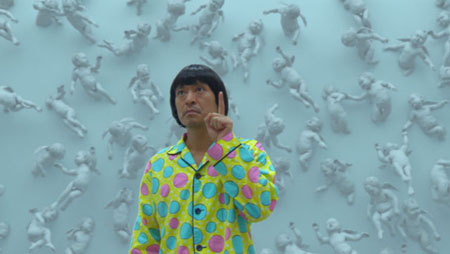
PLOT: A Japanese man wakes up in an enormous white chamber whose walls and floor are littered with cherubic phalluses; meanwhile a Mexican luchador, “Escargot Man,” prepares for a wrestling match.

Still from Symbol (2009)

WHY IT MIGHT MAKE THE LIST: The main narrative, following the action in the white room, is so absolutely removed from reality it demands a place on the List, while the Mexican wrestling scenes remain incongruous and weirdly exotic throughout.

COMMENTS: It’s difficult to talk about why Symbol is so arresting and oddly rewarding without spoiling details of the story or the reveals near the film’s end. Suffice to say the two seemingly unrelated narratives come together in a most unexpected and ridiculous way, and the torture experienced by the Japanese protagonist in the white room leads to a truly transcendent revelation by the film’s end.

The film is structured under three headings: “Learning, Practice and Future.” Learning refers to the rough education the Japanese man receives in the white room from the mischievous owners of the Cherubic phalluses, while the particulars of Practice and Future I’ll leave viewers to discover on their own.

Much of the early joy of the film involves watching Matsumoto interact with the white room and the objects released therein, seeing his mounting frustration at the “bait and switch” as the Cherubs deliver alternately helpful or useless items. They give him an endless stream of sushi rolls, but no soy sauce until after he’s eaten the very last one; 3D glasses direct him to press a particular button, only to have an enormous Cherub behind break wind on him. Another scene sees him releasing an endless pile of chopsticks before he finally presses a different phallus, sending an office trolley careening into his shin. This comedic torment in the vein of silent film comics like or Harold Lloyd continues until Matsumoto recognizes a means of escape…only to be led to earth-shattering alternatives.

There is very little to fault in this film; from its production values to its execution it is equally unique, vibrant and visually arresting. The pacing is surprisingly jaunty for an episodic film, and it actually rewards a re-watch to see how all the various threads build towards the film’s close. Some viewers may find the ridiculous payoffs a little too surreal to be satisfying; to them I can only recommend the consolation to be found in the philosophical treatise “In Praise of Silly,” the book never written by comedian Mike Myers’s father, who believed silliness “was our natural state, and we only get serious to get to silly.” Symbol contains moments of textbook Japanese cinematic weirdness.

A possible weak element of the film (other than two unnecessary moments of flatulence humor) could be identified in Matsumoto’s performance; while his timing is excellent and he works as a hapless, unassuming everyman, his constant screaming is often irritating. A more skilled slapstick performer like , Lee Evans or Rowan Atkinson could have made the physical comedy transcendent and ballet-like rather than merely solid and amusing. This is a rare case where I would not mind a U.S. remake.

I know little about director and star Matsumoto, other than he is one half of a comic duo—the boke or “funny man” of a team called “Downtown”—on Japanese television, just like his contemporary Takeshi “Beat” Kitano (Hana-bi, Violent Cop) was at the beginning of his career. The comparison to Kitano is apt due to the similar career trajectory the two men have followed, although Matsumoto only has four feature film directorial credits to his name and none of the Kitano’s international recognition—at least for the time being. Also, from a cursory YouTube glance, Matsumoto’s TV persona appears to be that of a histrionic, put-upon weed (the character he develops here follows a similar vein) whereas Kitano’s comedy always came from his role as bully.

WHAT THE CRITICS SAY:

“…one of the most bizarre, impenetrable films of the year. That doesn’t mean it is not funny, intriguing and visually impressive, just don’t expect to come out being anything less than baffled.”–Owen Van Spall, “Eye for Film” (contemporaneous)

(This movie was nominated for review by many people, but “Roy” was first when he advised us in 2010 “You gotta check out this flick ‘Symbol’ by the director of Big Man Japan.” Suggest a weird movie of your own here.)

CAPSULE: AIR DOLL (2009)

DIRECTED BY: Hirokazu Koreeda

FEATURING: Doona Bae, Arata Iura, Itsuji Itao, Joe Odagiri, Sumiko Fuji

PLOT: Nozomi, an inflatable sex doll, develops consciousness and comes to life, wandering through the streets while her owner is at work, encountering various lonely souls including a video store attendant, with whom she falls in love.

Still from Air Doll (2009)

WHY IT WONT MAKE THE LIST: The central conceit (and character) of the inflatable sex doll is the only weird element in this film. The people surrounding Nozomi and the contemporary Japanese setting are grounded in naturalism, positioning the film in the genre of magical realism rather than surrealism.

COMMENTS: The concept of an outsider or alien force experiencing human existence is a familiar trope in cinema. Ex Machina (2015), Her (2013), A.I. (2001), City of Angels (1998) and even Terminator 2: Judgment Day (1992) all explore similar concepts. In the main, these films present a robot or artificial intelligence evolving human characteristics, whereas Air Doll posits a less likely protagonist: an inflatable vinyl sex doll.

Nozomi, a “sexual surrogate” as she lamentably reminds us through the film, lives with her owner, Hideo, in modern urban Tokyo. She passively listens to his self-important ramblings about work (which we later learn are lies), and then later serves as an equally passive recipient to his sexual advances. The following morning, after Hideo leaves for work, Nozomi inexplicably comes to life (Nozomi describes the process as “finding a heart”) in a sequence where an animated puppet becomes actress Doona Bae, enjoying the sensual thrill of dripping water running over her hand. Her first thoughts on her newfound consciousness are “beau-ti-ful!,” but this will change by the film’s end.

Nozomi is a curiosity to those she encounters, but their reactions are no match for her own wonder at everything she sees. Even the garbage men fascinate her. Nozomi’s wonder and simple satisfaction with life remains a stark contrast to the thwarted happiness of the human characters throughout the film

Nozomi’s position as outsider is reinforced both by her status as an animated doll and the casting of Korean actress Bae in a Japanese film. This is purposeful casting by director Koreeda to throw his observations of modern urban life into sharper relief. Like Swift’s “Gulliver’s Travels,” the satire or analysis of a culture is strengthened the more alien the presence of the other observing it. Bae, the alien in question, seems incapable of delivering a poor performance; even if the film is weak (witness the failed splendor of Cloud Atlas) she is always in top form and her portrayal here is no exception. Nozomi is by turns curious, ebullient, playful, saddened, sensual and emphatic. Her small, staccato, childlike walk in her French Maid’s dress is also a lovely touch, emphasizing Nozomi’s innocence and vulnerability.

Despite the potential here for an incisive and engaging investigation of modern Japanese life—and by extension human existence—the overall tone remains light and humorous , although the film does take a much darker turn in its final act. Even the bleaker aspects of the human characters’ lives fail to inspire sympathy because they are so underdeveloped (many of them we only see once or twice in small cutaways). You could argue the conceit of a sex doll coming to life is farcical and thus the comic tone is appropriate, but elsewhere Koreeda teases us with more involved drama (for example, Nozomi’s boss blackmailing her for sex) without ever really committing to it.

That the film is a slight work that sadly never lingers in the memory is evidenced by the lack of interviews and production materials surrounding it online. Even the links on its Wikipedia page are dead and its archived page on the Cannes Film Festival comes up with an “error.” This is not to say that the film doesn’t have very beautiful and tender moments: for example the gentle touch the old man asks Nozomi to place on his forehead, or Nozomi opening up a tear on her arm in order to smell the breath of her lover; its simply that there is nothing significant about the human experience mined in any great depth. Akira Kurosawa’s Ikiru (To Live) (1952) is a much more palpable and urgent examination of what it means to be human and why life is so precious. (I mention it only because the initial pleasure in life Nozomi experiences is similar to the renewed urgency found by Ikiru’s protagonist).

As a rumination on urban loneliness and inertia, defeated dreams and the loss of innocence transitioning to adulthood, this film is arguably successful; however in addressing the larger questions of what it means to human it falls flat, suffering from a lack of focus and peripheral characters in need of further development.

WHAT THE CRITICS SAY:

“What’s most interesting about the story is not its apparent oddness, but the fact it maintains a sense of fairy tale magic even while it’s set in a cold and seemingly hollow world.”–Sara Maria Vizcarrondo, Boxoffice Magazine

212. AFTER LAST SEASON (2009)

“This movie makes no sense. I don’t mean the story doesn’t make sense, it almost does. I mean the movie as a thing that exists doesn’t make sense.”–Rob Steele

Beware

DIRECTED BY: Mark Region

FEATURING: , Peggy McClellan

PLOT: Matthew and Sarah are med students with an interest in neurology. A fellow student is knifed to death by a serial killer. Matthew runs a telepathy experiment with Sarah, who sees visions of the killer, and together they try to visualize the murderer.

Still from After Last Season (2009)

BACKGROUND:

  • After Last Season made a minor stir on the Internet in 2009 when its nonsensical (but, as it turns out, completely representative) trailer was released on YouTube and other video sites.  The piece was so thoroughly anti-cinematic, with its laughable props and the meaningless minutiae of its dialogue, that many people assumed it was a parody of a low-budget indie film created by an established director. The frenzy reached it’s peak when “Entertainment Weekly” published an article repeating rumors that the trailer was a hoax by notorious prankster Spike Jonze intended (somehow) to draw attention to his upcoming film Where the Wild Things Are.
  • After Last Season got a one week release in four U.S. theaters.
  • Director Mark Region claimed the film cost $5 million to make. Few believed him.
  • After the original run, producer/distributor Index Square stopped offering new DVDs for sale, and actor Jason Kulas said Region has told him there are no plans to produce more.

INDELIBLE IMAGE: The astoundingly crude computer-generated animation, which often looks like it could have been drawn in MS Paint. The best moment is when a killer’s knife (which looks like an ice cream cone held upside down) emerges from out of a blank wall.

THREE WEIRD THINGS: Cardboard MRI; Photoshopped telepathy; invisible ghost

WHAT MAKES IT WEIRD: “Huh?,” “um…,” and “whah?” are all equally valid responses to After Last Season.  This movie may go down as this generation’s Beast of Yucca Flats: stultifyingly dull at times, but so full of misguided directorial choices and  failed attempts at cinematic poetry that it takes on a dreamlike character. Watching After Last Season is like trying to follow a old-timey radio serial on an AM station with fading reception: you can tell there’s a voice trying to make itself heard, but the transmission is so garbled that the basics of the story become lost in static and long stretches of dead air. It’s difficult watching, for sure—thus the “beware” rating—but for intrepid curiosity seekers looking to experience the weirdest of the worst, it’s a must see.


Original trailer for After Last Season

COMMENTS: There’s a concept in cinema theory called “film grammar;” it refers to sets of filmmaking conventions that  have been Continue reading 212. AFTER LAST SEASON (2009)