Tag Archives: 2004

BORDERLINE WEIRD: CALVAIRE (2004)

[AKA:  The Ordeal]

366 Weird Movies may earn commissions from purchases made through product links.

DIRECTED BY:  Fabrice Du Welz

FEATURING, Jackie Berroyer,

PLOT: Small time entertainer Marc Stevens ventures along a rural route to reach his next gig, but everything goes profoundly wrong. His car breaks down in the middle of nowhere, a stranger takes him to an inn, and he finds himself trapped in a countryside of insane predatory sodomites.  When Stevens is outrageously and systematically victimized for no discernible reason, he begins to go insane.  Calvaire is a fantasy that depicts a series of absurd events in a strange setting: the foggy, boggy,  deep woods of rural Belgium.

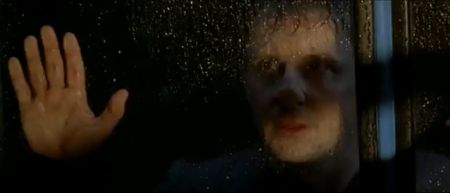
Still from Calvaire (2004)
WHY IT’S ON THE BORDERLINE:  When I watch a weird movie I expect to be horrified, scared as hell, titillated, awestruck or otherwise captivated.  At the very least I want to be inspired to think. Calvaire failed to deliver anything like this to me.  Calvaire‘s story is oddball, but frankly, I found it to be superficial, tedious and depressing without any real point.  Calvaire is a movie that could have been greatly weird, but wasn’t.

COMMENTS:  Calvaire opens with an odd scene and becomes inexplicably more bizarre.  A small time troubadour, Marc Stevens (Lucas) sings at a nursing home.  Later, an elderly woman drops by his dressing room to seduce him.  This peculiar encounter sets the tone for the rest of the film, but bears no relation to the subsequent plot points.  The remainder of Calviare’s storyline consists of a sequential chain of ghastly but only loosely related incidents.

While driving to his next venue on isolated back roads during a heavy rain, a figure darts out in front of Marc’s van.  The vehicle stalls and won’t restart.  An oddball stranger leads him to Continue reading BORDERLINE WEIRD: CALVAIRE (2004)

47. ETERNAL SUNSHINE OF THE SPOTLESS MIND (2004)

“Nothing fixes a thing so intently in the memory as the wish to forget it.”-Michel Eyquem de Montaigne

“How happy is the blameless vestal’s lot!

The world forgetting, by the world forgot.

Eternal sunshine of the spotless mind!

Each pray’r accepted, and each wish resign’d …”–Alexander Pope, Eloisa to Abelard

Must See

DIRECTED BY:

FEATURING: , , , Elijah Wood, Mark Ruffalo, Tom Wilkinson

PLOT: A shy introvert named Joel and a kooky gal named Clementine with ever-changing hair colors meet and fall in love.  After a fight Joel tries to reconcile, but discovers Clementine has availed herself of a strange and anachronistic mind-erasing technique to remove all memories of him; in a fit of pique and pain, he decides to undergo the same procedure.  But as Joel begins the erasure process, he realizes he doesn’t want to go through with it, and he travels through the landscapes of his memories to find and hold on to the rapidly vanishing Clementine.

Still from Eternal Sunshine of the Spotless Mind (2004)

BACKGROUND:

  • Charlie Kaufman came up with the idea for this fascinating tale and co-wrote the script with the help of director Michel Gondry and obscure Parisian performance artist Pierre Bismuth.
  • The title is taken from the classic Alexander Pope poem Eloisa to Abelard, which reflects a number of philosophical and emotional touchstones of the film.
  • Before Jim Carrey expressed a desire to play Joel, the likeliest candidate for the part was Nicolas Cage (!)
  • The scene where Mark Ruffalo scares Kirsten Dunst is completely genuine: director Gondry asked that before each take that Ruffalo hide in a different spot to really scare the pants off her!
  • Charlie Kaufman won an Academy Award for Best Original Screenplay. Kate Winslet was nominated for Best Actress but did not win.

INDELIBLE IMAGE: This bold and invigorating trip into the subconscious has a myriad of off-the-wall images that are sure to stick in your head. From faceless creatures to over-sized environments to entire train stations being drained of its inhabitants due to memory loss, there is a lot of weirdness going on here.  But as far as an indelible image, the one I pick is the simple scene in which Joel remembers when he and Clementine snuggle beneath an old ratty blanket and he consoles her after she recounts an intimate and revealing story about a doll she named after herself as a child.  As the memory seeps out of his head and Clementine’s body disappears, Joel crawls through the ratty blanket of his imagination begging to be able to hold on to this particular memory.

WHAT MAKES IT WEIRD:  Any film birthed from the madcap imagination of Charlie

Original trailer for Eternal Sunshine of the Spotless Mind

Kaufman and surreal visualist Michel Gondry has at least a pretty good shot of being kind of different.  But this movie in particular, a film about memories literally being erased from people like they were organic hard drives, really takes Kaufman’s dry strangeness and Gondry’s unhinged wild-eyed wonderment and melds it to a delightful perfection that muses on life while simultaneously compelling us with images of collapsing landscapes and Jim Carrey bathing in a sink.

COMMENTS: Some would say that Eternal Sunshine of the Spotless Mind is a movie about Continue reading 47. ETERNAL SUNSHINE OF THE SPOTLESS MIND (2004)

GUEST REVIEW: JESUS AND HER GOSPEL OF YES (2004)

Guest review by Kevin Pyrtle of WTF-Film

Here in Minneapolis there’s a strange little show [you’ll have to forgive me for not remembering the name of it] that plays the public access stations every week or so. It features a host of young talent who frolic in front of a blue screen in various stages of undress while ancient video effects are laid over top of it all in a random fashion. It goes on for an hour, reaching ever dizzier heights of incomprehensible nonsense and leaving you puzzled as to what, if anything, you were meant to take away from the experience.

Still from Jesus and Her Gospel of YesAll of the above could rightly be said for this Alfred Eaker film as well, which the director describes on the IMDB as ‘a surreal, complex, modern, psychedelic film retelling the life of Christ as woman and leader of the Gospel of Yes.’ The main difference between the two is that Jesus runs slightly longer, around seventy three minutes before the lengthy credits roll.

Complex it is, indeed – there’s never a moment [credits included] in which Jesus has nothing going on. We get endless loopy dialogue, re-interpreting the Gospel with frequent pop culture references and commenting on the various ills of contemporary society all the while. Not that there’s time to soak any of it in, as the words pile up in ungainly multitude and start to sound like inarticulate mush after a while. It’s akin to a rambling political address. I know that there’s a point to all of it somewhere, but the manner in which it’s put across leaves me with no interest in finding out what it is.

If interpreting the dialogue is difficult on its own, then the accompanying visuals make the task doubly so. Jesus is populated by an endless parade of excruciatingly bad visual effects that could have originated from the plugin archives of any prosumer video editing application. Most of them involve people doing random things while other people, through the magic of digital process photography, do random things in front of them. There is some interesting artwork on display [all credited at the end], but you have to look closely to even see it through the multiple layers of visual obfuscation. There is also some not-so-interesting artwork, much of which could have been accomplished in MS Paint.

Still from Jesus and Her Gospel of YesFar be it from me to say that Jesus, in spite of its obvious faults, is not a creative enterprise. Creativity is one thing its producers obviously have in spades. There’s no telling how many long days and sleepless nights went towards its realization, making it all the more a pity that something easier to appreciate didn’t result. There’s some good substantive meat to the rambling narrative [like commentary on drug abuse, abortion, and sexual dynamics], but you have to dig through piles of aesthetically repellent gunk to find any of it. I doubt that most, regardless of their artistic sensibilities, will have the patience for it.

Jesus and Her Gospel of Yes is undeniably weird and original to the max, but its crude brand of no-budget shot-on-video mayhem just wasn’t for me. While I didn’t enjoy it, I have to admire that Eaker was at least trying something new here – a rare thing in these days of utterly barren mass marketed entertainment. I have a feeling that the world would be a far better place if even a hundredth of a percent of the box office earnings from the latest Hollywood action debacle was to find its way into the pockets of the Eakers of the world.

Jesus and Her Gospel of Yes is currently available exclusively for download at DownloadHorror.com.

CAPSULE: ELEVATOR MOVIE (2004)

NOTE: Elevator Movie has been promoted to the List of the 366 Best Weird Movies ever made. Commenting is closed on this review, which is left here for archival purposes. Please visit Elevator Movie‘s Certified Weird entry to comment on this film.

DIRECTED BY:  Zeb Haradon

FEATURING:  Zeb Haradon, Robin Ballard

PLOT:  A socially maladjusted college student and a reformed slut turned Jesus freak are elevator_movie

trapped in an elevator together–impossibly, for weeks on end.

WHY IT WON’T MAKE THE LIST:  Quite possibly, Elevator Movie will make the overall list of 366 movies; I reserve the right to revisit it in the future.  By mixing Sartre’s “No Exit” with an ultra-minimalist riff on Buñuel’s The Exterminating Angel, garnished with large dollops of sexual perversity, writer/director/star Zeb Haradon has created one of the weirder underground movies of recent years.  Unfortunately, in a demanding two character piece that requires top-notch, nuanced dramatic performances to succeed, Haradon’s acting talent isn’t up to the level of his imagination and screenwriting ability.  The resulting film looks like an “A-” film school final project: it tantalizingly promises more than it’s capable of delivering. 

COMMENTS:  Zeb Haradon is definitely a writer to keep an eye on.  The script of Elevator Movie, though not perfect (it misses a few precious opportunities to ratchet the tension and drama up to stratospheric levels), is far and away the movie’s greatest asset.  Haradon takes a very threadbare set of motifs (most notably, infantile Freudian sexuality) and pushes them as far as he can.  This two-character, one setting drama could have been intolerably boring for the first few reels as it builds to its crashingly surreal climax, but Haradon manages to keep us interested by slowly revealing new facets of the characters and keeping up a reasonable tension as Jim and Lana struggle to reconcile their need for intimacy with their complete incompatibility and diametrically opposed agendas.  This could have been a masterpiece, had the actors been able to carry off the monumental task the script sets up for them.  Robin Ballard is passable in the easier role of Lana, but Haradon is almost unforgivably subdued as Jim.  Jim is passive, so some of the wimpiness of the characterization is intentional, but when he needs to project a menacing, seething passion subdued under a calm exterior, he can’t pull it off.  Therefore, at times the inherent dramatic conflict tails off into a bland “OK, OK”, just as Jim’s voice does when Lana once again rejects his advances. 

The images in Elevator Movie, largely scatological and sexual but also involving some brief animal cruelty, are not for the meek.  That said, some of these shocking images, and the surprising but perfect ending, can resonate a horrid fascination for a long time afterwards.  That’s what makes Elevator Movie come so achingly near to being a great weird movie.  Even with qualifications, it’s definitely worth a look for the Eraserhead set.

WHAT THE CRITICS SAY:

“As a champion of ‘Eraserhead’, ‘The Discreet Charm of the Bourgeoisie’, ‘Naked Lunch’, and ‘Back Against the Wall’, all fine films that downright bask in their toxicity to the homogenized masses, I found Haradon’s film to be unique and fascinating and a most worthy addition to the midnight movie circuit. Just don’t ask me to spend any longer in Haradon’s mind than I have to in any one sitting. It’s very likely I’d never make it out!”–Daniel Wible, Film Threat (contemporaneous)