Tag Archives: 2004

CAPSULE: ELEVATOR MOVIE (2004)

NOTE: Elevator Movie has been promoted to the List of the 366 Best Weird Movies ever made. Commenting is closed on this review, which is left here for archival purposes. Please visit Elevator Movie‘s Certified Weird entry to comment on this film.

DIRECTED BY:  Zeb Haradon

FEATURING:  Zeb Haradon, Robin Ballard

PLOT:  A socially maladjusted college student and a reformed slut turned Jesus freak are elevator_movie

trapped in an elevator together–impossibly, for weeks on end.

WHY IT WON’T MAKE THE LIST:  Quite possibly, Elevator Movie will make the overall list of 366 movies; I reserve the right to revisit it in the future.  By mixing Sartre’s “No Exit” with an ultra-minimalist riff on Buñuel’s The Exterminating Angel, garnished with large dollops of sexual perversity, writer/director/star Zeb Haradon has created one of the weirder underground movies of recent years.  Unfortunately, in a demanding two character piece that requires top-notch, nuanced dramatic performances to succeed, Haradon’s acting talent isn’t up to the level of his imagination and screenwriting ability.  The resulting film looks like an “A-” film school final project: it tantalizingly promises more than it’s capable of delivering. 

COMMENTS:  Zeb Haradon is definitely a writer to keep an eye on.  The script of Elevator Movie, though not perfect (it misses a few precious opportunities to ratchet the tension and drama up to stratospheric levels), is far and away the movie’s greatest asset.  Haradon takes a very threadbare set of motifs (most notably, infantile Freudian sexuality) and pushes them as far as he can.  This two-character, one setting drama could have been intolerably boring for the first few reels as it builds to its crashingly surreal climax, but Haradon manages to keep us interested by slowly revealing new facets of the characters and keeping up a reasonable tension as Jim and Lana struggle to reconcile their need for intimacy with their complete incompatibility and diametrically opposed agendas.  This could have been a masterpiece, had the actors been able to carry off the monumental task the script sets up for them.  Robin Ballard is passable in the easier role of Lana, but Haradon is almost unforgivably subdued as Jim.  Jim is passive, so some of the wimpiness of the characterization is intentional, but when he needs to project a menacing, seething passion subdued under a calm exterior, he can’t pull it off.  Therefore, at times the inherent dramatic conflict tails off into a bland “OK, OK”, just as Jim’s voice does when Lana once again rejects his advances. 

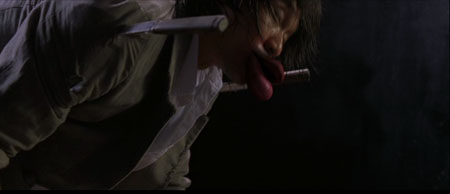
The images in Elevator Movie, largely scatological and sexual but also involving some brief animal cruelty, are not for the meek.  That said, some of these shocking images, and the surprising but perfect ending, can resonate a horrid fascination for a long time afterwards.  That’s what makes Elevator Movie come so achingly near to being a great weird movie.  Even with qualifications, it’s definitely worth a look for the Eraserhead set.

WHAT THE CRITICS SAY:

“As a champion of ‘Eraserhead’, ‘The Discreet Charm of the Bourgeoisie’, ‘Naked Lunch’, and ‘Back Against the Wall’, all fine films that downright bask in their toxicity to the homogenized masses, I found Haradon’s film to be unique and fascinating and a most worthy addition to the midnight movie circuit. Just don’t ask me to spend any longer in Haradon’s mind than I have to in any one sitting. It’s very likely I’d never make it out!”–Daniel Wible, Film Threat (contemporaneous)

13. KUNG FU HUSTLE (2004)

AKA Kung Fu, Kung Fu-sion

“It’s good to go over the line.  It’ll be boring if it doesn’t.  Following reality is not refreshing for me.”–Yuen Woo-ping, fight choreographer for Kung Fu Hustle

Recommended

DIRECTED BY: Stephen Chow

FEATURING: Stephen Chow, Qui Yuen, Wah Yuen, Siu-Lung Leung

PLOT: The Axe Gang, hatchet-wielding hooligans garbed in black-tie evening wear, terrorizes Shanghai in the 1930s. Only the poorest areas avoid falling under their thumb—neighborhoods like Pig Sty Alley, a tenement building where every other resident seems to have one-in-a-million kung fu powers.  When an incompetent ersatz gangster tries to extort protection money from the residents of Pig Sty Alley, he accidentally sets in motion a series of events that brings the Axe Gang into conflict with the poor fighters, with explosive results.
Still from Kung Fu Hustle (2004)

BACKGROUND:

  • Director Stephen Chow worked his way up from the trenches of the Hong Kong film industry, starting in television (including a stint as a children’s TV host). He became one of Hong Kong’s most popular comedians, specializing in a verbal style of comedy called “mo lie tau” (roughly, “nonsense”), which relies heavily on puns, wordplay, incongruities and non sequiturs. He began directing in 1994.
  • Chow’s previous film, Shaolin Soccer (2001), was supposed to be his breakthrough film in the West, but distribution was botched by Miramax and the picture became only a small cult hit on DVD.
  • Chow coaxed many older actors from the kung fu’s heyday out of retirement to star in major roles in Kung Fu Hustle. Qui Yuen (who played the part of “Landlady”) was one of the few female martial arts stars of the 1970s and had a small non-speaking role in the Bond film The Man with the Golden Gun. Wah Yuen (“Landlord”) has over one hundred acting credits, mostly from the late 1970s and early 1980s, and was at one time Bruce Lee’s stunt double. Siu-lung Leung (“The Beast”) was at one time considered third only to Bruce Lee and Jackie Chan as a martial arts star, and had been retired from the film business since 1988.
  • Kung Fu Hustle was the most profitable feature in Hong Kong cinema history. In its US theatrical run it opened as the #5 movie in the country and became the highest grossing foreign language film of 2005.

INDELIBLE IMAGE: There are so many memorable images in Kung Fu Hustle that it’s impossible to determine a consensus favorite.  The vision of two harpist assassins who strum their instruments to summon swords and warriors is a strong candidate, because their poetic menace draws a strong contrast to the lighter and less serious tone of the rest of the film.  Other contenders include the Axe Gang’s Broadway dance number, the Landlady’s whirling Road Runner legs, and a beatific Buddha in the clouds.

WHAT MAKES IT WEIRD: Kung Fu Hustle begins with a brutal and atypically realistic gangland slaughter on the neon-washed streets of Shanghai, and to celebrate gaining control of the city, the Axe Gang breaks into a carefully choreographed Busby Berkeley style fox trot, waving their tomahawks in the air. From this moment, the viewer realizes that they are in the hands of a maestro for whom reality is almost infinitely malleable, and who’s willing to switch cinematic styles at the drop of a hatchet to produce the effect he needs. Chow’s direction drives the movie through numerous stylistic incarnations, from absurd visual comedy through a ballet of breathtakingly beautiful and unreal violence, while quoting everything from Wong Kar Wai to The Shining and The Untouchables to Warner Brothers’ “Looney Tunes,” yet never loses its grip on the story or alienates the viewer with its madcap diversions.

U.S. release trailer for Kung Fu Hustle

COMMENTS:Kung Fu Hustle is likely to be the most commercially successful, mainstream Continue reading 13. KUNG FU HUSTLE (2004)

CAPSULE: CUBE ZERO (2004)

DIRECTED BY: Ernie Barbarash

FEATURING: Zachary Bennet, Stephanie Moore, Michael Riley

PLOT:  Audiences return to the cube from Cube in this prequel, only this time

cube_zero

we see the diabolical prison from the vantage point of its bureaucratic overseers as well as the poor souls trapped inside.

WHY IT WON’T MAKE THE LIST:  While the first Cube sequel (Cube 2: Hypercube) tried unsuccessfully to ratchet up the weirdness factor by throwing in more effects and a hyperbolic, reality-twisting plot, Cube Zero instead chooses to focus on a standard rescue narrative.  It also purports to answer (although unrealistically) pretty much every question one might have as to the cube’s design or purpose, thus completely exorcising the mysterious atmosphere of the original and leaving nothing left to be said or done in the Cube universe.

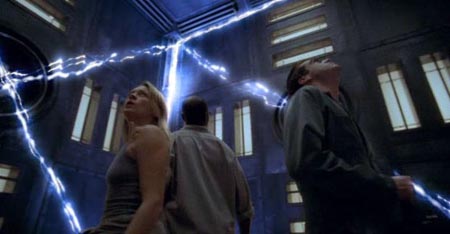
COMMENTS:  Unlike its predecessors, which showed b-movie influences but had higher aspirations, Cube Zero is an unapologetic action/sci-fi vehicle.  The paranoia of the previous entries only arises sporadically: once when drone Wynn asks a co-worker about his memories, and once in a highly effective scene that poses a surprisingly literal theological question.  Otherwise, the movie is more interested in the cube’s traps, imbuing them with gleefully gory capabilities (in an early scene, a victim startlingly dissolves into a pile of gooey grue before our eyes).  Add to this formula a cartoonish villain in the person of Jax, who sports not only a cane and an ironically genteel cadence but also a glittering metal implant where his eye once was, and you get an effective (if standard issue) b-movie, but a highly ineffective weird movie.

Some Cube fans (who apparently missed the major point of the movie) yearned for answers to the riddle of the Cube’s existence.  They finally got them with this installment.  Unfortunately, since these revelations destroy the fragile mystery and deliberate ambiguity that made Cube special, Cube Zero probably deals a fatal blow to the franchise.

WHAT THE CRITICS SAY:

“… if you enjoyed the last two ‘Cube’ movies, then you’ll feel right at home. True, there’s nothing overly original in ‘Cube Zero’… [although the] movie does offer a lot of answers, there’s that unshakeable sense of [deja] vu. Introducing Wynn and the other operators marks the sequel’s best decision, but adding the wacky Jax and his two black suited underlings takes away some of the film’s gloomy disposition and makes ‘Cube Zero’ something of a comedy, with a lot of ‘Brazil’-esque kooky bits and set scenery that seems to exist for the singular purpose of being kooky.” —Beyond Hollywood