WEIRD HORIZON FOR THE WEEK OF 8/19/2011

A look at what’s weird in theaters, on hot-off-the-presses DVDs, and on more distant horizons…

Trailers of new release movies are generally available on the official site links.

IN THEATERS (LIMITED RELEASE):

3-D Sex and Zen: Extreme Ecstasy: Well, this is weird.  The world’s first (widely released) 3-D softcore sex movie is a remake of Michael Mak’s surreal 1991 sex comedy Sex and Zen, which featured a bungled horse penis transplant as its comedic centerpiece.  In Hong Kong, 3-D Sex had a record-setting opening and had already outgrossed Titanic and Avatar.  It’s playing Austin, TX at the storied Alamo Drafthouse, but no word on other venues.  3-D Sex and Zen official site (warning: explicit content and annoying music!).

Griff the Invisible: A clerk who moonlights as a masked vigilante meets a girl lost in daydreams in this Australian romantic comedy.  Half the reviewers who’ve seen it use some form of the word “quirk” to describe it (and one even uses a form of “weird”).  Griff the Invisible official site.

The Last Circus [Balada triste de trompeta]:  Read our festival report.  Though we didn’t think Álex de la Iglesia’s allegorical tale of harlequin havoc was quite weird enough to be inaugurated onto the List, we can guarantee many readers are going to make it a point to attend this Circus.  Those of you in New York City will have the chance to catch it this week, while readers in a dozen other US cities will have to keep their eyes out.  The Last Circus official site.

NEW ON DVD:

Cul-de-sac (1966): ‘s followup to Repulsion is another tense, eccentric and psychological tale about a gangster who hides out in a castle and terrorizes (at first) a wimpy Englishman and his French wife.  It’s always cause for celebration when the Criterion Collection restores another neglected Polanski classic. Buy Cul-de-sac [Criterion Collection].

Elvira’s Movie Macabre: The Brain That Wouldn’t Die (1962) /The Manster (1959):  In 2010, horror hostess Elvira relaunched her 1980s franchise show “Movie Macabre” in syndication; this DVD matches up two of the weirder b-horrors she featured.  The Brain That Wouldn’t Die is the incredibly sleazy (by early sixties standards) story of a mad doctor shopping for a body for his decapitated girlfriend; The Manster describes what happens when an American journalist lets a Tokyo scientist experiment on him and grows an extra, evil, head.  Not to spoil anyone’s good clean cleavage-based fun, but you do realize Cassandra Peterson is now your grandmother’s age, don’t you?  Buy Elvira’s Movie Macabre: The Brain That Wouldn’t Die / The Manster.

The Ward (2010): Psychological thriller about a woman who sees a ghost after she’s involuntarily committed to an asylum.  John Carpenter’s first film since 2001’s Ghosts of Mars was not the comeback hit he hoped for, but fans may want to check it out anyway. Buy John Carpenter’s The Ward.

NEW ON BLU-RAY:

Cul-de-sac (1966): See description in DVD above. Buy Cul-de-sac [Criterion Collection Blu-ray].

The Ward (2010): See description in DVD above. Buy John Carpenter’s The Ward [Blu-ray].

FREE (LEGITIMATE RELEASE) MOVIES ON YOUTUBE:

Plan 9 from Outer Space (1959):  OK, perhaps Ed Wood’s opus about aliens who come to Earth to raise the dead so that stupid humans won’t learn how to blow up sunlight isn’t that weird—but you know you want to see it anyway.  It’s a notorious and hilarious anti-masterpiece that everyone needs to see at least once to complete their cinematic education.  Watch Plan 9 from Outer Space free on YouTube.

What are you looking forward to? If you have any weird movie leads that I have overlooked, feel free to leave them in the COMMENTS section.

PAUL LENI’S WAXWORKS (1924)

366 Weird Movies may earn commissions from purchases made through product links.

Kino International included ‘s 1924 Waxworks in its German Horror Classics collection.  While the usual Kino craftsmanship has gone into remastering and merchandising, the inclusion of Leni’s breakthrough film is a bit of a misclassification.  Waxworks is not a “horror” film.  It is representative of what may possibly be the most experimental period in the medium of film: German .  This style exploded with Robert Wiene’s Cabinet of Dr. Caligari (1920), which turned out to be an even more influential film than D.W. Giffith’s Birth of a Nation (1915).

Leni was among the apprentice filmmakers and artisans profoundly influenced by Caligari. That inspiration came to fruition in the anthology film Waxworks (screenplay by Henrik Galeen, also responsible for Golem-1920 and Nosferatu-1922). Leni’s breakthrough film is no mere carbon copy of Caligari.  Indeed, Waxworks is something of a yardstick for what an anthology film should be. (later an esteemed director whose credits include 1937’s Life of Emile Zola, the superior 1939 remake of Hunchback of Notre Dame, and 1940’s Dr. Erlich’s Magic Bullet) plays several characters, including the poet hired to write an article about wax figures of historical tyrants in a sideshow museum.  This framing sequence segues into a fantastic, carnivalesque omnibus.  In the first segment, plays Al-Raschid.  In this introductory Caliph vignette, Leni’s design work with Max Reinhardt is at its most impressive and expansive.  The ambiance is, paradoxically, both larger than life and remarkably introverted.  Fanciful, intricate roads wind and turn, leading to the Caliph’s aberrant belfry.  Gloom-laden canvases, crackling signs, and a towering wheel are remnants of a spidery, crepuscular  bacchanal.  Caligari‘s design is comparatively static next to this fluid, humorous, and transcendental Arabian tale.

Still from Waxworks (1924) gives a harrowing, anemic performance as Ivan the Terrible.  Angular and clammy, this segment is a paranoid fable which ends with a stark, memorable scene of the scourged despot forever turning the hour glass, convinced of his fate (death by poisoning).  Leni’s use of Eastern Orthodox iconography, inhabiting a shadowy world, is refreshingly and expressively idiosyncratic.  Helmar Lerski’s cinematography, which proved to be a considerable influence on Eistenstein, aggrandizes Ivan’s maniacal state.

The Jack the Ripper finale has been much discussed and is more a sketch than a climax. plays the infamous Whitechapel serial killer who dominates the shadows, blade in hand, awaiting the poet and his lover.  This surreal whisper was originally intended to lead into a fourth narrative based off Vulpius’ “Rinaldo Rinaldini.”  Although the dreaded captain’s wax likeness can be seen in several scenes, budget restraints forced that narrative to be deleted.

After Waxworks, Hollywood beckoned.  Considering what was to follow in Hitler’s Germany, Leni’s departure from his homeland may have saved the Jewish artist, but, most cruelly, fate prematurely deprived him, and us, of his life and art.

CAPSULE: THE BIG BANG (2011)

DIRECTED BY:

FEATURING: , Sienna Guillory, , Robert Maillet, Autumn Reeser, William Fichtner, Jimmi Simpson, Snoop Dogg

PLOT: An L.A. private eye goes looking for a missing stripper and uncovers a twisted plot involving the Russian mob, stolen diamonds, and the search for the God particle.

Still from The Big Bang (2011)


WHY IT WON’T MAKE THE LIST:  The fact that it’s only a bit offbeat means that we won’t have to dig too deeply into its filmic deficiencies; basically, it’s not weird enough.

COMMENTS: Most critics consider The Big Bang a cosmic failure, but, although the movie’s a mess, there may be just enough quirky particles floating around it to keep fans of the offbeat engaged.  Any movie that includes an invulnerable seven-foot Russian boxer, three different hair colors on Sam Elliot’s head, a horny waitress with quantum physics tattoos, a search for the origins of the universe, and a Snoop Dogg cameo is, in my book, worth at least a look.  The film also features entertaining (if often superfluous) visuals: crazy color schemes (you’ve never seen so much lavender outside of an aromatherapist’s waiting room), a dreamy overnight cruise in a convertible through a surreal CG desert, and some arresting tricks with spotlights whose beams stop short or bend around characters caught in its glare.  For the most part, the missing girl/stolen diamonds plot hangs together both as a mystery and a noir tribute, drawing you through to the end (even though that end doesn’t make a lot of sense).  The movie’s stylistically scattershot, with every color in the spectrum taking a turn dominating the palette (and the aforementioned lavender taking more than its fair share of turns) and magical realist digressions (like the catapulted flaming dwarf) popping up at unexpected times.  The eclecticism keeps it from being boring, but also prevents it from attaining the consistency it needs to be really effective.  The direction often seems improvised; the script, too, is a mixed bag.  The storyline is satisfactory, but the updated faux-Raymond Chandler patter lacks panache (“we’ve all got kinks… contrary to what science tells us, all DNA does not twist the same.”)  Despite an attempted application of quirkiness, the characterizations end up familiar and shallow: hard-boiled P.I., brutish boxer, stripper with a heart of gold, and so forth.  Elliot (as a hippie industrialist who builds supercolliding superconductors as a hobby), Reeser (as a quirky and perky waitress) and Simpson (as a synesthesiac scientist) add nuance to their portrayals, but the rest of the cast play their archetypes broadly.  Particularly disappointing is Banderas, who, squint and growl as he might, doesn’t bring anything new to the hard-bitten private dick role except his accent.  Maybe it’s not his fault, as the script doesn’t seem written with Antonio in mind: he’s given a Hispanic name (Cruz), but other than that there’s no acknowledgment of his foreign origin—which might have been the one thing the script could seize on to distinguish him from Phillip Marlow, Sam Spade, Mike Hammer, and their numerous clones.  The story stresses the detective’s philosophical acumen—his search for the missing girl becomes a metaphor for man’s search for meaning—but existentialism has always been the subtext of film noir, and The Big Bang just makes over-obvious what was implicit in the 40s.  The movie also wants to make sure you catch its many, many nods to subatomic physics, so it writes its references in letters three feet high (a warehouse named after Schrödinger, a cafe named after Planck).  Maybe The Big Bang‘s biggest problem is that it’s overanxious to impress us with its cleverness and style; it comes across like a desperate first date.  But that desperation also makes the movie crazy, and if you catch it with the right expectations you just may enjoy it.  It’s a movie that seems made to play on late night pay cable: if you caught it by accident at 2 AM on a sleepless night, you’d be incredulous, and wonder if you were actually dreaming.

Director has been a very successful producer, guiding several critically acclaimed TV shows (including cult favorites “Sports Night” and “24”).  He was also on the production team for David Lynch‘s Mulholland Drive.  He knows how to put together a professional-looking movie, but his directorial efforts (which also include the mildly surreal horror Sublime), though filled with interesting bits and pieces, have never really come together.   He’s got obvious visual talents and the right (i.e. weird) sensibilities, though, so he’s still someone to keep an eye on.

WHAT THE CRITICS SAY:

“… the film’s bleary, neon glamour and penchant for the bizarre suggests an attempted—and wayward—homage to David Lynch.”–Michelle Orange, The Village Voice (contemporaneous)

CAPSULE: THE FUTURE (2011)

DIRECTED BY: Miranda July

FEATURING: Miranda July, Hamish Linklater, David Warshofsky, Isabella Acres

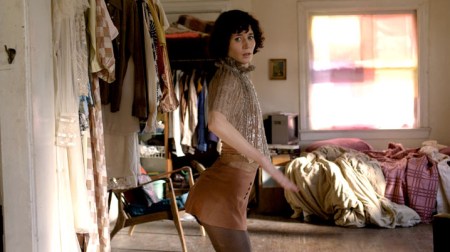
PLOT: A thirtysomething couple decides to adopt a sick cat in one month, during which time they quit their jobs and try to find ways to make their lives more satisfying. The cat (named Paw-Paw) narrates part of the story from her veterinary hospital cage.


WHY IT WON’T MAKE THE LIST: Populated with just enough flights of fancy to warrant “eccentric” and offering a surprisingly bleak and realistic look at two people on the brink of nervous breakdown while in a crumbling relationship, The Future just isn’t strange enough for a spot on the List.

COMMENTS: Though it opens with the creepy, nasally voice-over of Paw-Paw the cat detailing its rescue by a kind couple, The Future spends most of its time with Sophie (July) and Jason (Linklater).  She is an “overqualified” dance teacher for young girls, he works from home accepting tech support calls.  When they decide to adopt a sick cat, their future spreads before them as nothing but caring for it and then reaching old age after it dies.  Sophie tries to motivate herself to make online dance videos but instead finds solace in an affair with a friendly sign-maker.  Jason becomes “open to everything,” accepting a volunteer position with an environmental group and befriending an elderly pack rat.  As Paw-Paw waits patiently, her soon-to-be owners flounder in the face of self-fulfillment with anxiety-ridden freakouts.

Known in the film world for her quirk-filled debut Me and You and Everyone We Know, writer and performance artist Miranda July is developing definite trademarks.  She once again employs experimental voice-over and somewhat stilted scripting for a portrait of white middle-class romance, but this time her characters are more realized and the emotions more focused.  As Sophie and Jason claw their way through individual bouts of near-insanity, a surprisingly touching story unfolds.  For the most part we are looking at this relationship from the outside in, seeing these characters more often apart than together.  Sophie’s uncertain relationship with sign-maker Marshall and Jason’s curious friendship with elderly chatterbox Joe offer insights unseen in their actual interactions with one another.

This is uncharacteristic for me but I actually found most of the “weirder” parts detrimental to the film overall.  The creepy cat narration and puppet paws feel irrelevant and clashing—it doesn’t move the story forward and it doesn’t increase my sympathy for the cat or the couple.  Sophie’s suddenly animated t-shirt also feels out of the blue.  The best offbeat technique is employed towards the end, when Jason literally stops time so he can sort out his feelings about Sophie’s infidelity, and ends up in a sad conversation with the moon.  It’s a neat trick and sets forth an interesting structure for that segment of the film, and serves to highlight Hamish Linklater—an actor often set in supporting roles—as a performer.

There’s a good amount of twee baggage weighing down The Future.  Some of July’s little touches of style and wry humor are fun, but many drag the focus away from the central story unnecessarily.  The writing and characterization just aren’t tight enough.  It is at times a beautiful and heartbreaking film, and even quite funny at others, but viewers need to wade through a lot of excess in order to hit upon the most effective points.

WHAT THE CRITICS SAY:

“‘The Future,’ July’s coy and precious new film, is just oddball enough to be interesting, if not good.” –Peter Rainer, Christian Science Monitor (contemporaneous)

366 UNDERGROUND – RACE WAR: THE REMAKE (2011)

366 Underground is an occasional feature that looks at the weird world of contemporary low- and micro-budget cinema, the underbelly of independent film.

DIRECTED BY: Tom Martino

FEATURING: Howard Calvert, Jamelle Kent, Matt Rogers, Kerryn Ledet, Danny McCarty, Joe Grisaffi

PLOT: Baking Soda & G.E.D., a pair of misguided drug dealers, find themselves out of

Still from Race War: The Remake (2011)

customers when a new group of traffickers invade their hood with an alien form of smack. With only their friend “Kreech Da Black Kreecha from a Lagoon” at their side, the two crack heads—armed and ready—must fight their way back to the top.

COMMENTS: When I first saw the poster for Race War: The Remake, my first thought was that it was probably going to be the best part of the movie… your opinion may well vary.  But, if your taste runs towards Tromaesque spectacle and you have an ample supply of beer and bongloads to get you through the running time, then this will definitely make your weekend!

There’s some talent floating around in this bowl: Calvert and Kent make a decent pair of stoner badass heroes (with Calvert radiating a Rudy Ray Moore vibe), and the effects are decent.  Most of the other cast members hide under masks or disguises so embarrassment is not an issue here. What works against the film is mostly the past 30 years or so of Troma-type grossout humor and movies that a good portion of the audience has been exposed to.  There’s nothing new here. Which, if you’re calling your film Race War, means that a good opportunity has largely been wasted.  There’s still room for some biting racial comedy with no limits to step up and become the modern day equivalent of a Blazing Saddles or even a Darktown Strutters.

But this ain’t it.  At best, this is a group of friends screwing around on several weekends to make a party film… which, for some, ain’t bad, if there’s enough alcohol and weed around.  For others, it’s more like, ‘been there, done that”.

DWN Productions – Official site

Celebrating the cinematically surreal, bizarre, cult, oddball, fantastique, strange, psychedelic, and the just plain WEIRD!