A buck learns about Schopenhauer after an unfortunate accident during mating season.
CONTENT WARNING: Adult language, deer sex, Schopenhauer quotations

A buck learns about Schopenhauer after an unfortunate accident during mating season.
CONTENT WARNING: Adult language, deer sex, Schopenhauer quotations
366 Weird Movies may earn commissions from purchases made through product links.
Discussed in this episode:
The Assassin of the Tsar (1991): A man in a Soviet mental institution insists he has killed two different tsars, despite the fact that he would have had to be centuries old to do so. Karen Shakhnazarov directs Malcolm McDowell (versions were filmed in both English and Russian) in this psychological time-traveling mind-bender. Buy The Assassin of the Tsar.
Eyes Without a Face (1960): Read the Canonically Weird entry! Nothing new from this Criterion collection classic release, it’s just the 4K upgrade. Buy Eyes Without a Face.
Ferat Vampire (1982): A race car driver gets a new vehicle that runs on blood. A bizarre regional cult film from Czech New Wave icon Juraj Herz. Buy Ferat Vampire.
Jacob’s Ladder (1990): Read the Canonically Weird entry! This Limited Edition 4K disc comes exclusively from Lionsgate and includes a never-before-seen featurette (something called “The Rungs of Jacob’s Ladder“) along with legacy features. Buy Jacob’s Ladder directly from Lionsgate.
School in the Crosshairs (1981): A high school girl uses her psychic powers to stop a fascist alien takeover of her school. Of the four rare Nobuhiko Obayashi movies Cult Epics is releasing this year, School in the Crosshairs seems by far the wildest and the closest in spirit to Hausu. Buy School in the Crosshairs.
“Treasures of Soviet Animation, Vol. 1”: This Deaf Crocodile compilation contains 3 short (the longest is 48 minutes) psychedelic sci-fi Soviet cartoons: “The Mystery of the Third Planet,” “The Return,” and “The Pass.” These shorts are remastered and available for the first time outside of Russia. Buy “Treasures of Soviet Animation, Vol. 1”.
WHAT’S IN THE PIPELINE:
W.M. Weikart of Soul to Squeeze will be our guest on Pod 366 next week. In written reviews, Shane Wilson fits a date with Frankenhooker (1990) onto his reader-suggested Halloween viewing card, while Gregory J. Smalley takes in a fall Harvest (2024). And don’t be surprised if there’s a surprise review in there as well. Onward and weirdward!
366 Weird Movies may earn commissions from purchases made through product links.
DIRECTED BY: Hiroshi Nagahama, Yûji Moriyama
FEATURING: Uki Satake, Shin’ichirô Miki; Abby Trott, Robbie Daymond (English dub)
PLOT: Residents of a small Japanese town are increasingly haunted by spirals.

COMMENTS: Most horror story monsters are inspired by symbols of death, disease, and predation, not unthreatening geometric shapes like the humble spiral. Leave it to eerie manga star Junjo Ito to choose the spiral as his avatar of evil. Uzumaki (which had previously been adapted as a live-action feature) plumbs every possible devious iteration of the humble coil; it shows up in the story as whirlwinds, whirlpools, DNA, snail’s shells, hair curls, staircases, mosquito swarms, corkscrews, springs, and the twisted, intertwined bodies of snakes (and people). Watch with disquietude as everyday objects in the town gradually get twisted as the story spirals towards its grim conclusion.
The bizarre antagonist is not the only weird element here. The originally-serialized story lurches forward as a series of vignettes, with a threatening new spiral form dominating each mini-arc. In between episodes, normality resets. After the first girl’s head dissolves into a spiral, we would think the two high school protagonists would flee town; instead, the incident is never mentioned again. After the first kid turns into a human-snail hybrid, you would think the town would panic; instead, they accept it as the new normal, building a pen for the newly-minted escargot boy to live in. The commonsense idea of fleeing the town doesn’t even arise until the second episode, when one pair of aspiring refugees are frustrated in their attempt—but our main characters never even attempt to leave until the final episode, when the narrative finally proffers an explanation for their inability to escape. A particularly intense, vampire-adjacent incident dominates the third episode, but again, after a jarring edit, this horror is entirely forgotten. The characters’ incapacity—and their resigned unwillingness—to escape their situation lends the story an especially irrational, nightmarish quality. In fact, Uzuamki‘s entire structure, oscillating between grotesque visions and uneasy pseudo-normality, suggests madness; perhaps our main characters are actually trapped inside their own obsessive delusions, imagining spirals everywhere.
The art style is done entirely in black and white and imitates the intricate linework of Ito’s original drawings, sometimes recreating particularly bizarre panels. When animated, the absurdity of some of Ito’s visions—a dramatically curling tongue, a pair of eyeballs rotating independently—can be as weirdly comic as they are frightening. But the artwork is almost always strange and affecting, no matter the overall emotional effect. Much was made in anime fandom of the fact that the animation quality declines as the series progresses (probably due to budgetary mismanagement). By the final episode, the directors and producers aren’t even credited. I think that this complaint is mostly overstated, at least for the average viewer. I noted the decline in the cartoon’s fluidity and detail with each new episode, but it wasn’t as drastic as I feared; if I hadn’t been forewarned, I’m not sure how much I would have noticed. Perhaps I benefited from having my expectations lowered; perhaps you will, too. Although Uzumaki hobbles a bit on the way to the finish line, it eventually crosses it. It’s not the wall-to-wall masterpiece the first episode promised, but I wouldn’t say it exactly circles the drain, either.
WHAT THE CRITICS SAY:
366 Weird Movies may earn commissions from purchases made through product links.
DIRECTED BY: W.M. Weikart
FEATURING: Michael Thomas Santos, Danielle Meyer
PLOT: Jacob signs up for a dangerous psychological treatment to overcome his anger issues and finds himself trapped within a small home.

WHY IT MIGHT JOIN THE APOCRYPHA: Soul to Squeeze doesn’t wear its metaphor on its sleeve so much as encase the protagonist. This narrative framework allows for a psychological deep-dive which proffers as much ambiguity as it does clarity.
COMMENTS: A young fellow emerges from debris on the roadside. He’s bleary-eyed, but looks content—even happy. In fact, he’s doing so well that, when a kindly passerby offers help, he politely declines. The preceding ordeal nearly broke him, for this trash pile is the site of a rebirth. As he limps to the roadside, it is clear that our protagonist, Jacob, has had his soul squeezed, but not how you might think.
Certainly not how I thought, until some days after watching the movie when the title’s implications finally became clear. Weikart uses a number of tools to form the narrative, but a television documentary (which seems to be the only channel available where Jacob’s locked himself away for “treatment”) is nearly as omnipresent as the allegorical house the film was shot in. Alongside Jacob, we learn about the mysteries and wonders of the eye: its nerves, cones, strata, apertures, and, most importantly, the aqueous humour. You’ll develop an understanding and appreciation of this unlikely organ from watching Soul to Squeeze, if nothing else.
Jacob’s ordeal begins immediately upon signing the medical release for an unclear procedure—someone, or some force, locks the exit the moment he lifts the pen from the contract line. As Jacob angrily goes through his routines in confinement, he encounters an array of characters who probably aren’t there, though it’s difficult to be certain. (Surely there isn’t a kitchen game show titled “Don’t Fuck This Up!” lying in wait to pounce on the unsuspecting breakfaster.) As the story unfolds, and Jacob’s psychological journey dives deeper into the source of his omnipresent anger, the surrounding pressure of recollection and contemplation forces him (and us) to focus on his true ailment.
The documentary narrator explains: we know much about the hardware involved inside the eye, but there’s no concrete theory as to why it all works. As with the eye (a window to the soul, we’ve been told), so with the mind. Weikart’s one-set drama, putting actor Michael Thomas Santos through the wringer, features much that is obvious. But like an eye (which comes up as much in this review almost as much as in the film), it transcends the sum of its parts through an alchemical process that cannot be easily dissected into its constituent parts without destroying it. Apologies if I’ve veered too far into bio-philosophical rambling, but that’s just the kind of thing Soul to Squeeze catalyzes. With a little focus, life’s debris can be put into perspective, and you are free to move on in the world.
WHAT THE CRITICS SAY:
366 Weird Movies may earn commissions from purchases made through product links.
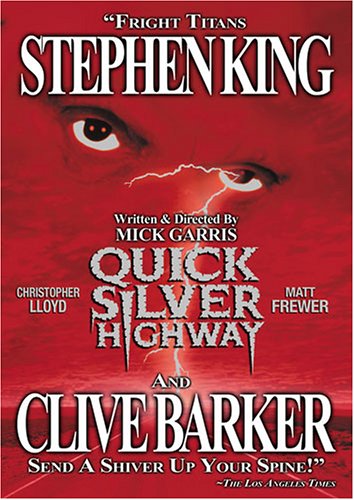
DIRECTED BY: Mick Garris
FEATURING: Christopher Lloyd, Matt Frewer, Raphael Sbarge, Missy Crider
PLOT: The mysterious Aaron Quicksilver shares two tales of ill-fated individuals: a traveling salesman who encounters a suspicious set of novelty clattering teeth, and a plastic surgeon who finds that his hands have developed minds of their own.

COMMENTS: Horror on television is a tricky proposition. The genre frequently relies upon visceral shock and gore, elements too unseemly for broadcast, which is why the most successful series either emphasize psychological terror or abscond to cable where the standards are looser. But Bless Mick Garris for continuing to try. He is responsible for five Stephen King TV adaptations, including takes on classics The Stand and The Shining. Plu,s he’s well-versed in the televised horror anthology, with credits in “Tales from the Crypt,” “Freddy’s Nightmares,” and “Masters of Horror.” If anyone is going to make Quicksilver Highway work, it’s Garris.
He doesn’t, though. That’s not necessarily his fault, of course. The film is a busted pilot, with two unrelated episodes inelegantly slammed together. They both traffic in body horror, a genre that is never going to get a fair hearing on network TV. The small-screen budget is also a limitation, with simplistic special effects (including some terrible CGI) and overly broad acting. The stories are also heavily padded to fill out 45 minutes apiece, with long diversions into pointless philosophical debates and weak character monologues arriving right at the moment when the story really needs to be gaining steam. Mostly, though, the finger needs to be pointed at the material, which is best described as “better on paper.” Neither of these are horror short story classics from genre masters King and Clive Barker, but one can see how they managed to create a sense of unease though their unlikely subjects. But visualizing them, without the reader’s imagination to hide behind, reveals them as low-stakes and low-impact.
The King story, “Chattering Teeth,” relies upon a familiar trope from the author, an innocent-looking object that carries with it bad juju and sinister intent. A classic monkey’s-paw scenario. In this case, the object is an oversized set of windup walking choppers, which the protagonist somehow imagines is going to be the perfect gift to appease his disappointed son. When the novelty mandibles attack a nasty hitchhiker, it’s impossible to see it as anything other than an actor forced to pretend-wrestle with a goofy prop. The teeth need to have a “creepy doll” vibe in order to work, and they just don’t.
The second tale, Barker’s “The Body Politic,” finds greater success by indulging in sublime silliness. Here’s a villain we can get behind: human hands which have somehow become imbued with the spirit of Che Guevara, calling for liberation from the oppression of being attached to Matt Frewer. They are ridiculous little gremlins, speaking to each other with Smurf-like voices and hyperactively gesturing at each other while plotting their revolution. They’re risible, but they benefit from a couple solid jump-scares and the full commitment of Frewer, who actually does some pretty nifty acting with opportunities for his face and his hands to play conflicting emotions. Once again, though, what probably reads as spectacularly macabre on the page becomes ludicrous on screen, as when Frewer outwits a whole platoon of severed hands by leading them off the roof of a building, resulting in the jaw-dropping sight of dozens of hands flinging themselves into oblivion. I am sure you’re supposed to laugh in shock. The laughter you get is different.
The connective tissue is our good Mr. Quicksilver, a sort of wandering troubadour of the grotesque. He repeatedly insists that his tales have no moral, but contempt for his audience positively oozes out of him. Lloyd is a curious choice for a narrator. Already odd with his spiky red hair, black peasant’s blouse and knee-high leather boots, looking for all the world like Johnny Rotten in a witches’ coven, he’s an actor we often recognize for his manic interior that threatens to break into the open. This puts him at odds with the cool detachment he tries to project, the hint of judgment from on high that we associate with Rod Serling in “The Twilight Zone,” Vic Perrin in “The Outer Limits,” or even David Duchovny in “Red Shoe Diaries.” It’s telling that, the moment he gets someone to join him in his trailer for a pleasant meal, he immediately jumps into an indictment of America as a land of lies and darkness. (He’s not necessarily wrong, but it’s hardly an icebreaker.) It’s hard to understand why someone would sit through his spiel. Intriguingly, one can easily imagine Frewer in the role in a slightly lower-budget version.
Quicksilver Highway isn’t bad, just extremely inessential, an empty-calorie snack that’s not a career highlight for any of its participants. If you’re driving out west and happen to pass by a strange-looking man in a Rolls-Royce towing an Airstream trailer, don’t stop for one of his stories. Not because of the horrible fate that awaits you. But because there are so many better things to do.
WHAT THE CRITICS SAY:
(This movie was nominated for review by Dave Pistol. Suggest a weird movie of your own here.)