
Bill Wurtz makes absurd shorts and music videos featuring Microsoft Paint-style animations with muzak quality instrument samples. The song And the Day Goes On could be the beginning of a new era for rundown grocery store background music.
WEIRD HORIZON FOR THE WEEK OF 4/27/2018
Our weekly look at what’s weird in theaters, on hot-off-the-presses DVDs and Blu-rays (and hot off the server VODs), and on more distant horizons…
Trailers of new release movies are generally available at the official site links.
NEW ON HOME VIDEO:
Dead Man (1995): Read the Certified Weird review! Jim Jarmusch‘s moody western about Nobody and William Blake gets the Criterion Collection treatment, with a host of new interviews, features, behind the scenes Neil Young performances, and deleted scenes for uberfans. On DVD and Blu-ray. Buy Dead Man
Moon Child (1989): A parapsychological cult believes they may have found the prophesied “moon child” in a 12-year old orphan. From Agustí Villaronga, with a score by Dead Can Dance. Blu-ray/DVD combo pack from Cult Epics. Review coming soon. Buy Moon Child
CERTIFIED WEIRD (AND OTHER) REPERTORY SCREENINGS:
The Rocky Horror Picture Show (1975). We won’t list all the screenings of this audience-participation classic separately. You can use this page to find a screening near you.
- Chicago, IL, 4/27-4/28 – Vertigo (1958). Buy a ticket and get a discounted ticket to Guy Maddin‘s new Vertigo-based visual essay The Green Fog (and vice-versa). At the Gene Siskel Film Center.
- Columbus, OH, 4/27 (midnight), 28, 30 & 5/2 – Suspiria (1977). At Gateway Film Center.
- Dallas, TX, 4/29 – Willy Wonka and the Chocolate Factory (1971). At the Texas Theater.
- Los Angeles, CA, 4/27 – Sweet Sweetback’s Baadasssss Song (1971). Part of the TCM Classic Film Festival, with Melvin Van Peebles in attendance. At the Egyptian Theater.
- Los Angeles, CA, 4/27 – Weekend (1967), with Vivre sa Vie (1962) (double feature). At the Aero Theater.
- Los Angeles, CA, 4/27 (midnight) – Society (1989). With an introduction by director Brian Yuzna. At Nuart Theater.
- New York City, NY, 4/27 – Blue Velvet (1986). At Videology Bar & Cinema.
- New York City, NY, 4/27-4/28 (midnights) – Videodrome (1983). At Nitehawk Cinema.
- New York City, NY, 4/27-4/28 (midnights) – Eraserhead (1977). At IFC Center.
- New York City, NY, 5/3 – A Clockwork Orange (1971). At Videology Bar & Cinema.
- Vancouver, BC, Canada, 4/27 – Paprika (2006). At the Rio.
FREE WEIRD MOVIES ON TUBI.TV:
The 50 Worst Movies Ever Made: A glorified YouTube upload posing as a one-hour feature film, but an interesting set of clips, nevertheless. At least three of these selections are Certified Weird, many others are reviewed here, and, as is usually the case with these kinds of lists, not all of them are actually bad—just beyond the curator’s expectations of what a movie “should” be. Watch The 50 Worst Movies Ever Made free on Tubi.TV.
What are you looking forward to? If you have any weird movie leads that I have overlooked, feel free to leave them in the COMMENTS section.
329. THE TESTAMENT OF ORPHEUS (1960)

Le testament d’Orphée, ou ne me demandez pas pourquoi!
“Man seeks to escape himself in myth, and does so by any means at his disposal. Drugs, alcohol, or lies. Unable to withdraw into himself, he disguises himself. Lies and inaccuracy give him a few moments of comfort.”–Jean Cocteau, Diary of an Unknown
DIRECTED BY: Jean Cocteau
FEATURING: Jean Cocteau, Edouard Dermithe, François Périer, María Casares
PLOT: Time-traveling poet Jean Cocteau visits a professor and asks to be shot with his faster-than-light bullets in hopes of escaping the condition of timelessness. After the bullet frees him from his 19th century garb, he wanders outside, witnesses a strange gypsy ritual, and unknowingly summons Cégeste, a character from his movie and play Orpheus. Cégeste orders him to travel to the goddess Minerva with an offering, but along the way they are detained and interrogated by Death and her chauffeur Heurtebise (two other characters from Orpheus), among other surreal encounters.

BACKGROUND:
- Testament is the third part of Jean Cocteau’s “Orphic trilogy,” which begins with The Blood of a Poet (1930) and peaked with its second entry, Orpheus (1950). Since characters from Orpheus play a role in Testament, this film will be much more meaningful to those who saw the second installment. Blood of a Poet has no narrative connection to the others, only a thematic one, and can be viewed in any order.
- Cocteau was 71 when he made this film, which he intended to be his final statement in cinema. He wrote that the title Testament of Orpheus “has no direct connection to my film. It meant that I was bequeathing this last visual poem to all the young people who have believed in me, despite the total incomprehension with which I am surrounded on the part of my contemporaries.” Cocteau died three years after Testament was released.
- Reportedly, when the production was short on funds, François Truffaut invested some of his profits from his recent hit The 400 Blows so Cocteau could complete his Testament.
- The film’s French subtitle (or alternate title), “ne me demandez pas pourquoi,” translates to “do not ask me why.”
- Besides Cocteau, the cast is uncredited. At the end, Cocteau says that “Any celebrities who you may see along the way appear not because they are famous, but because they fit the roles they play and because they are my friends.” Among the cameo appearances: musician Charles Aznavour, Brigitte Bardot, Yul Brynner, Pablo Picasso, and director Roger Vadim. Former Orpheus Jean Marais appears briefly as Oedipus.
- Edouard Dermithe, who plays the key role of Cégeste, was Cocteau’s adopted son, a fact alluded to in the script.
INDELIBLE IMAGE: Cocteau stages his own funeral. His pallbearers are lanky black horse-men. The mourners are gypsies. His corpse exhales smoke. He doesn’t stay dead long.
THREE WEIRD THINGS: The Poet as time-traveling fop; pantomime horse boy toys; Athena’s jet javelin
WHAT MAKES IT WEIRD: In his final film, a giant of the avant-garde unapologetically indulges himself in a surrealistic journey through a misty netherworld bordered by dreams, imagination, and narcissism.
Brief clip from The Testament of Orpheus
COMMENTS: The Testament of Orpheus is, beyond question, a self-indulgent film. “Testament” has a dual meaning: it is a statement of Continue reading 329. THE TESTAMENT OF ORPHEUS (1960)
CAPSULE: AMAZON WOMEN ON THE MOON (1987)
DIRECTED BY: Joe Dante, Carl Gottlieb, Peter Horton, John Landis, Robert K. Weiss
FEATURING: “Lots of Actors”, including Arsenio Hall, Michelle Pfeiffer, Joe Pantoliano, Steve Forrest, David Alan Grier, B. B. King, Rosanna Arquette, Steve Guttenberg, Ed Begley, Jr., Kelly Preston, Ralph Bellamy, Carrie Fisher, Andrew Dice Clay, Griffin Dunne
PLOT: A collection of sketches parodying late-night TV content, anchored by a specific parody of goofy 1950s space operas.
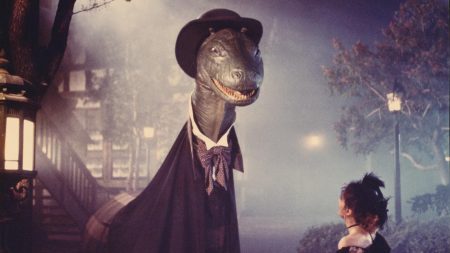
WHY IT WON’T MAKE THE LIST: The sketch film has always been rare enough to merit a double take when one appears in cinemas, but this particular example of the form isn’t especially unusual, with nothing particularly outlandish or shocking, and the majority of sketches being of the one-joke variety.
COMMENTS: Although anthologies have been a recurring genre since early cinema, the heyday of the “sketch film” variant was the early 1970s: The Groove Tube, TunnelVision, and king-of-the-form Kentucky Fried Movie all parodied television’s challenge to attention spans. The form was also fairly economical, providing quick work to underemployed actors and aspiring comedy writers alike. None of these were box office bonanzas, though, so when Amazon Women on the Moon came along more than a decade later, it was fair to ask if it was a bold attempt to refresh the formula, or a last gasp for a format that had never truly lived.
Let’s go with B. First and foremost, Amazon Women is a comedy, but while it has quite a few solid jokes, it reveals time and again that it doesn’t have much else. Let’s consider one of the film’s best sequences, a vivid re-creation of 1930-era Universal horror movies starring Ed Begley, Jr. as the son of Claude Rains’ Invisible Man. The black-and-white atmosphere is rich, and Begley even gets to repeat the famous bandage-removal scene. The catch: he’s not invisible at all. It’s a funny joke, as he obliviously cavorts about the room in the nude. The problem is, the sketch has another two minutes to go, and so we get more variations on the same joke, searching for an end.
This happens a lot. Scenes have a funny premise at their core, but then they have to keep going to justify their presence in a Hollywood motion picture: David Alan Grier sings in a super-white way—then he does it some more. A funeral turns into a Catskills roast—and we get the whole roast. Other sketches are shorter, but their jokes are smaller, too, and the scenes still feel stretched and padded. Amazon Women on the Moon has a tight five minutes; it gets an hour-and-a-half.
The film is not without its charms. The parodies have a clever eye for their sources, such as a 30s-era scare propaganda film that subtly re-dresses the same set over and over. Several performances capture the desired anarchic spirit, such as Griffin Dunne’s incompetent doctor and Carrie Fisher’s gullible ingénue. And every now and then, the film manages to tap into something sublimely silly; my personal favorite is an In Search Of/Unsolved Mysteries amalgam that manages to mashup the sordid deeds of Jack the Ripper with a more supernatural tale. But Moon’s a film that earns smiles more than laughs.
Ultimately, Amazon Women on the Moon is “Saturday Night Live” with slightly better production values: the jokes are hit and miss, and there’s a lot of work to get to the end of each sketch. It’s not the worst of its kind (that would be the execrable Movie 43), but it’s far from the finest. That honor probably belongs to Kentucky Fried Movie, and the filmmakers know it; references to fictional producer Samuel L. Bronkowitz mark Moon as Movie‘s spiritual sequel. But bad news, Sam: Amazon Women on the Moon is no Fistful of Yen.
WHAT THE CRITICS SAY:
(This movie was nominated for review by roastphoenix. Suggest a weird movie of your own here.)
LIST CANDIDATE: ANGUISH (1987)

DIRECTED BY: Bigas Luna
FEATURING: Zelda Rubinstein, Michael Lerner, Talia Paul
PLOT: An audience watches a movie about a serial killer under hypnotic control by his mother killing off patrons of a movie theater, while themselves being victims of an obsessed killer prowling their own theater.

WHY IT MIGHT MAKE THE LIST: You are getting very sleepy, back and forth, watch the metronome. Once you were like a snail, hiding in your shell. Now you’re on an elevator, going down to the twentieth floor, the nineteenth, the eighteenth… when you land, you will become one with us in nominating this unique thriller onto the List as one of the weirdest film experiences to be fooouuunnnd.
COMMENTS: As you read this review, if at any time you feel your mind leaving your body, you should cease reading immediately. Your humble author didn’t follow this warning, and look how I turned out. No really, we’re just passing along the William Castle-like warnings from the beginning of the film. But it’s good advice anyway, because this horror flick starts out invoking standard slasher fare, but ends up reminding you more of The Cabin in the Woods. We meet the creepy old lady Alice (Zelda Rubinstein) and her grown adult son John (Michael Lerner, also in Barton Fink) who live together in a house otherwise occupied by pet snails and pigeons. John is an eye doctor who is ironically going blind as a result of untreated diabetes, and his mother hypnotizes him into murdering people so he can harvest their eyes for her. Not that she’s motivated to cure his ailing vision; oh no, the eyes are just to increase her witchy powers. Among her many talents is the ability to remotely hear conversations by listening to a seashell, and project her own consciousness into her son’s mind when he’s out and about. And for a man losing his vision, John throws a pretty mean scalpel anyway.
But did you think that was the whole movie? Ha, just kidding, this is actually a movie about a theater audience watching the above movie, and getting melodramatically distressed at it. As the hypnotic scenes commence, the audience falls under the spell, variously swaying into a trance, or squirming uncomfortably as if they were held against their will to watch. Ah, but we go back to the movie they’re watching, and now John, in a quest for fresh victims at his mother’s behest, invades yet another movie theater showing The Lost World. Even this black-and-white dinosaur adventure holds its audience enthralled enough to provide great cover for John to quietly off the victims and collect the eyeballs, in between dinosaur roars. A young lady leaves what is revealed to be the theater showing The Mommy, where we’re now starting to get lost as to which layer of of movie we’re in. As we follow the distressed girl getting her bearings in the theater bathroom, we realize that she wasn’t watching The Lost World, but The Mommy, the movie we’ve been mostly concerned with up until now.
Just when we’re begging not to get anymore confused, a new murder plot forms around the people watching The Mommy. As the events of The Mommy continue, the movie theater staff and eventually the audience watching it are preyed upon by a new killer, even as John in The Mommy scalpels victims in his own theater while this new killer prefers a trusty gun. From here on out, events blur between the two theaters, as the film practically dares you to keep up. The new killer huddles in the bathroom and also babbles “mother”; it turns out he’s a fan obsessed with The Mommy. Both killers barricade the doors of their respective theaters, the better to trap victims for an all-out rampage. At times you’re watching an audience watching an audience, at other times you’re asking which bathroom we’re in, and at times even The Lost World’s events blend with the various audiences’ experiences. And guess what? We’re not done shifting points of reality yet, because it turns out we were watching a movie in a movie in a movie… or something. And you thought Inception was hard to follow!
If you’re a big fan of Zelda Rubinstein, who also plays the spooky psychic from the Poltergeist series, then this is your party. Rubinstein dominates the earliest film, her dulciloquent baby-doll voice rasping away and chanting hypnotic spells as her face fills the screen in between shots of whirling spirals, ticking metronomes, rocking lights, and sometimes shots filmed with a spinning camera—bring your barf bag. This goes on for most of the inner movie (and the movie’s movie, and the movie’s movie’s movie…), and when it’s not, the visuals establish artistic motifs around eyes and spirals until it switches to the stacked-movie premise, which invites us to ponder the thin wall between violent movies and obsessed fans (which gets uncomfortably close to later real-life events, even). Anguish does everything it can to drill itself into your conscious. It’s a corkscrew roller-coaster ride through a hall of mirrors, smartly setting you up for an expectation and then veering off into a new curve. While it has some flaws, such as the secondary cast at times giving performances so wooden they smells like lemony furniture polish, Anguish works its ass off to end up giving you several movies in one.
WHAT THE CRITICS SAY: