WEIRD HORIZON FOR THE WEEK OF 4/22/2011

A look at what’s weird in theaters, on hot-off-the-presses DVDs, and on more distant horizons…

Trailers of new release movies are generally available on the official site links.

Nothing of interest coming to theaters this week.

FILM FESTIVALS: TRIBECA (New York City, April 20-May 1):

The eighth annual running of the Manhattan-based festival co-founded by Robert De Niro.  Tribeca Film, the distribution arm of Tribeca Enterprises, released 2009’s Certified Weird The Immaculate Conception of Little Dizzle, so you know these guys aren’t afraid to go weird.  We list the features we think hold at least a little bizarre promise below:

  • Beyond the Black Rainbow: Surrealist sci-fi supposedly in the 2001 vein about a mute woman trying to escape from a mysterious enclave.
  • Bombay Beach: Footage of three residents of the decaying Salton Sea region—a bipolar boy, a high school athlete fleeing gang violence, and a retired oil-rig worker—is mixed with musical montages from Beirut and Bob Dylan to create what the makers describe as a “slightly surreal documentary experience.”
  • Detective Dee and the Mystery of the Phantom Flame: A mystery/action epic set in a fantastical steampunk China; some say this is a return to form for director Tsui Hark (Once Upon a Time in China, Zu Warriors)
  • Grey Matter [Matière Grise]: An African filmmaker is advised to make an upbeat film instead of his war atrocity opus, “Cycle of the Cockroach;” when he goes ahead with his original plan, he finds scenes from his script manifesting themselves in reality.  This is the first movie we’ve ever heard of from a Rwandan director; it’s nice to imagine they’re starting their national film industry off weird.
  • Hideaways: Fantasy/fable about a teen who flees to the woods in an attempt to escape an inherited curse: he seems to be something of an accidental angel of death.
  • The Miner’s Hymns: 52-minute experimental film mixing old black-and-white footage of British coal miners with contemporary color footage, scored to a new avant-garde composition by Icelandic composer Jóhann Jóhannsson.
  • The Troll Hunter [Trolljegeren] – We mentioned this one in our Sundance column: it’s a Norwegian “found footage” film about a man who literally hunts trolls for the government. It’s weirdness is questionable, but it appears to be a crowd-pleaser.
  • Underwater Love – a “pink musical” (!) about a woman who falls in love with a water spirit; lensed by big-time cinematographer Christopher Doyle, with “outrageous” sex scenes

Tribeca Film Festival Home page.

NEW ON DVD:

Heartless:  Philip Ridley (writer/director of the Certified Weird The Reflecting Skin) is back after a fourteen year hiatus from filmmaking with this arthouse horror starring Jim (Across the Universe) Sturgess as a photographer with a disfiguring birthmark who makes a Faustian bargain in a hellish modern London. Ridley’s return would be notable even if the film wasn’t being well-reviewed; as it is, it won “Best Independent Feature” at the Toronto After Dark festival. Buy Heartless.

The Worst Horror Movie Ever Made (2005):  An axe-wielding maniac interrupts a card game, and the survivors are thrown into a stream-of-consciousness nightmare of horror movie cliches.  This frequently blasphemous amateur film (featuring Jesus pleasuring himself in a way only He could) from Bill Zebub (shouldn’t that be Bill Z. Bub?) was previously released in 2005; Zebub also remade the movie in 2008, but this is presumably an upgraded version of the original. Buy The Worst Horror Movie Ever Made.

NEW ON BLU-RAY:

Tokyo Gore Police (2008):  The notorious, crazed gore-fest set in a future Tokyo where self-mutilation is a fad and private police hunt “engineers” who modify human bodies to turn genitalia into deadly bio-weapons.  One Blu-ray disc, although reports say that the back cover claims the package contains two discs (because they recycled the art from the DVD version).   Buy Tokyo Gore Police [Blu-ray].

FREE (LEGITIMATE RELEASE) MOVIES ON YOUTUBE:

Bad Taste (1987): Peter Jackson’s aptly named first movie is a gory comedy about aliens using the Earth as a fast food franchise. This is sitting deep in the reader-suggested review queue at the moment. Watch Bad Taste free on YouTube.

What are you looking forward to? If you have any weird movie leads that I have overlooked, feel free to leave them in the COMMENTS section.

TOD BROWNING’S WHERE EAST IS EAST (1929)

Like a true auteur, Tod Browning essentially kept remaking the same film. He was a peculiarity in Hollywood. He refused an agent, generally refused assignment scripts and, instead, consistently sought out material that interested him.

Poster for Where East Is EastWhere East is East (1929) was the last of the Tod Browning/Lon Chaney collaborations, it was the last of Browning’s silent films, and it contained many themes from their previous efforts together.

The heavily scarred, large-feline-monikered Tiger Haynes (Chaney) is an animal trapper who has an uncomfortably playful relationship with his daughter Toya (the bubbly Lupe Velez).   Their relationship alters between games of feline patty cake and overt protection.  Daddy and Toya’s relationship gets thrown its first monkey wrench when Toya acquires a new boyfriend, Bobby (Lloyd Hughes).

Acting like a jealous lover, Tiger refuses to warm up to Bobby, until Bobby assists Tiger in saving Toya from a real tiger. Now Bobby is a real swell and welcome to the pride. While delivering tigers on a cruise to the East, Tiger and Bobby run into Tiger’s ex-wife and Toya’s mother, Mme. de Sylva (Estelle Taylor, the real-life one time wife of Jack Dempsey).  For Bobby, Sylva is the embodiment of oriental fantasy.  She is a true tigress with a jealous, soothsayer-like female servant (hints of a lesbian relationship). Sylva spews her man-baiting poison on the intoxicated Bobby, in order to exact sexual revenge on Tiger and parental revenge on their daughter,Toya. This is a reversal of West of Zanzibar (1928), in which Chaney was the parent exacting parental revenge on a whelp. The incestuous relationship hinted between Tiger and Toya (on Tiger’s part, twice unrequited) is paralleled in Bobby and Sylva.

Sylva enters Toya’s world and repressed, invisible secrets threaten the illusory fabric of Tiger’s world.   Of course, some animals devour their young, and Sylva, one step removed, attempts to incestuously devour Toya.  Unfortunately for Sylva, behind a fragile cage she has a nemesis in a gorilla holding a grudge for secret, past abuses.  It is the savage animal kingdom that will exact revenge.  Chaney, impotently declawed, scowls and threatens Sylva from the sidelines until he unleashes the beast, which will end in paternal sacrifice for the daughter he cannot possess (shades of West again).

Where East is East hands the film to Taylor, who, reportedly, managed her off-screen relations with men in a fashion similar to Sylva.  Luckily, Taylor is up to the part, as is Velez, who conveys innocence, diverse emotions, and energetic sexual charm. Chaney is excellent as usual, in the secondary, castrated role.

One off-screen note of interest: “Mexican Spitfire” Velez and Taylor became quite close after working together in this film. Velez, pregnant and abandoned, spent her last hours on earth with Taylor, before departing her mortal coil with the aid of Seconal. Somehow, in the Browning universe, that is an apt, dark underside to the narrative.

Needless to say, Where East is East does not subscribe to any sort of orthodox realism. It is representative of the blue collar surrealism that both Browning and Chaney espoused and can be best enjoyed with a heaping plate of elephant ears and cotton candy, along with a well-worn copy of “The Interpretation of Dreams.”

85. BRAZIL (1985)

366 Weird Movies may earn commissions from purchases made through product links.

“Port Talbot is a steel town, where everything is covered with a grey iron ore dust.  Even the beach is completely littered with dust, it’s just black.  The sun was setting, and it was really quite beautiful.  The contrast was extraordinary.  I had this image of a guy sitting there on this dingy beach with a portable radio, tuning in these strange Latin escapist songs like ‘Brazil.’  The music transported him somehow and made his world less grey.”–Terry Gilliam on his inspiration for the title Brazil

Must See

DIRECTED BY: Terry Gilliam

FEATURING: , Kim Greist, Michael Palin, Robert De Niro, Katherine Helmond, Ian Holm, Peter Vaughan, Bob Hoskins, Charles McKeown

PLOT:  Sam Lowry is a lowly, unambitious bureaucrat working in the Records Department in an authoritarian society “somewhere in the Twentieth century” who frequently dreams he is a winged man fighting a giant robotic samurai to save a beautiful woman.  An error results in the government picking up a Mr. Buttle as a suspected terrorist instead of a Mr. Tuttle; Buttle dies during interrogation. Sam visits Buttle’s widow to deliver a refund check for her dead husband, and finds that the upstairs neighbor, Jill, looks exactly like his dream woman; he transfers to the “Information Retrieval” Department to access Jill’s personal files and learn more about her, but ends up running afoul of powerful government interests.

Still from Brazil (1985)

BACKGROUND:

  • Brazil is the second part of Gilliam’s unofficial “Imagination” trilogy, which began with Time Bandits and ended with The Adventures of Baron Munchausen. Time Bandits is told from the perspective of a child, Brazil from that of an adult, and Munchausen from an elderly man. Katherine Helmond, Ian Holm and Monty Python buddy Michael Palin all appeared in Time Banditsas well.
  • Terry Gilliam co-wrote the script for Brazil with Charles McKeown (who also plays Harvey Lime here, and would later collaborate on the scripts for The Adventures of Baron Munchausen and The Imaginarium of Dr. Parnassus) and playwright Tom Stoppard. The three together were nominated for a Best Original Screenplay Oscar. Novelist Charles Alverson also worked on an early version of the script, but he and Gilliam had a falling out and he was not credited for his work, although he was paid.
  • Besides Best Original Screenplay, Brazil was also nominated for a Best Art Direction Oscar.
  • The movie is named after its theme song, Ary Baroso’s 1939 “Aquarela do Brazil” [“Watercolors of Brazil”]. “Brazil” represents the exotic, colorful world (with an amber moon) that Sam dreams of escaping to. According to one story, the film was originally to be titled 1984 1/2, but the title was dropped over worries about lawsuits from George Orwell’s estate (a fine adaptation of 1984 had been released the previous year).
  • Robert De Niro read the script and lobbied to play the part of Jack, but Gilliam turned the star down because he wanted Palin in the role. De Niro accepted the role of Tuttle instead.
  • Brazil has a legendary distribution story. The film was released overseas in Gilliam’s original cut, but in the U.S. Universal Studios did not like the unhappy ending and attempted to recut the film, reducing it from 142 minutes to 94 minutes and editing the ending in an attempt to give it a happy ending. (This studio cut of the film later played on television and has been dubbed the “Love Conquers All” version of Brazil). Gilliam opposed the changes and feuded publicly with Universal Studios head Sid Sheinberg, blaming him personally for holding up the movie’s release, appearing on the television program “Good Morning America” and holding up a picture of Sheinberg, and paying for a full page ad in Variety reading “Dear Sid Sheinberg, when are you going to release my movie?” Against studio orders, Gilliam screened the uncut film for free at the University of Southern California. Curious critics attended the screenings, and before the movie had been released to U.S. theaters, the Los Angeles Film Critics voted Brazil Best Picture of 1985. In a compromise agreed to by Gilliam, Universal cut only 11 minutes from the complete version, left the unhappy ending largely intact, and released the movie soon after (reportedly so as not to jeopardize its chances at winning an Academy Award).
  • Calling its style “retro-futurism,” Marc Caro and Jean-Pierre Jeunet credit Brazil‘s art design with influencing their vision for Delicatessen and The City of Lost Children. Brazil’s junkyard of the future look also directly inspired the visual sensibilities of movies such as Dark City, Tim Burton‘s Batman, and 2011’s Sucker Punch.

INDELIBLE IMAGE: Some may nominate Sam’s dream of soaring as a mechanical angel battling a giant robotic samurai, or the torturer posed in his decrepit doll’s mask in the foreground with his tiny victim chained in the center of a massive open-air tower in the distant background, but it’s Katherine Helmond’s personal plastic surgeon gripping and stretching her facial flab impossibly tight that’s the most striking, incisive and unexpected of Brazil‘s many visual non sequiturs.

WHAT MAKES IT WEIRD: Terry Gilliam explained his vision for the milieu he molds in Brazil as one that’s “very much like our world” but “just off by five degrees.” He was shooting for an atmosphere that’s uncannily familiar, something just strange enough to shock the viewer while still highlighting the absurdities of modern existence. Watching Brazil‘s many surreal touches—as when what appears to be a giant boozing tramp peers over a horizon dominated by cooling towers painted sky blue with white clouds—most viewers will conclude Gilliam overshot the five degrees at which he was aiming. But in the unlikely event the rest of the film isn’t strange enough for you, wait for the finale in which Gilliam pulls out reality’s remaining stops, including a scene where a man is literally killed by paperwork.

Original trailer for Brazil

COMMENTS:  Terry Gilliam wasn’t kidding when he located Brazil “somewhere in the

Continue reading 85. BRAZIL (1985) →

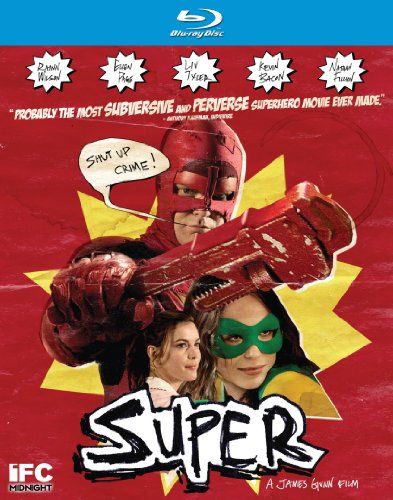
CAPSULE: SUPER (2010)

366 Weird Movies may earn commissions from purchases made through product links.

DIRECTED BY:

FEATURING: , Ellen Page, , Liv Tyler, Nathan Fillion

PLOT: A schlub of a fry cook (Wilson) takes drastic action after his wife (Tyler) leaves him for her drug dealer (Bacon), deciding to become a superhero called “The Crimson Bolt” to win her back. Teaming up with a lively comic store clerk (Page), he experiences the pain and very real violence that isn’t detailed in the comic books he reads.

WHY IT WON’T MAKE THE LIST: It’s yet another “regular guy becomes a superhero” story, equally mixing dark humor and gritty drama while throwing in some comic book action segments. It stands out for its more realistic portrayal of the premise and unexpectedly unsettling moments, but never exceeds “offbeat” on the Weird-o-meter.

COMMENTS: At its core, Super offers nothing new. After a life-changing event, a “normal” loser realizes how easily he can dress up in a funny costume and run around at night surprising “bad guys” with a blunt weapon. Wearing a mask and taking out his frustration with his own bad luck in life makes him feel powerful and gives him a new perspective, etc, but he also learns that being a fake superhero has real-life consequences. It’s only the bleakly comic tone set against hyper-realistic violence that makes the film stand out from an over-slicked, stylized effort like Kick-Ass.

Attempting to balance kooky jokes and drug-fueled shootouts, writer/director James Gunn capriciously changes moods from scene to scene. One moment Rainn Wilson is delivering delightfully deadpan narration, and the next he’s unleashing a crazed fury indicative of a truly unsettled mind.  One moment Ellen Page is excitedly extolling the fun of superhero-dom, and the next she’s purposefully crushing someone’s legs with a car.  Kevin Bacon cracks wise over a strange breakfast of scrambled eggs, and later encourages his seriously drugged-up girlfriend to give herself over to a horny drug lord.  There is a constant tugging at the audience’s emotions and affections, and honestly, my nerves.  I was more often uncomfortable or just turned off by the proceedings, especially when the unnecessary religious angle was added followed by a stupid attempt to give Page and Wilson a romance.

I’d be lying if I said I didn’t find Super very funny at times, primarily a result of the talented cast.  Wilson has his share of cute, quirky moments, while Nathan Fillion’s all-too-short appearance as a Christian TV superhero is gleefully hammy. Bacon impressed me with an unexpectedly entertaining performance. It’s really Page who stands out though, infusing comic nerd Libby (aka “Boltie”) with as much bubbly enthusiasm as she does unhinged sadism.  Boltie’s more outspoken and petty than the Crimson Bolt, and just as easily incited to violence, serving as whatever the opposite of a “conscience” would be.

Super never finds its footing, resulting in an uneven attempt at a realistic superhero movie, though I’m sure Gunn was aiming for a unique and more in-depth exploration of the concept. It’s primarily a comedy, but the heavy doses of drugs, violence, and relationship drama make for a confusing watch.  Some of the action sequences are exciting, but more often than not they feel out of place.  It’s watchable for the cast (especially the ever-likable Page), but doesn’t excel in any other area, except perhaps for a very cool animated opening credits sequence.

WHAT THE CRITICS SAY:

“In the end, this diffuse and off-balance film—one that weirdly combines cardboard characters and emotional urgency, high conceptualism and visceral rawness—does come together, albeit in a strange, and strangely fitting, way.”—Nathan Heller, Slate.com (contemporaneous)

Super [Blu-ray]

  • Factory sealed DVD

List Price : 29.98 $

Offer: 18.8 $

Go to Amazon

GUEST REVIEW: ALICE IN WONDERLAND (1933)

366 Weird Movies may earn commissions from purchases made through product links.

Guest review by Scott Sentinella, a freelance writer whose work has appeared in “The Carson News”, “The Gardena Valley News”, “Animato”, “Videomania Newspaper”, “Cashiers du Cinemart”, Dugpa.com and ALivingDog.com.

DIRECTOR: Norman Z. McLeod

FEATURING: Charlotte Henry, , , , Mae Marsh, , Alison Skipworth, Charlie Ruggles, Edward Everett Horton, , and many others.

PLOT: A teenage girl named Alice travels through a mirror into a nonsensical fantasy world where animals talk, mad tea parties are held, and queens threaten beheadings.

Still from Alice in Wonderland (1933)

WHY IT MIGHT MAKE THE LIST: Because of the source material, and because of this version’s especially creepy use of bizarre, grotesque masks on many members of its all-star cast.

COMMENTS: Before Tim Burton’s 2010 Alice in Wonderland, every big-screen adaptation of Lewis Carroll’s classic book had flopped at the box office, and this early 1930’s curio was no exception. Directed by Norman Z. McLeod (known for the Marx Brothers’ Monkey Business and Horse Feathers), and with a screenplay by Joseph L, Mankiewicz (All About Eve) and William Cameron Menzies (better known as the art director on Gone With the Wind), this primitive-looking extravaganza rounded up some 22 stars from the Paramount lot and immediately hid most of them behind very unpleasant-looking masks and bulky costumes. This Alice was made only five-and-a-half years before The Wizard of Oz, but some of the technology on display here looks like it was left over from the Victorian era. (Incidentally, Alice’s then-starry cast now consists of three legends—Cooper, Fields, Grant; a lot of character actors familiar to viewers of Turner Classic Movies—Horton, Holloway, Ruggles; and then a host of performers unknown to even the most die-hard classic film buffs—-Jackie Searle? Raymond Hatton?) The results are a bit too disturbing, even for Lewis Carroll, but at least it captures the madness of the novel(s) in a way that Burton’s neutered, watered-down disappointment never does.

Like most films based on Alice, this one liberally combines elements of both “Alice’s Adventures in Wonderland” and “Through the Looking Glass.” This time, Alice (Babes in Toyland’s Charlotte Henry) first finds her way through a mirror and then tumbles down a rabbit hole, where she meets the usual Continue reading GUEST REVIEW: ALICE IN WONDERLAND (1933) →

Celebrating the cinematically surreal, bizarre, cult, oddball, fantastique, strange, psychedelic, and the just plain WEIRD!