Category Archives: Canonically Weird (The List)

90. BLACK SWAN (2010)

“It’s a Polanski movie, and then it becomes a Dario Argento movie. And maybe a little bit of David Cronenberg too.”–Vincent Cassell

Must See

DIRECTED BY: Darren Aronofsky

FEATURING: Natalie Portman, Mila Kunis, , Barbara Hershey, Winona Ryder

PLOT: Nina, a goody two-shoes ballerina, wants to dance the lead role in a production of “Swan Lake,” but although she’s perfect for the role of the White Swan, she lacks the seductiveness to portray the Black Swan. Lily, a sexy, irresponsible dancer newly arrived from a San Francisco troupe, becomes her primary competition for the part, but also helps her loosen up by talking her out on the town for a night of drinking and meeting guys. Nina starts physically break down and hallucinate as the stress of preparing for the role takes its toll; by opening night, she can’t distinguish reality from the story she dances of the princess trapped in the body of a swan who takes her own life.

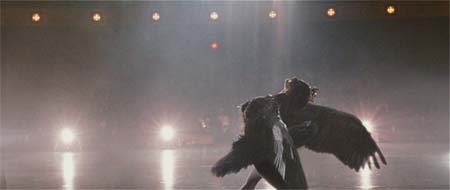
Still from Black Swan (2010)

BACKGROUND:

  • Natalie Portman danced many of her own parts, and actually dislocated a rib while dancing during the shoot. More difficult moves were performed by professional ballerinas, and for two sequences Portman’s face was digitally superimposed on dancer Sarah Lane’s body. There was a minor controversy over how much of the dancing Portman actually did herself and how much was performed by doubles; Aronofsky estimated that the actress executed more than 80% of the dance moves that appear onscreen.
  • Portman won the 2010 Best Actress Oscar for her role as Nina. The film was also nominated for Best Picture, Director, Cinematography and Editing.
  • Aronofsky received “The Understudy,” the original script that became Black Swan, while he was making Requiem for a Dream (2000). He described the script as Dostoevsky’s “The Double” meets All About Eve. Aronofsky combined that script, which was set in an off-Broadway production, with an idea he had to shoot a movie in the New York ballet world to create Black Swan.
  • Aronofsky and Portman had discussed doing a ballet movie together 8 years prior to shooting.
  • Made on a relatively small budget of about $12 million, Black Swan has grossed more than $300 million worldwide as of this writing.

INDELIBLE IMAGE: Nina’s “triumphant” onstage transformation into the Black Swan: as she pirouettes, feathers sprout from her arms, thickening with every swirl, until her limbs have been replaced by wings.

WHAT MAKES IT WEIRD:  Up until opening night, Black Swan is a backstage melodrama about backstabbing ballerinas, with an exaggerated, lurid psychopathology that’s thrust even further over-the-top by lesbian love scenes, hints of horror, and mirrors, mirrors, mirrors.  When the curtain rises on the big night, we experience the performance through the subjective perspective of an overworked, paranoid, demented dancer, whose psychology has been shattered by the film’s sledgehammer symbolism.  No avant-grade choreographer could stage as disorienting a “Swan Lake” as the one she hallucinates for us through her obsessed eyes.

Promotional Music Video for Black Swan

COMMENTS: Black Swan is the weirdest movie ever to win a major Academy Award (Natalie Continue reading 90. BLACK SWAN (2010)

89. FINAL FLESH (2009)

“I don’t know if I really like this movie, it’s just kind of weird. It’s worth checking out; it’s weird. Something to talk about. So, if you like really, really weird stuff, check out Final Flesh, it’s really weird.”–YouTube reviewer

Weirdest!

DIRECTED BY: Written by Vernon Chatman, directed by “Ike Sanders” and three other uncredited directors

FEATURING: Twelve amateur porn stars

PLOT: After a prologue explains that the atom bomb is about to drop, we’re shown a family of three (mother, father and adult daughter) sitting around a kitchen table, deciding that they will stay and “die with dignity.” The mother and daughter give birth to various food items and the father tires to climb back into the womb, and then daughter relates a dream. We see a mushroom cloud, then another trio of actors in a different apartment who believe they are in the afterlife: they recite more humorous nonsense about God, death and the apocalypse and enact more bizarre skits before the action shifts to another trio in a different room, then another…

Still from Final Flesh (2009)

BACKGROUND:

  • Vernon Chatman made Final Flesh by submitting scripts to four different amateur porn production companies that specialize in acting out their client’s fantasies. The scripts were submitted between 2002 and 2009, so the film was actually 7 years in the making.
  • Chatman is a stand-up comic and Emmy-winning television writer. He wrote for “Late Night with Conan O’Brien,” and “The Chris Rock Show” before co-creating the short-lived, weird cult TV series “Wonder Showzen” and “Xavier: Renegade Angel.” He’s most famous for his work with “South Park,” where he provides the voice of “Towelie,” the pot-smoking towel.
  • Chatman is a member of the Brooklyn-based art collective PFFR, who produce music, art, and short films. The first segment of Final Flesh was made as a short film for a PFFR art show, and although the final project was Chatman’s work alone, it was still released under the PFFR umbrella.
  • Final Flesh is distributed by Drag City, an independent music label that has only recently branched out into underground film (and may have given up that side-business already). Drag City’s other 2009 movie release, Trash Humpers, hogged the company’s headlines when it became a minor cause célèbre after Netflix refused to stock it.  Final Flesh received relatively little promotion, despite the fact that Netflix declined to carry it, as well.

INDELIBLE IMAGE: For Final Flesh, we’re going to break with tradition and provide four different “indelible images,” one from each segment of the film. A girl breastfeeds a porterhouse steak; a woman in a jeans, a tank-top and a skull mask threatens a man on his deathbed; a couple make out by mashing the skulls drawn on their backs together; a young lady in black lingerie performs a wedding ceremony on two corpses lying side by side.

WHAT MAKES IT WEIRD: The conceptual art premise of sending a non-erotic script to be acted out by pornstars-for-hire might be weird enough, but when that apocalyptic screenplay requires the bemused amateur actors to bathe in the tears of neglected children and recite lines like “I just creamed my demon” after being slapped, we’ve traveled beyond the snarkily experimental into the realm of the existentially deranged. All the world’s a stage and these men and women play many parts; if some of those roles require them to pour ketchup in a conch shell and poke at it with a turkey baster while moaning orgasmically, then maybe that’s just how this universe rolls.


Short clip from Final Flesh

COMMENTS: In porn, when a woman wiggles and says “oh my God, there’s something going Continue reading 89. FINAL FLESH (2009)

88. THE PILLOW BOOK (1996)

366 Weird Movies may earn commissions from purchases made through product links.

“I am certain that there are two things in life which are dependable: the delights of the flesh, and the delights of literature. I have had the good fortune to enjoy them both equally.”–Sei Shōnagon, “The Pillow Book,” Section 172.

DIRECTED BY: Peter Greenaway

FEATURING: , Ewan McGregor, Yoshi Oida

PLOT: Every birthday, Nagiko’s father draws calligraphic figures on her face while ritualistically reciting the story of creation. Nagiko grows into a beautiful young fashion model obsessed with the intersection of calligraphy and sex, seeking lovers who will use her naked body as a canvas on which to write. She meets and falls in love with a bisexual British translator who convinces her to write on others’ bodies, and together they conspire for revenge against the publisher who wronged her father.

Still from The Pillow Book (1996)

BACKGROUND:

  • The “Pillow Book” from which the movie takes its title is “The Pillow Book of Sei Shōnagon,” the diaristic collection of anecdotes, observations, poetry and lists by a lady-in-waiting to Empress Sadako of Japan in the Heian era (the book was composed around 1000 AD). Shōnagon’s work, though probably never intended for others’ eyes, became one of the classics of Japanese literature and a tremendous source of historical data about the Japanese imperial court. Greenaway was inspired by “The Pillow Book,” but the film is not an adaptation of Shōnagon.  In an interview he explains: “I took some of [the book’s] sensitivities, primarily where Sei Shōnagon said, ‘Wouldn’t the world be desperately impoverished if we didn’t have literature and we didn’t acknowledge our own physicality?’ And the movie’s just about that.”
  • Occasionally, the spoken Japanese dialogue is not translated into subtitles. This is deliberate.
  • Venerable cinematographer Sacha Vierny had shot Greenaway’s previous six feature films and had previously worked with Resnais (Hiroshima Mon Amour, Last Year at Marienbad), Buñuel (Belle de Jour) and Raoul Ruiz (The Hypothesis of the Stolen Painting, Three Crowns of the Sailor), among other notable (and weird) directors.

INDELIBLE IMAGE: There are a bewildering number of nominees to choose from, especially since Greenaway frequently places two or three images on the screen at once, picture-in-picture style. The overwhelming repeated image is that of writing inked on nude bodies, however, and so the shot of glowing letters cast on Vivian Wu’s darkened, reclining body as she writes in her diary in bed best captures The Pillow Book‘s visual fetish.

WHAT MAKES IT WEIRD: The Pillow Book is a movie about a fetishistic, eccentric, obsessed character, brought to us by an auteur with firsthand knowledge of those qualities. Greenaway splashes the screen with visual extravagances, with pictures framed inside of other pictures, and images layered on top of one another, melding one into the next. Full of obscure musings about the nature of art and sex, The Pillow Book tells a story of lust and revenge, but subjugates the text to the image, the narrative to the cinematic. The result is visually hypnotic, frequently frustrating, and all Greenaway.

Trailer for The Pillow Book


COMMENTS: A man and woman make love. The entwining limbs are spectral, as their Continue reading 88. THE PILLOW BOOK (1996)

87. MAELSTROM (2000)

“Maelstrom, from my humble point of view, was inspired as follows: we all have an amazing built-in system of personal and social defense: we interpret the world and construct for ourselves an image of it, which comforts us and eases our conscience, and we do this instinctively.  For me, Maelstrom is a playful call to be responsible and to be careful.  Some of my friends found this definition childish and tried to convince me that Maelstrom was, instead, a dark and serious drama about a woman emerging from chaos and mythomania.  Others consider it a luminous noir fable of a voyage to the limits of reality and myth.  That’s ridiculous.  Don’t believe a word they say.”–Denis Villeneuve, Director’s Note to Maelstrom

DIRECTED BY: Denis Villeneuve

FEATURING: Marie-Josée Croze, Jean-Nicolas Verreault, Pierre Lebeau (voice)

PLOT: A fish about to be chopped up and made into seafood explains that, with his last breaths, he would like to tell a “pretty story” about a young woman “on a long voyage toward reality.”  We then meet Bibi, undergoing an abortion; later that day, she will lose her position in the family business, then leave the scene of the accident after striking a pedestrian while driving drunk.  In the guilt-ridden weeks that follow, she tracks down the man she struck to find out who he was and what happened to him.

Still from Maelstrom (2000)

BACKGROUND:

  • Maelstrom swept the 2001 Genies (the Canadian equivalent of the Academy Awards), winning the Best Picture, Director, Lead Actress, Screenplay, and Cinematography awards.  Other than film festival appearances, the movie received little distribution outside of Canada. A DVD was released in 2003 with little fanfare, and Maelstrom has been largely forgotten since.
  • Set in Montreal, Maelstrom was filmed in French, but a small portion of the dialogue is in untranslated Norwegian, as is the opening epigraph.
  • Maelstrom was included in film critic Richard Crouse’s book “The 100 Best Movies You’ve Never Seen” (coincidentally, this makes the eighth of the titles Crouse chose that we’ve independently reviewed).
  • In 2010 Denis Villeneuve scored an international arthouse hit with the (not weird) Incendies, a story about twins traveling to the Middle East to uncover a family secret, which was nominated for a Best Foreign Language Film Oscar.

INDELIBLE IMAGE:  The grotesque, philosophical fish who croaks out the tale between gasps while waiting for the fishmonger (sharpening his blade on a stone and looking like an executioner) to finish him off.

WHAT MAKES IT WEIRD:  The story is narrated by a dying fish.  If you need more than that, there’s the confusing, impressionistic, nonlinear timeline (that replays certain scenes); some incredible plot and thematic coincidences; and the stylishly stoned scenes of Bibi drowning her woes in booze and pills. But I keep coming back to the fact that the story is narrated by a (surprisingly reflective) dying fish. Talk about cod philosophy!


Trailer for Maesltrom

COMMENTS: “You’ll get nightmares from eating stale octopus,” Bibi’s friend warns her Continue reading 87. MAELSTROM (2000)

86. DEAD MAN (1995)

“Do what you will this life’s a fiction,
And is made up of contradiction.”

–William Blake, Gnomic Verses

Recommended

DIRECTED BY: Jim Jarmusch

FEATURING: Johnny Depp, , Lance Henriksen, Michael Wincott, , , Iggy Pop, Billy Bob Thornton, Mili Avatal, Gabriel Byrne

PLOT: Mild-mannered accountant Bill Blake heads west to take a job in the wild town of Machine, but when he arrives he discovers the position has been filled and he is stuck on the frontier with no money or prospects. Blake becomes a wanted man after he kills the son of the town tycoon in self defense. Wounded, he flees to the wilderness where he’s befriended by an Indian named Nobody, who believes he is the poet William Blake.

Still from Dead Man (1995)

BACKGROUND:

  • William Blake, the namesake of Johnny Depp’s character in Dead Man, was a poet, painter and mystic who lived from 1757 to 1827. Best known for Songs of Innocence and Songs of Experience, he is considered one of the forerunners of English Romanticism.
  • Jarmusch wrote the script with Depp and Farmer in mind for the leads.
  • Elements of the finished script of Dead Man reportedly bear a striking similarity to “Zebulon,” an unpublished screenplay by novelist/screenwriter Rudy (Glen and Randa, Two-Lane Blacktop) Wurlitzer, which Jarmusch had read and discussed filming with the author. Wurlitzer later reworked the script into the novel The Drop Edge of Yonder.
  • Film critic Jonathan Rosenbaum coined the term “acid Western”—a category in which he also included The Shooting, Greaser’s Palace and El Topo—to describe Dead Man. Jarmusch himself called the film a “psychedelic Western.”
  • composed the harsh, starkly beautiful soundtrack by improvising on electric guitar while watching the final cut of the film. The Dead Man soundtrack (buy) includes seven solo guitar tracks from Young, plus film dialogue and clips of Depp reciting William Blake’s poetry.
  • Farmer speaks three Native American languages in the film: Blackfoot, Cree, and Makah (which he learned to speak phonetically). None of the indigenous dialogue is subtitled.
  • Jarmusch, who retains all the rights to his films, refused to make cuts to Dead Man requested by distributor Miramax; the director believed that the film was dumped on the market without sufficient promotion because of his reluctance to play along with the studio.

INDELIBLE IMAGE: Nobody peering through William Blake’s skin to his bare skull during his peyote session? Iggy Pop in a prairie dress? Those are memorable moments, but in a movie inspired by poetry, it’s the scene of wounded William Blake, his face red with warpaint, curling up on the forest floor with a dead deer that’s the most poetically haunting.

WHAT MAKES IT WEIRD: Dead Man is a lyrical and hypnotic film, with a subtle but potent and lingering weirdness that the viewer must tease out.  It’s possible to view the movie merely as a directionless, quirky indie Western; but that would be to miss out on the mystical, dreamlike tinge of this journey into death.


Original trailer for Dead Man

COMMENTS: Dead Man begins on a locomotive as a naif accountant is traveling from Continue reading 86. DEAD MAN (1995)