Category Archives: Capsules

CAPSULE: GUTBOY: A BADTIME STORY (2017)

366 Weird Movies may earn commissions from purchases made through product links.

Weirdest!

DIRECTED BY: Nick Grant

FEATURING: David Homyk, MaryBeth Schroeder, voices of Will Cooper, Nick Reed, Misty Foster, Megan Rosen, Anthony Herrera

PLOT: Goot is tricked into selling his skin to Besto, and seeks revenge with the help of a similarly skinless “mermaid.”

Still from Gutboy: a Badtime Story (2017)

COMMENTS: Gutboy is a strange little creature, and the star of a strange little movie that occupies an odd niche on this site’s recommendation spectrum. The movie is slight and casual and doesn’t feel weighty or significant enough to challenge for a spot on our list of the weirdest films ever; and yet, it’s so darn weird that nearly every serious reader of this site will find something to enjoy in it. The “” tag affixed here is, therefore, an attempt to bring attention to this worthy amateur effort, while acknowledging that it doesn’t fit alongside some of the more serious or professional titles honored here.

Not that the movie doesn’t actually earn that “weirdest!” designation. (In fact, some argue that it works too hard for it.) Framed as a story told by an emcee to a sick boy who’s wheeled out before an audience of insects, the plot involves a fisherman tricked into selling his skin, who then immediately hooks a “mermaid” (a similarly skinless woman given to lines like “you learn a lot of things on the ocean floor… like how to please a man”) who tires to seduce him, and also grants him a wish. Gutboy doesn’t think to ask for his skin back, but instead asks to marry the policeman’s daughter. And the story just keeps getting odder when skin-merchant Besto breaks out his giants (portrayed by a well-toned couple of real live humans spray-painted gold) to wrestle for his amusement. Oh yes, and there are also musical numbers, ranging from show tunes to rockabilly and lo-fi punk and pop.

So yeah, it’s pretty strange. The marionettes are appropriately crude and grotesque: Gutboy and his paramour (who, after a brain-swapping mishap, becomes known as “Sophieguts Prettybutts”) look genuinely bloody, and for some reason have exposed brains. The other puppets are all quite ugly, too, bulbous and vaguely resembling antique Eastern European dolls, with sunken wooden eyes covered in black mold. The puppeteering is not particularly accomplished, but it doesn’t matter, given the project’s insouciant attitude. Any movie in which a wooden hooker on strings sings the line “porking me ain’t easy, and diddling me ain’t fun” isn’t aiming for much beyond cheap amusement.

The kitchen sink approach often turns a would-be weird movie into a unwatchable mess, but here it works to Gutboy‘s advantage, with each new quirk catching your attention, but not completely derailing the loose worldbuilding efforts. The movie is also helped immensely by its economical runtime: take out the four-minute introduction and the ten-minute post-credits “Titus Andronicus”-themed bonus short, and it runs just under an hour. Any longer, and it might have started to try your patience.

It might not surprise you to learn that Gutboy was a crowdfunded project. It played well enough in limited screenings that picked it up for distribution. It can now be seen free on Amazon Prime for subscribers.

WHAT THE CRITICS SAY:
“…a triplike piece of weirdness that defies all sorts of logic – and that’s exactly why it works so well…”–Mike Haberfelner, (re) Search My Trash

CAPSULE: THE WIZARD OF SPEED AND TIME (1988)

DIRECTED BY: Mike Jittlov

FEATURING: Mike Jittlov, Richard Kaye, Paige Moore

PLOT: Aspiring filmmaker Mike Jittlov makes a wondrous, delightful short film that catches the eye of Hollywood producers; they enlist him to make a feature containing the same formula of special effects magic and raucous whimsy, but sinister forces conspire to prevent Jittlov from realizing his dream.

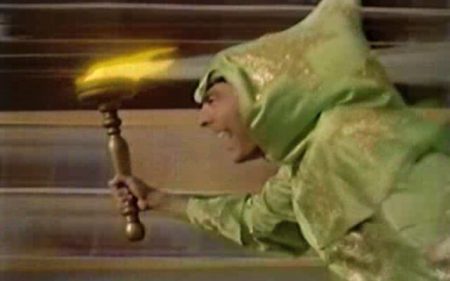
Still from Wizard of Speed and Time

COMMENTS: Moviemaking is a cutthroat business, you know. Maybe you got a hint of that from a film like The Player. Or possibly  Barton Fink. Could have been The Big Picture. Or perhaps State and Main. Come to think of it, it might’ve been Living in Oblivion. Or Bowfinger or Hollywood Shuffle or My Life’s In Turnaround or In the Soup or …And God Spoke or any number of films where Hollywood takes a look in the mirror to catch a glimpse of the laborious and fraught process of trying to get a movie made. When filmmakers are instructed to write what they know, there are plenty who do exactly that.

Well, you can add Jittlov’s sole feature to that list, with the twist that what he knows is how to make lively low-budget special effects. In 1979, he created a short film exploiting his editing and stop-motion photography skills. As these things often do, the short became Jittlov’s calling card, a golden ticket into the world of Hollywood filmmaking. That turns out to be the starting point for this feature-length exploration of his journey into the heart of the moviemaking beast. And when it comes to “writing what you know,” Jittlow keeps his focus squarely on what he’s good at: special effects. The result is… almost exactly what you’d expect.

On the one hand, anyone who manages to assemble a feature film, particularly without the aid of a well-heeled studio, has undertaken a major achievement. On the other hand, Jittlov’s production is laden with the self-awareness of this achievement, and practically demands to be recognized for its own bravery and pluckiness. To call it self-indulgent is a ground-shaking level of understatement. Self-indulgence is the point; the message seems to be, “Everybody deserves a piece of this genius.”

For a zany comedy, The Wizard of Speed and Time is notably angry. One subplot of the film is Jittlov’s ongoing battle against moviemaking’s gatekeepers. Studio indifference, greedy vendors, apathetic accountants, zealous cops, guild oppressiveness (boy howdy, does this movie hate unions), gawking tourists, and general grownup shallowness are just a few of the forces lined up against the filmmaker’s pure and simple goal to make jolly little movies. Atlas Shrugged wishes its heroes and villains were drawn as starkly as this.

So this movie stands as Jittlov’s demonstration of what the Magic Store could be like if there wasn’t so much red tape and cynicism in the business. That being the case, let’s hear it for the bad guys, because The Wizard of Space and Time is exhausting. Determined to pile on the charm, it never lets up. Every jokey moment is slammed up against another jokey moment, with irony-laden captions, a music score taken directly from a theme park, undercranked footage, goofy sound effects, and so much post-production audio looping to guide you along the way. It’s so breathlessly insistent, it makes Airplane! look like a film.

The Wizard of Speed and Time is undeniably weird (or, as the movie itself jokes, “WHOLLY ODD”), but it’s so invested in its zany iconoclasm that it’s impossible to enjoy on any terms if you’re not Mike Jittlov. The climax of the film features a complete re-creation of the original short. This is a smart move; it reminds the audience that there is something genuinely charming here. What Jittlov does with little money and a whole lot of imagination is quite remarkable. And probably best appreciated in a small dose.

WHAT THE CRITICS SAY:

“Created by cult animator and weirdo Mike Jittlov, this 1988 hella-low-budget film follows a talented but jobless special effects wizard as he navigates Hollywood… Jittlov’s enthusiastic DIY production earned a generation of cult fans, who allege he slipped over 1000 subliminal messages into the film. Spooky.”–Chase Burns, The Stranger

(This movie was nominated for review by Marko. Suggest a weird movie of your own here.)

ONLINE FILM CRITICS SOCIETY 25TH ANNUAL AWARDS (WITH OUR VOTES)

The Online Film Critics Society awards for 2021 are out. Two weird films did reasonably well in the nominations this year: The Green Knight and Titane each received multiple nominations, including for Best Picture, although neither won. Although hurt by its distribution strategy, Memoria nevertheless won a special technical award for Sound Design.

As always, despite the occasional levity in my tone, I take my voting responsibility seriously. I do not put forward weird films at the expense of worthier mainstream candidates just because it’s “my thing.” Here is the list of this year’s winners, along with my choices and a touch of personal commentary for the major categories.

BEST PICTURE

The Power of the Dog Winner: The Power of the Dog

Also nominated (listed in ranked order of final votes): Drive My Car, Licorice Pizza, Dune, The Green Knight, Pig, The Worst Person in the World, Titane, West Side Story, Belfast

My pick: The Green Knight

Comments: Jane Campion’s semi-Western drama led the field with nine nominations, and was a kind of consensus pick: it was not clearly artistically miles ahead of the other contenders in a strong year, but it likely was the most widely seen (via Netflix) and had the fewest negatives attached. It was nothing too fancy or chancy, but above average in every respect, from technical aspects to screenplay to acting. I thought The Green Knight did surprisingly well in the voting considering its many negatives: it was released in July and not fresh on anyone’s mind, it was almost a genre picture (though with a literary pedigree and an art-house sensibility), and it had moments of alienating weirdness (talking foxes, random processions of giants). In this case, just being nominated was, indeed, a victory.

BEST ANIMATED FEATURE

Winner: The Mitchells vs. the Machines

Also nominated: Encanto, Flee, Luca, Raya and the Last Dragon

My pick: The Mitchells vs. the Machines

Comments: This movie for the YouTube/Snapchat generation has it all: family drama, a cross-eyed dog, contemporary technological satire, robot-fighting action, a giant demonic Furby, subtle references to other movies, and multiple cat filters. A Sony Pictures Animation film that got shelved due to Covid—before getting snapped up by Netflix—beating out two Disney offerings: it feels like a major upset.

BEST DIRECTOR

Winner: Jane Campion, The Power of the Dog

Also nominated: , Licorice Pizza; Ryusuke Hamaguchi, Drive My Car; Steven Spielberg, West Side Story; , Dune

Continue reading ONLINE FILM CRITICS SOCIETY 25TH ANNUAL AWARDS (WITH OUR VOTES) →

CAPSULE: HANGER (2009)

366 Weird Movies may earn commissions from purchases made through product links.

Beware

DIRECTED BY: Ryan Nicholson

FEATURING: Dan Ellis, Nathan Dashwood, Wade Gibb, Ronald Patrick Thompson, , Candice Lewald (as Candice Le), Alastair Gamble

PLOT: A deformed 18-year old who survived a coat hanger abortion teams up with a vigilante to hunt down the pimp who killed his hooker mom.

Still from Hanger (2009)

COMMENTS: Tastelessness is one of the very few weapons low-budget filmmakers have in their arsenal that their big-budget counterparts can’t match. That is, at least, an explanation for Ryan Nicholson’s Hanger, if not an excuse. There is not much a movie with this kind of budget and shooting schedule can do to set itself apart from the pack of cheap VOD horrors—which themselves have to compete for scarce viewing eyes against the huge glut of what most audiences consider “real movies”—except to try to show you what Hollywood doesn’t dare.

In simpler times, exploitation films could survive on nudity, sex and violence, but since the big studios now dominate these niches, too, the scum at the bottom of the entertainment bucket are nudged instead towards the scatological, the pornographic, and the nihilistic. Hanger exists as a string of shock scenes hung on a dull and talky narrative that leads nowhere. We get a graphic (if incredibly fake-looking) coat hanger abortion; penis grilling; grotesque prosthetic putty slathered on nearly every character; prostitutes murdered with car doors; misogyny and homophobia; yellowface and Asian stereotyping; fart torture; the N-word; an explicit female masturbation scene; a stoma rape with chocolate pudding prop; tampon tea; bad gore effects, bad sound, and bad attempts at comedy. And, because talk is cheap, lots of talking.

Half-assed is the aesthetic choice here. Like its title character, Hanger is an ugly, angry outsider, fated to be a loser and pissed off about it. Unlike its title character (but like its comic relief character), it believes itself to be funny. I think. I didn’t laugh once, but it does appear that parts were intended to be humorous: specifically, scenes of the intensely annoying Wade Gibb, in a prosthetic mask narrowing his eyes to slits, talking in a high-pitched sing-songy “Chinaman” squeal straight out of a WWII-era propaganda film about how he loves tampons and other unfunny topics that are difficult to discern due to a combination of fake buck teeth, a badly crafted accent, and abysmal sound. These scenes double as painful comic relief and interminable padding. The movie’s highlight is Lloyd Kaufman’s appearance as a “tranny” prostitute who gets his penis burned off; Lloyd flew in, learned his lines when he arrived, shot his scene, and (wisely) got the hell out of there. If you’re unfortunate enough to see Hanger, you’ll spend more time watching it than Kaufman spent filming it.

The DVD and (2 disc!) Blu-ray are filled with an unusually high number of extras. Kaufman’s 11-minute behind-the-scenes home video is more entertaining than the entirety of the feature.

WHAT THE CRITICS SAY:

“If you like this sort of stuff, have a good sense of humor, a strong stomach, and a pad on your floor, (you’ll need it for the number of times your jaw drops) you’ll come away from this singular experience with a new red badge of courage.”–Kurt Dahlke, DVD Talk (DVD)

(This movie was nominated for review by jef t-scale, who advised “think street trash but more trash and more weird.” Suggest a weird movie of your own here.)

CAPSULE: KAFKA (1991)

366 Weird Movies may earn commissions from purchases made through product links.

DIRECTED BY: Steven Soderbergh

FEATURING: Jeremy Irons, , Ian Holm, Joel Grey, Brian Glover

PLOT: Franz Kafka is a mid-level functionary at an accident insurance firm whose minor involvement with a group of revolutionaries leads to an unsettling discovery.

Still from Kafka (1991)

COMMENTS: Franz Kafka doesn’t deal in protagonists, technically. The term “Kafkaesque” suggests a main character who moves the action forward. Kafka’s oeuvre is populated almost solely by entities—from men to cockroaches—who shuffle through their environments without adequate comprehension, and without any ability to alter their fate. Gregor Samsa in “The Metamorphosis” wiggles back and forth literally on his bed at the start of the tale, then squirms metaphorically as he tries to maneuver through his new circumstances; Josef K. in The Trial (the better translation is “The Process“) proceeds from start to finish never learning anything substantial about the nature of his charges. Franz Kafka in Kafka starts out as a mid-level insurance functionary and finishes one pay-grade above where he began. The intervening narrative never quite rises above an elaborate shaggy dog story.[efn_note]In 2021, an ostensibly different, and certainly revamped, version from Soderbergh (titled Mr Kneff) poked its head up at the Toronto International Film Festival. This item has not presented itself as “easy to find,” but with Kafka, of course, nothing is ever easy.[/efn_note]

In this way, Sorederbergh’s Kafka is like its literary inspiration. Beautiful Prague, in beautiful black and white, is a maze of courtyards and corridors. Kafka himself (deftly played by Jeremy Irons) is merely a face in the crowd, albeit striking in his bland way. Kafka’s work chum, Edward, goes missing, is found dead—suicide, suggests an incongruously-accented police detective, one of the film’s only smiling characters—and Kafka makes the acquaintance of some revolutionaries. Ominous rumors abound concerning “the Castle,” seemingly the seat of government, at the very least the seat of bureaucracy. The ostensible doings of the mysterious administrators situated there vex this gaggle of bomb-crafting anarchists.

Kafka succeeds in capturing omnipresent but ill-defined menace, while simultaneously eliciting a shrug both on the part of the audience and the main character. Soderbergh does his best, though, and the whole semi-nightmare feels stylish and important as it briskly shuffles along as if carrying a very important missive for middle-management.

The film’s climax is strange, but it is more thought-provoking than anything else. Kafka travels to “the Castle” by way of a passageway in a false-bottomed tomb, and the film switches from black and white to color. This suggests at least three intriguing interpretative possibilities. Is Kafka (the character) seeing the world as it truly is for the first time? Or is the whole (comparatively) dazzling sequence merely a fantastic dream on the part of the hero?

My preferred view is the most abstract. At the end of the graveyard entrance is a file storage room. The hero emerges from one of its drawers. Is he—and by extension, the viewer—merely an archived history of a failed experiment?

WHAT THE CRITICS SAY:

“Clearly borrowing from the bravado visual style of Orson Welles’ breath-taking version of Kafka’s The Trial (1962), Kafka is a less intense, more entertaining affair than the former film. Kafka‘s surreal yet strangely familiar fictional worlds have been given a dash of Frankenstein by [screenwriter] Dobbs, which makes for a more immediately enjoyable experience but somewhat diminishes the power of the calculated atmosphere expertly borrowed by Soderbergh from Kafka’s prose.”–Niall McCallum, Eye for Film

(This movie was nominated for review by Brad. Suggest a weird movie of your own here.)