Category Archives: List Candidates

LIST CANDIDATE: ONE POINT O (2004)

AKA Paranoia 1.0 (DVD)

DIRECTED BY: Jeff Renfroe, Marteinn Thorsson

FEATURING: , , , Eugene Byrd,

PLOT: Computer programmer Simon J develops crippling paranoia, and a craving for branded milk, when he begins receiving a series of empty packages at his apartment.

Still from One Point O (2004)

WHY IT MIGHT MAKE THE LIST: Telling the classic tale of corporate-owned dystopia through a low-budget lens mixing Kafka and noir, the film creates a uniquely arthouse-ian mashup out of familiar tropes.

COMMENTS: Jeff Renfroe (no connection, thankfully, to the trucker from that exploitation shock-fest The Bunny Game) is a director whose name is not likely to be widely recognized, but who, as the cutthroat movie industry goes, hasn’t done too badly for himself. Certainly, he’s been chiefly restricted to TV episodes, but they’re decent gigs: “Killjoys,” “Helix,” “Dominion,” and various other shows that, while crowd-pleasing in that way that modern television is obligated to be, are far from the worst that the medium has to offer.

Point is, I like to console myself about the negligible notice that Renfroe’s directorial debut got by telling myself that, judging by the path his career took, he must have at least impressed somebody relatively high up.

Paranoia 1.0—or One Point O, as it was called at its Sundance premier—follows Simon J, an isolated computer programmer struggling to meet his latest deadline. When a succession of empty packages begin mysteriously appearing in his apartment, Simon finds himself overwhelmed by a growing sense of crippling paranoia, and an insatiable craving for Nature Fresh brand milk.

Paranoia 1.0 draws its primary influences from film noir, Kafka, and philosophical science fiction. None of these are genres or styles I’m particularly familiar with; but I know enough to be able to tell that their combination here is a major part of what lends the film its particular atmosphere.

In the tradition of low-budget sci-fi, Paranoia 1.0 takes place in that weird historical limbo that exists only in films: contemporary fashions, computers and coding interfaces exist alongside rotary phones and vaguely Soviet architectural backdrops (the film was shot in Bucharest), while artificial intelligences, nanotechnology and VR games that are advanced even by today’s standards factor heavily into the plot.

There’s a myriad of reasons why one could argue that—in comparison with Hollywood’s tendency to invest in polished, lily-white backdrops that make the world of the future look like a gigantic Apple store—this rugged and piecemeal representation of the future comes across as more genuine. But in this case, the most relevant aspect of it is its timelessness, a timelessness that matches fittingly Continue reading LIST CANDIDATE: ONE POINT O (2004) →
LIST CANDIDATE: THE ORNITHOLOGIST (2016)

O Ornitólogo

366 Weird Movies may earn commissions from purchases made through product links.

DIRECTED BY:

CAST: Paul Hamy, Xelo Cagiao Teijo, Han Wuen, Chan Suan

PLOT: After being swept away by rapids, Fernando, an ornithologist looking for black storks, finds himself in a mysterious forest where he’ll undergo a transformative spiritual journey mirroring the life of Saint Anthony of Padua.

Still from The Ornithologist (2016)

WHY IT SHOULD MAKE THE LIST: The Ornithologist is the allegorical tale of an atheist ornithologist’s conversion through a succession of increasingly bizarre occurrences. Given that these moments vary from slightly odd to truly surreal, the film plays the weirdness card, although the limited number of remaining slots in the List make its inclusion uncertain.

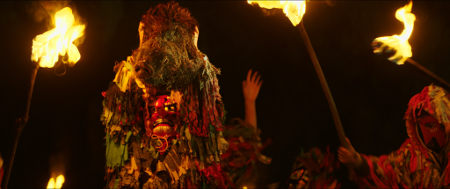
COMMENTS: The first shots of The Ornithologist, after an introductory quote by Saint Anthony, depict a dark, calm river with a bird and plant life, accompanied by the ambient sounds of nature. After the film’s weird notes kick in, the atmosphere remains remarkably the same: quiet and naturalistic, persistently treating the strange sights of Fernando’s mystical journey as perfectly normal. The stunningly shot setting, a Portuguese forest that director João Pedro Rodrigues populates with strange images and figures, also persists for the entirety of the movie (save for the very last, and very weird, scene).

After he crashes his kayak, the titular protagonist is rescued by two female Chinese pilgrims, on their way to Santiago de Compostela, with whom he spends the night. This moment marks the film’s first foray into Fernando’s symbolic journey, as well as a turn to a darker tone. When a menacing sound is heard, the frightened pilgrims assume it’s a demonic entity just as quickly as Fernando casually rebuts their belief, claiming there’s no God or Devil. Shocked by his lack of faith, they oblige him to sleep outside of their tent, and the next morning finds him tied to a tree.

From that point on, the steps on the ornithologist’s conversion grow progressively surreal; some are blatant in their symbolism (such as the appearance of the Holy Spirit as a white dove), others more obscure (naked amazons shooting him with a rifle, only to have a quick chat with him after he revives). Most are blasphemous and/or contain homoerotic undertones. They include Fernando’s baptism in urine (!), sex with a mute shepherd named Jesus (!!!), and the appearance of what appear to be embalmed animals in the woods, among other outrageous stops in his mystical-existential self-discovery arc.

These episodes are consistently engaging and reveal Rodrigues’ fascination with Christian iconography, mysticism and eroticism (a potently heretical mix), as well as his intention to filter universal religious symbols through his personal sensibilities. The “enlightenment quest” narrative will likely remind weirdophiles of ’s El Topo or The Holy Mountain, but the film is stylistically much closer to ’s Uncle Boonmee Who Can Recall His Past Lives. Like that film, The Ornithologist‘s bizarre and phantasmagorical apparitions seamlessly blend in the environment as if they were no less natural than a tree or a bird. Accordingly, our main character remains stoic throughout his adventure. Speaking only when needed (that is, sparsely), his language, like the film’s, is mostly non-verbal. Actor Paul Hamy subtly conveys feelings of confusion and curiosity; interestingly, he has explained in interviews that he likes physical expression, comparing himself to a sculpture that the director shapes in front of the camera. The Ornithologist displays this particularly well, as Hamy’s character is aloof and his metamorphosis occurs internally, manifesting itself mostly in his careful physicality and expressions.

Even if you have difficulty relating to Fernando, it’s apparent that this is a very personal affair for Rodrigues. At one point near the end, the director himself literally steps into the shoes of the main actor. The character’s name changes to António (another reference to Saint Anthony), signalling that his transformation is complete. Fernando is not meant to be an avatar of the audience but, rather, of his creator; as a result, viewers without familiarity or investment in the narrative of Saint Anthony may find themselves estranged. The story is clearly very important to Rodrigues, and ultimately asserts itself as vaguely autobiographical. This is not to say, however, that its deeper meaning is impenetrable. Surely, watching The Ornithologist is, above all, an experience, and the beautiful cinematography and pervading atmosphere, languid and sometimes sinister, will please the adventurous viewer. But I believe exploring the film’s symbolism is a rewarding enhancement. Like Fernando, we feel shipwrecked and disoriented in such a strange environment, but by the end, we’ll probably have changed.

WHAT THE CRITICS SAY:

“Rodrigues toys with his audience with the deadpan playfulness of Luis Buñuel, whose films The Ornithologist sometimes recalls in its tricky approach to religious themes… If nothing else, the film reminds one of how strange and beautiful existence can be.”–Ben Sachs, The Chicago Reader (contemporaneous)

LIST CANDIDATE: SLACK BAY (2016)

Ma Loute

366 Weird Movies may earn commissions from purchases made through product links.

DIRECTED BY:

FEATURING: , Fabrice Luchini, Valeria Bruni Tedeschi, Brandon Lavieville, Raph

PLOT: During the holiday season on the beaches near Calais, two young people from opposite worlds discover a mutual attraction, but complications arise from the behavior of their quirky families and an ongoing investigation into unexplained disappearances among vacationers.

Still from Slack Bay (2016)

WHY IT MIGHT MAKE THE LIST: The film goes all in on the oddness, contrasting over-the-top dramatics with an aggressively blasé attitude toward the more salacious elements of its story. Writer/director Bruno Dumont wants very badly to put you off your guard, mixing in livewire topics like cannibalism, incest, and gender confusion with characters who are carefully calculated to be ridiculous. But the effort is so determined, so blatantly deliberate, that there’s a case to be made that the weird factor is reduced by the strain behind it.

COMMENTS: Not long after the first run of Twin Peaks flamed out in the dual crucibles of American television production and audience fickleness, ABC decided to see what other ideas David Lynch might have up his sleeve. In the wake of perhaps the moodiest show in TV history, Lynch decided to mix things up by proffering, of all things, a situation comedy. Although possessing a quirky and dark sense of humor, Lynch was hardly anybody’s idea of the next Garry Marshall, and the resulting show—a true curio called “On the Air,” about a failing TV network in the 1950s—was so strange and off-putting in its attempts at comedy that the network pulled the plug after three episodes. There’ll be no latter-day revival for that Lynch project.

It would come as no surprise to learn that Bruno Dumont had stumbled upon “On the Air” and been suitably inspired. Known for the intense gravitas of his raw autopsies of life in Cannes Grand Prix-winning films like L’Humanité and Flanders, Dumont surprised everyone by throwing in with the comedians for Li’l Quinquin, a French TV miniseries that answered the burning question, “What if ‘Broadchurch’ were played for laughs?” Slack Bay continues that dalliance with silliness, viewing a number of serious themes through a filter of absurdity.

The most visible example of this is the extremely broad acting of almost everyone in the cast, resembling the broad physicality of the earliest sound films. Nearly every actor seems to have been given the note, “Go over the top and keep going.” The vacationing family, the nitwit Van Peteghems, revels in stretching every character choice to its extreme. Luchini’s hunchbacked, perpetually perplexed father is so flummoxed by basic tasks that it takes him several minutes to try to cut a piece of meat. (He is unsuccessful.) Bruni Tedeschi is eternally frazzled until a surprising burst of flight provides her with much-needed inner calm. And then there’s Binoche, attempting to become the dictionary definition of the word “histrionic.” She reacts in the biggest way possible to everything, so that when situations finally seem to justify an outsize response (such as an anguished revelation of a family secret), she has Chicken Littled herself into unbelievability.

But it’s not just the upper-class twits whom Dumont captures at their looniest. There are the taciturn Bruforts, who mostly grimace and grunt, barely speaking except to lash out at each other. And then there are the two detectives who stumble across the countryside like a Gallic , utterly incapable of putting one clue together with another. Didier Després’ Machin is a particular idiot: corpulent to the point of being unable to move around effectively (his repeated falls are Slack Bay’s nod to slapstick), he confronts everyone he meets with an aggressive tone and is defiantly oblivious to information directly in front of him. When he too unexpectedly takes to the skies, his experience is utterly different: inspired by nothing, angry, and only resolved by shooting him down.

The closest thing to normal is a young romantic couple. Played with a charming lack of guile by novice actors, Billie and Ma Loute are appropriately awkward, coy, and relatable in ways that set them apart from everyone else in the film. Well, as relatable as a couple can be when they consist of a gender-fluid teenager and a tight-lipped young man who whacks people over the head with an oar so they can be served up as food. It’s almost as though Dumont is playing a game in which you have to decide what makes a character more tolerable: acts or behaviors. In Slack Bay, he seems to lean toward behaviors.

The question of whether or not Slack Bay is weird relies heavily on whether you think Dumont is staging an elaborate put-on. Everything is so broadly vaudevillian, it’s easy to suspect that he’s purposely having a go at us. But I choose to believe that he earnestly wants to explore the human condition via these crazed antics. Maybe, like Lynch in sitcom mode, everything will inevitably filter through his old sensibilities, which will certainly carry over to other styles and genres, like his most recent film: a musical about Joan of Arc.

WHAT THE CRITICS SAY:

“Just as you near the end of your patience with an item of slapstick farce, something weird and wonderful straight out of a Kevin McSherry painting comes into the frame to transfix you… The shenanigans oscillate from dark and distorted to joyously daft but they may prove too willfully eccentric for some viewers. Others, however, may find delight in such gay abandon.”–Hilary A. White, Sunday Independent (contemporaneous)

LIST CANDIDATE: THE BABY OF MÂCON (1993)

Recommended

DIRECTED BY: Peter Greenaway

FEATURING: Julia Ormond, , Philip Stone, Jonathan Lacey

PLOT: The story of a pseudo-miraculous infant unfolds in an elaborate passion play, which we watch along with 17th-century Italian aristocrats as they take in, and at times partake in, the play’s action.

Still from The Baby of Macon (1993)

WHY IT MIGHT MAKE THE LIST: Beyond my usual answer of, “quite frankly, every Greenaway movie probably qualifies for the List,” is the less fatalist reason that The Baby of Mâcon should count among the weirdest movies of all time because it makes all other Greenaway films (except, perhaps, The Falls) feel positively accessible and happy. More a recording of a hyper-sumptuous stage production than a film, this movie is such an embodiment of hyper-stylized hyper-formalism it proves that Peter Greenaway can, like Spinal Tap’s guitar amp, “go to eleven.”

COMMENTS: Despite his oeuvre’s opulence, stylishness, and glamour, Peter Greenaway could never be accused of catering to any audience other than himself. I mean this as no criticism. The reception to his films proves that there are non-Greenaways out there who can get on the same wavelength and, if not always enjoy, then at least appreciate the detailed grandeur of his vision. The Baby of Mâcon checks its way down the Greenaway list: stylized setting and dialogue, grandiose presentation, and a vicious current of sadism. We’ve seen that he can be lyrical (The Pillow Book), quirky (The Falls), and, sometimes, even commercially successful (The Cook, the Thief, his Wife, & her Lover). The Baby of Mâcon, however, is Greenaway at his angriest. Watching this film is like watching a back-alley murder scored by Wagner and choreographed by Baryshnikov.

The story is a simple plot of cynicism hijacked by vengeance. Sometime in the middle of the last millennium, a baby is born. The baby’s actual mother was long thought barren, and through some quick maneuverings, one of her daughters (Julia Ormond) claims to have birthed the child through some immaculate conception. A local Bishop’s son (Ralph Fiennes) is, along with his father, skeptical. The baby has his own evil streak and condemns the Bishop’s son to death by ox-goring for having almost taken (consensually) his false-mother’s virginity. The Bishop (Philip Stone) finds his son dead, takes the child, and exploits him further. The boy is killed by his false-mother, who herself is condemned to a fate that would be best left unsaid.

Nonetheless, it must be. Peter Greenaway, through all the pomp, costumery, and stylization of the dialogue, shows his true fury at religion, the aristocracy, and much else about societal order. With the blessing of the in-film audience member Cosimo Medici (Jonathan Lacey), the false-mother of the titular child is doomed to a death by rape. I won’t trouble you with the “logic” behind it, but through one of his beloved lists, Greenaway subjects his character to hundreds of such experiences, consecutively, at the hands of the local militia—all blessed and “pre-forgiven” for their acts by the Bishop. All this is done before an audience who gaze, along with us, at the cruelty. They, however, are observers of a “morality play”; we have the discomfort of acknowledging how immoral the play’s events are. The only blameless character, the Bishop’s son, is the unfortunate catalyst of this evil. He is referred to as a scientist before his demise, and seems of a level head. No room for him in this world of intrigue, superstition, and malice.

There is simultaneously not much more to say about this film, as well as extensive remarks to be made about the reams of allusions throughout. Uncharacteristically for Greenaway, there is often a great deal of on-screen confusion (à la Aleksey German), as the camera is often (seemingly) obtusely placed, mimicking the position of an audience member of a stage play. It is left to us to follow the action, scouring the screen for what is happening where.

A bit of trivia: this was Ralph Fiennes’ second film role. His third, which would make him famous, is substantially more uplifting and, even, more cheerful—Schindler’s List. Released the same year as The Baby of Mâcon, film distributors in North America found it easier to put the evils of the Holocaust on display than to reckon with the malignity found in Greenaway’s offering.

WHAT THE CRITICS SAY:

“Not even Ken Russell could have dreamed up the stew of grotesque religiosity, slavering voyeurism and sexual violence that is Peter Greenaway’s 1993 movie, ‘The Baby of Macon’…”–Stephen Holden, The New York Times (1997 screening)

LIST CANDIDATE: THE KILLING OF A SACRED DEER (2017)

Recommended

DIRECTED BY:

FEATURING: , , , Raffey Cassidy, Sunny Suljic

PLOT: A cardiologist’s odd relationship with a teenage boy reveals a secret about his past, and will lead him to a dilemma in the future.

Still from The Killing of a Sacred Deer (2017)

WHY IT MIGHT MAKE THE LIST: Two-time Certified Weird director Giorgos Lanthimos never fails to deliver weirdness; it’s in his DNA. His first official stab at a horror movie is every bit as disturbing as you might hope—which is to say, every bit as disturbing as his comedies and dramas.

COMMENTS: The Killing of a Sacred Deer flips the script of The Lobster. That was a comedy with terrifying moments, while Deer is an unapologetic horror movie with a few funny bits (most of which come from blasé or inappropriate conversations about weighty or grotesque subjects). As is always the case with Lanthimos, what you notice first is the anti-acting acting style: the characters barely register emotions, and when they do express, say, marital tenderness, it’s strained, like they’re pod people trying to fake it to fool the humans. That’s the case here, where Steven, Colin Farrel’s cardiac surgeon, trudges through relationships with both Martin, a pleasant but mysterious teen boy, and his own family with the usual Lanthimos-imposed rigidity. This lack of humanity magnifies the mundanity of the family’s suburban existence. The drama is accented by heavy, obtrusive bursts of dissonant classical music (e.g., cue a Ligeti chord at the conclusion of mother/daughter conversation re: smartphones) to give it that ominous horror film feel. It sounds forced, but it’s effective; combined with the awkward interpersonal relations, the technique creates a real sense of dread that rises for nearly an hour before the first major revelation.

Despite the initially repressed thesping, an interesting thing happens in Deer. Delving into horror forces the director to allow his actors to reveal genuine feelings, however briefly. You can’t remain restrained and unreactive when faced with immediately horrific situations like mental or physical torture, however absurd the premise from which they flow might be. Farrell (and Kidman, but mainly Farrel) gets to play furious, frightened and bereaved here. The further into the plot they venture, the more emotions are unleashed, an unexpected progression that feels natural and satisfying.

Although this isn’t a thriller that depends on a twist, I still don’t want to give away too much of the plot. I think it will be more rewarding if the viewer is in the same position as Steven when Martin quickly and casually recites the rules of the game at a cafeteria. I will say that the tale involves a moral dilemma, of sorts. I also feel obliged to say that I found the final resolution unsatisfying, for reasons I can’t discuss in detail without crossing the border into spoiler territory. Let’s simply say that the way Lanthimos resolves the situation, though perhaps the only reasonable solution, allows the protagonist to avoid responsibility for his choices—a surprising cop-out in a movie otherwise so uncompromising, both formally and in its cruelty.

Before sailing to Troy, Agamemnon, the high king of the Greeks, unknowingly killed a deer that was sacred to the goddess Artemis. Angry, the goddess calmed the winds so that the fleets could not sail. To atone for his sin, she demanded that Agamemnon sacrifice his own beloved daughter, Iphigenia. Even though Steven’s daughter Kim got an “A” on her presentation on Iphigenia in class, it’s not necessary to know how that story ends (versions of the myth differ, anyway) to understand Lanthimos’ The Killing of a Sacred Deer. But the title is intentional foreshadowing that lets you know you’re in for something approaching classical tragedy—and if you know your ancient Greeks, you know they liked their tragedy gruesome. So do modern Greeks. They also like it a little weird.

WHAT THE CRITICS SAY:

“…as things spun out of control, getting ever stranger, I started to wonder if the director had merely written himself into a corner and was doubling down on weirdness to get himself out. And yet the film never quite loses its mythic drive. You walk out feeling like you’ve truly had an experience.”–Bilge Ebiri, The Village Voice (contemporaneous)

The Killing of a Sacred Deer [Blu-ray]
  • A teenager's attempts to bring a brilliant surgeon into his dysfunctional family takes an unexpected turn.