Category Archives: List Candidates

APOCRYPHA CANDIDATE: ZAPPER! (2023)

366 Weird Movies may earn commissions from purchases made through product links.

DIRECTED BY:

FEATURING: Christoper James Taylor, Skye Armenta, Nick Gatsby

PLOT: Godlike beings direct banana-wielding “zappers” in a game to recover pieces of a puzzle in order to access a mystical skateboard.

Scene from ZAPPER! (2023)

WHY IT MIGHT JOIN THE APOCRYPHA: It’s low, low budget makes it a long shot, but ZAPPER! is a movie best represented by a scene where a hippie in a ski mask fires a banana laser at a flying moose head. That’s enough to keep it in the game.

COMMENTS: Let’s be upfront here: ZAPPER! was inspired by, sponsored by, and endorsed by LSD. It includes characters named “Lucy” and “Tabs.” The movie’s only bar only serves “electric kool aid.” The opening titles warn “The trip you are about to embark on contains sequences of flashing lights.” And at one point a guy (played by director Gatsby) takes a dropper full of blue liquid and drips it onto the perforated squares of a Grateful Dead dancing bear blotter, then drops it on his tongue. So ZAPPER! is not exactly subtle about its lysergic origins.

Of course, even without those nods to acid culture, you might have detected some psychedelic influence from the constant colored kaleidoscopic filters covering everything on the screen. While ZAPPER!  incorporates actors and a rather wild script, all the other cinematic elements take a back seat to the visuals. Nearly every frame of film has some sort of color filter applied to it, cycling through every shade of the rainbow, sometimes within a couple seconds. Layered on top of that obsessive chromatic fiddling you’ll see digital snow, superimposed images, snatches of animation, animated figures painted on live action (at one point “Persistence of Memory” melted clocks drift across the screen), lavish green screen backdrops, actual lava lamps and black lights, and local psychedelic graffiti incorporated into the imagery. The “game master” scenes, shot in simple black and white, provide short breaks for your tired eyes. The visual twists are constant: wearisome for some, exhilarating for others, but in either case offered with tremendous love and dedication.

All of this trickery is desperately needed, because otherwise the film is just a glorified home movie. At times, the lack of production value peeks through the psychedelic overlay: you can become painfully aware of the bananas, lunchboxes and toy gun props, the public spaces and apartment locations. Acting is amateur, and Gatsby doesn’t turn the actors’ lack of glamour into an asset the way a would. The script is full of crazy ideas, which naturally don’t always work: in particular, a couple of times Gatsby deliberately shows the crew shooting the scene, which breaks the spell without adding anything thematically. Still, there is just barely enough structure to the story to keep it from totally floating off into a purple haze. ZAPPER! sells itself as a trip movie, and it is that, but it’s also a demo reel for Gatsby’s advanced design sensibilities, which have grown more lavish and assured since his microbudget debut My Neighbor Wants Me Dead. I could see him finding work as a visual effects specialist or credits sequence designer on bigger budget projects. If you’re dropping acid tonight, give ZAPPER! a spin; even if you’re not, if you’ve got a craving for cinematic adventures beyond the bounds of reality, this is a drug you might want to just say “yes” to.

ZAPPER! currently exists on Tubi and other free streaming platforms.

WHAT THE CRITICS SAY:

“…exist[s] in the liminal space between needing psychedelic drugs to enjoy it and feeling like you are already half a carton of magic mushrooms on a wild trip… This may be just the wild hunt through acid-drenched technicolor weirdness you need.”–Benjamin Franz, Film Threat (contemporaneous)

(This movie was nominated for review by “Thomas.” Suggest a weird movie of your own here.)

APOCRYPHA CANDIDATE: UNICORN WARS (2022)

366 Weird Movies may earn commissions from purchases made through product links.

Unicorn Wars is currently available for VOD rental.

DIRECTED BY: Alberto Vázquez

FEATURING: Voices of Jon Goirizelaia, Jaione Insausti, Itxaso Quintana, Ramón Barea

PLOT: Cuddly teddy bears are at war with mysterious unicorns; meanwhile, simians are undertaking a sinister ritual.

WHY IT SHOULD MAKE THE APOCRYPHA: If rainbow caterpillars devouring Snuggly’s oozing form doesn’t do it for you, Unicorn Wars has plenty more madness to share—most of it far more disturbing.

COMMENTS: Dark visions come in all colors, it seems, as proved by Alberto Vázquez’s latest animated feature, Unicorn Wars. Traditionally a medium for children’s and family films, cartoons have a lesser-appreciated history as a means of capturing distress and madness which, for various reasons, may be impossible to convey with live-action, even when heavily injected with unsettling practical effects or CGI. Be they Gerald Scarfe’s vivid grotesques from Pink Floyd: the Wall,  or Ralph Bakshi‘s racially-charged brutality in Coonskin, or ‘s and Cristóbal León‘s eerie stop-motion in The Wolf House, or Vázquez’s own dark flights of fantasy in Birdboy, animation can be a sure-fire way to capture the uncapturable, and to illuminate some of the most harrowing imaginings put to screen. Unicorn Wars joins this canon of wrenching, disturbing fare. And it does it with cutesy teddy bears.

Bluey and Tubby are brothers in boot camp. Their bunk-mates include Pompom, the Cuddly-Wuddly twins, and Coco, the grizzled teddy who has seen it all. Under the harsh mentorship of their drill sergeant (“Here, ‘cuddles’ are made of steel, blood, and pain!”), the latest recruits are preparing for a mission into the heart of the nearby forest to investigate the fate of lost outpost. Bluey is driven by ambition and insecurity, striving to be the best, and tormenting his brother Tubby. Meanwhile, in the forest, María the unicorn seeks her lost mother, last seen in what is perhaps a vision: a viscous dream of ill-formed goo and an all-consuming monster. The new teddy troops are dispatched, ultimately setting into motion a final confrontation between the teddy bears and the unicorns.

Unicorn Wars is dark, dark, dark, but it presents itself as, perhaps, something of a comedy-of-incongruity. (The humor is of the type found in the needlessly unsavory “Happy Tree Friends.”) Vázquez puts his boot-campers through the typical montage motions: dehumanizing treatment, callous mental conditioning (the hymnal chant, “Dead Unicorn, Good Unicorn”, well illustrates the mindset of these pastel-painted patriots), and violent rivalries. The mood shifts resolutely away from uneasy comedy once the troupe enters the woods and messily devour a clutch of rainbow-toned caterpillars. The ensuing psychedelic frenzy, rendered in all the colors of the blacklight rainbow, is when Unicorn Wars kicks into full sprint, removing any hope for the characters—and viewer.

I will readily admit that this is one of the most harrowing movies I’ve seen. Jaundiced though both my eyes have become over the years, I was still speechless and immobile all through the climactic finale, where teddy bear massacres unicorn, unicorn gore teddy bear, and brother destroys brother. Were it not for its many moments of deeply troubling events, and occasional blasts of sickening horror, I would have “Recommended” Unicorn Wars. As it stands, I can only warn potential viewers: this is heart-wrenching, eye-glazing drama, soaked in bright pinks, powder blues… and reds.

WHAT THE CRITICS SAY:

“Provocative, bright, weird, and completely out of left field, Unicorn Wars is one hell of a drug..” -Kate Sánchez, But Why Tho? (contemporaneous)

Unicorn Wars [Blu-ray]

    New starting from: 14.19 $

    Go to Amazon

    APOCRYPHA CANDIDATE: BLOOD FOR DRACULA (1974)

    AKA Andy Warhol’s Blood for Dracula

    366 Weird Movies may earn commissions from purchases made through product links.

    DIRECTED BY: Paul Morrissey

    FEATURING: Joe Dallesandro, Udo Kier, Maxime McKendry

    PLOT: Count Dracula is dying for want of a virgin’s blood, and so sallies forth to Italy in an attempt to take advantage of its selection of religious-minded young women.

    Still from Blood for Dracula (1974)

    WHY IT MIGHT JOIN THE APOCRYPHA: A treatise on class struggle and it’s a softcore Eurotrash vampire gore movie? Thank you kindly, Misters Morrissey and Warhol.

    COMMENTS: Among many questions raised by Blood for Dracula are: what is to be done with the idle aristocracy now that it has served its purpose? Did it serve a purpose in the first place? What is a mid-’70s New York City tough guy doing as a handyman on a decayed Italian estate? And, what year is this movie set in, anyway? Paul Morrissey has a vision, I am certain, and it was put to screen in soothing verdigris, soft yellows, and spurts of crimson. The variegated colors emphasize the manifold oddities unspooling over the delicious palette, with performances one might politely describe as “eccentric” bringing to life the director’s singular vision of the vampire myth.

    The opening shot unveils the chromatic motif as the camera lingers on Count Dracula (Udo Kier), forlornly applying makeup. His vampirehood is revealed in the mirror in front of him—a mirror devoid of reflection. This ailing man is in need of virgin blood to continue on, and so his manic servant has hatched a plan of questionable merit. Dracula wishes to die, it seems, but is convinced instead to shuffle into a car and trundle off to the Italian countryside. There, he hopes to find a virgin’s blood to rejuvenate him—e’er he dies, forever.

    Udo Kier’s performance as the sickly Count is a standout among a number of unlikely choices. His two long stretches of vomiting impure blood, as well as his line delivery (which I suspect stem partly from an imperfect grip on the language), lay the groundwork for Nicolas Cage‘s own nuanced performance in Vampire’s Kiss. The patriarch of the Italian estate is a jolly old soul with a love for gambling matched only by his love for language (“Dracula? Drah-cule-ah. I like it!”). The lone servant on the grounds, Mario, is perhaps the only card-carrying member of the Communist party for miles around—at least I presume he’s card-carrying; what dialogue he has that doesn’t concern the overthrow of the aristos is typically, and unsettlingly, rape-y. And if you like sister-with-sister action, you’re in luck: this “art-house” rollick has got you covered.

    Yes, yes: this is a sexploitation feature alternating titillation with shlock violence (by the end, I was reminded of the infamous Black Knight), and I have no right to expect haut cinéma. But the little touches, heavy-handed though some were, are evidence that Morrissey is a dab hand at capturing compelling visuals. And even in his moments of regurgitative bombast, there is a dancer’s alacrity to Kier’s performance, showing there is a grim, lively past to this melancholy invalid. Maxime McKendry (in her sole film appearance) exudes a beautiful subtlety as an obviously English noblewoman filtered through an incongruous Italian accent. Come to this film with no demands other than for angst and spectacle, and you will not leave disappointed. If you come demanding logic and internal consistency, then you should perhaps hone your title-reading skills.

    WHAT THE CRITICS SAY:

    “It’s a strange film—sometimes a beautiful one—but it’s also the textbook definition of ‘not for everyone.'”–Ken Hanke, Mountain XPress

    APOCRYPHA CANDIDATE: INFINITY POOL (2023)

    366 Weird Movies may earn commissions from purchases made through product links.

    Infinity Pool is currently available for VOD rental or purchase.

    Recommended

    DIRECTED BY:

    FEATURING: , , Jalil Lespert, Cleopatra Coleman,

    PLOT: A foreign couple on vacation accidentally run down a local while driving drunk and learn of that country’s strange legal arrangement: in death penalty cases, for a generous monetary donation, they can substitute a clone for execution.

    Still from infinity Pool (2023)

    WHY IT MIGHT JOIN THE APOCRYPHA: Cronenberg fils continues his plunge into the deep end of human darkness with Infinity Pool, a feverish nightmare of sin and excess spiked with hallucinogens.

    COMMENTS: Infinity Pool takes place in an uncertain locale—an island paradise that might be in some Adriatic outpost of Eastern Europe (where it was actually filmed), or the Muslim world, or Oceania. Detective Thresh, tourists’ point of contact with the otherwise unseen government, has a vaguely Nazi-ish aura about him. Street signs and license plates are written in an alien language unknown on this planet. The time is also uncertain: for all intents and purposes the story is set in the modern day, except that this unknown backwater inexplicably possesses cloning technology, including complete personality and memory duplicating, that must be centuries away from realization. In short, Infinity Pool contains within it exactly what it needs to enact its parable, nothing more or less. The insular reality of the setting is as isolated as an all-inclusive resort protected from contact with the populace by huge fences and armed guards, where only a filtered simulacrum of authentic culture exists.

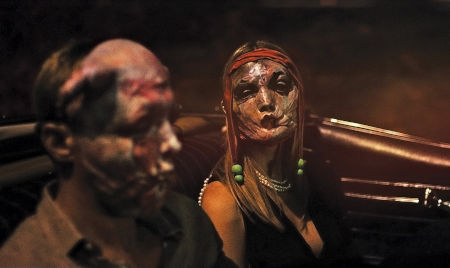
    Cinematographer Karim Hussain, who has shot every B. Cronenberg film so far, uses disorienting techniques—vertical 360 pans, extreme closeups of lips and eyelashes, a strange shot where Thomas Kretschmann‘s silhouette turns into a pinheaded alien—to remind us that we’re in an exotic land defying norms and expectations. These stylistic excesses are capped by two epilepsy-warning, -styled psychedelic montages—one deployed to the depict the psychological effect of the doubling process, one the result of an orgy sparked by an indigenous hallucinogen—featuring swirling lights, disco balls, nude women, and, most disturbingly, a nipple oozing… something. These heavy techniques magnify Infinity Pool‘s weighty mood of moral doom.

    Skarsgård is good as James, a writer who reveals less and less character as the film progresses. His decline is inevitable and believable: who among us would have the courage to defy the devil’s bargain Thresh offers to escape permanent oblivion? Still, Mia Goth dominates the film, cementing her position as horror’s nonpareil femme fatale of the moment. The ginger domme grows larger as Skarsgård shrinks. She has a wine-guzzling blast as a depraved seductress peeling away masks to reveal what seem to be infinite layers of evil.

    The events of Infinity Pool work as pure moral horror, but also operate on a two-tiered satirical layer. As a social critique, the film illustrates first-world exploitation of poorer countries, while on an individual level it plumbs the perverse depths of self-destructive behavior. The rich selfishly appropriate local culture by stealing grotesque ceremonial masks for a disguise to perpetrate additional crimes. Meanwhile, sinking into hideous hedonistic excess, James finds himself engaging in shockingly literal self-abuse. The rich treat the poor as expendable, and James objectifies himself to escape responsibility for his own crimes. The premise naturally invites speculation about the nature of identity: an exact clone of myself with all my memories isn’t exactly me, but what is it? A mystery and a horror.

    WHAT THE CRITICS SAY:

    “If you’re willing to surf on the wonderfully weird and wild wavelength of ‘Infinity Pool’ it is indeed a singular, and unforgettable, ride.”–Katie Walsh, Los Angeles Times (contemporaneous)

    APOCRYPHA CANDIDATE: PLAYING WITH FIRE (1975)

    Le jeu avec le feu

    366 Weird Movies may earn commissions from purchases made through product links.

    DIRECTED BY: Alain Robbe-Grillet

    FEATURING: Anicée Alvina, ,

    PLOT: Carolina fails to be kidnapped by a sex-trafficking syndicate, but that does not stop her father from playing along with the crooks as an excuse to send his daughter to a curious health clinic.

    Still from Playing with Fire (1975)

    WHY IT MIGHT JOIN THE APOCRYPHA: This bafflement features a hearty portion of stylistic and narrative eccentricities, but it might be imperfectly described as Jean-Luc Godard helming a Hostel movie while promised of a cash bonus for every tableau featuring a naked chick.

    COMMENTS: Alain Robbe-Grillet indulges in a bold combination of erotica, thriller, and shaggy-dog story in Playing With Fire. The first half-hour alone is a cavalcade of coyly directed nonsense: a reminiscence about an erotic picture book; an exploding doll leaving a cats-paw burn mark; a fabricated cry for help on the back of an Arc de Triomphe postcard; a pair of goons with the graceful articulation of marionettes. And so on. There’s more than a touch of Godard in Playing With Fire, and a hearty portion of lian commentary. Considering the source, this is unsurprising. Robbe-Grillet’s greatest contribution to cinema was providing the screenplay for ‘ cryptic and beautiful chef d’œuvre, Last Year at Marienbad, but he had a long directorial career afterwards where he was left to his own mischievous devices.

    The mischief begins with a voiceover by Georges Balthazar de Saxe (a stately Jean-Louis Trintignant, positively oozing “monied patriarch”) as the camera points at the household servants nominally acting out domestic tasks. The maid dusts a picture frame as an excuse to linger by the master’s door. The all-too-upright butler randomly passes a polishing cloth over nearby furniture, but is primarily focused on taking snap-shots. He sets the mantel timepiece to 4 o’clock. Why? Who can say. And more to the point, why is it that Carolina de Saxe (Anicée Alvina) failed to be kidnapped despite the considerable coordination efforts of a shadowy group of sex slavers?

    I am convinced that Robbe-Grillet is playing with us—he practically admits as much in the title. There is a seeming precision to his efforts, but a tell-tale bit in the first act is heavy enough of a wink to discourage any serious lock-picking. After having been drugged in his garden by agents of the sinister syndicate, Georges de Saxe converses with his butler about the matter. There is an obvious shot of butler cocking his head toward the house, as if there were a sound. Moments later, the gesture is repeated, this time in response to an actual audio cue. This whole film is meta-charade.

    The ensuing romp brings Carolina to a mental-clinic-cum-sex-dungeon, where the voyeurism motif established by the camera-clicky butler is cemented. The waif wanders a hallway arrayed with innumerable doorways with a photograph of each occupant. Inside, pukingly rich bourgeoisie enact pseudo-sadistic tableau featuring the young woman advertised on the exterior. Similarly, Playing With Fire is a showcase of our storyteller’s cinematic prowess, and wit. The nonsensical (“All men’s moustaches are fake”) mingles giddily with the sinister (threats of rape and bodily harm are scattered throughout the film like so much confetti). If you ignore the comedy, you’re left with an obtuse art-house Hostel morass. But the comedy and absurdism are real (so to speak), and it’s best to watch Playing With Fire as if not much on-screen actually happens—which is probably the point Alain Robbe-Grillet is trying to make.

    WHAT THE CRITICS SAY:

    “A weird madcap tale that benefits from gorgeous scenery and cinematography, experimental arthouse editing, and arousing sexual vignettes.” – Ken Kastenhuber, McBastard’s Mausoleum (Blu-ray box set)