Category Archives: List Candidates

APOCRYPHA CANDIDATE: FALL OF THE HOUSE OF USHER (1928)

DIRECTED BY: Jean Epstein

FEATURING: Charles Lamy, Jean Debucourt, Marguerite Gance, Abel Gance

PLOT: Roderick Usher invites an old friend to the portentous mansion where he lives in the company of the servants and his dying wife, Madeline, whose portrait he has been obsessively trying to paint.

Still from The Fall of the House of Usher (1928)

WHY IT MIGHT MAKE THE APOCRYPHA: Like it’s source material, Epstein’s silent film treatment of ’s short story doesn’t explicitly depict any extraordinary phenomena, but the aura of metaphysical discomfort and  mysterious menace is so pervasive that it lends it an oneiric character—one that’s likely to give a stronger and longer lasting impression than any more overt effect.

COMMENTS: Despite the expected controversy over the precise definition and characteristics of the movement (or whether it even qualifies as a movement), one could say that the underlying tenet of French Impressionism is the search for an emancipated cinematic language, with its own forms and techniques, in contrast to the “filmed theater” approach. Instead, cinema was to articulate, with its own unique means, certain realities (and modes of expressing them) that no other art-form could. Impressionist films focused on, among other things, subjective, psychological reality: dreams, madness and all sorts of altered states of consciousness, The methods necessary to compellingly bring it to life were unconventional camerawork, including character point-of-view perspectives, innovative editing techniques, a preoccupation with the visual composition of shots and their picturesque qualities (such as the contrasts between light and dark), etc.

With this said, it’s easy to see how such a movement proved vitally influential to weird cinema (and filmmaking in general)—as well as why it’s the perfect fit for an adaptation of an Edgar Allan Poe story. And indeed, Jean Epstein aptly translates the author’s most revered hallmarks—a constant, underlying sense of unease—to the language of cinema. It’s so well-realized that the viewer can predict the house’s impending ruin even without the title. The suggestion of a spectral world of shadows and unconscious forces subtly advances on diurnal reality, and the persistent aura of mystery and the uncanny reveals itself at each new turn, be it in the enigmatic presence of Madeline Usher, in Roderick’s afflicted mood and behavior, or in the many disquieting details of the mansion and its surroundings.

The resulting atmosphere of dreamlike disquiet is sustained through the film’s runtime, as if the viewer were trapped in the elegant and ethereal matter of a cloud as it gradually darkens and thickens before the storm. And as overused as it might be, “atmosphere” is indeed the appropriate term, considering the amount of shots purely devoted to its establishment (the ominous images of Nature, the manor’s vast, empty spaces where nothing but the wind manifests itself)—especially when compared to the more practical approach Continue reading APOCRYPHA CANDIDATE: FALL OF THE HOUSE OF USHER (1928) →
APOCRYPHA CANDIDATE: TODD TARANTULA (2023)

366 Weird Movies may earn commissions from purchases made through product links.

DIRECTED BY: Ansel Faraj

FEATURING: Ethan Walker, Kelly Erin Decker, Nathan Wilson, David Selby

PLOT: Todd Tarantula’s prized motorcycle is stolen; more disconcertingly, he keeps slipping through time.

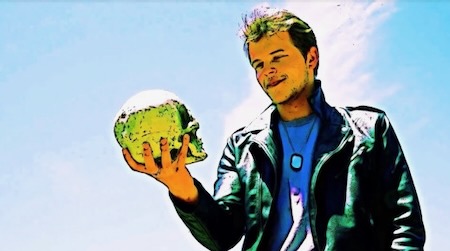
Still from Todd Tarantula (2023)

WHY IT MIGHT MAKE THE APOCRYPHA: Todd Tarantula renders L.A. in neon-sparked hues, a surreal effect heightened by the underlying grit of the smog-soaked city. The slippery narrative coursing beneath the death-candy visuals touches on ancient Pueblo lore, modern ennui, technological immortality, and a pleasing finish that is fairly rare in our corner of cinema. Also, there’s a skull-headlight time-travel motorbike.

COMMENTS:

I can’t tell if this is blood or snot! Can somebody help?

The scene is set with efficiency, because for Ansel Faraj, time is of the essence. This pressing speed is somewhat ironic when one considers that the protagonist, ne’er-do-well business scion Todd Tarantula, has time on his side. Well, more accurately, he has time at his disposal. This stubbled James Dean stand-in has his share of troubles—deceased mother, estranged father, dead-end life—but  at least hehas a bitchin’ bike: his treasured means of escape from the demons that pursue him. But over the course of an evening, he loses that, and considerably more.

Tell me one—just one dream—that’s all I ask.

Rotoscoping is a wondrous technique, creating what is possibly the uncanniest of valleys. Grafting animation on to filmed reality anchors us in form and flow, while allowing unfettered tinkering. Faraj’s peripheral tinkering is limited, for the most part, to a glorious color skew. Murky nights shift from green to black. Dazzling sun-lit cityscapes become a Technicolor kaleidoscope. Negative space morphs into clingy radiance. When Todd finally encounters his father, the wire-and-bandage-wrapped patriarch appears as a tethered angel amidst his array of hospital machines and plastic draping. During a car ride with Lucifer (a business rival of his father), the power of animation emphasizes Todd’s claustrophobia and draws the eye to the old gentleman’s skull-topped cane, hinting at the unspoken cost of the business deal playing at the tip of Lucifer’s tongue.

News of death travels fast; dare I say, ‘I’m sorry’?

Ansel Faraj’s film is not perfect. The performances are inconsistent, and the narrative thread sometimes veers too far from the main stitching. However, he has an interesting story to tell here, and it is told entertainingly, with many clever bursts. When he learns of his father’s demise, and the deceased’s disrupted attempt to achieve digital immortality, Todd is idling at the La Brea Tarpits—site of others who have failed to achieve a favorable form of perpetuity.

I don’t know what’s real any more, and I’m really fucking tired of it.

As events unfold (and, in some cases, re-fold), Todd Tarantula slows its pace, drawing everything together at the end for a finish that some will consider a touch too trite. I, on the other hand, was pleased, and relieved to see something pleasant and astounding befall this troubled bohemian nomad. Todd Tarantula sears the eyes, bends the mind, and has the good manners to elicit a satisfied grin.

Todd Tarantula is currently streaming free on Tubi.

WHAT THE CRITICS SAY:

“The search for his missing motorcycle takes Todd on a journey into the darkest and weirdest byways of Los Angeles… Todd Tarantula is like the lovechild of an unholy union between an urban dungeons and dragons quest and a ‘50s teen angst movie. To bless the union, Faraj and company digitally rotoscoped the footage in post production to make the colors, characters and scenery pop like a cross between a live-action graphic novel and an acid trip.”—Brian Schuck, Films From Beyond (contemporaneous)

APOCRYPHA CANDIDATE: A NEW OLD PLAY (2021)

Jiao ma tang hui

椒麻堂会

366 Weird Movies may earn commissions from purchases made through product links.

A New Old Play is currently available for VOD rental.

Recommended

DIRECTED BY: Qiu Jiongjiong

FEATURING: Yi Sicheng, Guan Nan, Qiu Zhimin, Xue Xuchun, Gu Tao

PLOT: Two affable demons come for the soul of Qui, a famous Chinese opera clown; on his way to the afterlife, he reminisces about his life’s experiences.

WHY IT MIGHT MAKE THE APOCRYPHA: The saga unfurls on stage-like sets using theater tricks and practical effects, with an easygoing charm bubbling throughout. The mindless catastrophes besetting the Chinese from the 1930s through 1980s batter fruitlessly against a quiet resolution to survive. Demons, symbolism, wit, and magic realism co-mingle with the tragedy, creating an experience unlike anything this reviewer has ever seen.

COMMENTS: This is a daunting prospect: stage-theater style, a deep-dive into Chinese cultural politics, and an epic length. The day before watching A New Old Play, I quipped that I was certain that this three-hour film would be sooo good, I’d want it four hours long. But I can admit when I’m mistaken. Its theatrical nature gives Qiu Jiongjiong’s film a stylish and deeply cultural resonance; the deep-dive into the darkest times of the People’s Republic of China is tempered throughout by playful humanity; and when the film wrapped up, I could have happily sat through another hour—or more. From the protagonist’s friendly acquisition at the hands of two neophyte demons (they had just taken over from their recently retired fathers), during the long reminiscences at the Netherworld inn, and up through Qui’s final, memory-washing meal at the river to Hell, A New Old Play is a jaunty, enlightening ride.

Old Qui learns that his fame as an opera clown performer transcends the Earthly plane. The King of Hell himself has sent his death invitation in the care of two escorts—demons whom Qui recollects from his childhood days during China’s “Great Leap Forward” and Cultural Revolution, when they come to collect the soul of his briefly adopted sister. As Qui travels from our world to the next, he makes a stop at a wayside inn established by a fellow Sichuan who owned an inn topside, and staffed by the handyman for Qui’s troupe. The “New New Players” were an elite band of performers founded by Commander Pocky to maintain the morale of the troops: first the anti-Japanese rebels, then the Chiang Kai-shek Nationalists, and then the Maoist People’s Liberation Army. Always the same troupe, shuffling to and fro as factional powers ebb and flow.

Qiu Jiongjiong sets the stage with humor from the get-go. One demon laboriously employs a bicycle pump to inflate the front tire of the faerielight-lined rickshaw on which he and his fellow demon travel. The opening memory corrects the demon’s information about when Qui joined the acting ensemble (they admit that certain records have been lost), introducing the concept of “New New Players” via a committee-style exploration of the merits of the repetitive term. The war against Japan is framed as a competition for theater funds and an irritating lack of flour for steamed buns. The civil war is nearly reduced to the swapping-out of a poster on the theater building: first anti-communist, then anti-nationalist.

The bulk of the melodrama (if I might even to call it that) occurs during the famine and cultural destruction unleashed by Mao as he sought to maintain his grip on the fledgling new (new) country. But the focus is on the the actors, and how the downtrodden manage to cock a snook at the gun-toting thugs. As happened to nearly all those caught in the vortex of the “Cultural Revolution”, Commander Pocky falls out of favor, and his actors are forced into self-abasement; Qui, the clown, stands amongst the troupe, dressed shabbily, wearing ridiculous makeup, and wearing a sign advertising his transgression. But as he is a clown, he manages to gather a small adoring crowd with a near-immobile performance, turning those who came to shun and gawk back into human beings through the power of his performance. Qiu Jiongjiong has nothing good to say about the evils of the Maoist regime, but refuses to grant that blood-soaked tyrant even a semblance of power over him. Like his film, all of time is a new-old play, as we stumble forward with a trip and a laugh, forever escaping from the inhumanity which the evil among us would subject us to.

WHAT THE CRITICS SAY:

“… filmed as theatrical tableaux, complete with blatantly contrived sets and supernatural fantasy sequences, which virtually shout at viewers not to take the depicted events as literal truth.”–Richard Brody, The New Yorker (contemporaneous)

APOCRYPHA CANDIDATE: SOMETHING WEIRD (1967)

DIRECTED BY: Herschell Gordon Lewis

FEATURING: Tony McCabe, Elizabeth Lee, William Brooker, Mudite Arums

PLOT: Electrical worker Mitch is horribly disfigured in an accident, acquires psychic powers, and is blackmailed by a hideous hag who promises to restore his looks in exchange for becoming her lover.

Still from Something Weird (1967)

WHY IT MIGHT MAKE THE APOCRYPHA: It is honestly surprising that we haven’t yet found a way to include the Godfather of Gore among our honorees, although it would be amusing if the movie that did so failed to feature any of his trademark bloodshed or exposed skin. Still, it says a lot that the man responsible for such no-room-for-nuance titles as Blood Feast and Two Thousand Maniacs chose to call this one Something Weird. The combination of ESP, LSD, and witchcraft ladled with heavy doses of terrible acting, barely decorated sets, and herky-jerky editing make Lewis’ titular assessment feel pretty spot-on.

COMMENTS: Before I’ve watched a frame, this movie has me at a disadvantage. Look at that title, practically daring me to leave it off our list. Think you can do my job for me, do you, movie? Well, I’ll be judging whether you’re truly something weird, thank you very much.

It does seem like they’re on to something, though. The first few minutes make a strong case for its peculiarity, with dramatic swings in tone and a schizophrenic mix of characters and locations. The opening credits share the screen with a murder-in-progress. (The interruptions are a mercy, as Lewis offers a credit to seemingly every actor in the film, and possibly a few that aren’t.) This is immediately followed by a karate demonstration in which one untalented black belt lectures another even-less-talented black belt. Their sparring gives way to a different kind of wrestling, in which a couple’s heavy petting leads to the woman’s to declare, “You’re electrifying!,” which gleefully segues into an actual electrocution. Even at this point, there’s room for a quick educational voiceover about the fascinating and totally real world of extrasensory perception before our story can truly begin. It’s a dizzying kickoff.

The actual tale threatens to be a major letdown, as our hero is the newly scarred, newly psychic Mitch (an insufferably smug McCabe). He’s immediately unlikeable, assaulting a nurse, bemoaning his fate, and barely concealing his contempt for the clients who visit his fortune-telling parlor. Fortunately, he meets his match in a hideous crone resembling a “Laugh-In” dancer whose makeup was done by a 5-year-old and whose laughter is so forced that it manages to go past sarcastic and come all the way back around to creepy. We don’t see it happen, but Mitch and his mysterious companion Ellen (the unnamed harridan now in disguise as a beautiful young woman who can’t act) quickly become the toast of the town with their incredible abilities.

Somehow, the story still hasn’t gotten started at this point, because Lewis seems unsure where the focus belongs. Is it Mitch trying to Continue reading APOCRYPHA CANDIDATE: SOMETHING WEIRD (1967) →

APOCRYPHA CANDIDATE: ALICE OR THE LAST ESCAPADE (1977)

Recommended

DIRECTED BY: Claude Chabrol

FEATURING: Sylvia Kristel, Charles Vanel, Fernand Ledoux

PLOT: After leaving her husband, Alice Caroll’s travels leave her stranded during a storm; she ends up at a mysterious mansion populated by odd characters, discovering that she can’t leave.

Still from Alice or the Last Escapade (1977)

WHY IT MIGHT MAKE THE APOCRYPHA: Your present author stumbled upon Alice or the Last Escapade on Tubi, and I could not shake the feeling that “366 Weird Movies should have this one already.” That’s because Alice or the Last Escapade brings to mind several movies already in our canon. First, the sparse “” elements give the story a thin fairy tale flavor. French director Chabrol (himself often described as “the French ”) dedicates the film to the memory of Fritz Lang. We have a classic ontological mystery in which a character is trapped by strange forces without explanation. A few reviews of this movie even compare it to ‘s The Exterminating Angel. I can see that, but more importantly, there is one specific movie on The List, a seminal cult classic, which I dare not mention lest I spoil the movie, because Alice or the Last Escapade has the exact same plot and ending.

COMMENTS: If you ask me, the best comparison for Alice is an hour-and-a-half long “Twilight Zone” episode. Alice Caroll (Sylvia Kristel) leaves her annoying bore of a husband to set out on the road. Driving at night, she finds herself in the classic Euro-Gothic plot: stranded at night with car trouble during a storm, forced to seek refuge at a strange mansion. The inhabitants of said mansion welcome Alice and insist she stay overnight, even offering to fix her car for free. But in the morning, Alice tries to leave, only to be confronted by reality-warping events that prevent her departure. There’s a “broken” clock which starts up at odd hours and seems to control other events in the house. The same view is visible out the front door and the back. She tries to trace her way around the property wall only to discover that the gate has vanished. When she does drive around, all roads lead back to the mansion. Meanwhile the mansion is populated by oddball characters who speak in riddles and have odd rules about conversation, such as not responding to any direct question.

The “Alice in Wonderland” elements are kept to a minimum. We have the protagonist’s name, of course; the checkered floor tiles in some rooms suggest a chessboard; a gentleman dressed all in white confronts Alice in the surrounding woods. Alice’s meals and tea are left prepared for her by an unseen entity, but aren’t specifically labeled “eat me” and “drink me.” The wake/dance party she encounters stands in for a “mad tea party.” Among elements definitely not drawn from Lewis Carroll, we get a single nude scene, when Alice gets lectured by a ghostly voice in the bath. (This blink-and-you-miss-it scene is there just to remind people that Sylvia Kristel used to play Emmanuelle.) Otherwise, there are no hints of sexuality to the proceedings; this movie seems designed as a vehicle for Kristel to demonstrate her advanced acting chops—which aren’t much to write home about, truth be told. But at least her character is no pushover. Alice quickly learns the arbitrary rules of her captivity, and even turns the mansion inhabitant’s own conversational rules back at them, as she schemes to figure out the situation and find loopholes.

Alice or the Last Escapade did not fare well at the box office, and is seen today as a one-off venture for director Chabrol, who had an extensive and otherwise successful career. Actress Kristel stated in interviews that she thought the movie would have fared better with more nudity. I disagree; the movie would have fared better if it took more chances and pulled out the weird stops. For being made in 1977, it feels like a much later movie made from parts of other popular weird cinema. As it stands, this is more of a slow-burn “comfort weird” movie, to be enjoyed in the good faith that it treads ground already familiar to those who have extensively explored our canon.

WHAT THE CRITICS SAY:

 “In the incredibly varied oeuvre of director Claude Chabrol there are few films as bizarre as Alice ou la dernière fugue, a dark, hallucinatory fairy tale in which fantasy and reality become intertwined to chilling effect… a haunting excursion into an Escher-like dreamscape from which there is no possibility of escape.”–James Travers, FrenchFilms.org