Category Archives: List Candidates

APOCRYPHA CANDIDATE: I SAW THE TV GLOW (2024)

366 Weird Movies may earn commissions from purchases made through product links.

I Saw the TV Glow is currently available for VOD rental (premium pricing) or purchase.

Recommended

DIRECTED BY:

FEATURING: Justice Smith, Brigette Lundy-Paine, Ian Foreman

PLOT: Two misfit teenagers become obsessed with a paranormal TV show, leading them into delusions that persist into adulthood.

Still from I saw the TV glow (2024)

WHY IT MIGHT JOIN THE APOCRYPHA: Glossy yet staticky, ever-glowing with pinks and purples, I Saw the TV Glow broadcasts lo- and hi-fi visuals that always threaten to drift away into dreams and nightmares. Paired with its melancholy psychological depth and extreme narrative ambiguity, Schoenbrun‘s plucky hallucination is a clear contender for one of the weirdest low-budget, high-impact films of 2024.

COMMENTS: To sophisticated eyes, “The Pink Opaque” doesn’t seem too entrancing; but when you’re a teenage outcast yearning for an escape from reality, you cleave to any alternate reality you can. The fake TV show within the movie is about two teenage girls who communicate through a psychic bond; in each episode they fight a different “monster of the week” sent by the “big bad,” Mr. Melancholy, who is also the Man in the Moon. The show’s theatrical character designs are culled from “Pee Wee’s Playhouse,” Nightbreed, and A Trip to the Moon, and the mythology and general vibe resemble “Buffy the Vampire Slayer” or a juvenile version of “X-Files.” Or does it? Owen’s memory may be unreliable. The show’s stylistic characteristics aren’t stable, but get jumbled up in his mind. The series finale he remembers seeing—or maybe which Maddy only convinces him he saw—includes the main characters being drugged with amnesia-inducing “luna juice.” It has a much darker tone than the rest of the series, more indigo than pink and more murky than opaque. It seems highly unlikely the Young Adult Network would greenlight this disturbing ““-adjacent finale.

Owen is drawn to the program for several reasons, the most important of which is that he has trouble making, and keeping, friends, and Maddy is so obsessed with the show that she showers anyone who expresses the slightest interest in it with attention. “The Pink Opaque” also has a forbidden allure for Owen: it airs in the latest original programming slot on the Young Adult network, after his strictly-enforced bedtime, and his stern father disapproves of it, scoffing that it’s a “show for girls.” Sneaking over to Maddy’s house to watch it, or secretly watching the clandestine VHS copies Maddy leaves for him, is an adventure. Maddy’s attachment to “The Pink Opaque” is even unhealthier: although we are spared direct evidence, there’s a strong implication of abuse and neglect in her home life. The show is the most escapist form of escapism for her—that is, until she decides to actually run away from home, leaving a burning husk of a TV on the lawn in the wake of her disappearance. Coincidentally, “The Pink Opaque” is canceled when Maddy leaves town.

While the following paragraph may be spoiler-ish—so zip out of here if you wish to go in blind—it is likely you’ve already heard that I Saw the TV Glow is a metaphor for gender dysphoria. The allegory, however, is not too on-the-nose. If I didn’t know writer/director Schoenbrun was trans1, would I even pick it up? Given the clues scattered about, I think I probably would, but I can’t say for sure. Owen’s backstory is only revealed in hallucinations and hallucinatory flashbacks. All we really know is that he feels like he doesn’t fit in—that pervasive teenage affliction that, in his and Maddy’s cases, is simply more pathological than their peers. Meanwhile, the theme of the effect of media on vulnerable populations—which was also explored in Schoenbrun’s debut, We’re All Going to the World’s Fair, wherein a similarly alienated teenage protagonist gets delusionally swept up in a viral Internet phenomenon—is more at the forefront. By the film’s end, imagery merging humans and TVs, reminiscent of Videodrome, reinforces the focus on pathological fandom in the face of pervasive media—but leaves a crack for Schoenbrun’s underlying metaphor to shine through.

WHAT THE CRITICS SAY:

“…a trippy experience about soothing teen angst and existential uncertainty with media… the narrative doesn’t always engage, and some choices feel broad or more like weird-for-weird’s-sake flourishes. Still, there’s enough here to applaud and consider for days afterward, particularly the raw performances by Smith and Lundy-Paine, who each have a magnetic screen presence.”–Brain Eggert, Deep Focus Review (contemporaneous)

  1. The original text of this review read “Shoenbrun was a trans woman.” Further research, inspired by a reader, showed that Schoenbrun does not specifically identify as a “trans woman.” Most common they refer to themselves as “nonbinary, using they/them pronouns.” However, in interviews Schoenbrun does identify as “trans” or “transfeminine,” though not specifically as a “trans woman.” Since “transness” is so essential to the movie’s theme, I have chosen to use the word “trans” here. ↩︎

APOCRYPHA CANDIDATE: THE TUNE (1992)

366 Weird Movies may earn commissions from purchases made through product links.

Recommended

DIRECTED BY: Bill Plympton

FEATURING: Voices of Daniel Neiden, , Marty Nelson, Emily Bindiger, Chris Hoffman

PLOT: A tunesmith on a tight deadline races to make a meeting with an impatient music producer, but gets lost in the wacky town of Flooby Nooby en route.

Still from The Tune (1992)

WHY IT MIGHT JOIN THE APOCRYPHA: In Flooby Nooby you can enjoy love-struck food pairings, consult with a macrocephalic metamorphing wise man (named “Gus”), check into a heartsick hotel staffed by a bell-boy-cum-suicide-assistant, ride with a cabbie suffering the “No Nose Blues,” and learn a jig or two from eternally dancing surfers. Is that enough?

COMMENTS: From nothing, comes the great hand of the Creator. It rises through the beigeful void and crashes toward us, blackening the screen. And then,

.

.

.

*THUNK*. We are grounded by a discordant slam of notes, and who do you think we see? Whose mighty hand have we witnessed? Why, it’s none other than Del, a love-smitten schlub trying to noodle out the final line of his number-one hit tune. So begins the eccentric, caricaturist charm of The Tune, as Bill Plympton bangs out an oddball voyage for his oh-so-mild-mannered protagonist.

What little narrative there is in The Tune exists to permit Plympton to dig deeply into his bag of tricks. After Del travels the crazy nested loops of highway on his way to his boss, the few nods to mundane reality are cast aside in favor of eccentric characters, daffy tunes, and the awe-inspiring power of an animator’s pencil.

Del’s surreal encounters never let up upon arrival in the unlikely town of Flooby Nooby, where he is greeted by the mayor with a zingy song expounding the virtues of this small town (accompanied by some horrible whistling, no less). Del meets a wary dog—doesn’t trust out of town folk, you see, with their heartless ways—who eventually morphs into a crooning Elvis canine belting out a stomping rock number about his improbably tall hairdo. Perspective comes and goes as trees shrink along a path, or as Del climbs a set of stairs and encounters a gentleman traveling downwards, walking along the steps’ rise. Heads (so many heads) morph to the point of breaking, but seamlessly pop back into form. “Gus” the Wise One suffers more than most—trains travel in and around it, burgers fly forth from his mouth, a fish is drawn from a forehead drawer, and so on—when his idiotic truisms go a step too far: “Just as a slice into a loaf of bread makes two pieces, you must multiply your wisdom.”

The ramble toward the climax is appropriately relaxed, and at one point Del inquires to the camera, “Why am I watching this?” The context is an extended (and gloriously masturbatory) sequence between two randos who obliterate each other’s faces through increasingly elaborate methods. Plympton more than hints at the pointlessness, but the pointlessness is the point. This is a cheery cartoon, stuffed to the gills with cheery airs, and its unceasing frivolousness underscores the sophistication of the craft. It’s a film where the line “Mr Mayor! How could you eat that adorable—and talented—hamburger?” is a sensible question. It’s got surf rock pathos and soulful noselessness. It has a Fat, Falling Pig hotel death suite and a Bad Joke Tango. The Tune is a Kantian ding an sich, hatching from nothingness and forging a wiggly world of absurdist tomfoolery.

WHAT THE CRITICS SAY:

“Plympton’s first feature is a surreal surety, chock full of brilliant gags, decent tunes, and lots of unobtrusive heart: it’s 78 minutes of unrelenting fun.”–Marc Savlov, Austin Chronicle (contemporaneous)

APOCRYPHA CANDIDATE: THE PIED PIPER (1986)

Krysař [AKA Ratcatcher]

Recommended

366 Weird Movies may earn commissions from purchases made through product links.

DIRECTED BY:

FEATURING: Voices of Oldřich Kaiser, , Michal Pavlíček, Vilém Čok

PLOT: A retelling of ‘The Pied Piper of Hamelin’: a town is overrun by rats, a piper is hired to get rid of them, and when the town leaders renege on their agreement… it’s not good.

Still from The Pied Piper (1985)

WHY IT MIGHT JOIN THE APOCRYPHA : It’s a visually striking adaptation, and the uncompromising mood and tone is equally striking. It’s not your average children’s Christmas special—and it still remains a relevant and timely tale.

COMMENTS: Genuine folktales are not known for being warm, snuggly, and uplifting; ‘The Pied Piper of Hamelin’ is definitely not so. It’s centered on rat genocide, with financial deal-breaking and child kidnapping as mere side dishes. Adapting it to family-friendly entertainment programming can be an especially tricky business, ending up soft-pedalling some elements of the tale, usually by adding songs and turning it into a musical.1

Intended as a children’s Christmas special for Czech television, Barta’s adaptation could have gone that route. Two previous directors had been fired for not taking a light enough approach to the material. But Barta, going back to source (mainly a 1915 novella by Viktor Dyk, as well as the original tale) instead leaned even further into the dark elements. In this iteration, the term “rat” doesn’t just apply to the usual rodents. In mammals, there’s little difference between rats and men; well, maybe the 4-legged kind aren’t as overtly cruel as the 2-legged.

The film opens on morning in Hamelin. The grinding of gears in the town clock chime to start the day as the townspeople scurry to do business: toiling laborers and craftsmen, coin minters, haggling merchants and customers, and merchants cheating customers. There are also cruelties: a rat killed for stealing pastry, the jeweler who barbs a necklace to cut the skin of the woman who will try it on, and the gluttony of the leaders of Hamelin as they indulge their appetites to obscene excess.

Business continues; people scurry to and fro, trying to get whatever coin they can, which goes into hidden stashes, while the rats grab whatever leftovers they can… behavior blackly reinforced in the overnight actions of the subterranean rat community.

The town is wealthy, corrupt, and debased—overrun by rats. And in this iteration, it gets what it deserves: the Exterminator. (It’s worth noting that the translation of the original title is “The Ratcatcher,” which is much more fitting to the mood and tone.)

Not your average children’s television special, certainly. But it was successful, both in Czechoslovakia and worldwide. Much of that success is rooted in the onscreen artistry: the design of the production is incredible, intricately textured with puppets carved from walnut and characters rendered in Cubist style—the angularity emphasizing their grotesque natures. The Piper himself resembles a gaunt specter of Death.

No one is innocent in this take, aside from a fisherman, an infant, and a female who comes to an unfortunate end. The Piper has come to cleanse the town of all of its rats. A glimmer of hope and happiness comes to fruition at the end—but only after the cleansing.

WHAT THE CRITICS SAY:

“Barta doesn’t radically divert from the legend, but there are surreal touches to ‘The Pied Piper’ to keep it interesting and dark, examining the brutality of rats and men, with the helmer going expressionistic and pitiless as he mounts his take on the central betrayal.”–Brian Orndorf, Blu-ray.com (Blu-ray)

HOME VIDEO INFO: In 2023, Deaf Crocodile issued a Region A Blu-ray featuring a new restoration of the film with a commentary by Czech film expert Irena Kovarova and film historian Peter Hames. Also included is a restored Barta short, “The Vanished World of Gloves”; “Chronicle of the Pied Piper”, a behind-the-scenes featurette on the production; a new interview with Barta; and a booklet essay by Kovarova.

  1. The exception to this may be the 1972 musical adaptation directed by Jacques Demy, featuring Donovan, Donald Pleasance, and John Hurt, with music by Donovan. This writer has not seen it but from the description, it seems to be a fitting candidate for us to feature in the future. ↩︎

APOCRYPHA CANDIDATE: TRACK 29 (1988)

366 Weird Movies may earn commissions from purchases made through product links.

DIRECTED BY: Nicolas Roeg

FEATURING: Theresa Russell, Gary Oldman, Christopher Lloyd, Sandra Bernhard,

PLOT: Linda leads a boring existence in a small southern town, taken for granted by her model-railroad aficionado husband; she is roused from her stupor by the arrival of Martin, a volatile young Englishman who claims to be the child she gave up for adoption at birth.

Still from Track 29 (1988)

WHY IT MIGHT JOIN THE APOCRYPHA: If Track 29 were only about the taboo subjects at its heart – sexual assault, incest, adoption, infidelity – it might get our attention for that audacity. But those touchy subjects pale in comparison to the outlandish manner in which these characters behave, seemingly immune to any rational expectations of behavior. For what could have been (and once was) an intimate drama, it’s a lot.

COMMENTS: The pairing of a screenwriter with a message and a director with vision is a risky thing. Two strong points of view can sometimes coalesce, but they can just as easily result in conflict and confusion. Usually, one of those voices has to dominate the other. Now, I’m not 100% certain what happened when a Dennis Potter screenplay wound up in the hands of Nicolas Roeg, but I’m willing to hazard a guess: Roeg won.

Potter’s script is based upon his BBC teleplay “Schmoedipus,” and it’s instructive to watch both because you can see where expanding the material has taken it from a comparatively sedate affair to become hyperactive and exceedingly peculiar. Much of Potter’s dialogue makes the transition intact, but the whole tone of the piece changes significantly. Opening up the setting from a cramped suburban London rowhouse to a sun-kissed beach community in the Outer Banks changes the stakes, as does the creation of a more violent backstory for the child’s conception and the introduction of railroads as an unexpectedly prominent theme. (The title is a reference to the lyrical location of the Chattanooga Choo Choo.) The characters themselves have undergone an enormous transformation. The middle-aged Elizabeth becomes Russell’s youthful, childish Linda; her husband’s tedious office job becomes Lloyd’s doctor with a toy train fixation, and the quietly seductive stranger played by Tim Curry on television is a wholly different animal as embodied by Oldman, fresh off his portrayal of Sid Vicious and primed to play the angriest of young men. 

Oldman is fully schizoid, turning on a dime from deranged madman to bereft toddler. (There is no reason for his character to be British, except that it reverses Potter’s gambit in the teleplay, where the young mother’s child has been shipped off to Canada.) His unpredictability is magnetic, as he lures Linda in with sweetness and just as quickly turns antagonistic. Amazingly, though, Oldman shares the wackiest scene in the film with Lloyd’s appearance at a model train convention that unexpectedly turns into a rabble-rousing political rally. As Lloyd becomes more histrionic on behalf of (double-checks notes) toy railroading, the crowd gets increasingly amped up. This is intercut with Oldman’s full-blown assault on Lloyd’s personal track Continue reading APOCRYPHA CANDIDATE: TRACK 29 (1988) →

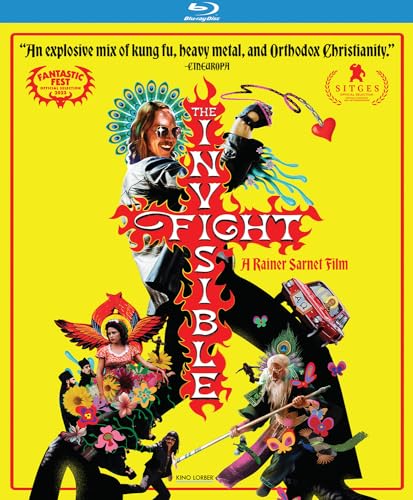
APOCRYPHA CANDIDATE: THE INVISIBLE FIGHT (2023)

AKA Nähtamatu võitlus

366 Weird Movies may earn commissions from purchases made through product links.

The Invisible Fight is currently available for VOD rental or purchase.

Recommended

DIRECTED BY: Rainer Sarnet

FEATURING: Ursel Tilk, Kaarel Pogga, Ester Kuntu, Indrek Sammul

PLOT: A conscript is inspired to join a local monastery where he hopes to pursue his new dream of mastering holy martial arts after surviving a massacre at the hands of three kung fu masters who descend from the heavens.

WHY IT MIGHT JOIN THE APOCRYPHA: Deeply informed by both Eastern Orthodox Christian theology and kung fu film lore, Rainer Sarnet’s fish-out-of-water comedy bubbles over with goofy slapstick, heavy metal, and ancient wisdom.

COMMENTS: The path toward enlightenment is traveled with humility—and preferably while listening to Black Sabbath. The Invisible Fight dives deeply into the past, with anachronistic layers coexisting as joyfully as its insouciance interweaves with asceticism. What could easily have come across as the height of judgmental arrogance—fun poked at holy traditions (brick pillow, anyone?), martial artistry (pierogi fight and sausage stand-off), and flippant dismissal of a sinister Soviet past—sublimates into a vapor of merry rumination as it zips from set piece to set piece, leavening its silliness with wisdom, and vice versa, as its main character grows from a blithe, metal-head mechanic into a blithe, metal-head Starets monk.

It is 1973, and our hero, a border guard named Rafael, witnesses the unlikely arrival of three kung fu fighters. Though his peers are murdered mercilessly—if quite stylishly—by this gang of heavenly warriors, Rafael is spared, with his commander’s dying words (“I guess God has other plans for you”) seared into his young mind as deeply as the transcendent run-in with the boombox-bearing bad-asses. Fast forward to life at home, where he rocks, and while rocking rocks long, rebellious hair, a shiny cross (in defiance of the Soviet authorities), and a dumb little red car that’s always breaking down.

Stylistically, The Invisible Fight owes its verve to silent comedy, classic wuxia, and the ubiquitous Black Sabbath classic, “The Wizard.” (This track is, appropriately, from the album “We Sold Our Soul for Rock ‘N’ Roll.”) Cartoony blast-titles mark the chapters, with designations like “A Lesson in Humility”, “A Lesson in Humility Number 2”, “Shadow Fight”, “The Demon”, and so on. Sarnet plinks in Looney Tunes sound cues for winks, wobbles, whacks, and whiplash. Practical martial arts duels are liberally sprinkled throughout, whether they be between Rafael and a rival monk, or during a bout with a State Security agent on a holy road trip.

This film is, as you have sussed by now, silly to the core, and borders on giddy. But this renders the deep philosophy all the more remarkable and memorable. Christ’s many icon-ic gestures are correlated to martial moves; Rafael’s challenges, though often solved with kung fu, echo the trials and tribulations of holy men of yore; and the overarching—might I even say, fundamental—lessons of Christ’s philosophical teachings are constantly reinforced while never feeling preachy. Humility, forgiveness, and self-awareness elude Rafael. But by the end, under the benevolent tutelage of the elderly brother Nafanail, Rafael cruises his blindly-cheerful self to a form of Zen—introducing the monastics to the joys of Black Sabbath along the way.

WHAT THE CRITICS SAY:

“Writer-director Rainer Sarnet’s deliriously weird The Invisible Fight would be irksome if it weren’t crafted so lovingly and with a charming earnestness.” — Charles Lyons-Burt, Slant (contemporaneous)

Invisible Fight [Blu-ray]
  • Kung fu meets heavy metal meets Orthodox monks in this Estonian action comedy