All posts by Giles Edwards

Film major & would-be writer. 6'3". @gilesforyou (TwT)

CAPSULE: SCHRAMM (1993)

Schramm: Into the Mind of a Serial Killer

DIRECTED BY:

FEATURING: Florian Koerner von Gustorf,

PLOT: Life ebbs from the body of Lothar Schramm after a fatal fall from a ladder. Memories of murders, self-loathing, hallucinations, and his love for his next door neighbor blink on and off the screen. What starts with the death of a murderer becomes a portrait of a grisly, nuanced soul.

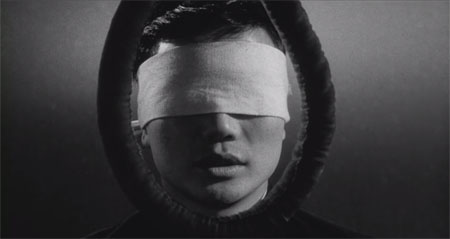
Still from Schramm: Into the Mind of a Serial Killer (1993)

WHY IT WON’T MAKE THE LIST: As with his previous film, Der Todesking, Buttgereit somehow manages to ride the crest between gore and philosophy, making Schramm considerably more meditative than would be expected. Its (now) familiar “mind of a serial killer” theorizing does result in the occasional shock, but it certainly isn’t the weirdest thing you could see before breakfast.

COMMENTS: There is something to be said for efficient film-making. So often it seems the case that a director wants his or her film to go on for as long as it takes to say everything about its subject. Sprawling movies abound; some peter out, some take forever to find their target, and the worst neither gain momentum nor really tell much of a story. Such a curse is not suffered by Jörg Buttgereit, the affable German behind the underground horror hits Nekromantik (1 and 2), Der Todesking, and, the last feature of his early career, Schramm. In a tight sixty-five minutes, Buttergereit explores the final thoughts and days of the titular serial killer.

Schramm’s chronology is only slowly revealed, beginning, effectively, at the end of the story. Suffering a fall while painting a blood-spattered door frame, Lothar Schramm (Florian Koerner von Gustorf) collapses in the spilt paint, and time slowly rewinds. Our first living encounter with him shows him dispatching two altogether wholesome evangelizers. An impatient woman knocks on the door. Eventually things sift back further and we see what are likely childhood memories, interspersed with the scenes from the days immediately preceding the fall. Schramm’s manner and actions may now seem typical, but in 1992 (the year Schramm was filmed), the precarious mental state of a rather off-kilter man was quite a bit fresher. (As Buttgereit remarks in his charmingly cute introduction, the reason he made this film was he was tired of watching “chain-smoking detectives pursuing the serial killer”, instead of seeing things from the other side.)

As I mentioned, the film is brief. However, it gets everything done that it needs to in the run-time. In what has become almost standard in the genre, Schramm is a generally low-key, pleasant guy who enjoys jogging and chatting with his next-door neighbor (Monika M.), a prostitute who relies on him for company and, later, protection. Stylized flashbacks of murders, a kitchen drawer full of lipstick, and unsettling hallucinations of his own physical deterioration hint at his mental imbalance. (Taking a cat-nap in his taxi, he dreams about a dental appointment for a tooth removal that quickly escalates into an eye removal). While he’s keeping busy with loneliness and killing prostitutes, his neighbor gets herself involved with some rather demanding and unsavory older clients.

There is certainly a fair share of repellent material in Schramm, but anyone familiar Buttgereit’s work should be unsurprised. However, unlike the gross-out tours-de-force of his Nekromantik films, Schramm is more the sibling of his pensive work, Der Todesking. The violent scenes in Schramm are sparingly scattered, and all the more troubling for so being. With this release (and the upcoming über Buttgereit set), the people at Cult Epics have made available a neat little treasure that not only illustrates why this director deserves (a little) greater fame, but also that underground cinema has more to offer the public than just cheap thrills.

WHAT THE CRITICS SAY:

“…has ‘fans only’ written all over it… Using out-of-date experimental means (repetition and color distortion), Buttgereit tries to put the audience into the killer’s mind, and probably gets as close as a director with limited means can.”–Eric Hansen, Variety (contemporaneous)

233. DEATH BY HANGING (1968)

Koshikei

“You mustn’t think our film is just labored theorizing. The officials’ attempts to convince R that he is R are amusing and bizarre. I think it’s a spot-on depiction of all us Japanese in all our amusing bizarreness.”–Nagisa Ôshima

Recommended

DIRECTED BY:

FEATURING: Yung-Do Yun, Fumio Watanabe, , Akiko Koyama

PLOT: After the failed execution of a Japanese-Korean double murderer, various state functionaries are at a loss as how to proceed when the criminal’s body refuses to die. Going to increasingly outlandish lengths to remind the convict of why he is there and condemned, the prison’s officials inadvertently explore the nature of crime, nationality, and culpability. Eventually a young woman is introduced to the group, and the captors decide to get drunk.

Still from Death by Hanging (1968)

BACKGROUND:

  • The criminal in Death By Hanging is based on Ri Chin’u, who also murdered two Japanese school girls. In addition to his crimes, Ri Chin’u gained a degree of fame for his extensive writings while in prison.
  • Much of the dialogue between R and his “sister” is taken from actual correspondences between Ri Chin’u and a Korean journalist.
  • Death by Hanging came during Ôshima‘s most experimental period, made back-to-back with the Certified Weird satire Japanese Summer: Double Suicide. Like most of Ôshima‘s mid-to-late 1960s work, Hanging was initially ignored in America, not even screening for the first time until 1974 and not officially reaching home video until 2016.

INDELIBLE IMAGE: The movie is stuffed to the gills with claustrophobic shots of slapstick fused with philosophy, none more so than the penultimate scene: an unlikely combination of prison officials getting hammered around a “table” while the convict “R” and his (probably imaginary) sister consider the nature of guilt. The drinkers take turns discussing how they came to this kind of work while R, reclining with the young woman beneath a Japanese flag, comes to the conclusion that though he committed his crimes, he is not responsible for them.

THREE WEIRD THINGS: Stubborn corpse; rape re-enactment; hallucination participation

WHAT MAKES IT WEIRD: Death By Hanging starts with a very traditional documentary approach, including narration reeling off statistics and some expository shots of a nondescript execution facility in a prison compound. Quickly, however, the aura of formality disintegrates as the hapless officials endeavor in vain to make sense of the film’s central conceit: a young convict refusing to die. Their efforts to restore his memory and edge him toward accountability grow desperate and extreme until a point is reached where everyone involved in the process begins to believe in the unreal.


Original trailer for Death by Hanging

COMMENTS: While most leftist directors merely point a shotgun at Continue reading 233. DEATH BY HANGING (1968) →

231. ORPHEUS (1950)

Orphée

“When I make a film, it is a sleep in which I am dreaming. Only the people and places of the dream matter. I have difficulty making contact with others, as one does when half-asleep.”–Jean Cocteau

Must See

DIRECTED BY:

FEATURING: , , , Marie Déa,

PLOT: Orpheus, a famed poet in post-war France, is stagnating until his life takes a sudden turn when a brawl at the Poets Café precipitates a ride with Death and her latest victim. Smitten by her mystery and charm, Orpheus becomes obsessed to the point of neglecting his wife, who is dispatched by supernatural agents. It turns out the underworld has rules, though, and complications force Orpheus, Death, and the innocent people in their orbit to redress their unauthorized actions.

Still from Orpheus (1950)

BACKGROUND:

  • The film is an adaptation of Jean Cocteau’s 1926 play of the same title.
  • Orpheus is the middle film of Cocteau’s “Orphic Trilogy”, preceded by The Blood of a Poet (1932) and followed by Testament of Orpheus (1960).
  • The credits for the movie were all drawn by Jean Cocteau, who was something of an artistic jack-of-all-trades: poet, painter, filmmaker.
  • Orpheus is played by Jean Marais, a matinée idol whom Cocteau launched to critical acclaim with Beauty and the Beast (1946). Marais was also Cocteau’s lover. By the time Orpheus was being filmed, Cocteau had a new lover, whom he cast as Orpheus’ professional rival, Cegeste.
  • The unearthly transmissions from the Princess’ car radio were inspired by the coded BBC broadcasts Cocteau heard during World War II.

INDELIBLE IMAGE: Cocteau’s bag of tricks in Orpheus is a large one, but the most memorable bit of legerdemain shows up when Orpheus is making a second trip to “the Zone,” a wind-scarred mass of ruins that makes up the Underworld. Orpheus and his guide, Heurtebise, struggle against gusts of tremendous force as they travel, only to plummet laterally upon turning the corner into the tribunal chamber.

THREE WEIRD THINGS: Forward in reverse; Underworld radio; mirror doorways

WHAT MAKES IT WEIRD: Cocteau’s obsession with mirrors continues unabated, and in Orpheus they explode, dissolve, and are traveled through with a magic so commonplace it borders on the mundane. The Underworld is overseen by judicial bureaucrats, time is flexible (but at a price), and for a movie about poets and poetry, it’s interesting that there are no examples at all of the latter.


Criterion Collection promotional video for Orpheus

COMMENTS: As a writer and as a director, Jean Cocteau hit the Continue reading 231. ORPHEUS (1950) →

CAPSULE: THE OSSUARY AND OTHER TALES (2013)

DIRECTED BY:

FEATURING: Various

PLOT: The collection of short films on this disc range from people-puppet tellings of classic opera to unconventional documentaries, as well as examples of what Svankmajer is most known for: stop motion animation with a decidedly macabre aura of cheekiness.

Still from The Ossuary and Other Tales
“The Last Trick”

WHY IT WON’T MAKE THE LIST: It would be easy to argue that these short films are all very well done, and easier still to contend that a handful of them are disorientingly bizarre. However, the overall degree of weirdness fluctuates greatly, and seeing as this is a compilation of shorts anyway, Mr. Svankmajer will have to make do with his feature-length Certifications.

COMMENTS: Jan Svankmajer’s influence is well known to the visitors of this website. His body of work, beginning in 1964 with “The Last Trick,” has inspired everyone from ‘s to the Pennsylvanian duo, the . The Ossuary and Other Tales is something of a scatter-shot collection of his short films from the mid-1960s through the late 1980s, and is intriguing both for its content and its omissions. Over the course of two hours, the viewer gets to marvel at increasingly surreal sleight-of-hand from a pair of competing magicians (“The Last Trick”), watch a summary of the earth’s life forms put to classic dance riffs (“Historia Naturae [Suita]”), see ominous social commentary (“The Garden”), and even catch up on some classic opera (sans opera) with “Don Juan.” The overall result is a nice showcase of Svankmajer’s scope and talent, but it leaves one feeling that there are some gaps.

Two of the highlights of the anthology are “The Ossuary” (1970) and “Castle of Otranto” (1979). Both are documentaries. The former is made up entirely of shots of the famed Sedlec Ossuary, home to the remains of forty to seventy thousand people whose bones are arranged in intricate formations. Most notable are an enormous bone chandelier and the coat of arms of the royal house that funded the project. The voice-over from the never-seen tour guide provides commentary, challenging the school children the guide is ostensibly lecturing to contemplate what they could hope to make with all this human material, and constantly reminding them that there is a 50 crown fine (“to be paid immediately!”) for touching the remains.

“Castle of Otranto” is more conventional in that it features an interviewer speaking with an amateur archaeologist who is convinced the fabled story from Horace Walpole’s Gothic tale is based on an actual castle, the Otrhany ruins found in (then) Czechoslovakia. The documentary bits are interspersed with Gilliam-esque (Svankmajer-esque?) animations of Walpole’s story, one that involves love, betrayal, and a truly massive knight. The amateur archaeologist contends that the Otrhany ruins show evidence of both the existence and gargantuan size of said knight as described in the book; the interviewer is skeptical, providing some mundane explanations for the archaeologist’s circumstantial evidence. In a nice twist, the words of doubt prompt a tumbling of rocks and debris on the pair and the camera pans up to a massive gauntlet smashing through the tower above them.

There is too little space to cover everything included here, but at the same time I was left wanting more material. Those who enjoyed the “uncanny valley” effect of the Certified Weird Marquis will revel in Svankmajer’s “Don Juan,” with its people dressed as marionettes. The dangers of solitary drinking and soccer obsession are explored in “Virile Games,” which features a man slowly getting hammered while watching a match on TV, and combines live-action, cut-out animation, and stop motion (the last of which showcases the offing of the soccer players in various clever ways). So there is a wealth of material here: but not nearly all of it. Looking over a list of Svankmajer’s shorts, it appears that maybe just half show up in The Ossuary. Hopefully a truly comprehensive Blu Ray disc will come along to put things right; until then, I advise completists to pick up what they can where they can.

WHAT THE CRITICS SAY:

“…a great compilation of truly odd little films.”–Ian Jane, DVD Talk

(This movie was nominated for review by “hazebass7,” who said “This movie is teeming with weird imagery and a great avant-garde feel. I was greatly entertained by this collection’s weirdness and I think that it would be a great addition to the list!” Suggest a weird movie of your own here.)

229. ROSENCRANTZ & GUILDENSTERN ARE DEAD (1990)

“No! I am not Prince Hamlet, nor was meant to be;
Am an attendant lord, one that will do
To swell a progress, start a scene or two,
Advise the prince; no doubt, an easy tool,
Deferential, glad to be of use,
Politic, cautious, and meticulous;
Full of high sentence, but a bit obtuse;
At times, indeed, almost ridiculous—
Almost, at times, the Fool.”
–T.S. Eliot, “The Love Song of J. Alfred Prufrock”

Recommended

DIRECTED BY: Tom Stoppard

FEATURING: , , , Iain Glen

PLOT: Two of Hamlet’s old school chums are summoned to Elsinore to glean what afflicts the moody prince. Along their journey they encounter a traveling troupe of Players, whose leader offers to a put on a performance for them. Magically transported to the castle from the Players’ stage, Rosencrantz and Guildenstern find themselves trapped within the convoluted machinations of the royal court, confused as to their own identities and struggling to keep their heads while discussing basic questions of existence and fate.

Still from Rosencrantz & Guildenstern Are Dead (1990)

BACKGROUND:

  • Adapted from his own 1967 hit play, Rosencrantz & Guildenstern Are Dead is the first and (so far) only film directed by accomplished playwright and screenwriter Tom Stoppard (who also contributed to Brazil).
  • The title comes straight from “Hamlet,” from the very last scene (Act V, Scene II). Arriving in Denmark to find nearly everyone in the royal court dead, the English ambassador bemoans, “The sight is dismal,/And our affairs from England come too late./The ears are senseless that should give us hearing,/To tell him his commandment is fulfill’d,/That Rosencrantz and Guildenstern are dead.”
  • Though it received tepid-to-positive reviews from contemporary critics (with most of the negative reviews comparing it unfavorably to the stage experience), Rosencrantz & Guildenstern did bag the top prize at the 1990 Venice Film Festival.

INDELIBLE IMAGE: I suspect I take no risk of spoiling the ending (the title itself gives something of a hint as to our heroes’ ultimate fate) by singling out the execution scene of Guildenstern and Rosencrantz. The former has a look of a man of reason who’s been broken by the illogical; the latter sports the complementary look of a man of whimsy who’s been worn down by niggling reality. Both accept their fate in states of differing exasperation.

THREE WEIRD THINGS: “Heads,” “heads,” “heads”…; am I Rosencrantz or are you Guildenstern?; play within a play within a play within a movie

WHAT MAKES IT WEIRD: Tom Stoppard’s semi-medieval world is one of modern wordplay, post-modern comedy, existentialism, tragedy, and ambiguous identity. As it stands, the movie is perhaps the only example to be found in the “Nihilistic Farce” genre of cinema.


Clip from Rosencrantz & Guildenstern Are Dead

COMMENTS: Sometimes it’s just better to stay home. This lesson is Continue reading 229. ROSENCRANTZ & GUILDENSTERN ARE DEAD (1990) →