All posts by Giles Edwards

Film major & would-be writer. 6'3". @gilesforyou (TwT)

CAPSULE: STROSZEK (1977)

DIRECTED BY:

FEATURING: , Eva Mattes, Clemens Scheitz

PLOT: When his elderly landlord suggests that he, recently-released prisoner Bruno, and their mutual friend Eva escape to America, the trio head to Railroad Flats, Wisconsin; there, they start living the American Dream, only to have it reposessed.

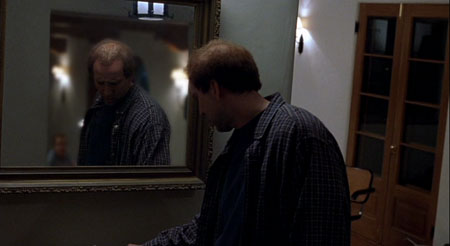
Still from Stroszek (1977)

WHY IT WON’T MAKE THE LIST: The unlikely plot, combined with the unlikely locales (Berlin and the fictional “Railroad Flats”), further combined with unlikely leads (mostly non-actors) results in a strange story—but not-so-strange a movie. The tale being told is a weird one; the movie itself is a (commendably) straightforward telling of it.

COMMENTS: As road movies go, this one is quite the odd duck. This is, of course, to be expected from one of the great oddball directors of the ’70s and ’80s (the reliably offbeat Werner Herzog) who concocted this film specifically for one of the great eccentrics of the last century, the vagrant/street-performer/poet/musician/non-actor known as Bruno S. Like the lead, most of the characters are played by people who did not act for a living, and as such they give their story a layer of truthfulness.

In fact, much of the movie has a documentary vibe. Straight-forward mise-en-scène, realistic lighting, medium shots, and even occasional glances at the camera from Bruno all combine to provide a sensation one is watching, as it were, a “movie-movie” as it flows in and out of a “documentary movie”. Various avenues are explored by this non-documentary: alienation, family, emotional and physical survival, but most of all, the American Dream. The simple joys of this dream, however, quickly give way to the grinding vexations of bleak reality. Toward the end of the movie, Bruno makes a telling remark as he listens to an English conversation he doesn’t understand. He mutters, “I’m really pessimistic about all this.” But I’m getting ahead of myself.

As a man seemingly transplanted from another time (if not another world), Bruno S. copes with his surroundings as ably as his innocence allows. The audience first meets him when he’s being released from jail, imprisoned for unspecified “alcohol-related crimes.” He has only two friends: his landlord, Clemens Scheitz, who not only kept Bruno’s room as he left it but also watched after his Myna bird; and Eva, a much-abused prostitute who may or may not be Bruno’s lover. In Berlin, their lives are semi-tragic but comfortingly mundane. Once in America, Bruno doesn’t so much eventually “lose it” as much as he realizes as there isn’t really any place for him to quietly exist. As events unfold, his American experiences become increasingly strange, until everything unravels. His home is repossessed by the world’s friendliest banker, his old friend goes around the bend and gets arrested, and he himself ends up being hunted by the police. His escape through the most crudely conceived tourist attraction imaginable—which includes not only a “Fire Chief” rabbit but also two (2!) musical chickens—stands as one of Herzog’s stranger set-pieces.

Both location and society seem out to get our endearing protagonist. In the film’s first half, his environment conspires to force him to flee his home; in the film’s second half, it conspires to take away the only people he cares about. Somehow, Herzog makes great swaths of the movie either hilarious or just plain delightful to watch. While a happier trajectory for the film would have been enjoyable, Herzog’s nuanced cynicism makes the film, for all its eccentricity, feel very real.

WHAT THE CRITICS SAY:

“…one of the oddest films ever made.”–Roger Ebert, Great Movies series

CAPSULE: HOW THE SKY WILL MELT (2015)

At the time of this writing How the Sky Will Melt can be watched for free on Nobudge.com

DIRECTED BY: Matthew Wade

FEATURING: Sara Lynch, Annika Karlsen, Michael Webster

PLOT: In the late 1980s (?), a young musician disappears and returns; her father detects something amiss about her, and when she and her friends somehow manage to summon a visitor from the sky, things slowly fall apart.

Still from How the Sky Will Melt (2015)

WHY IT WON’T MAKE THE LIST: The movie has some astounding (and weird) imagery, as well as one of the best film scores I’ve heard in a good while. However, the amateurishness of the effort is apparent throughout, and every time the actors speak, the semblance of magic is destroyed.

COMMENTS: The opening of director Matthew Wade’s first feature quickly transports the viewer to an elsewhere. A synth score blasts an unearthly melody as drab landscapes pan by, all seen on nicely washed-out Super-8 film stock. We see a young woman in her twenties, through canted angles and disorienting close-ups. The scene jumps to a sort-of dream sequence involving brightly colored eggs in a nest by the sea. While watching this, I wrote in my notebook, “Made or broken by voice(s).” This comment, unfortunately, was prescient. At the 12-minute mark, we hear dialogue for the first time, and the dreamy atmosphere evaporates.

All that follows, I am sad to say, is largely a disappointment. The young woman, Gwen (Sara Lynch), is the leading light of a modestly popular but highly respected rock band. Back home after working on an album, she meets up with some friends from her high school days and, while smoking clove cigarettes, they carry on a series of banal meta-conversations about the banality of what normal people talk about. She also reunites with her father (Michael Webster), whose role is under-written and stiltingly acted. Somehow, though, he still comes across as likable (aided, no doubt, by his comparative lack of jadedness and pretense). Meanwhile, the 20-somethings go to a lakeside retreat. Gwen’s friend Pearl (Annika Karlsen) gets pregnant (possibly with a monster-eel thing inside her). A mushroom is found and devoured, a man falls from the sky, and… so forth. On top of this meandering string of events is the recurrence of a mask-like device that possibly has the power to show alternate dimensions, possibly just plays sci-fi audio cassettes (now with video!), and certainly has the power to kill if abused.

At this point I should reiterate that the film score is nothing short of amazing. During scenes with nothing but imagery and eerie synth music, I saw glimpses of potential. In fact, it was almost as if the director had grafted the score from a far superior ’70s cult classic onto his work—the music is much like an amped-up Popul Vol, ‘s go-to group. It was an interesting surprise to find that the director (who also wrote the screenplay and edited) was the man behind the music. If nothing else, I’d say that Matthew Wade should have a bright future as a composer.

It’s apparent that How the Sky Will Melt was a labour of love, but also apparent it’s the work of a neophyte. After watching the movie, I found myself confused, but also not interested enough in the fate of the lightly-sketched and uncharismatic characters to invest further thought. There are some beautiful, surreal montages here, and not one, but two great hooks — the cassette glasses and the ominous figure that falls from the sky. But aside from the score, I did not particularly care for this movie. However, I would love to see the director remake this in a few years with a better cast and a firmer grip on the story he’s trying to tell.

WHAT THE CRITICS SAY:

“… you’re a fan of David Lynch’s more bizarre and atmosphere-driven works (i.e. Eraserhead, Lost Highway,Mulholland Drive) and perhaps early David Cronenberg or just experimental film in general, I think you’ll find How the Sky Will Melt interesting and thought-provoking.”–Jacqui Siler, Film Inquiry (contemporaneous)

CAPSULE: DA SWEET BLOOD OF JESUS (2014)

DIRECTED BY: Spike Lee

FEATURING: Stephen Williams, Zaraah Abrahams, Rami Malek, Elvis Nolasco, Thomas Jefferson Byrd

PLOT: A well-to-do doctor of anthropology gets stabbed with an ancient Ashanti dagger and becomes immortal but addicted to blood.

Still from Da Sweet Blood of Jesus (2014)

WHY IT WON’T MAKE THE LIST: The movie’s vampire-origin premise is an uncommon one, but the movie is weighed down by a cold—bordering on somnolent—lead performance, a scattershot tone, and the fact that the most compelling scenes are largely uninvolved with the main action.

COMMENTS: The opening credits of Spike Lee’s latest movie are fully alive. Across the acting and production shout-outs, Lee shows off a very skilled street dancer (Charles “Lil Buck” Riley) performing a number of smooth, impressive moves in various Brooklyn street spots. The momentum continues with the opening scene proper, a lively gospel shout ceremony at “Lil’ Piece of Heaven” church. During the full-blooded, upbeat sermonizing, we see Dr. Hess Green (Stephen Williams) sitting alone in the back, noticeably separate from the rapt congregants. After this introduction, however, it seems that all the blood drains from the movie.

What follows is a sometimes dreamy, sometimes intellectual, and consistently tedious affair involving the realities of a modern, bookish vampire. Dr. Greene hosts big parties for intelligentsia at his large estate in Martha’s Vineyard (with grounds spanning 40 acres, no less). He chats amiably, but briefly, with the various educated bourgeoisie, before having to hightail it to his basement for some blood packs from the refrigerator. He emerges with a wine glass of blood; when an insistent guest tries it and spits it out, he glibly explains, “It’s organic.” And so comes and goes one of the few breaks from the largely unremitting monotony of the film.

Between his unfortunate conversion to vampirism and a personal spiritual revelation, he murders and drinks blood of various poor women of color. His traces of hyper-shy charm are smudged over by his callous and guileless manner. For reasons not entirely clear, he immediately falls in love with Ganja Hightower (Zaraah Abrahams), who was once married to his erstwhile assistant. She seems to hate everything and everyone, and has adopted the unfortunate habit of being 100% honest 100% of the time. She has a backstory to explain her current hostility to the world, but I found myself utterly incapable of seeing how that justifies her sheer unpleasantness. Throughout the movie, Spike Lee (who co-wrote the screenplay) dribbles in bits and pieces of mumblecore exchanges; where he should have focused on creating an atmosphere of angst and ambiguity, instead he makes each character no more than a projection of a type. Even the hammy characters from Blacula have more nuance and relatability.

There are some scenes of vitality and beauty. Whenever the action shuffles over to the church (all too infrequently), the movie  immediately gets a shot in the arm. And while I am not one to generally marvel at the visual splendor of a scene, the marriage on the private beach that takes place in the second half was a sheer joy just to look at. Unfortunately, I can only come to the conclusion that while the movie toyed with greatness, it came short in a number of ways. It may have been a worthy recommendation if it had been: more atmospheric, more puzzling, livelier, wittier, and so on. Had it thoroughly pursued any one of those directions, it may have been on to something. Instead, Spike Lee seems to want it all, and it ends up falling flat.

WHAT THE CRITICS SAY:

“…with no one breathing down [Lee’s] neck, it’s free to zoom all over the place — from seriousness to high comedy to weird comedy to quietly anxious set pieces…  For better and sometimes worse, ‘Jesus’ is undiluted Lee — a half-committed attempt at a twisted genre film that freely gets lost down unexplored alleyways.”–Matt Prigge, Metro (contemporaneous)

CAPSULE: BLACULA (1972)

DIRECTED BY: William Crain

FEATURING: William Marshall, Vonetta McGee, Thalmus Rasulala, Gordon Pinsent, Denise Nicholas

PLOT: After being cursed and imprisoned by Count Dracula, African prince Mamuwalde is revived after two centuries when his coffin is brought to Los Angeles by a pair of interior decorators who purchased the Count’s estate. There, he meets what he believes to be the reincarnation of his murdered wife while stalking the backstreets of 1970s LA.

Still from Blacula (1972)

WHY IT WON’T MAKE THE LIST: Blacula’s weirdness  mostly stems from the manner in which it has aged. While the concept of a black vampire remains something of a novelty (and in fact, Blacula is the first movie to have an African vampire), the story is a fairly pedestrian string of horror-movie situations. Perhaps the weirdest thing about it is that it presents Los Angeles as a town inhabited exclusively by black citizens, white policemen, and homosexuals of both racial groups.

COMMENTS: As an early example of 1970s blacksploitation movies (and as the first horror-themed blacksploitation movie), Blacula is a fairly straightforward affair that nonetheless could be discussed at length on any number of levels. Having volunteered to watch it and write this review, I’m kicking myself for not having taken advantage of the “African-Americans in Horror” cinema class that was offered my senior year in college. That said, I’ll take comfort in the fact that the lens through which I watched this movie was a “weird” one, and at least in that regard, I can speak with some degree of license.

The movie opens in an unexpected way: in 1780, Prince Mamuwalde and his bride are dining at the palace of Count Dracula. They have come as emissaries to Europe in order to discuss ending the slave trade. The Count makes an offhand remark that comes across as a bid to purchase Mamuwalde’s wife, the two Africans try and leave, and bam: the wife is murdered, and the Count passes along his curse to the unfortunate African prince. Throughout this vignette, the husband and wife come across as educated and humane. As to what Dracula’s business with the slave trade was, I leave that to history. Fast-forward two hundred years and a couple of gay antiquarians snap up the late Count’s castle and belongings for a song, with the ambition of selling the Gothic kitsch for a bundle back in their hometown of L.A.

Looking back on that description, the plot does sound more than a little strange. However, Blacula is primarily a period horror piece (that period being, in this case, then-contemporary 1970s). There’s an open-minded black LAPD pathologist, Dr. Gordon Thomas, sporting an Afro, turtle-neck shirts, and a belief that the untimely demise of the two antique dealers was not caused by rats. Appropriately, his best buddy is a rumpled Irish cop, Lt. Det. Jack Peters, who acts as the down-to-earth foil of the occult-inclined Dr. Thomas. Conveniently, the doctor’s main squeeze, Michelle, is the sister of Tina, the young woman whom Mamuwalde is convinced is his wife reincarnated.

So, all the main characters are tied together, to varying degrees of coincidence. They are all at first charmed by the undead prince, with Tina falling (rather quickly) in love with him. She can’t be blamed, really. William Marshall makes Blacula profoundly charming, and it is he who carries the movie with a performance as weighty as that of Othello (unsurprisingly, as he played that role on stage in no fewer than six productions over his acting career).

Shuffled into this mix of B-grade horror, A-grade oratory, and ’70s-grade costume and vernacular are a couple of chase scenes set to a funky score, an eyebrow-raising series of remarks on homosexuals, and a strangely elaborate opening-credit animation title sequence that has a black bat hunting a glob of blood that morphs into a woman. Blacula is a passable horror movie, and Marshall makes the titular villain unforgettable — but this movie isn’t quite on the same plane as ‘s shelved sequel, Funkferatu.

2015 saw Shout Factory’s horror subsidiary, Scream Factory, release Blacula and its sequel Scream Blacula Scream on on double-feature Blu-ray, with commentary by film historian David F. Walker.

WHAT THE CRITICS SAY:

“‘That,’ observes a casual companion, ‘is one strange dude!’ We can only agree… Anybody who goes to a vampire movie expecting sense is in serious trouble, and ‘Blacula’ offers less sense than most.”–Roger Greenspun, The New York Times (contemporaneous)

CAPSULE: THE FALL (2006)

Recommended

DIRECTED BY: (as “Tarsem”)

FEATURING: Catinca Untaru, Lee Pace, Justine Waddell

PLOT: In a Los Angeles hospital, a young girl with a broken arm befriends Roy, a stunt-man paralyzed by a recent accident. Through her eyes, a beautiful vision of his epic yarn unfolds; and, as a quintet of wronged men hunt for the hated Governor Odious in his story, the crippled Roy slips further into suicidal depression.

the_fall

WHY IT WON’T MAKE THE LIST: Fans of the movie will likely kneecap me for this, but by placing the free-spirited story within the framing of the realistic (and touching) “actual” narrative, Tarsem has made a movie that, though beautiful and full of the fantastic, is not wholly weird.

COMMENTS: Set all around the globe, but primarily in a turn-of-the-century hospital, the Fall is both a grand, epic adventure and the intense emotional drama of a sick, suicidal man bonding with an impressionable young girl. Roy Walker (Lee Pace) is an ironically named stunt-man who has worked in countless “flickers”. In his latest, his jump from a train bridge on to a moving horse goes awry. Perhaps he intended to kill himself—the movie is noncommittal—but the result is he becomes paralyzed from the waist down. Now crippled, he is also sick at heart, pining for a starlet who cast him aside. Through a chance encounter involving a secret note and a crate of oranges, he meets the young Alexandria (Catinka Untaru, an amazing find on the director’s part), a 5-year-old Romanian fruit-picker, who is in the hospital because of a fall of her own. She has taken to wandering the corridors of the hospital, carrying a “box of things [she] likes” in her hand.

Moods ranging from wonderment to tragedy and back to joy bubble up and dissipate over the course of the film. As Roy’s situation goes from bad to worse, the heroes of the story he tells, originally poised for a quick triumph, get waylaid and thwarted. Alexandria sees the five heroes of the tale largely as described by Roy, but also through her own subjective lens. For instance, Roy mentions one of the heroes being a brave Indian warrior. Alexandria has no knowledge of the Native Americans he is referring to, so she sees in her mind’s eye a glorious Sikh. The main hero of the group, the Masked Bandit, changes too; first he is her father, then a Frenchman, and then finally Roy himself. The epic’s various characters are all based on the hospital’s denizens and visitors (à la the Wizard of Oz). Alexandria even makes herself appear in the story; when Roy is giving up on life, both in the hospital and in the story, a small masked bandit saves the five heroes. And all the while, dozens of fantastical (and, apparently, real-world) locales are explored as the adventurers pursue their sworn enemy. The movie’s unbelievable locales—a blue city, an endless maze of stairs, a glorious wedding temple, among many others—merit research. Apparently little to no CGI was used (somehow).

While the story-within-the-story is a good one, the truly compelling drama unfolds as we see Roy and Alexandria together. He tries to trick her into bringing him enough morphine to end his life, but she misinterprets his handwriting. As he spirals downward, her entreaties for him to keep telling the story—to keep living—become the film’s driving force. Naturally, I cared about the vengeance of the Bandit and his crew, but even more, I wanted to see the stuntman and the little girl. Their story was so charming and moving that every bit of the mundane hospital world still had magic. All told, this movie is both boisterous and heart wrenching — and has an ending for which we can only be grateful.

WHAT THE CRITICS SAY:

“These rambling scenes then inform the way the fable unfolds, which at best is impressionistic and dreamlike, but for the most part is just haphazard… The end result is like listening to a little kid tell a story: sometimes intriguingly bizarre and surprisingly clever, but mostly just futile and frustrating.”–Josh Bell, Las Vegas Weekly (midnight screening)