
“I think it is a film fantastique in a way… a film fantastique can have almost anything in it, it’s based on facts but it can take flights of fancy which are still rooted to the truth, to the reality of the story, so the imagination can roam.”–Robin Hardy

DIRECTED BY: Robin Hardy
FEATURING: Edward Woodward, Christopher Lee, Diane Cilento, Britt Ekland, Ingrid Pitt
PLOT: A devout Christian policeman flies to the isolated island of Summerisle off the coast of Scotland to investigate a report of a missing girl. When he gets there, everyone denies knowledge of the girl, but he notices with increasing disgust that the entire island is practicing old pagan rituals and licentious sex. As his investigation continues, he uncovers evidence suggesting that the missing girl was a resident of the island, and may have met a horrible fate.
BACKGROUND:
- Screenwriter Anthony Shaffer was a hot property in 1973 after adapting his own successful mystery play Sleuth into a 1972 hit movie with Laurence Olivier and Michael Caine, and penning the screenplay for Frenzy (1972) for Alfred Hitchcock. His clout was so great that this film was released under the official title Anthony Shaffer’s The Wicker Man. He later adapted Agatha Christie novels such as Murder on the Orient Express (1974) for the big screen.
- Director Robin Hardy, despite doing an excellent job on this film, did not direct a feature film again until 1986’s Wicker Man variation, The Fantasist.
- Christopher Lee, who had just come to the end of his run as Hammer’s Dracula, donated his acting services to the production. He was quoted in 1977 as saying, “It’s the best part I’ve ever had. Unquestionably.”
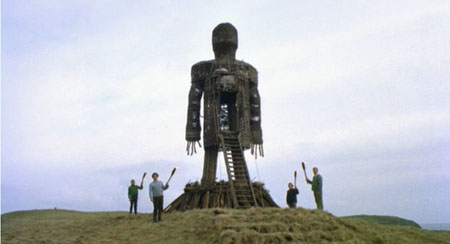
- The “wicker man” was a historically accurate feature of Druidic religions that was first described to the world by Julius Caesar in his “Commentary on the Gallic Wars.”
- In Britain the film was released on the bottom half of a double bill with Don’t Look Now, perhaps the most impressive psychological horror double feature in history.
- Shaffer and Hardy published a novelization of the film in 1976.
- “Cinefastique” devoted an entire 1977 issue to the film, calling it “the Citizen Kane of horror movies.”
- In 2001, an additional 12 minutes of deleted scenes were added to create a “Director’s Cut” version.
- Some of the original footage is believed to be lost forever, including part of the scene where Sgt. Howie first meets Lord Summerisle. The original negative was accidentally thrown away when original producer British Lion Films went under and cleaned out its vaults.
- The climax was voted #45 in Bravo’s list of the “100 Scariest Movie Moments.”
- The 2006 Neil LaBute remake starring Nicolas Cage had as little as possible to do with the original story, was universally reviled, and was even accused of being misogynistic. Some argue that it is so poorly conceived and made that it has significant camp value.
- Hardy released a “spiritual sequel,” The Wicker Tree, in 2011.
INDELIBLE IMAGE: The wicker man itself (although, for those of a certain gender, Britt Ekland’s nude dance may be even harder to forget).
WHAT MAKES IT WEIRD: Hardy and Shaffer create an atmosphere like no other; it’s an encounter of civilized man with strange, primeval beliefs. Select scenes are subtly surreal—observe how the villagers break into an impossibly well-choreographed bawdy song about the innkeeper’s daughter preternaturally designed to discomfit their sexually repressed guest. Other weird incidents are more outrageously in the viewer’s face: the vision of a woman breastfeeding a child in a graveyard while delicately holding an egg in her outstretched hand. Almost invisible details such as the children’s lessons scribbled on the classroom blackboard (“the toadstone protects the newly born from the weird woman”) saturate the film and reveal how painstakingly its makers constructed a haunting alternate world of simultaneously fascinating and repulsive pagan beliefs. The rituals Sergeant Howie witnesses don’t always make sense (and when they do, their significance is repulsive to him), but they tap into a deep, buried vein of myth. The viewer himself undergoes a dread confrontation with Old Gods who are at the same time familiar and terrifyingly strange.
Original trailer for The Wicker Man
COMMENTS: CONFESSION: The version reviewed here–horrors!–is the 88 minute theatrical Continue reading 21. THE WICKER MAN (1973)

 ; your enjoyment of the movie is unlikely to be affected by which version you choose (I can’t determine if there’s a difference in runtime between the two versions).


 , featuring Manos: The Hands of Fate and Santa Claus Versus the Martians, is probably the best place to start). Distributors Gramercy Pictures were concerned that the “riffing” style of the TV show, which was filled with esoterica and in-jokes, might alienate newcomers to the series. Therefore, no references to Kierkegard, Bud Powell or “The Courtship of Eddie’s Father” make it into The Movie. For the most part, Mike, Crow and Tom confine their wisecracks to literal commentary about what’s onscreen: when a mutant hoves into frame, Mike astutely observes that he appears to be wearing slacks, while Tom and Crow quip that the matte painting depicting the alien landscape looks like the planet was designed either by Dr. Seuss or by someone painting a Yes album cover. The wisecracks come at the show’s typical breakneck pace, averaging perhaps three or four a minute, so there’s probably something here to tickle everyone’s funnybone. Still, the writers seem slightly out of their element in this outing: some of the bits seem too carefully scripted, and they grind out a couple of sex jokes and four letter words just to keep the film from getting a dreaded “G” rating. After test audiences unfamiliar with the show squirmed a bit at its length, the entire movie (“host sequences” and all) was cut to a mere 75 minutes at Gramercy’s insistence: by comparison, an average episode of the TV series averaged 90 minutes and the unedited (and more coherent) version of This Island Earth ran 86 minutes! [UPDATE 9/3/2013: Shout! Factory’s 2013 release includes the deleted scenes as extras, along with an alternate ending]..