
366 Weird Movies may earn commissions from purchases made through product links.
“Port Talbot is a steel town, where everything is covered with a grey iron ore dust. Even the beach is completely littered with dust, it’s just black. The sun was setting, and it was really quite beautiful. The contrast was extraordinary. I had this image of a guy sitting there on this dingy beach with a portable radio, tuning in these strange Latin escapist songs like ‘Brazil.’ The music transported him somehow and made his world less grey.”–Terry Gilliam on his inspiration for the title Brazil

DIRECTED BY: Terry Gilliam
FEATURING: Jonathan Pryce, Kim Greist, Michael Palin, Robert De Niro, Katherine Helmond, Ian Holm, Peter Vaughan, Bob Hoskins, Charles McKeown
PLOT: Sam Lowry is a lowly, unambitious bureaucrat working in the Records Department in an authoritarian society “somewhere in the Twentieth century” who frequently dreams he is a winged man fighting a giant robotic samurai to save a beautiful woman. An error results in the government picking up a Mr. Buttle as a suspected terrorist instead of a Mr. Tuttle; Buttle dies during interrogation. Sam visits Buttle’s widow to deliver a refund check for her dead husband, and finds that the upstairs neighbor, Jill, looks exactly like his dream woman; he transfers to the “Information Retrieval” Department to access Jill’s personal files and learn more about her, but ends up running afoul of powerful government interests.

BACKGROUND:
- Brazil is the second part of Gilliam’s unofficial “Imagination” trilogy, which began with Time Bandits and ended with The Adventures of Baron Munchausen. Time Bandits is told from the perspective of a child, Brazil from that of an adult, and Munchausen from an elderly man. Katherine Helmond, Ian Holm and Monty Python buddy Michael Palin all appeared in Time Banditsas well.
- Terry Gilliam co-wrote the script for Brazil with Charles McKeown (who also plays Harvey Lime here, and would later collaborate on the scripts for The Adventures of Baron Munchausen and The Imaginarium of Dr. Parnassus) and playwright Tom Stoppard. The three together were nominated for a Best Original Screenplay Oscar. Novelist Charles Alverson also worked on an early version of the script, but he and Gilliam had a falling out and he was not credited for his work, although he was paid.
- Besides Best Original Screenplay, Brazil was also nominated for a Best Art Direction Oscar.
- The movie is named after its theme song, Ary Baroso’s 1939 “Aquarela do Brazil” [“Watercolors of Brazil”]. “Brazil” represents the exotic, colorful world (with an amber moon) that Sam dreams of escaping to. According to one story, the film was originally to be titled 1984 1/2, but the title was dropped over worries about lawsuits from George Orwell’s estate (a fine adaptation of 1984 had been released the previous year).
- Robert De Niro read the script and lobbied to play the part of Jack, but Gilliam turned the star down because he wanted Palin in the role. De Niro accepted the role of Tuttle instead.
- Brazil has a legendary distribution story. The film was released overseas in Gilliam’s original cut, but in the U.S. Universal Studios did not like the unhappy ending and attempted to recut the film, reducing it from 142 minutes to 94 minutes and editing the ending in an attempt to give it a happy ending. (This studio cut of the film later played on television and has been dubbed the “Love Conquers All” version of Brazil). Gilliam opposed the changes and feuded publicly with Universal Studios head Sid Sheinberg, blaming him personally for holding up the movie’s release, appearing on the television program “Good Morning America” and holding up a picture of Sheinberg, and paying for a full page ad in Variety reading “Dear Sid Sheinberg, when are you going to release my movie?” Against studio orders, Gilliam screened the uncut film for free at the University of Southern California. Curious critics attended the screenings, and before the movie had been released to U.S. theaters, the Los Angeles Film Critics voted Brazil Best Picture of 1985. In a compromise agreed to by Gilliam, Universal cut only 11 minutes from the complete version, left the unhappy ending largely intact, and released the movie soon after (reportedly so as not to jeopardize its chances at winning an Academy Award).
- Calling its style “retro-futurism,” Marc Caro and Jean-Pierre Jeunet credit Brazil‘s art design with influencing their vision for Delicatessen and The City of Lost Children. Brazil’s junkyard of the future look also directly inspired the visual sensibilities of movies such as Dark City, Tim Burton‘s Batman, and 2011’s Sucker Punch.
INDELIBLE IMAGE: Some may nominate Sam’s dream of soaring as a mechanical angel battling a giant robotic samurai, or the torturer posed in his decrepit doll’s mask in the foreground with his tiny victim chained in the center of a massive open-air tower in the distant background, but it’s Katherine Helmond’s personal plastic surgeon gripping and stretching her facial flab impossibly tight that’s the most striking, incisive and unexpected of Brazil‘s many visual non sequiturs.
WHAT MAKES IT WEIRD: Terry Gilliam explained his vision for the milieu he molds in Brazil as one that’s “very much like our world” but “just off by five degrees.” He was shooting for an atmosphere that’s uncannily familiar, something just strange enough to shock the viewer while still highlighting the absurdities of modern existence. Watching Brazil‘s many surreal touches—as when what appears to be a giant boozing tramp peers over a horizon dominated by cooling towers painted sky blue with white clouds—most viewers will conclude Gilliam overshot the five degrees at which he was aiming. But in the unlikely event the rest of the film isn’t strange enough for you, wait for the finale in which Gilliam pulls out reality’s remaining stops, including a scene where a man is literally killed by paperwork.
Original trailer for Brazil
COMMENTS: Terry Gilliam wasn’t kidding when he located Brazil “somewhere in the
Continue reading 85. BRAZIL (1985)

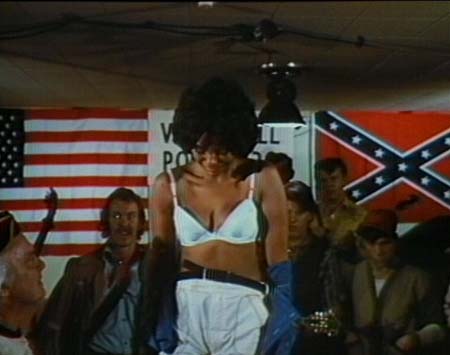


 Alex de la Iglesia bolsters his already fine cult film résumé (Acción Mutante, The Day of the Beast) with this b-movie styled action/melodrama that’s also an allegory for the Spanish Civil War. The movie’s best sequence is the prologue, where the Republican army conscripts a circus troupe into emergency action (“a clown with a machete—you’ll scare the s**t out of them”!) Flash forward to 1973, when the embittered son of one of the Shanghaied carnies embarks upon a career as a “Sad Clown,” but is immediately smitten by a beautiful trapeze artist. Unfortunately for him, the acrobat Natalia is the personal property of the “Happy Clown,” a psychotic, drunken woman-beater who just happens to be great with kids. The two mountebanks’ working relationship quickly turns sour as they take turns beating the greasepaint off each other in a brutal rivalry that eventually leaves both of them mutilated and insane. Which mad harlequin will Natalia choose? The Spanish Civil War angle is simplistic and neither adds nor subtracts from the narrative, which starts as a tawdry carnival melodrama and morphs into an action movie with a high-flying, clown-mauling showdown atop a giant cross. A few Sad Clown dream sequences–he keeps seeing his dead father and archival footage of Spanish pop singer Raphael singing a vintage ballad in clownface—add nominal weirdness, but these touches aren’t pervasive enough to raise the film above the level of aggressively offbeat. Still, there are those who are going to want to check out any film where an insane jester uses lye, an iron, and some clerical vestments to improvise his own clown costume, then steals a cache of automatic weapons and walks the streets of Madrid armed to the teeth with homicidal gleam in his eye. One final note: my movie-going companion was disappointed in the lack of variety in the clown-on-clown violence; he had been hoping to see a wide variety of Bozos brutalizing each other in an all-out melee. So be forewarned—if you consider two killer clowns too few, this Circus is not for you.
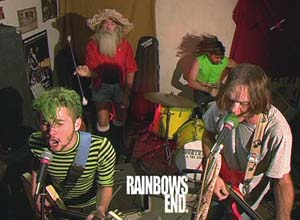 If The Last Circus is edgy, Rainbows End occupies the opposite end of the offbeat spectrum—it’s whimsical. Ostensibly a documentary about six east Texas eccentrics on a road trip to California to pursue a motley assortment of dreams, it’s also one of the funniest movies yours truly has had the privilege of checking out in 2011. It’s the characters who drive the bus in this episodic feature—and in this case that bus needs a push start, leaks radiator fluid, and at times is literally held together with duct tape.