All posts by Gregory J. Smalley (366weirdmovies)

Gregory J. Smalley founded 366 Weird Movies in 2008 and has served as editor-in-chief since that time. He is a member of the Online Film Critics Society, and his film writing has appeared online in Pop Matters and The Spool.

CAPSULE: SLACKER (1991)

Recommended

DIRECTED BY:

FEATURING: The citizens of Austin, Texas

PLOT: Slacker spies on the aimless exploits of the slackers of Austin, TX; the camera follows one character for a few minutes, then veers off to chase another through a series of comical, philosophical, and absurd vignettes involving hit-and-run drivers, elderly anarchists and video fetishists.
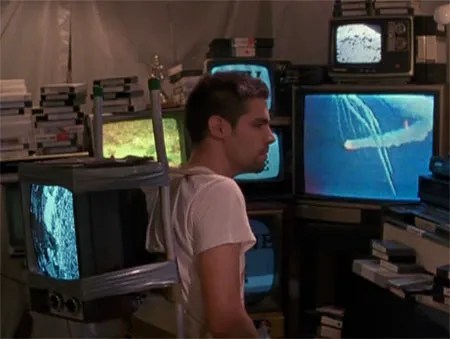
Still from Slacker (1991)

WHY IT WON’T MAKE THE LIST: Slacker is a seminal, interesting, and at times incisive storytelling experiment, but it’s of interest to weirdophiles mainly as the spiritual prequel to Waking Life, which is virtually Slacker remade as a dream.

COMMENTS: The batty cast list—credited characters include “Dostoevsky Wannabe,” “Recluse in Bathrobe” and “Hit Up for Cigarettes”—accurately reflects the mix of mundanity and eccentricity on display in writer/director Richard Linklater’s slice-of-life tour of the coffee shops and crash-pads and on the fringes of Austin, Texas in 1991. Slacker is a character study of the subculture of bright but unambitious dropouts and unemployed postgrads bent on extending their undergrad lifestyles that exists in every college town. At the time of its release it was seen as emblematic of “Generation X”‘s alienation and withdrawal from mainstream culture, but in reality this Bohemian substrata of unmotivated aesthetes and anti-establishment hedonists has always been with us under various names (if the movie had been made in 1291 in Saint-Rémy-de-Provence it would have been entitled Goliard). For this peripatetic essay Linklater borrows the elegant but seldom used narrative device invented by Luis Buñuel for The Phantom of Liberty: two characters walk down the street discussing whether they should leave the country, then the cameraman suddenly gets bored and starts following a man who enters a coffee shop where an insane woman advises him that he should “never traumatize a woman sexually,” then decides instead to see where the guy who just entered the shop wearing a bathrobe is headed to, and so on. The result is a series of vignettes which are occasionally funny, occasionally disturbing, and often repetitive, but which capture a peculiar, laid-back, mad energy of a particular place at a particular point in time. Still, as the film’s oldest character rhapsodizes when remembering Charles Whitman, “this town has always had its share of crazies—I wouldn’t want to live anywhere else.” Memorable characters range from the UFO enthusiast who accosts passersby to explain his theory that we’ve been on the moon since the 1950s to the tomboy who’s looking to fence stolen celebrity gynecology artifacts, cheap. Linklater, who delivers the first of the film’s many discursive monologues himself in the role of “Should Have Stayed at the Bus Stop,” shows an attitude of fond disdain for a town where everyone sleeps in late and is working on an unfinished novel or playing in an unsigned band. The director may have arisen out of the Austin milieu, but if he’s a slacker, then he’s a type-A personality slacker; he’s obviously a much harder worker than the guy who earnestly muses “who’s ever written a great work about the tremendous effort required not to create?” over a cup of cappuccino.

If Slacker has one downside (besides excusably spotty acting by the amateur cast), it’s that the movie turns repetitive and arguably outstays its welcome. Somewhere between twenty and forty-five minutes in we start to get the picture; although the UFO guy and the JFK guy have totally different obsessions, ultimately they’re both just proselytizers with a passion for explaining stuff we don’t care about to us in ridiculous detail. The overall portrait Linklater manages to paint is still very impressive; Slacker may be the most passionate and invigorating movie about doing nothing ever made.

On a personal note, I was lucky enough to see Slacker in Austin, TX in 1991 in a theater in a strip mall (I lived in Dallas at the time but had a friend attending UT with a couch I could crash on). The movie, which was playing nowhere else in the country, had been held over for a second week, and the afternoon matinee showing was standing room only; everyone in the audience but me probably had a friend or two who was an extra in it. I had an aisle seat; a middle-aged woman came in late and stood next to me during the entire show, shooting me nasty looks as she shifted from foot to foot. I recall thinking it ironic that the Austinite had to stand through the whole performance simply because she had slacked off on getting to the show on time.

WHAT THE CRITICS SAY:

“…funny, surreal and weird… Linklater traces the dehumanized weirding of America — as collectively defined by David Lynch, Errol Morris, Jim Jarmusch and others. But he does it with a detached, yet sympathetic sense of irony.”–Desson Howe, The Washington Post (contemporaneous)

(This movie was nominated for review by nicolas, who suggested that all of Linklater’s films were “pretty weird and deep with one or two exceptions.” Suggest a weird movie of your own here.)

CAPSULE: JULIEN DONKEY-BOY (1999)

DIRECTED BY:

FEATURING: , , , Evan Neumann

PLOT: Scenes from the life of schizophrenic Julien and his bizarre family.

Still from Julien Donkey-boy (1999)


WHY IT WON’T MAKE THE LIST: Made between his startling debut Gummo (1997) and his acerbic comeback movie Trash Humpers (2009), Julien Donkey-Boy is the Harmony Korine experiment that falls through the cracks. Sure, it’s got its fertile weird moments—Korine puts Werner Herzog in a gas mask and has him swill cough syrup—but its indifference to narrative or structure makes for a lot of dry patches, resulting in a frequently dull movie that’s of interest to hardcore Korine-ophiles only.

COMMENTS: Switching from familial underwear wrestling matches to hidden camera thrift store excursions to snippets from a freakshow talent contest, with all the footage apparently shot by a drunk and edited by a psychotic, the movie Julien Donkey-boy is as schizophrenic as its protagonist. Julien himself is ably, if unpleasantly, portrayed by Scottish Ewan Bremner, who drools and slurs ridiculous monologues from behind a grill of gold teeth (presumably the source for the “donkey-boy” title reference). Julien’s brother is an aspiring wrestler; his sister practices ballet in her room at night, but she’s in her third trimester. Lording over this motley brood is pop Werner Herzog; he swigs cough syrup (from a slipper), listens to Dock Boggs and occasionally wears a gas mask. He has given up on Julien and his sister and focuses all his hopes and attention on their athletic brother. We absorb these relationships slowly as the movie weaves from one improvised incident to another. Julien spies on his sister dancing, then takes a bath and gibbers out a prayer, then the family has dinner and Herzog discusses the false-teeth cleaning habits of famous people, and so on. Other scenes are simply impressionist camera experiments, with out-of-focus, seasick handheld shots and experimental lighting. Korine keeps up his obsession with grotesqueries and freaks, finding ways to shoehorn a dwarf who plays drums with his feet, a rapping albino, and a human ashtray into the story. One bizarre, disconnected scene shows a nun masturbating. The deliberately undisciplined technique of stitching together sketches shot in various styles is carried over from Gummo, but the collage approach doesn’t work as well for painting a portrait of an individual as it did for a town. By repeating words like mantras and babbling nonsense syllables to fill in the empty spaces in his monologue stream, Julien’s speech resembles a real schizophrenic. But, like a real schizophrenic, although you feel sorry for him, you also don’t want to spend a lot of time with him. The character manages to be simultaneously irritating and boring, which are not the defining characteristics you want in a movie protagonist. In a key scene, Julien proudly recites a poem at the dinner table: “morning chaos eternity chaos midnight chaos noon chaos eternity chaos…” It goes on for several stanzas before Herzog interrupts, explaining he doesn’t like the poem because it’s too “artsy-fartsy.” He then describes the climax of Dirty Harry as his idea of great art. Korine seems to be mocking the public preference for meaningless exploitation over artistic ambition, but the irony is that anyone would consider Dirty Harry a greater achievement than Julien’s nonsense poem. Julien Donkey-boy emerges as the least interesting of Korine’s experimental features, which is a shame because it’s also his most humanistic pictures, and the only one where he seems to truly like his characters (Julien was based on Korine’s uncle). The scene where Sevigny pretends to be Julien’s dead mother while talking to him on the telephone is unexpectedly touching, and the shots of the pregnant blonde meandering through a golden field of sunlit grain while singing hymns counts as the most legitimately beautiful thing Korine has ever filmed. It’s too bad these few sympathetic moments are drowned out by a cascade of babble.

Julien Donkey-boy starts with a certificate (signed by ) proclaiming that the movie was produced in accordance with the Dogma 95 movement. Dogma was a set of rules set forth by von Trier and other Danish filmmakers intended to make filmmaking more naturalistic: i.e. there should only be handheld cameras, no music added, only natural lighting, etc. In practice, almost no Dogma film ever followed all of these arbitrary rules (although, as Armond White incisively pointed out, almost every amateur porn movie did). Julien Donkey-boy includes a non-diegetic musical score and lots of optical trickery that should have precluded it from being certified as a Dogma film.

WHAT THE CRITICS SAY:

“…Korine emerges more clearly this time as a filmmaker exploring the territory where the circus sideshow meets the avant-garde.”–Janet Maslin, The New York Times (festival screening)

(This movie was nominated for review by Eric SG, who rhapsodized that it was “frickin’ weird… Korine’s finest/weirdest accomplishment to date.” Suggest a weird movie of your own here.)

139. PERSONA (1966)

366 Weird Movies may earn commissions from purchases made through product links.

“[The persona is] a kind of mask, designed on the one hand to make a definite impression upon others, and on the other to conceal the true nature of the individual… one result of the dissolution of the persona is the release of fantasy—disorientation.”–Carl Jung, Two Essays on Analytical Psychology

Must See

DIRECTED BY:

FEATURING: ,

PLOT: Without explanation, Elisabeth, an actress, suddenly decides to stop talking and checks into a mental hospital. Alma, a young nurse, is assigned to take care of her, and even travels with her to vacation at the psychiatrist’s summer home as part of her therapy. Once there, Alma grows attached to the mute actress and begins confessing secrets to her; but as the two women spend time together, their personalities seem to merge, and Alma finds herself being mistaken for Elisabeth…

Still from Persona (1966)

BACKGROUND:

  • Ingmar Bergman wrote the script while in the hospital recuperating from a viral infection. He was partly inspired by seeing a photograph of actresses Bibi Andersson and Liv Ullmann together and noticing how similar they looked.
  • Bergman said that “Persona saved my life… if I had not found the strength to make that film, I would probably have been all washed up.” He also said that “…in Persona—and later in Cries and Whispers—I had gone as far as I could go… I touched wordless secrets that only the cinema can discover.”
  • Although they were both married to other people at the time, Bergman and Liv Ullmann fell in love on set and had a child together after the film was completed. Bergman had previously had an affair with Andersson, as well.
  • An almost subliminal shot of an erect penis (it lasts for about one-eighth of a second) was cut from most prints during the film’s original run. The film also occasionally ran into censorship problems due to Bibi Andersson’s long erotic monologue.
  • Persona was ranked the 18th greatest movie of all time on Sight and Sound’s 2012 critics poll, and came in 13th on the director’s poll.

INDELIBLE IMAGE: Beautifully lensed by Bergman cinematographer Sven Nykvist, Persona is justly celebrated for its many doubling shots where the faces of the lead actresses overlap; at one point, their images are overlaid in a mirror, and at another we actually see a composite woman made up of half Liv Ullmann, half Bibi Andersson. The most meaningful of these effects comes near the very beginning of the movie, then recurs again near the very end. A mysterious, gangly young boy looks at a glowing screen with a face on it; the image blurs, then resolves into Andersson, then defocuses and morphs into Ullmann. The boy caresses the screen as if he’s trying to feel the face.

WHAT MAKES IT WEIRD: The first five minutes bring us an erect penis, a tarantula, a sheep being eviscerated at a slaughterhouse, nails hammered into palms, and corpses in a morgue. It’s an assault of images from a boiling id, but mixed with formalist reminders that we are watching a film: the first shot is of a projector’s arc lamp lighting in an incendiary burst, followed by film spooling, cartoons projected upside down, and so on. All of this before the title appears. Are you convinced the director has weird intentions yet?

Original U.S. trailer for Persona

COMMENTS: If you are a fan of the identity-morphing brainteasers Lost Highway (1997) and Mulholland Drive (2001), or Performance (1970), or Continue reading 139. PERSONA (1966) →

CAPSULE: HIGHLANDER II: RENEGADE VERSION (1991)

366 Weird Movies may earn commissions from purchases made through product links.

DIRECTED BY: Russell Mulcahy

FEATURING: , , ,

PLOT: Opposed by a ruthless corporation, an Immortal investigates whether it’s time to remove the ozone shield blanketing the Earth, while he’s being hunted by another Immortal.

Still from Highlander II (1991)
WHY IT WON’T MAKE THE LIST: Highlander II is just crazy enough that it actually has a long shot to make the List—but not in this “Renegade” version. Word has it that the original, pre-director’s cut theatrical release (Highlander II: The Quickening) is even more incoherent, and if a Highlander II makes the cut it should be the most illogical edition in existence.

COMMENTS: Confession: I haven’t seen the original cult classic Highlander. I think this makes me the perfect candidate to review Highlander II, because when I tell you this movie sucks, you can be sure that I am not just some fanboy whining because the sequel violated some obscure point of Highlander canon law (like bringing Sean Connery back from the dead or changing the Immortals from mythical beings into space aliens). No, I can assure you that Highlander blows on its own terms, that it’s internally as well as externally inconsistent, and that it violates the conventions of professional moviemaking as rudely as it breaks the rules of the Highlander mythos.

For a movie to go as spectacularly bad as Highlander II, multiple things have to go wrong; director Russell Mulcahy takes as many wrong turns as someone following handwritten directions to the Dyslexia Association’s national convention. The movie’s first issue is its dual-plot (plus subplots) structure; not a killer flaw on its own, but a good substrate for growing other problems. Our ancient Highlander is being hunted by Immortals from the ancient past who want to decapitate him; that makes sense, I guess. Simultaneously, however, he’s dealing with a shield he helped build around the Earth to protect it from a hole in the ozone layer; the atmosphere may have fixed itself, or so eco-terrorists seem to believe, but evil Shield Corporation wants to keep their monopoly on protective barriers despite the fact that their product keeps the Earth in perpetual darkness. This seems like a totally different, though equally brain dead, sci-fi script that was jammed together with a Highlander sequel screenplay to make a new movie.

Forget the obvious problems, though—like the fact that you couldn’t grow crops in the endless night caused by the ozone shield—nothing in Highlander II makes sense from a basic storytelling perspective. Characters motivations aren’t explained. Their attachments aren’t developed: after our immortal beheads a pair of twitchy goggle-faced time traveling punk assassins, he grows forty years younger, which makes potential love interest Madsen throw herself at him and start dry-humping in an alley—they’ve just met and they’re already a couple. To make things even worse, Mulcahy seems to have his heart set on making a comedy instead of an action movie, including sequences with ancient Spaniard Sean Connery interrupting a modern staging of “Hamlet” (which he thinks is real, yuk yuk) and a comic haberdashery montage.

Yes, I said “Spaniard Sean Connery”: Connery plays a character named Ramirez, who’s Spanish but speaks with a Scottish accent, while the French Lambert plays a Scotsman named MacLeod, who sometimes sounds like a Frenchman trying to do a Don Corleone impression while he has a small piece of walnut shell caught in his throat. Everything is wrong in this movie, but the most memorable and ill-considered scene has to occur when bad guy Michael Ironside, fresh arrived from the past, commandeers a subway train; for no good reason he uses his magic powers to make it go really fast, exposing the passengers to G-forces so powerful that most of them are violently hurled against the back wall of the train, and causing one guy’s eyes to pop out of his head (?) There are about a dozen reasons this scenario makes no sense, but nothing that happens in Highlander II much resembles our reality. Hell, the goings-on in Highlander II‘s universe are implausible even by the standards of Hollywood action movie reality. Sean Connery would have been embarrassed to appear in this mess, if not for the fact that his fully clothed appearance here was a step up in dignity from his turn in a red diaper in Zardoz. Highlander II is nonsensical, but it’s not boring; you’ll shake your head the whole way through, wondering why producers shelled out tens of millions of dollars for that Industrial Light and Magic blue lightning effect, but not one cent for a continuity supervisor.

Highlander II: The Quickening was the version of the film that played in theaters; in it, the Immortals were aliens from “planet Zeist,” not mystical demigods from Earth’s past. In 1995 Mulcahy re-cut the film to make the “Renegade Version,” adding about twenty minutes of additional footage and removing all references to Zeist. There’s no logical improvement in having the Immortals be time travelers rather than aliens, other than better matching the first film. The Quickening version seen in theaters came out on VHS, but as far as I can tell all DVD releases of the film have been the “Renegade” cut. It’s hard to believe there’s an even more incoherent and illogical version of Highlander II running around out there somewhere.

WHAT THE CRITICS SAY:

“…the most hilariously incomprehensible movie I’ve seen in many a long day – a movie almost awesome in its badness.”–Roger Ebert, The Chicago Sun-Times (contemporaneous)

CAPSULE: RETURN OF THE KUNG FU DRAGON (1976)

Ju Ma Pao

DIRECTED BY: Yu Chick-Lim

FEATURING: Polly Kwan (as Sun Kuan Rin Feng), Cheung Lik, Li Chung-Chien, Hsiao Wang

PLOT: A teenage princess learns kung fu so that she can return from exile inside a magic mountain to claim her kingdom from usurpers.

Still from Return of the Kung Fu Dragon (1976)

WHY IT WON’T MAKE THE LIST: This colorful costume fantasy martial arts adventure brandishes a couple of bizarre characters, a convoluted epic plot containing a couple of unintentionally surreal digressions, and editing and dubbing problems that sink below even the usual low standards of the genre. With their warriors flying through the air and doing improbable double backflips while delivering stuttering threats in dubbed English, almost all of the 1970s chopsocky movies are at least a little bit weird; this one contains enough extra strangeness to qualify as a noteworthy movie of its type, though not enough to challenge for a place on the List of the 366 Best Weird Movies.

COMMENTS: Ah, , the weirdest of the martial arts! You never see a devotee of judo using her martial prowess to put her hands all over a street vendor’s stock of steamed buns, or a karate master hanging out with an red-nosed androgynous dwarf who looks like Bjork’s stunt double. Even American kickboxers look dignified by comparison. But it’s the on-the-cheap craziness of the comic book kung fu inspired by Bruce Lee’s Seventies box office success that makes this short-lived but demented sub genre so lovable. Return of the Kung Fu Dragon is, at the same time, one of the most ambitious and the least competent of Taiwan’s action offerings of the period. There’s a childishness to the gaudy presentation, with the bright colors and wizards and princesses and invisible dwarfs, which suggests that Dragon may have been aimed at Taiwanese kids, although of course in the US it played drive-ins and UHF “Kung Fu Theater” venues rather than kiddie matinées. Dragon is constantly throwing so many new characters and twists at you that, if the story wasn’t ultimately such a generic rightful-ruler-returns-from-exile-to-depose-tyrant affair, it would be nearly impossible to follow. Much is made of certain plot devices—e.g. a magic jade dragon staff that somehow allows the evil interloper to finally attack the peaceful island kingdom—that simply disappear later in the tale. The editing doesn’t help the continuity: the aforementioned staff is seen in closeups alternated with shots of a bunny running through the underbrush (to show, we eventually gather, that the wizard is ambushing a hunter as part of the invasion scheme). The schizophrenic editing serves the castle-storming sequence well, at least, as the camera cuts from one individual melee to another and captures the chaos of battle. But even here there are odd inserts, such as when an archer shoots a flying man (?) out of the sky. Neither character was seen before that shot, and neither is seen after. The most jarring moment comes in the middle of the film, when one of the characters, who has taken time out for some martial training, suddenly starts popping into frame, high-kicking in front of a Chinese chess board backdrop, then disappearing. We assume this expressionistic sequence means to stress the analogy between learning to fight and intellectual tactics. But immediately afterwards, another set of characters stumble upon an actual game board set up in the middle of the wilderness—and when their evil imperial pursuers find them the ensuing battle is a stylized kung fu/chess hybrid. It’s that kind of movie; the disdain for realism is amusing and refreshing, but it can also be frustrating and disorienting. Dragon‘s wild cast of characters include, among others, two princesses (well, one is a fake princess who’s also referred to as “the Black Girl” for reasons that are never explained) and an evil usurper who’s given to highly inappropriate bouts of maniacal laughter. The chief bad guy is a wicked old wizard with a beard so long that he has a servant girl whose sole job is to carry it around for him twenty four hours a day; but, he’s not even the weirdest character. That honor goes to the comic relief, an effeminate dwarf with bizarre ponytails and a red nose who can turn invisible (although we in the audience can see him perfectly well whenever he does). In the eyes of the filmmakers, of course, all of this plot and characterization was just necessary filler and carrier for the fight scenes. They are frequent and energetic and, although they lack the athleticism you’d see in some of the better Shaw Brothers productions of the period, they should satisfy chopsocky fans. All in all, Kung Fu Dragon is a frantic, somewhat disorienting experience that should appeal to gonzo martial arts fans; if you’re not already a devotee of the genre, or if you require a plot that makes sense, you should stay far away.

Return of the Kung Fu Dragon is in the public domain in the U.S. and can be viewed at the Internet Archive, among other Net sources. I viewed it on Mill Creek’s fun Martial Arts 50 Movie Pack Collection, which also contains the action oddities Kung Fu Arts and Ninja Champion.

WHAT THE CRITICS SAY:

“Everything is thrown into the cauldron for this one (dig the magic mirror & the burning gravel!), which means there are enough crudely imaginative elements to make Return of the Kung Fu Dragon strangely viewable at best.”–Joe Burrow, The Action Mutant Reviews (DVD)