All posts by Gregory J. Smalley (366weirdmovies)

Gregory J. Smalley founded 366 Weird Movies in 2008 and has served as editor-in-chief since that time. He is a member of the Online Film Critics Society, and his film writing has appeared online in Pop Matters and The Spool.

CAPSULE: THIRTY TWO SHORT FILMS ABOUT GLENN GOULD (1993)

366 Weird Movies may earn commissions from purchases made through product links.

DIRECTED BY: François Girard

FEATURING: Colm Feore

PLOT: A patchwork of short vignettes explores the allure of the eccentric piano virtuoso.

Still from thirty two short films about glenn gould (1993)

COMMENTS: I discovered my all-time favorite recording, Glenn Gould’s complete “The Well-Tempered Clavier,” and François Girard’s Thirty Two Short Films About Glenn Gould at about the same time. I can’t definitively remember which I encountered first: my guess would be Girard’s film, because it is such an effective advertisement for Gould’s genius that it seems likely to have inspired a purchase. On the other hand, it’s entirely possible that I saw there was a film out about this marvelous pianist who accompanied his nimble fingers with ecstatic spontaneous humming,  breathing humanity into Bach’s precise baroque miniatures, and knew I had to learn more about this man. I do know that Gould’s “Clavier” was reissued in on CD in 1993, likely to coincide with this film, and I love to imagine I actually picked up that set from Tower Records and rented a VHS of Thirty Two Films from my local mom and pop video store on the same weekend in 1993 or 1994.

The movie does what it says on the tin (although some might object to calling the closing credits a “short film.”) The sequences break down into four main categories: documentary-style interviews with friends and co-workers, dramatic reenactments of events in the pianist’s life, adaptations of Gould’s own works, and abstract experimental sketches. The interviews are illuminating, and give the film its hybrid documentary character. The dramatic scenes form the bulk of the movie. They follow in a roughly chronological format, but do not tell a continuing story: each is a standalone vignette. Memorable moments show Gould corralling his hotel chambermaid to listen to his hot-off-the-presses LP and the Gould mesmerized by contrapuntal conversations he hears in a diner. A performance of “String Quartet, Opus 1,” one of his few original compositions, an excerpt from the word collage “The Idea of North,” and a dramatization of a portion of his puckish essay “Glenn Gould Interviews Glenn Gould About Glenn Gould” ground us in the legend’s actual creative output. The experimental shorts constitute the most intriguing category, although there are only five or six of them (considering how you count). They include closeups of Gould’s own CD318 piano in action, hammers striking the soundboard, illustrating the physical geometry of the sonic construction; a scene of Gould playing the piano in x-ray vision; and “Gould Meets McLaren,” a 1969 animated short (originally entitled “Spheres”) that shows globes popping into existence, dancing symmetrically across the screen, and dividing like eggs undergoing musical mitosis as Gould plays a Bach fugue.

I once defined bopic as “a movie genre that’s not accurate enough to be documentary or interesting enough to be fiction.” One of the most formulaic and cliched film formats, the celebrity biography only really works when it is heavily fictionalized, as in Amadeus or Lisztomania (which, coincidentally, both involve classical musicians). Thirty Two Short Films shatters the mold of this generally insipid movie genre. There are enough talking head reminiscences to capture the spirit of the man, but not so many that it appears lazy. Girard solves the genre’s central problem—the fact that messy human lives rarely fit neatly into three act structures with unified themes—by ignoring narrative almost entirely. This collage portraiture method captures its subject more faithfully than a “realist” approach would. When we think back on people we know, we recall them as a collection of moments and characteristics; we don’t think of them as a contiguous life story. Glenn Gould was the piano prodigy and the hypochondriac and the man who went everywhere wrapped in a coat and gloves and scarf and the man who called up his friends late at night and talked their ears off and the virtuoso who developed a hatred for performing and the monster who put ketchup on his eggs and the genius and the possibly asexual hermit. He is at least thirty two separate stories, and this seemingly chaotic collection of vignettes creates a portrait of a real person far better than a tick-tock chronology or a forced storyline would. Plus, the music is, naturally, great, and what Gould himself likely would have wanted us to focus on; his passion shines through every segment, turning almost anyone into a classical music fan for at least 90 minutes. Glenn Gould is a strong contender for the greatest biopic ever made.

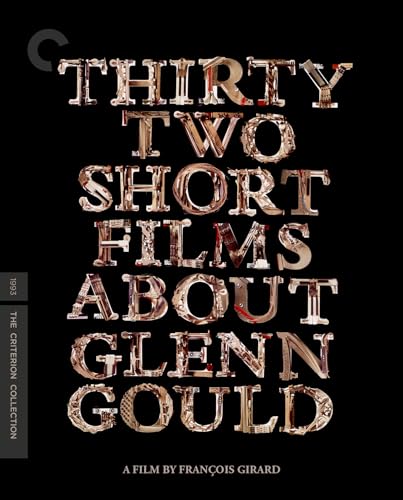
Thirty Two Short Films About Glenn Gould entered the Criterion Collection in June 2025 on 4K UHD and Blu-ray. Of course it is a new 4K director approved transfer. Of course it comes with a booklet (a nice fold out broadsheet with titles and scenes from the shorts on the other side) with an informative essay (from Michael Koresky.) Of course it has a director’s commentary (Girard is joined by co-writer Don McKellar). Other extras include a thirty minute conversation between Girard and fellow Canadian director Atom Egoyan, archival interviews with star Colm Feore and producer Niv Fichman, and a two part 1959 television portrait called “Glenn Gould: Off the Record” and “Glenn Gould: On the Record.”

WHAT THE CRITICS SAY:

“…because of the deadening uniformity of the genre, Girard’s film appears all the more miraculous in retrospect. From its rigorous and deliberately distancing structural gambit to its restless stylistic experimentations, Thirty Two Short Films proves that biopics needn’t color within the lines to effectively portray their subjects.”–Derek Smith, Slant (Blu-ray)

[(This movie was nominated for review, without further comment, by “Anonymous.” Suggest a weird movie of your own here.)
CAPSULE: THE TOXIC AVENGER (2023)

366 Weird Movies may earn commissions from purchases made through product links.

DIRECTED BY: Macon Blair

FEATURING: , , , Jacob Tremblay,

PLOT: A mild-mannered janitor becomes an avenging superhero after being thrown into a vat of toxic waste.

Still from THE TOXIC AVENGER (2023)

COMMENTS: The idea of Hollywood types spiffing up an old script for a polished take on the underground exploitation studio’s punk sensibilities is inherently intriguing. And although some might miss the Jersey grime and DIY nihilism, there’s enough of a novelty factor to the whole enterprise to make the new Toxic Avenger worth a look.

Right away, you can tell that little things like editing, lighting, and cinematography far surpass ‘s capabilities. Not to mention, of course, the acting. (If you can even name an actor from another Toxic Avenger movie, you’re a real fan.) Who wouldn’t be curious to see Peter Dinklage, Kevin Bacon, and Elijah Wood ham it up in Tromaville? Even the supporting characters with less name recognition, Taylour Paige and Jacob Tremblay, blow away most Troma performers, who tend to be broad comic caricatures who come across more through costuming and outrageousness than through line deliveries. The stars don’t sleepwalk through the project, either. Dinklage gives it his all, putting real pathos into Winston Gooze, snuffling in terror and even donning a pink tutu at one point. Bacon has as much of a ball as you would expect as a soulless and unscrupulous corporate huckster with his own mad science dungeon in the basement of his mansion. Wood is nearly unrecognizable as a pasty-faced, Penguin-like chief of security with a bizarre hairdo (he’s balding, but with one exceptionally long wisp of hair growing from the front of his crown).

The major tonal change is that this new Avenger sports conspicuously more heart than Troma’s cynical output. The script goes out of its way to show us that Winston is a decent man, whose only flaw is that he’s overly meek. A widower, Winston takes his responsibility as sole provider for surly teen stepson Wade seriously. Maybe he lacks the courage to stand up to a slumlord who’s harassing his grandmotherly neighbor, but he will instinctively risk his life to save her cat from an oncoming car. When he’s diagnosed with an unspecified fatal illness from mopping up toxic waste all day to feed his family, and then denied lifesaving care by healthcare bureaucrats, he generates legitimate sympathy. And the Avenger’s ultimate targets—corporate scallywags poisoning the populace, not just teen bullies as in the original—make for a noble cause. Paige’s J.J. is an activist, a legitimate self-sacrificing idealist in the usually everyone-for-themself Tromaville. Whether these changes represent a welcome humanizing touch, or a sellout of Troma’s laugh-while-burning-society-to-the-ground ethos, is a matter of personal taste. I think it generally works.

What the remake keeps from Troma is the reliance on comic violence and gore, which is in fact amped up to even higher decibels. Yep, arms get yanked off and heads split open aplenty, and the finale sprays megagallons of blood. The makeup also hearkens back to Troma’s glory days; the Avenger has an inarticulate rubber mask, and the chief baddies (a “horrorcore” band called the Killer Nutz) feature characters like a giant chicken with a mohawk. The comedy, however, misses even more than a Troma production. I didn’t hear a single hearty laugh ringing out at a lightly-attended screening, only occasional muffled chuckles. The humor is not transgressive or politically incorrect in the slightest; targets are kept safe (who could be offended by making fun of health insurers or narcissistic CEOs?) The mostly PG-13 jokes are similar to, but not quite as funny as, those in Attack of the Killer Tomatoes. It would have been nice to see the script go a little harder; one of Troma’s few virtues is their willingness to be equal opportunity offenders.

In the end, the new Toxie is neither the disaster nor the success it might have been. At a minimum, it fulfills what the project promised: a look at what the 80s superhero spoof might have looked like with a reasonable budget. It corrects some of the original’s shortcomings, but abandons some of the outsider charm in the process. Next up: a big budget remake of Pink Flamingos with RuPaul as Divine, Pedro Pascal and as the Marbles, and Lizzo as the Egg Lady.

WHAT THE CRITICS SAY:

“…a weird, messy, heartfelt little beast that finds a surprising amount of soul beneath its buckets of blood…  Against all odds, The Toxic Avenger has grown up, just a little, without losing the sense of gonzo fun that made him a cult legend.”–Nicolas Delgadillo, Knotfest (contemporaneous)

CAPSULE: MAGNETOSPHERE (2024)

366 Weird Movies may earn commissions from purchases made through product links.

DIRECTED BY: Nicola Rose

FEATURING: Shayelin Martin, Patrick McKenna, Colin Mochrie, Mikayla Kong, Steven He, Tania Webb

PLOT: A 13-year old girl with synesthesia deals with a new school, first crushes, bullying, and other typical teen problems.

Still from Magnetosphere (2024)

COMMENTS: Synesthesia, the neurological condition commonly described as “seeing sounds” or “hearing colors,” provides a tempting, if underutilized, possibility for filmmakers. A director can use “draw on the lens” techniques, easily achieved on the cheap through commercial software, to depict a protagonist’s subjective experience of seeing rainbows and candy-colored floaters overlaid on reality, providing an easy excuse to add phantasmagoric visual flair to any story. Typically, an in-film illicit drug trip would provide the pretext for such effects. By addressing synesthesia, director Nicola Rose can create a childlike world of sparkly kiddie psychedelia—fluffy unicorn and cotton candy stuff, but with a tie-dye aesthetic—while staying safely within the confines of a Disney/Nickelodeon storyline.

Protagonist Maggie almost constantly, if inconsistently, hallucinates. Sure, there are the green and purple and yellow sparkles that fill the screen when she sings a ballad on her portable keyboard, and the fact that, when she concentrates, she sees all the other characters with individual colored auras: pink for her sister, brilliant green for her crush, a squiggly mess of multicolored threads for her conflicted bestie. That’s textbook synesthesia. But Maggie can also draw lines and shapes in the air, persistent tracers that form hearts and crowns and words that glow with neon colors. An art lesson is so visually intense for her that the screen glitches into an incoherent muddle as dissonant music plays, causing her to puke. Her Barbie doll, Cassiopeia, talks to her, frankly confessing that she represents Maggie’s insecurities (while denying that she’s part of her host’s “weird brain thing.”). This expansive magical realism, transcending the bounds of simply “hearing colors,” is poetic license that expresses Maggie’s inner sense of alienness. But it also makes the girl seem like she suffers more from Hallucinogen Persisting Perception Disorder than synesthesia. Perhaps her parents slipped LSD into her bottle back in their hippie days?

While the tastefully trippy visuals are novel in this context, the plot is formula, occasionally approaching pure corn. Insecure teen girl has some ultimately minor affliction that makes her self-conscious, experiences normal teen girl problems, gains confidence and the tools to resolve life’s little disappointments with maturity, the future looks bright. There’s bullying, an inappropriate crush, and an LGBTQ subplot to deal with, and it all gets resolved as neatly as you’d expect. To pass the time while the pattern plays out, we have not only the hallucinatory bursts, but a lot of comedy. Maggie’s dad is a goofball thespian directing a community theater production of “Pirates of Penzance” (which also has a predictable arc, with the scrappy citizen-singers overcoming obstacles with help from an unlikely source). The primary comic relief comes from “Whose Line Is It Anyway?” veteran Colin Mochrie, who plays weirdo handyman Gil, a guy who comes off like a kid-friendly version of Creed Bratton from “The Office.” He has a mysterious private existence somewhere outside of polite society and is given to inappropriate, absurd non sequiturs (“I saw action in ‘Nam so that boneheaded, ungrateful numbnuts like you could have a kitchen toilet!”) Gil also hunts rats with a chainsaw. I didn’t find his silly, unmotivated antics particularly amusing, but humor is subjective, and the jokes are for a much younger crowd.

We provide allowances for the script’s formularity, since the film is prosocially pedantic and aimed at a pre-teen to young teen audience. Still, the high ratings on this low-budget film are astounding: an 8.4 on IMDb (the original Toy Story has an 8.3), 100% on Rotten Tomatoes (Lady Bird has a 99% rating). Admittedly, that’s on inappreciable numbers (a mere 88 IMDb voters and 12 RT critics), but even accounting for the small sample size, these scores are a bit baffling. The movie is perfectly fine. The acting is competent, the effects cheap but effective, the message heartwarming, the comedy… probably works for some. But it seems that Magnetosphere is largely lauded for its good intentions rather than its actual quality. It’s a nice movie. There is a large element of self-selection here: with a very limited release, only people already well-disposed to this material are likely to queue it up. There aren’t enough teenage synesthetics to form a cult audience, and even those kids will be drawn more to the same mainstream Marvel/Hunger Games fare their peers devour—it’s mostly their parents who will be cheering Magnetosphere. For curiosity seekers like us, this is a decent, modest movie that won’t feel like a waste of time, but it’s not some hidden classic that justifies those gaudy metrics. A reminder to always be skeptical of high internet ratings on low-distribution niche items.

WHAT THE CRITICS SAY:

“Magnetosphere is for the weirdo in all of us who believes in the beauty the world has to offer.”–Tina Kakadelis, Beyond the Cinerama Dome (contemporaneous)