
An incurable illness puts its victims into a death-like sleep for days at a time. Those afflicted are subject to a life of solitude, or scientific experimentation.
Monthly Archives: June 2016
WEIRD HORIZON FOR THE WEEK OF 6/17/2016
Our weekly look at what’s weird in theaters, on hot-off-the-presses DVDs, and on more distant horizons…
Trailers of new release movies are generally available at the official site links.
IN THEATERS (LIMITED RELEASE):
Cosmos (2015): Andrzej Zulawski‘s first film in 15 years—and the last before his death in 2016—is a metaphysical farce about a law school flunkout vacationing in a strange house. Based on a novel by Witold Gombrowicz.
Tickled (2016): Investigating a “competitive tickling” video, a journalist finds himself harassed by cyberbullies. Reviewers have called this documentary “strange,” “offbeat,” and yes, “weird.” Tickled official site.
SCREENINGS – (Tribeca Screening Room, New York City, Jun. 17):
“In the Bight”: Ben Finer is offering a free screening of his latest 28-minute short, a moody, weird horror about two eight-year-olds who make macabre discoveries while playing in the woods. There are two screenings, at 7:00 and 8:00 PM, so you still have time to make a midnight movie (see below) afterwards. The screening room is at 375 Greenwich St. Tribeca Film Center.
SCREENINGS – (Nitehawk Cinema, New York City, Jun. 17-18):
Eraserhead (1977): Read the Certified Weird entry! Eraserhead on Fathers’ Day weekend; brilliance. Eraserhead at Nitehawk Cinema.
SCREENINGS – (IFC Center, New York City, Jun. 17-18):
The Holy Mountain (1973): Read the Certified Weird entry!” Lucky New Yorkers, who can catch Eraserhead one night and Mountain the next. The Holy Mountain at IFC Center.
NEW ON DVD:
Cemetery of Splendor (2015): A medium helps a woman explore the troubled dreams of a soldier with sleeping sickness in Apichatpong Weerasethakul’s latest mystical drama. Anxiously awaited by “Joe”‘s fans, this release contains behind-the-scenes footage and deleted scenes. Buy Cemetery of Splendor.
NEW ON BLU-RAY:
Cemetery of Splendor (2015): See description in Blu-ray above. Buy Cemetery of Splendor [Blu-ray]
“Nikkatsu Diamond Guys: Vol. 2”: A collection of obscure yakuza comedies produced by Nikkatsu in the early 1960s: Tokyo Mighty Guy, Danger Paws and Murder Unincorporated. Unincorporated is the one that caught our attention: from what we can gather from the few fans who caught it, it features assassins named “Joe of Spades” and “Al Capone III” (who uses an exploding slingshot) and features bizarrely-staged killings Seijun Suzuki might have approved of. Buy “Nikkatsu Diamond Guys: Vol. 2”
What are you looking forward to? If you have any weird movie leads that I have overlooked, feel free to leave them in the COMMENTS section.
DIRECTOR RETROSPECTIVE: THE FILMS OF DAINA KRUMINS
During one of my incognito Sacred Heart Catholic Church field trips with my Aunt Greta, visiting from the Arizona desert, I received a mild scolding—albeit not from immediate family, who would have flipped out had they known my father’s sister had smuggled me into one of those Catholic churches. Rather, it was from Greta herself, who corrected my venial sin: in being transfixed by the statues of the Infant of Prague (a toddler Jesus in drag), Our Lady of Sorrows (Mother Mary with seven knives jabbed into her chest), and Teresa of Avila (she of Lorenzo Bernini’s orgasmic ecstasy), I made the mistake of saying: “It’s cool that your church has such weird imagery, worships women, and you don’t have to worship Jesus.” Greta very quickly and sternly pointed out to me: “We do worship Jesus, and we don’t worship Mary or Teresa. We venerate them.” In hindsight, and putting aside that I was in my teens that was probably the first time I became vaguely conscious of a latent (although denied by some) connection between feminism and blue-collar Catholic Surrealism.
The films of Daina Krumins have these qualities, and more. As with most Krumins followers, I was introduced to her via The Divine Miracle (1972). I can’t recall where I first saw it, but it was in the late seventies, and Aunt Greta’s parish icons immediately called to mind Krumins’s film. Another weird image that I had cemented at the time, mixing my mythologies, was from a TV documentary about the suicide of George “Adventures of Superman” Reeves, in which the narrator described the late actor’s devoutly Catholic mother going to the crime scene and placing holy cards of saints on all the blood stains and bullet holes in the room (the narration was accompanied by eccentric flashing images of devotional postcards). The reason I reference the latter is that there’s something of a holy cards-on-bloodstains texture to Krumins’ work.
Krumins was born in 1947 in a Munich refugee camp. Her family immigrated to the U.S.A. Like her mother, Krumins suffers from Asperger’s syndrome. Fortunately, her father, who was an accomplished photographer, and her uncle, a Latvian painter, encouraged her early creative eccentricities, which included collecting metal shavings, wax teeth, snakes in formaldehyde, jellyfish, and crabs. Ignoring her teachers’ advice to be more social and pursue a normal life, Krumins received her BFA at the NYU Film School, followed by an MFA from the California Institute of the Arts, and found employment as a rotoscoper with Lookout Mountain Films. Images from her art and film can be viewed on the filmmaker’s website).
 Krumins is a New Jersey resident and has been described as a “homegrown Surrealist.” That description suggests something coming from the earth, which is apt. Krumins refers to her film, photographs, woodwork, and sculpture as preoccupations with textures. To date, she has completed a total of four films, Continue reading DIRECTOR RETROSPECTIVE: THE FILMS OF DAINA KRUMINS
CAPSULE: THE CHASE (1946)
DIRECTED BY: Arthur Ripley
FEATURING: Robert Cummings, Michèle Morgan, Steve Cochran, Peter Lorre
PLOT: A mentally fragile veteran of the U.S. Navy stumbles into the employ of an eccentric gangster and inadvertently seduces the hoodlum’s wife; his dodgy escape gets dodgier when his mind snaps and he awakens in an unfamiliar apartment.

WHY IT WON’T MAKE THE LIST: While it is rare to find an example of film noir that isn’t worth seeing, it is also rare to find one that fits the description of “weird.” The Chase dabbles with some strange encounters and has a plot explosion that very nearly carries it into 366’s warm embrace, but it comes up short enough to make one wish the film-makers had gone the distance.
COMMENTS: With a scramble of memory loss, noir grit and brevity, oddball bad guys, and a side of Peter Lorre, The Chase cruises down its narrative path with an unlikely mix of the conventional and the abnormal. We dive right into the story of Chuck Scott (Robert Cummings), a down-at-the-heels navy veteran in Florida who finds and returns the cash-filled wallet of one Eddie Roman (Steve Cochran). Both impressed and amused by the man’s honesty, Roman hires Scott as his chauffeur, firing the man’s predecessor on the spot. Scott quickly gains the trust of Roman’s captive wife, Loran (Michèle Morgan), and after a number of trips to a nearby beach, they plot an escape. An hour in, we are deep indeed in standard noir territory—and then something odd happens.
But please allow me to back-track for a moment. As characteristic as it was to start with, The Chase already seemed to have a weird undercurrent attempting to break free. The scene where Scott tracks down Roman and tries to get a meeting with him to return the wallet is a bizarre set-piece that I can only describe as repetition at the corner of creepy and amusing. Through the door’s peep-hole, Scott first explains himself to a butler (named “Job,” of all things), then holds the exact same conversation with a henchman, one “Mr Geno” (Peter Lorre). Gaining entrance, Scott explains himself a third time before Mr Geno reluctantly directs him to Eddie Roman, who is being groomed by two female attendants. Roman asks one, “How do you feel being a barber … cutting a man’s hair. Feels good, doesn’t it?”
Between this scene and the twist we see a souped-up luxury car with rear-seat gas and brake, Peter Lorre laconically quipping, a knife-throwing Cuban waiter, and a biddable Asian imports/exports shop-keeper. Or do we? There is a dimly lit transition shot of a telephone ringing and all of a sudden the movie jumps from bad things happening in Cuba to unclear things happening back in Florida.
Scott, waking up in a room we know he lives in, has no idea what’s going on. He stumbles around a little, he takes the medication he left on the desk, and makes a phone call, explaining, “…it’s happened again.” At that point, The Chase seems to shift into high-weird gear, and we start trundling down an understated but “off” string of events. Build, build, build—and oh so sweetly—only, alas, to have the weird rug pulled away to make room for an altogether too prosaic ending. I generally don’t say this, but this film seems ripe for a re-make by a director who’d be willing to go as far as coherently ((Or, for those who’d prefer, as incoherently as possible.)) possible; that said, I recommend you check this one out.
Kino Lorber’s 2016 DVD/Blu-ray release of The Chase includes commentary by none other than Guy Maddin.
WHAT THE CRITICS SAY:
LIST CANDIDATE: SYMBOL (2009)
Shinboru
DIRECTED BY: Hitoshi Matsumoto
FEATURING: Hitoshi Matsumoto, David Quintero, Luis Accinelli
PLOT: A Japanese man wakes up in an enormous white chamber whose walls and floor are littered with cherubic phalluses; meanwhile a Mexican luchador, “Escargot Man,” prepares for a wrestling match.
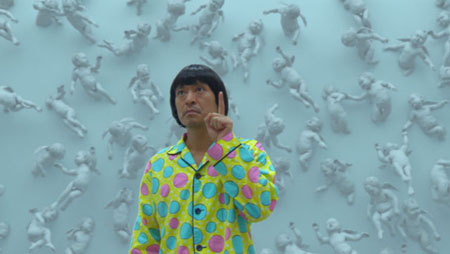
WHY IT MIGHT MAKE THE LIST: The main narrative, following the action in the white room, is so absolutely removed from reality it demands a place on the List, while the Mexican wrestling scenes remain incongruous and weirdly exotic throughout.
COMMENTS: It’s difficult to talk about why Symbol is so arresting and oddly rewarding without spoiling details of the story or the reveals near the film’s end. Suffice to say the two seemingly unrelated narratives come together in a most unexpected and ridiculous way, and the torture experienced by the Japanese protagonist in the white room leads to a truly transcendent revelation by the film’s end.
The film is structured under three headings: “Learning, Practice and Future.” Learning refers to the rough education the Japanese man receives in the white room from the mischievous owners of the Cherubic phalluses, while the particulars of Practice and Future I’ll leave viewers to discover on their own.
Much of the early joy of the film involves watching Matsumoto interact with the white room and the objects released therein, seeing his mounting frustration at the “bait and switch” as the Cherubs deliver alternately helpful or useless items. They give him an endless stream of sushi rolls, but no soy sauce until after he’s eaten the very last one; 3D glasses direct him to press a particular button, only to have an enormous Cherub behind break wind on him. Another scene sees him releasing an endless pile of chopsticks before he finally presses a different phallus, sending an office trolley careening into his shin. This comedic torment in the vein of silent film comics like Buster Keaton or Harold Lloyd continues until Matsumoto recognizes a means of escape…only to be led to earth-shattering alternatives.
There is very little to fault in this film; from its production values to its execution it is equally unique, vibrant and visually arresting. The pacing is surprisingly jaunty for an episodic film, and it actually rewards a re-watch to see how all the various threads build towards the film’s close. Some viewers may find the ridiculous payoffs a little too surreal to be satisfying; to them I can only recommend the consolation to be found in the philosophical treatise “In Praise of Silly,” the book never written by comedian Mike Myers’s father, who believed silliness “was our natural state, and we only get serious to get to silly.” Symbol contains moments of textbook Japanese cinematic weirdness.
A possible weak element of the film (other than two unnecessary moments of flatulence humor) could be identified in Matsumoto’s performance; while his timing is excellent and he works as a hapless, unassuming everyman, his constant screaming is often irritating. A more skilled slapstick performer like Jim Carrey, Lee Evans or Rowan Atkinson could have made the physical comedy transcendent and ballet-like rather than merely solid and amusing. This is a rare case where I would not mind a U.S. remake.
I know little about director and star Matsumoto, other than he is one half of a comic duo—the boke or “funny man” of a team called “Downtown”—on Japanese television, just like his contemporary Takeshi “Beat” Kitano (Hana-bi, Violent Cop) was at the beginning of his career. The comparison to Kitano is apt due to the similar career trajectory the two men have followed, although Matsumoto only has four feature film directorial credits to his name and none of the Kitano’s international recognition—at least for the time being. Also, from a cursory YouTube glance, Matsumoto’s TV persona appears to be that of a histrionic, put-upon weed (the character he develops here follows a similar vein) whereas Kitano’s comedy always came from his role as bully.
WHAT THE CRITICS SAY:
(This movie was nominated for review by many people, but “Roy” was first when he advised us in 2010 “You gotta check out this flick ‘Symbol’ by the director of Big Man Japan.” Suggest a weird movie of your own here.)