Tag Archives: Thriller

TARGETS (1968)

Although Targets (1968) is not the masterpiece debut film of Peter Bogdanovich, as some have claimed, it is a compelling, near-valedictory film for star . Being an almost autobiographical story, it should have served as a near-perfect coda for the actor. Instead, Karloff wanted to die acting, and for the first time in his career since 1931’s Frankenstein, he did not have a plethora of offers. Producers knew that the horror icon was almost literally on his last leg, and the cost of insuring him was undoubtedly a problematic casting factor. The final offers came from  to make a series of low budget Mexican horrors, but it is best to conveniently imagine those swept under the rug.

Targets serves more as a last, satisfactory glimpse at the Karloff screen persona, as opposed to being a successful film on its own terms.  It also is the film debut of director Peter Bogdanovich, who miscast himself in the film in order to save money. In part, this was due to having  as his tight-fisted producer. Pragmatic in his business approach as usual, Corman  wanted to use clips from his previous film with Karloff, The Terror (1963) as filler, and granted Targets a twenty-three day shooting schedule and $125,000 budget. From this simple instruction, Bogdanovich crafted a surprising, awkwardly innovative narrative, which the artist in Corman responded to, advising Bogdanovich: “Shoot it like Hitchcock.”

Karloff plays aging horror star Byron Orlok , screening his latest film, The Terror. Much to everyone’s surprise, Orlok announces his retirement. Script writer Sammy ( Bogdanovich) waxes angsty; he has finally written a screenplay, one which hints at something akin to the plot of Targets itself.  Feeling like a Gothic anachronism amidst the authentic horrors of the newspaper headlines, Orlok refuses to read the script. The studio heads encourage Sammy to dissuade Orlok from his decision. Orlok and Sammy get drunk and screen Karloff’s Criminal Code (1931, dir. Howard Hawks), the film which lead to his casting as the monster in Frankenstein (1931). Orlok agrees, albeit reluctantly, to promote The Terror at a local drive-in cinema.

Targets then roughly shifts to its parallel narrative: Bobby Thompson (Tim O’Kelly) who sports a Baptist haircut as the husband and son of diehard Republican gun-lubbin, red, white and blue super-patriot suburbanites. Cue massacre.

This is the more compelling plot, ultimately rendering  the Orlok narrative a bit prodigal, despite Karloff’s very satisfactory depiction of Orlok.

Still from Targets (1968)Looking at Targets in hindsight, it may be tempting to see Bogdanovich’s film as prophecy after a string of infamous media-inspired shooting events (as John Hinckley’s obsession with Jodie Foster in Taxi Driver led directly to his assassination attempt on President Ronald Reagan in 1981, or James Holmes’ massacre in an Aurora movie theater during the premiere of Dark Knight Rising). Life imitating art? Art imitating life?  It is hardly that simplistic, nor can Targets serve so accessibly as a model.

Bobby’s domestic scenes are the most unsettling, awash in grisly rural hues. His Charles Whitman-like sniper escapades reveal Orlock’s drive-in horror host gig as clunky medievalism. That, of course, is Targets intent , but it tries so hard to be clever and profound that by the time we get to the cinema-under-the-stars shootout,  we feel the residue of a naive fusion. Considering our growing apathy to the aftermath of pop culture inspired violence, perhaps Targets‘ coarseness is all too apt.

174. VERTIGO (1958)

“If Vertigo remains, unchallengeably, Hitchcock’s masterpiece, this is surely because there the attitude to the unknown and mysterious is not simply one of terror but retains, implicitly, a profound and disturbing ambivalence.”–Robin Wood, “Hitchcock’s Films”

“Only one film had been capable of portraying insane memory, impossible memory: Alfred Hitchcock’s Vertigo.”—, Sans Soleil

Must See

DIRECTED BY:

FEATURING: James Stewart, , Barbara Bel Geddes

PLOT: During a rooftop pursuit of a fleeing suspect, John “Scottie” Ferguson finds himself hanging from a drainpipe; the uniformed cop who tries to save him slips and falls to his death. Suffering from debilitating acrophobia and vertigo, as well as survivor’s guilt, Scottie quits the police force. An old college acquaintance offers him a job tailing his wife, and Scottie becomes obsessed with the beautiful and mysterious woman who believes she is possessed by the spirit of a suicidal ancestor.

Still from Vertigo (1958)
BACKGROUND:

  • The source of Vertigo was the novel “D’Entre Les Morts” (translated in English as “The Living and the Dead”), by the French writing team of Pierre Boileau and Thomas Narcejac. Hitchcock had wanted to adapt the pair’s first novel, “Celle qui n’était plus,” but the rights were sold to a French company and it was made as Les Diaboliques by Henri-Georges Clouzot. Boileau-Narcejac would later write the screenplay for Les Yeux Sans Visage [Eyes Without a Face] (1960).
  • Hitchcock bought the rights to Vertigo back from Paramount (along with four other 1950s-era films), then willed them to his daughter. The film went out of circulation for many years. The rights eventually ended up with rival studio Universal, who restored and re-released the film theatrically (in 1983 and again, after a major restoration, in 1996) to great acclaim.
  • The dizzying “vertigo” effect (sometimes known as the “dolly zoom” or “trombone shot”) is the film’s most famous technical innovation: the camera tracks backwards on a dolly while simultaneously zooming the lens, resulting in  a disorienting visual experience of moving backwards and forwards simultaneously.
  • Abstract Expressionist painter John Ferren designed the dream sequence.
  • A controversial flashback scene reveals the “twist ending” about two-thirds of the way through the movie. Before the film’s release Hitchcock decided to remove this sequence, over the strenuous objections of his producer, Herbert Coleman. After preview audiences were unimpressed by the flashback-free cut, the studio ordered Hitchcock to return the film to the way it was originally shot.
  • Vertigo, which was exceedingly dark compared to the average Jimmy Stewart vehicle, was not as successful as Hitchcock’s previous hits such as 1954’s Rear Window, and barely broke even at the box office. The scale of its initial failure is often exaggerated, however, for the sake of a good story: it qualified more as a minor disappointment than a flop. The contemporaneous reviews were also mixed (leaning towards positive with reservations about plausibility and pacing), rather than universally negative, as is sometimes implied.
  • In the 2012 Sight & Sound critics poll, Vertigo replaced Citizen Kane, the top vote getter every year since the poll’s inception in 1962, as the greatest movie of all time. (It ranked #7 on the director’s poll, where Tokyo Story took the top spot).

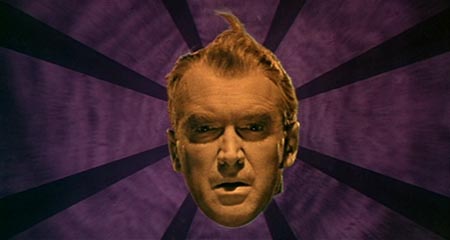
INDELIBLE IMAGE: It has to come from the dream sequence. Although we chose Jimmy Stewart’s head floating against a shifting kaleidoscope background to illustrate this review, the most thematically significant image is the male shadow falling, first onto a terracotta rooftop and then through a white void (this figure is incorporated into the original Saul Bass-designed poster, where it combines with the movie’s other significant motif, the spiral).

WHAT MAKES IT WEIRD: Vertigo may be one of the most subtly strange movies out there. It’s entirely possible to watch it and see it as no more than a conventionally (if implausibly) plotted mystery. But peer into its vortex closer and you’ll see why this brightly lit but oddly dreamlike tragedy has fascinated generations of moviegoers: in its depths hides madness, illusion, necrophilia, sexual domination, a perverse longing for death, guilt, and the grinding gears of merciless fate. There’s a reason Vertigo is a cult movie. It doesn’t give up its secrets easily. Watch it again, with your weird eyes.


Re-release trailer for Vertigo

COMMENTS: Did any movie produced under the Hollywood studio system ever torture its protagonist as mercilessly as Vertigo torments Scottie Continue reading 174. VERTIGO (1958) →

173. THE NIGHT OF THE HUNTER (1955)

“Dream, little one, dream,

Dream, my little one, dream.

Oh, the hunter in the night

Fills your childish heart with fright.

Fear is only a dream.

So dream, little one, dream.”

Lullaby from Night of the Hunter (lyrics by Walter Schumann)

Must See

DIRECTED BY:

FEATURING: , Billy Chapin, ,

PLOT: Harry Powell is a self-ordained Reverend during the Great Depression who makes a living by touring Appalachia and marrying widows, who disappear soon thereafter under mysterious circumstances. In prison for stealing a car, he shares a bunk with Ben Harper, a bank robber on death row who has refused to tell the authorities the location of the $10,000 he has stolen. After his release (and Harper’s execution), Rev. Powell finds the robber’s widow, and learns that his young son John knows where the fortune is hidden.

Still from Night of the Hunter (1955)
BACKGROUND:

  • The film is based on a 1953 novel by Davis Grubb. The book was a bestseller at the time of it’s release but was long out-of-print until a 2014 reprint.
  • Night of the Hunter‘s Harry Powell was based on real-life murderer Harry Powers, nicknamed “The Bluebeard of Quiet Dell,” a West Virginia-based killer responsible for the deaths of two widows and three children.
  • was Laugton’s first choice for Harry Powell but he turned down the role of the serial-killing misogynist preacher, thinking it might damage his career. Robert Mitchum had no such concerns and was eager to play the part.
  • Mitchum’s autobiography contains several inaccurate accounts of the filming, including the allegation that Laughton heavily rewrote James Agee’s original script (an accusation supported by Laughton’s widow Elsa Lanchester). Film scholars who studied Agee’s original script, which was discovered in 2003, reported that the director shot the film almost exactly as written.
  • This was the only film Charles Laughton ever directed. Although the story that he was so stung by the negative critical reaction to the movie that he never directed again is often repeated, Laughton himself claimed that he simply preferred directing theater to working on films.
  • Prior to shooting, Laughton screened silent films by D.W. Griffith to get a feel for the look he wanted for the movie.
  • In 1992, Night of the Hunter was selected for inclusion in the National Film Registry.
  • Ranked #71 in Empire Magazine’s 2008 poll of the Greatest Films of All Time. Ranked #2 on “Cahiers du Cinema”‘s list of the “100 Most Beautiful Movies.”

INDELIBLE IMAGE: Pick a single image from Night of the Hunter? It’s a fool’s errand. As much as it hurts to pass up the vision of the “good” Reverend with his right hand of love wrestling his left hand of hate, or the dreamlike serenity of Willa Harper’s final resting place, we think the most meaningful image must come from the children’s flight downriver—specifically, we chose the shot of the skiff passing before the spiderweb, as John and Pearl (temporarily) float away from their murderous stepfather’s snares.

WHAT MAKES IT WEIRD: The Night of the Hunter is such a massive achievement that we’re invoking 366 Weird Movies’ sliding scale rule: the better a movie is, the less weird it needs to be to make the List. Not that Hunter isn’t strange, by Hollywood standards (and particularly by 1950s Hollywood standards). Film archivist Robert Gitt called this expressionist/Southern Gothic hybrid “the most unusual and experimental film made in Hollywood in the 1950s.” Perhaps that is why director Charles Laughton decided to bring cinematographer Stanley Cortez, who once bragged “I was always chosen to shoot weird things,” onto the crew. Hunter is packed with shadowy, stagey, artificial shots (contemporary critics complained that the effects—both narrative and visual—were “misty”). Mixing fairy tale menace and Freudian killer fathers while masquerading as a titillating potboiler, Hunter was so unique and unexpected that it slid right under the upturned noses of viewers in the 1950s, that most conformist-minded of decades. Generations since have remembered it fondly—well, in their nightmares, at least—and it has since been elevated into the canon of great movies. And now, of great weird movies.


Original trailer for Night of the Hunter

 COMMENTS: An utterly original blend, Night of the Hunter is simultaneously a melodrama, a fairy tale, a film noir, a Southern Gothic, a Biblical Continue reading 173. THE NIGHT OF THE HUNTER (1955) →

LIST CANDIDATE: TRANS-EUROP-EXPRESS (1967)

DIRECTED BY:

FEATURING: , , Alain Robbe-Grillet

PLOT: A director (played by Robbe-Grillet himself) pitches a complicated story about a cocaine smuggling caper to a producer during a train ride, and the audience watches the results play out, revisions and all.

Still from Trans-Europ-Express (1967)
WHY IT MIGHT MAKE THE LIST: The second film from novelist-turned-director Alain Robbe-Grillet is a pioneering work of cinematic meta-fiction that prefigures the work of (among others) by putting a fictional author inside of the movie, one who supposedly writes the script in real time as we watch. Sometimes the story backtracks on itself, erasing old plot points or creating alternative scenarios. To make things even stranger, the protagonist of the movie-inside-the-movie is obsessed with bondage, and begins a relationship with an elegant prostitute who may help him fulfill his most excessive fantasies.

COMMENTS: Sitting on the Trans-Europ-Express from Paris to Antwerp, a director tells his producer that they should set a movie on this train; they decide it should be about drug smuggling. A man, who we’ve previously seen buying a suitcase to smuggle cocaine, walks into their compartment. The producer and director are invisible to him; he only sees the script girl. When he leaves almost immediately, the director comments “is he crazy?” “Didn’t you recognize him?,” asks the producer. “It’s Trintignant. What about using him in your film?” They then do proceed to use Trintigant in their film treatment. The story they concoct on the fly sends him to an Antwerp where everyone is either an operative working for the local cartel or a detective, and where he is sent on an increasingly Byzantine series of rendezvous to prove his worth and to obscure his tracks. Along the way he begins a relationship with the prostitute Eva, with whom he indulges his strangling fetish. After a series of double crosses and betrayals which are nearly impossible to sort out, because the director keeps rewriting the script, it all ends in tragedy at “Eve’s Witchcraft Cabaret,” a bondage-themed club with a naked girl chained to a rotating stage.

Despite the dark themes, Trans-Europ-Express is actually a comedy, though in a high-minded, very French way—more “witty” than “funny.” The movie’s abstract, Cubist twists on gangster scenarios recall ‘s crazy yakuza film Branded to Kill, also from 1967. Although it deconstructs the conventions of a genre picture in similar fashion to ‘s 1960 Breathless, the light touch and playfulness keeps Express from feeling as ponderous and self-important as the works of some of Robbe-Grillet’s New Wave contemporaries. At the same time, the movie’s perverse sexuality, related to the subconscious desires of Surrealism, ventures further into the forbidden than his contemporaries dared. Express‘ scenes of sexual strangulation, implied rape and even nudity were considered pretty hot stuff at the time, although they will look tame through jaded modern eyes.

Robbe-Grillet began his career as an experimental novelist, helping to found the avant-garde “nouvelle roman” genre. He turned to cinema after co-writing the script for Last Year at Marienbad with . Trans-Europ-Express was his second film as director. The Kino sub-label Redemption began releasing Robbe-Grillet’s neglected films, some of which have never been on DVD before, in 2014.

WHAT THE CRITICS SAY:

“The result is both a pure example of narrative deconstruction – with some genuinely absurd moments – and a pretty weird experience for the viewer…”–Johnathan Dawson, Senses of Cinema

CAPSULE: IRON DOORS (2010)

DIRECTED BY: Stephen Manuel

FEATURING: Axel Wedekind, Rungano Nyoni

PLOT: A man wakes up to find himself locked in a concrete vault sealed with iron doors; he hopes the key to his escape lies inside the padlocked locker that, besides a dead rat, is the room’s only furnishing.

Still from Iron Doors (2010)

WHY IT WON’T MAKE THE LIST: It’s a well-made independent film heavily influenced by fantastical survival movies like Cube and Saw; while it is interesting, it languishes in the shadow of its superior predecessors.

COMMENTS: Iron Doors asks the gross, but mesmerizing, question: if you were locked inside of a concrete room for days with no hope of escape, how long would it take before you started drinking your own urine and eating maggots to survive? This is the situation a nameless man finds himself in when he wakes up with a hangover in a concrete vault, assuming he’s the victim of a prank. But as the hours pass and no one answers his calls from help—and the iron doors locking him in refuse to budge—he will be forced to draw on all of his ingenuity and will to survive. Part of a mini-genre of “people abducted and held in mysterious bondage” movies that includes Cube, Saw, the first act of Oldboy, Iron Doors is ably acted by Axel Wedekind, who rants and raves at his fate before settling down to the business of devising a seemingly impossible escape. The early reels are surprisingly involving. The purgatorial gray stone and steel of the bunker, flickering in fluorescent lights, provides an oppressive and claustrophobic atmosphere, but director Manuel finds ways to add splashes of color for excitement, and the film doesn’t look dour or cold at all. Just as the script seems to have run out of survivalist tropes to mine for life-and-death drama, a surprise development in the second act gives it fresh new dynamics to explore. So far, so good; Iron Doors manages to involve us in its high stakes and mystery through the first hour of its brisk eighty minutes. The big problem is, not surprisingly, the ending. Having built up such a sense of baffling mystery, its almost certain that the resolution will be a letdown. Without giving away the secret, we can safely say that most viewers have found the ending disappointing. The filmmakers intend an allegorical reading, which is fine, but mildly ambiguous denouement doesn’t satisfy. It neither magnifies the mystery, nor provides a plot-hole free logical solution; it instead splits the difference between a mystical and a rational explanation, satisfying no one. Furthermore, the end comes on too abruptly, without a properly tense buildup, and the final shot snaps off quickly before we can process it. Despite the lack of a final killing blow, however, Iron Doors is still a fine and worthy independent effort that deserves neither its current obscurity nor its unconscionably low IMDB rating of 4.5. The principals involved here all show talent and I look forward to seeing them in future projects.

Iron Doors was made in Germany by an Irish-born director, but the main character speaks perfect English and appears to be American. The film was originally shot and presented in 3-D. This gimmick didn’t go over well with those who saw it at film festivals, who frequently complained that the stereoscopic effects were pointless given Iron Doors‘ minimalist setting. The DVD version looks just fine on a flat screen.

WHAT THE CRITICS SAY:

“…appears to have a lot to say but is very ambiguous about its message and intent. The twist conclusion only baffles the film further and, perhaps, for the better.”—Doc Rotten, Horror News (contemporaneous)