Tag Archives: Sex

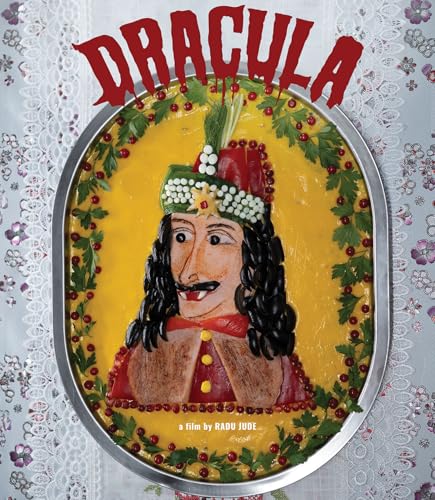
CAPSULE: DRACULA (2025)

366 Weird Movies may earn commissions from purchases made through product links.

Recommended

DIRECTED BY:

FEATURING: Adonis Tanta, Oana Maria Zaharia, Gabriel Spahiu

PLOT: A film director narrates the tale of a washed- up actor playing Dracula, while AI- crafted sketches inspired by the vampire myth play as interludes.

Still from Dracula (2025)

COMMENTS: When a movie starts with shots of the historical Dracula—also known as Vlad the Impaler—clearly made by AI, you know you are in for a treat. Romanian director Radu Jude, one of the most uncompromising voices in European cinema today, proves once again his willingness to be weird and sarcastic. Dracula is a spiritual successor to some of his most controversial works, especially the infamous Bad Luck Banging or Loony Porn (2021).

A film director narrates the tale of an actor performing Dracula through a structure somewhere in between sex-show and participatory theater. Jude intersperses a plethora of interludes among this story as the in-film director occasionally asks AI for inspiration and help in creating embedded narratives. This complex form of tales-within-tales recall everything from “The Arabian Nights” to ambitious cinematic projects like Mariano Llinás’ colossal La Flor (2018).

Dracula is a Frankenstein of a movie, a pastiche of vastly different genres and styles. There are adaptations of Romanian vampire tales, love stories set in different time periods, a hyper-stylized farce about a farmer harvesting cocks, a vulgar song, and ads inspired by Nosferatu (1922). Some sketches place Dracula in contemporary Romania to comment on the re-emergence of extreme right and nationalism, while another uses the vampire as an allegory for bloodsucking capitalism, in the vein of Julian Radlmaier’s Blutsauger (2021).  There is even a realistic slice-of-life episode towards the end.

Jude works here with a wide range of styles, from grim realism to surrealism. Some things remain constant, however. The acting is mostly over-the-top with rapid dialogues, as if we were watching a variety show. Jude applies Brechtian techniques, with fourth wall breaks reminding us of the artificiality of everything portrayed here. The theatrical props and AI shots further the theme. Dracula is Jude’s most ambitious work yet, a cinematic mammoth lasting almost three hours and an exemplary labyrinth of narrative complexity.

WHAT THE CRITICS SAY:

“Jude combines A.I., dark humor, tongue-in-cheek humor and unhinged zaniness that creates a surreal experience that might be enjoyed more while drunk or high.”–Avi Offer, The NYC Movie Guru (contemporaneous)

Dracula [Blu-ray]

  • Region A Blu-ray

List Price : 36.97 $

Offer: 22.36 $

Go to Amazon

IT CAME FROM THE READER-SUGGESTED QUEUE: 8½ WOMEN (1999)

366 Weird Movies may earn commissions from purchases made through product links.

DIRECTED BY: Peter Greenaway

FEATURING: John Standing, Matthew Delamere, Polly Walker, , Toni Collette, Amanda Plummer, Shizuka Inoh

PLOT: A wealthy businessman’s son attempts to bring his widower father out of his grief by introducing him to the pleasures of libertinism.

Still from 8 1/2 Women (1999)

COMMENTS: Probably the most quoted line from Peter Greenaway’s exploration of high-class sexual adventurism comes when father and son watch Fellini’s classic 8½. “How many film directors make films to satisfy their sexual fantasies?” Philip asks. “Most of them,” his son replies. It’s a noteworthy piece of art that coughs up its mission statement so readily. Greenaway is already renowned for his treatment of sex as an artistic endeavor. By aligning himself with one of the acknowledged greats of the cinema, he would seem to be making a definitive statement on the primal urge.

It’s important to remember, however, that Greenaway really doesn’t think much of the male of the species. The two weirdest elements of 8½ Women—how much humiliation men are willing to endure to get their base needs met, and what women deem important enough to lead them to assent—are opposite sides of the same coin. Blinkered, selfish, easily distracted by carnal matters, men are always getting in their own way, and so it goes with Philip and his son Storey. These men possess staggering wealth (their fortune was built on debt collection), so much so that they can usually ignore the niceties of culture or propriety, and even then, they can think of little but their next gratification. No surprise that women recognize them for the pathetic, hollow beings they are. 8½ Women feels like an argument for mutual benefits: the men get the sexual gratification they crave, and the women get to fulfill their own needs, be they professional or psychological.

Those needs, to be certain, are kinda peculiar. Gioconda wants to be pregnant at all times, but Clothilde just wants permission to wear her old mistress’ hats, while Beryl has a thing for farm animals, a fetish that lands her in the world’s most perverse body cast. Lording over them all is Palmira, the most powerful person in the house (and probably in any room she enters) by virtue of having the most control over her reason for being there: the pleasure of shagging Philip until he drops, a fact which is completely lost on Philip’s son, who petulantly expects to be next in line.

Walker is electrifying in her power, which highlights how deliberately unsexy this movie about men who keep a harem is. This spiciest scene in the film features novice nun Griselda (played by Colette) leading the Emmenthal boys to her chamber; they are enraptured, she is paying off a debt. She’s not the only one. It’s noteworthy that when one of them actually needs something from the men–such as Mio, a Japanese woman who wants to take on the qualities of a Kabuki female impersonator–they come up pathetically short. 8½ Women never stops reminding you that these relationships are transactional, and is surprisingly cruel to anyone who dares think love has anything to do with it. (One woman is even bludgeoned over the head with a roof tile for her mistake.)

8½ Women is implicitly weird because of what Greenaway brings to any project, but it ultimately doesn’t add up to much. People come, people go, those who understand the rules get what they want. Philip and Storey may get to the root of Fellini’s imagination, but never get anywhere near the magic found there.

WHAT THE CRITICS SAY:

“Like all other Greenaway movies, 8 1/2 Women transpires in a surreal setting that reflects our reality as seen through a looking glass darkly… traditional cinematic elements exist primarily to provide a framework in which Greenaway can operate to present a variety of outrageous sequences… unless you like the offbeat simply because it’s offbeat, 8½ Women may not be the best choice for an evening’s entertainment.” – James Berardinelli, Reel View (contemporaneous)

(This movie was nominated for review by Caleb Moss, who described it thusly: “”Peter Greenaway presents Marquis de Sade, complete with father/son homoerotic subtext, a giant pig, a woman with an odd sexual predilection for horses and swine, inexplicable earthquakes, self-aware parallelisms with Fellini, and as you may of guessed, literally half of a woman, to name some of the very least of strange, detached debaucheries in this film.” Suggest a weird movie of your own here.)

CAPSULE: WARM WATER UNDER A RED BRIDGE (2001)

Akai hashi no shita no nurui mizu

366 Weird Movies may earn commissions from purchases made through product links.

DIRECTED BY: 

FEATURING: , Misa Shimizu, Kazuo Kitamura

PLOT: An unemployed salesman intends to steal hidden treasure from a confectionary shop, but complications arise when he falls for the elderly owner’s caretaker, a woman with a unique condition.

COMMENTS: Sasano is already down on his luck when his only friend, Taro, passes away. The architectural firm he worked for has folded, leaving him unemployed, and his wife only calls to insult him while demanding his unemployment check. Taro, known as the “Philosopher,” lived as a hobo in a tent filled with rare books, but he was the only person to treat Sasano with respect and to offer him advice gleaned over the course of a misspent life.

Taro once told Sasano of a buried treasure, secreted in a pot, in a house with a view of a red bridge, in a summer resort town on the Sea of Japan. At an impromptu funerary meal held in his honor, Sasano mentions Taro’s claim to this improbable treasure. His hobo companions laugh it off; Taro told the rest of them about it, too. But after a series of unpromising job interviews, Sasano decides to leave Tokyo for the seaside, in search of Taro’s supposed pot of gold.

Arriving in the off season, Sasano stands out as an unlikely tourist. He locates the red bridge, and the house, which Taro had worried wouldn’t still be standing. Sasano spies a woman leaving the building and tails her to the grocery store. There, he catches her stealing cheese while awkwardly standing in a puddle of water. A dropped earring gives him an excuse to follow her back home. She hesitantly welcomes him in, then their chance meeting rapidly becomes a rather. . . aqueous sexual encounter.

Saeko, as she reluctantly explains, suffers from too much “water,” and when it overflows, she’s driven to commit crimes like petty theft. Thoroughly shocked by the whole thing, Sasano hypocritically reproaches her for stealing, while the relationship provides him convenient opportunities for him to search the house for Taro’s treasure.

As Sasano spends more time in the town and comes to know its quirky residents, the story heads in a predictable direction; but its tale of two unlikely romances is tinged with metaphysical symbolism surrounding the element of water. In one scene, Saeko takes Sasano to meet a nuclear physicist who studies neutrinos. He explains to them how the particles have to be shot through “superpure water” in order for their experiments to work. The town’s pure water also provides the key ingredient to making the perfect sweet cakes, though as Saeko eventually reveals to Sasano, their river was once dangerously polluted with cadmium.

Director Imamura’s enduring interest in the connection between human beings and their environment, as well as his explorations into the influence of crime and nonconformity on Japanese society, surface here again, in his final film. The flights of philosophical fancy lead into brief moments of CGI-animated imagery, but most of the scenes remain rooted more or less firmly in reality. Ultimately, Warm Water makes for a slightly kinky but heart-warming tale of how to find purpose, meaning, and happiness in life, along with sex without shame.

WHAT THE CRITICS SAY:

“…combines fish out of water stories with a weird metaphor for female sexuality in this sweetly quirky film which never quite gels.”–Laura Clifford, Reeling Reviews

IT CAME FROM THE READER-SUGGESTED QUEUE: SNOW WHITE AND RUSSIAN RED (2009)

Wojna polsko-ruska (Polish-Russian War)

366 Weird Movies may earn commissions from purchases made through product links.

DIRECTED BY: Xawery Żuławski

FEATURING: Borys Szyc, Roma Gąsiorowska, Maria Strzelecka, Sonia Bohosiewicz, Anna Prus, Dorota Masłowska

PLOT: Against the backdrop of ongoing tensions between Poland and Russia, Silny, a drug-using student, pines for his unfaithful girlfriend Magda; he sublimates his pain through hedonism, but begins to question his role in the universe and the very nature of his own reality. 

COMMENTS: Finding a suitable title to sell a movie to another country’s audience is not the least challenge foreign films face. If a direct translation doesn’t work, then you have to come up with something that makes sense to a different culture without betraying the original spirit. By this standard, Snow White and Russian Red is a pretty good effort, evoking the colors of the Polish flag while referencing two of the protagonist’s greatest foes: the cocaine that provides an escape and the oppressors who continue to loom over Polish life even decades after the fall of communism. Nice work, title translators.

The undercurrent of politics is a constant in Snow White and Russian Red, and Silny, looking like the lead singer of Right Said Fred and alternating between uncontrolled violence and tearful self-pity, is ill-equipped to understand any of it. He is supposedly pursuing a business degree, he is surrounded by decadent baubles of the West like beauty pageants and fast-food joints, and he dreams of living in a McMansion in a suburb where everything looks the same. But he’s continually drawn back to Magda, the hot blonde in the Soviet-red dress whose infidelities infuriate him and only make him want her more. They are beyond co-dependent; they are perpetually locked in each other’s orbits, pushed and pulled by gravity.

Someone more well-versed in the particulars of Polish politics and society could do a better job of deciphering the allusions that populate the film, particularly the women who simultaneously entice and frustrate Silny’s attempts to find escape through sex: Angela, the nihilistic goth who embraces suicide but also is protective of her virginity; Arleta, who seems to want Silny’s affections but consistently irritates him with insulting gossip; Natasha, the tough girl who teases Silny but is so focused on getting her next hit that she snorts powdered soup broth; and Ala, the cute nerd who loves her parents but gets physically aroused talking about this amazing 16-year-old writer she’s discovered named Dorota. Silny feels superior to all of them on an intellectual level, but consistently fails to score sexually. If director Żuławski (son of Andrzej) has any metaphor to convey, it’s that Poland is like Silny, neither fish nor fowl, small on the world stage but unsatisfied at home. 

But while there’s the sociopolitical allegory going on, there’s also a weirder level of surrealism that suggests what we’re seeing is somewhere beyond the realm of reality. Within the opening minutes, an irate Silny deploys cartoon physics to fling his erstwhile girlfriend across the room. When Angela gets sick during a two-person dance party, she spews sick like a fire hose, and then upchucks rocks. Silny engages in a ridiculous fight with nearly everybody in a public park, dispatching them with greater ease than Neo in The Matrix. But it’s only with Silny’s arrest for fighting that we jump headfirst into the rabbit hole, when he is led to the desk of a clerk named Dorota Masłowska. Those in the know will recognize that name as belonging to the author of the original novel upon which this film is based. (Also, the same teen author who got Ala hot and bothered.) Turns out that’s not just a cheeky tip-of-the-cap; we’re looking at the genuine article. We’ve actually seen Masłowska before, moping around in a striped hoodie and narrating some of Silny’s story in the first person, but now that they’re face-to face, she can demonstrate her omnipotence by forcing him to do her bidding and literally deconstructing the set. It’s a pivot that evidently comes straight from the book, a piece of meta-narrative that Żuławski replicates with the author’s participation. It’s also a twist that only muddies the waters. The godlike powers of the author don’t equate neatly to the forces keeping Silny down, or to Poland, for that matter. It’s just a whole other element that Żuławski and Masłowska want to play with, and it doesn’t serve the story or stand on its own. It’s a hat being worn on top of another hat.

After despairing about ever knowing what in his life is real, Silny rams his head into a wall and finds himself in Hell, which turns out to be a talk show where he fabricates his encounters with the devil for the audience’s amusement. Masłowska is in that crowd, too, and if anything sums up the arc of Snow White and Russian Red, it’s this: a character reckoning with things he can hardly understand, and the author who created him sitting in judgment. It’s a dance that seemingly has no end.

WHAT THE CRITICS SAY:

“The visually splashy sophomore effort of Polish helmer Xawery Zulawski is just as helter-skelter as the spiky local literary sensation that inspired it, but is finally too thematically anemic to provide any real dazzle… no amount of wacky occurrences can substitute for any deeper insight or suggest possible solutions. This makes the film totally static on a thematic level, despite its pumping soundtrack, roving camera, often psychedelic lighting and snazzy (though thankfully not hysterical) editing. Effects work and wire-fu fight scenes add to the generally off-the-wall tone.” – Boyd van Hoeij, Variety (contemporaneous)

(This movie was nominated for review by haui. Suggest a weird movie of your own here.)