Tag Archives: Recommended

354. URUSEI YATSURA 2: BEAUTIFUL DREAMER (1984)

“It’s no use, Mr. James — it’s turtles all the way down.”–J. R. Ross, “Constraints on Variables in Syntax”

Recommended

DIRECTED BY:

FEATURING: Voices of Toshio Furukawa, Fumi Hirano, Machiko Washio, Akira Kamiya, Takuya Fujioka; Wayne Grayson (as Vinnie Penna), Roxanne Beck, Marnie Head, Draidyl Roberts (English dub)

PLOT: Students in the town of Tomobiki prepare for a fair the following day. One of the teachers, suffering from exhaustion, develops a strange feeling of déjà vu, finds his apartment covered in dust and mushrooms, and hypothesizes that the entire town is living the same day over and over. As the school nurse launches an investigation, people gradually begin disappearing from the town until only she and a small group of high schoolers are left.

Still from Urusei Yatsura 2: Beautiful Dreamer (1984)

BACKGROUND:

  • “Urusei Yatsura” began as a manga (by Rumiko Takahashi) in 1978 and was adapted as a long-running animated television show in Japan starting in 1981 and ending in 1986. It was also known as “Lum, the Invader Girl,”  titled after its main character, when it played on the BBC. The series incorporated a wide variety of influences and was especially known for mixing science fiction with Japanese folklore. It had an “anything can happen” quality to it; eating mysterious candy might make hearts appear over your head, or one of the characters might find a camera that sent those it photographed to alternate dimensions. Even so, Beautiful Dreamer was a radical departure from the series’ comic formula.
  • Mamoru Oshii worked on 106 episodes of the “Urusei Yatsura” television series and was credited as lead director on two. He is also the credited director on the first Urusei Yatsura movie, For You, but was only brought in after a previous director quit, and considered his work on that film a “rush job.”
  • This excursion departs from the series’ usual focus on Lum and aliens, but is partly inspired by a previous episode of the series, “Wake up to a Nightmare.”
  • Beautiful Dreamer contains many references to the Japanese folk tale Urashima Tarō, about a fisherman who marries a spirit princess and spends what seems like a few years in her kingdom, but returns to his village to find that centuries have passed. This is an old and recurring theme in folk tales, which Washington Irving took as the basis for America’s “Rip Van Winkle.” In Urashima Tarō’s story the fisherman is originally rewarded for rescuing a turtle, which is why there are so many references to turtles in the movie.
  • Beautiful Dreamer also references the baku, a mythological monster who eats dreams and nightmares. It has no Western equivalent.
  • Beautiful Dreamer was Eric Young‘s staff pick for a Certified Weird movie.

INDELIBLE IMAGE: The main characters briefly escape Tomobiki on a Harrier jet, only to look back and see that their city rides on a turtle’s back, à la Hindu cosmology.

THREE WEIRD THINGS: Nazi tea shop; copyrighted piglet; town on a turtle

WHAT MAKES IT WEIRD: Beautiful Dreamer co-stars an amorous flying turquoise-haired alien in a tiger-striped bikini. Not only is that not the weirdest thing in the movie, it’s the touchstone of normality in a film that drops the romantic slapstick conventions of the TV series it was adapted from in favor of a mind-bending trip, bearing its characters into dreamlike worlds on the back of a cosmic turtle.


Original trailer for Urusei Yatsura 2: Beautiful Dreamer

COMMENTS: What would happen if you took a beloved Japanese Continue reading 354. URUSEI YATSURA 2: BEAUTIFUL DREAMER (1984) →

CAPSULE: BROTHERHOOD OF THE WOLF (2001)

Le pacte des loups

Recommended

DIRECTED BY: Christophe Gans

FEATURING: Samuel Le Bihan, Mark Dacascos, , Émilie Dequenne,

PLOT: It’s 1764 and a vicious monster is terrorizing the French province of Gevaudan; the king sends his foremost naturalist, along with his Iroquois companion, to track down and slay the beast.

WHY IT WON’T MAKE THE LIST: Convoluted plot and Matrix-style combat in a period drama do not a Weird Movie make, but darn it if it doesn’t come close.

COMMENTS: When contemplating this wondrously over-the-top film, I was struck (once more) with too many ways to open a review. Perhaps, “Wikipedia informs me that Brotherhood of the Wolf is a ‘French historical action horror film'”; or alternately, “Reader, be warned that along-side the ‘Recommended’ tag slapped at the top should be an as-prominent ‘Ridiculous’ tag.” I’ll settle, instead, on the following: “Baroque ’90s action hits its peak in Christophe Gans’ period drama, Brotherhood of the Wolf.” This movie crams in so many rehashed film techniques that it becomes a gloriously Bruckheimer-Woo-Ritchie-Besson-esque romp through mid-eighteenth century France.

The French Revolution is in full swing, but within minutes we careen back to half a century prior. Two horsemen in the rain approach a gaggle of thugs (dressed in drag) who are harassing an old man and his daughter. Down jumps Mani (Mark Dacascos), an Iroquois warrior, and after a bit of slow-motion, quick-cut bandit-thrashing, he remounts and continues his journey with the other rider and soon the two arrive at the castle of Gévaudan’s local aristocrat. Who are these mysterious strangers? Along with Mani is the much-laureled Grégoire de Fronsac (Samuel Le Bihan), a natural philosopher and some-time adventurer, who is determined to solve the mystery of the “Beast of Gévaudan.” What follows involves French-court courtship, martial-arts, French-court politics, a mess of cultists, and even some aristocratic incest. And of course there’s that big wolf monster cutting down the peasantry with impunity.

The stylistic approach Christophe Gans employs is apt for a narrative as convoluted as Brotherhood of the Wolf. Granted, he allows himself one-hundred and forty minutes to spin his yarn, but a miniseries’ worth of characters, events, and twists is jammed therein. The cinematic bombardment is pinned onto the plot bombardment: slo-mo combat set pieces, where one man (typically Iroquois) dispatches the baddies with an unchanging expression; staggered “pan and pause” shots setting things up for some not-so-subtle action foreshadowing; and even a few reverse chromatic effects for no reason other than, “Hey, you know what would look cool?”-ism. Having immersed myself during the ’90s in some of the best action movies the decade had to offer, I saw all their elements distilled in the service of an obscure eighteenth-century wolf legend[efn_note]Admittedly not as obscure to residents of France, but still.[/efn_note]. I was overwhelmed with what could be best described as “smirking nostalgia.”

Alas, while Brotherhood of the Wolf stands as tour-de-force that attains considerable novelty through its impressive derivativeness, it is something of a “weekend warrior” in the realm of weird movies. Gans keeps the movie’s tone turned up throughout the run time, but despite being the director of the second (ever) Certified title, he seems more commercially inclined with this “French historical action horror” romp. But I have no complaints about that what-so-ever.

WHAT THE CRITICS SAY:

“The Brotherhood of the Wolf plays like an explosion at the genre factory… I would be lying if I did not admit that this is all, in its absurd and overheated way, entertaining.” –Roger Ebert, Chicago Sun-Times (contemporaneous)

CAPSULE: CANNIBAL! THE MUSICAL (1993)

Recommended

DIRECTED BY: Trey Parker

FEATURING: Trey Parker, Matt Stone, Dian Bachar, Ian Hardin, John Hegel

PLOT: Alferd Packer and a small band of hopeful gold-rushers lead an ill-fated expedition from Utah to Colorado through the snowy Rocky Mountains. Six walk in; one walks out. It’s also a musical.

Still from Cannibal! the Musical (1993)

WHY IT WON’T MAKE THE LIST: The base premise of a comedy-musical about a historic cannibal gold-rusher is certainly attractive enough to watchers of weird. Beyond that, Cannibal! The Musical, while funny and charming, doesn’t shoot for the extremes of weirdness commonly seen on the List. It’s not even the first musical western comedy we’ve reviewed here, and it’s way at the end of the line of movies we’ve considered.

COMMENTS: Fans of the animated franchise “South Park” can already tell you how skilled Trey Parker and Matt Stone are at writing musicals; the theatrical feature South Park: Bigger, Longer & Uncut was a surprising hit with show-stopping numbers, and then “The Book of Mormon” (the play, not the book) cemented their reputation. And of course, black humor is a given with this creative pair. So it’s interesting to see their work on this low-budget production when they were still students at University of Colorado-Boulder, before “South Park” made them famous. It released originally as Alferd Packer: The Musical in 1993 before Troma Entertainment, spiritual peers to Parker/Stone, picked it up for distribution as Cannibal! The Musical.

For a hopeful few seconds it meets the expectation you have for a Troma movie, when the film opens with a deranged cannibal attacking and taking bites out of hapless settlers in the snowy woods. This turns out to be a flashback from a courtroom, circa 1883, where defendant Alferd Packer (Trey Parker) is on trial for murdering his traveling party. Later, in his cell, a local reporter who’s attracted to bad boys goads him into telling her his story, by segue of talking about his horse, Liane. And so we’re swept into the musical tale of the ill-fated Alferd Packer’s Gold Rush expedition in 1874, accompanied by a ragtag band of optimistic hangers-on—teenagers James Humphrey (Matt Stone) and George Noon (Dian Bachar), Mormon priest Shannon Bell (Ian Hardin), butcher Frank Miller (Jason McHugh), and twinkle-toed Israel Swan (John Hegel)—none of whom have the slightest clue about gold-mining or surviving treks through the Rockies in the dead of winter.

Of course, for a campy comedy musical, the movie treats the historical Packer’s tale with about as much accuracy as Mel Brooks recounting the Spanish Inquisition. Townspeople and random pioneers on the trail warn the party of grave doom, Indians, and a cyclops (who proves disappointingly un-Harryhausen). The group stays disciplined by putting individuals on time out when things get uncivil. Bad luck haunts the crew in every way from losing the horse (to which Packer will sing an ode) to stumbling into random bear traps, and the crew gets lost enough to chance upon the Grand Canyon on their way from Utah to Colorado. A band of punk-rock trappers taunt the party along the way. Asian kung-fu Indians beset the party. While not a lot makes sense, the story moves at a swift enough clip that you’ll barely mind. Be wary after watching it so you aren’t caught idly singing “Hang the Bastard” in inappropriate contexts.

Formed from the quirky imaginations of the Parker/Stone team, Cannibal! The Musical is an enjoyable romp with plenty of the team’s trademark dark humor. The production at times is patterned after Oklahoma! There’s parody of tropes both musical (songs break down mid-verse as the singers argue about chord theory) and western (“Look at all these teepees we have; because we’re Indians!”), yet despite the gory opening scene there’s barely a whiff of a horror aspect: our Troma expectations fizzle after the first five minutes and don’t rekindle until the final twenty. Considering it was a student effort that started out as a fake trailer for film class before the professor called the team’s bluff, the movie is an excellent, if silly, effort. Its legacy is a cult following, the occasional stage revival, and the introduction of “shpadoinkle” into weirdophile vocabulary. But it only has passing business flirting with the wild west of weird cinema.

WHAT THE CRITICS SAY:

“It’s all pretty stupid, but at times, there are refreshingly ludicrous notes that even people old enough to see this movie without a guardian can appreciate. One approach: Imagine the film taking place in South Park animation. If Cartman were ripping that man’s arm off and eating it, it might be cute.”–Anita Gates, The New York Times (1998 revival)

CAPSULE: “DIRK GENTLY’S HOLISTIC DETECTIVE AGENCY, SEASON 2” (2017)

Recommended

DIRECTED BY: Douglas Mackinnon (episodes 1 & 2), (ep. 3 & 4), Richard Laxton (ep. 5 & 6), Wayne Yip (ep. 7 & 8), Alrick Riley (ep. 9 & 10)

FEATURING: , , , Amanda Walsh, , , , , John Hannah, Alan Tudyk

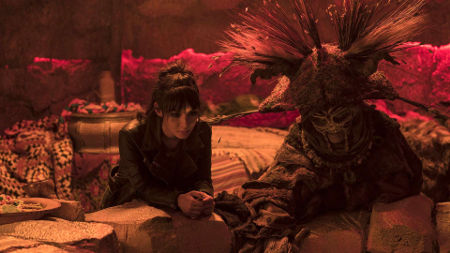
PLOT: After the events of Season 1, Todd and Farrah are on the run and Dirk is a prisoner in a secret military facility; a new mystery begins when a visitor from the magical land of Wendimoor reveals that Dirk is prophesied to save their world from an evil Mage.

dirk_gently's_holistic_detective_agency_season_2

WHY IT WON’T MAKE THE LIST: TV series, not movie. But it’s a series you may want to take note of: otherwise, we wouldn’t be reporting on it, would we? “Dirk Gently”’s mix of absurd humor, bewildering but addictively complex plotting, and fanboy-friendly sci-fantasy tropes was just intriguing enough that that BBC America took a chance on it as potential cult item, but also so weird and difficult that it was cancelled after only two seasons.

COMMENTS: “Have you noticed an acceleration of strangeness in your life?”

The following synopsis may not make much sense to a lot of you. This includes veterans of “Dirk Gently Season 1” as well as newcomers to the series. The one advantage Season 1 viewers have over total neophytes is that they understand “Gently”’s method—throw about a dozen subplots and random events at the viewer in episode 1, then spend the rest of the season slowly connecting the dots, with every little detail merging in a “holistic” (and fantastic) fashion. So, I’ll just lay it out: season 2 introduces a gay pink-haired hero with a scissor sword. A train in the sky. A fishing boat run aground in a field in Montana. A friendly, sort of slow sheriff and his hard-partying deputy. A beleaguered middle-aged woman with a limp, a crummy son, a crummy husband, and a crummy job at the quarry where her crummy boss is making shady deals. A dashing gangster in a snappy white suit with a black tattooed hand and a fabulous mustache. A magic wand. A car stuck in a tree. (The literal Purple People Eater won’t show up until episode 4).

It does all connect, naturally. This high-fantasy based plot is perhaps not as satisfying as Season 1’s time-travel yarn, but on the other hand the show devotes more time to building up its underlying infrastructure, dropping hints about Project Blackwing and introducing new “anomalous individuals” like Dirk and the Rowdy 3. (They’re all sort of a team of metaphysical X-Men gone renegade.) Rather than dominating the plot with his clueless exuberance, Samuel Barnett’s Gently is sidelined a bit this season, moping through most of the story in an existential crisis. He and Elijah Wood’s Todd Brotzman invert their Season 1 dynamic, with Todd now eager to solve the case for his own reasons, dragging the reluctant detective along with him. Other characters pursue their own arcs. Farrah shows more vulnerability, and there are hints of burgeoning romance between her and Todd. Todd’s sister Amanda develops magical powers, making her character more relevant—although this development feels a little forced. Ken is set up for a heel turn. And holistic assassin Bart (Fiona Dourif) remains the most fascinating entity. Her fans will be thrilled with her opportunities to prove she is the ultimate badass killing machine, and she gets by far the best lines: “I think that sometimes when you’re killing people they don’t like it, and it makes them unhappy, and scared, and also dead, which they don’t like, I don’t think…” If that monologue doesn’t intrigue you, then “Dirk Gently” isn’t the show for you.

Unfortunately, the series has been canceled, and we’ll never get to see where creator was ultimately headed with all of this. The most bittersweet part of what turned out to be the series finale is that the last shot sets Bart up for a dramatically increased role in the unmade Season 3.

WHAT THE CRITICS SAY:

“…a show where weird things happen in literally every frame…”–Hahn Nguyen, IndieWire (season premier)

350. SHADOWS OF FORGOTTEN ANCESTORS (1964)

Tini zabutykh predkiv, AKA Shadows of Our Forgotten Ancestors; Shadows of Our Ancestors; Wild Horses of Fire

“To say that Shadows of Our Forgotten Ancestors violates every narrative code and representational system known to the cinema is an understatement—at times, in fact, the film seems intent upon deconstructing the very process of representation itself. The relationship between narrative logic and cinematic space— between point of view inside and outside the frame—is so consistently undermined that most critics on first viewing literally cannot describe what they’ve seen. Adjectives frequently used to characterize Shadows of Forgotten Ancestors are ‘hallucinatory,’ ‘intoxicating,’ and ‘delirious’—terms that imply, however positively, confusion and incoherence.”–David Cook, filmreference.com

Recommended

DIRECTED BY:

FEATURING: Ivan Mykolaichuk, Larisa Kadochnikova, Tatyana Bestayeva

PLOT: Ivan, a Hutsul villager in a remote town in the Ukrainian Carpathian mountains at an undetermined time in the past, falls in love with village girl Marichka. After Marichka tragically dies he’s inconsolable for a time until he finds and marries Palagna. He and Palagna cannot conceive a child, however, and when she seeks the help of a sorcerer to become fertile, she ends up seduced by the wicked magician.

Still from Shadows of Forgotten Ancestors (1964)

BACKGROUND:

  • The story is adapted from an (out-of-print in translation) short novel of the same title by writer Mikhail Kotsyubinsky (to whom the film is also dedicated, on the centennial of his birth).
  • Director Serjei Parajanov considered Ancestors the real start of his filmmaking career, calling the five features he directed before this one “garbage.”
  • Shadows of Forgotten Ancestors launched Parajanov’s rocky relationship with Soviet authorities, which would eventually lead to his blacklisting and even to jail time in 1974 after the release of The Color of Pomegranates. This movie contained three elements sure to raise the ire of the Communists: Christian imagery, the suggestion of a Ukrainian ethnic identity separate from the Soviet Union, and flights of fantasy that defied the official aesthetic of socialist realism.
  • The actors in Ancestors speak in an authentic Hutsul dialect of Ukrainian and Parajanov refused to allow it to be dubbed or translated into Russian, further angering Soviet authorities.

INDELIBLE IMAGE: Seven minutes into Shadows of Forgotten Ancestors, a man is struck with an axe. Blood runs across the camera lens, and we cut to an insert of rusty red horses leaping through a white sky. At this point, you either turn the film off in frustration, or fall totally in love with it and ride it to the end.

THREE WEIRD THINGS: The red horses of death; blindfold yoke wedding; Christmas reaper

WHAT MAKES IT WEIRD: In Shadows of Forgotten Ancestors Sergei Parajanov creates a specific yet idealized universe that feels like a fairy tale. Real Ukrainian folk rituals are painstakingly recreated, but with a postmodern spin that makes them seem new and strange. Red horses leap through the sky, a parade of Christmas characters includes the Grim Reaper, and it all plays out under a star of eternal love twinkling in an icy sky. Soviet authorities saw these nostalgic fantasies as dangerously counter-revolutionary, but they are as much a manifesto for a superior counter-reality.


Trailer for the narrated Russian-language version of Shadows of Forgotten Ancestors

COMMENTS: Sergei Parajanov saw Shadows of Forgotten Ancestors as the beginning of his career; it was also almost the end of it. Ancestors displeased his Soviet overseers so much that it is miraculous that he was allowed to make another movie before the dawn of Continue reading 350. SHADOWS OF FORGOTTEN ANCESTORS (1964) →