Tag Archives: Recommended

CAPSULE: ODDSAC (2010)

Recommended

DIRECTED BY: Danny Perez

FEATURING: The music of Animal Collective and a bunch of unknown actors.

PLOT:  Zilch.  ODDSAC is completely without narrative, or much coherence.  The only line of

Still from Oddsac (2010)

dialogue is, “Yeah, he hates chocolate.  He hates everything but green beans,” spoken by a young girl with a southern drawl.  Oh, and there is a vampire.

WHY IT WON’T MAKE THE LIST:  While it is certainly one of the weirdest pieces of film-making I’ve encountered in awhile, it is not a movie.  It is an extended performance art video piece for a new, unreleased Animal Collective album.  Although it has some very cool visuals and the weirdness never lets up during the 52 minute running time, I say the art form of music videos should be separate from a list of the best 366 weird movies of all time.

COMMENTS:  If you are familiar with the oddball musical stylings of Animal Collective, you would expect a visual album from these guys to be an “out-there” extravaganza.  Well… it is.  The film is a barrage of acid-fueled, kaleidoscopic visuals that may melt your retinas if you stare too long.  Like the band’s music, ODDSAC does not follow conventional structure in its visual montages.  At times, it is reminiscent of the experimental art films painstakingly crafted by Stan Brakhage in the early 1960’s. Whereas Brakhage was a pioneer in the experimental film field, Danny Perez is just really good at quick-cut editing and manipulating his visuals into a trippy panorama.  At an open-discussion forum after the screening of the film in Los Angeles, Perez and the Collective gang mentioned the influence of John Carpenter’s Halloween.  Say what?!? There are elements of horror interspersed with the craziness, but I don’t see any connection to a straight-forward slasher film.

The film is divided into 13 chapters.  Each segment features a different song, so essentially it is 13 music videos.  The first segment sets a tone of darkness and dread with the creepy song “Mr. Fingers,” which writhes its way around images of a towel-headed man with a red-painted face.  Ropes of fire rhythmically swing around him, brightly lighting the pitch black sky.  Elsewhere, a young woman claws into a wall, only to be immersed in a stream of oil that Continue reading CAPSULE: ODDSAC (2010)

BORDERLINE WEIRD: THE BLACK CAT (1934)

The Black Cat has been promoted onto the List of the 366 Best Weird Movies ever made. Please make comments general comments about the film on the official Certified Weird entry.

Recommended

DIRECTED BY: Edgar G. Ulmer

FEATURING: , Bela Lugosi

PLOT: A young couple find themselves caught between the machinations of a doctor bent on revenge and a mad engineer in the latter’s Art Deco mansion, built on the graves of the soldiers he sold out in a World War I battle.

Still from The Black Cat (1934)
WHY IT’S ON THE BORDERLINEThe Black Cat has the cadence of a nightmare.  Its shadows haunt the mind long after the DVD clatters out of the tray. Still, as impressive as the movie’s evocation of corruption masked by civility is, it’s highly creepy but only mildly weird; it remains to be seen whether it’s eccentric excellence will overcome it’s somewhat suspect surreality and catapult it onto the List.

COMMENTS:  Today, The Black Cat looks like a cult film.  In the popular memory it’s almost never mentioned alongside the Universal horror classics Frankenstein (1931), Dracula (1932), and The Wolf Man (1941), but “those in the know” sing its praises to the uninitiated: The Black Cat is a forgotten Expressionist classic, too cool for the masses, a film that had to be resurrected from oblivion by the cinematic savants at Cahiers du Cinema who recognized its neglected genius.  Truth be told, however, The Black Cat, which teamed up terror titans Bela Lugosi and Boris Karloff for the first time, was a huge box office hit in 1934.  Despite reviews from The New York Times, Variety,and Time that ranged from dismissive to near-scathing, the film was a blockbuster, Universal’s highest-grossing release of the year.  Through modern eyes—with its daring pre-code perversity and its disjointed, dreamlike rhythms—The Black Cat looks like an ahead-of-its-time oddity we assume musty old timers would have misunderstood, but perhaps audiences in 1934 were hipper than we give them credit for.

At the time, the two rising horror stars were the main draw, and they acquit themselves admirably.  Returning to wreak revenge on the man who wronged him after spending 15 years in a WWI prisoner-of-war camp, Lugosi’s Dr. Vitus Werdegast makes an unlikely, suspect hero.  He’s a raw and damaged bundle of obsessions and phobias hidden underneath a suave, aristocratic exterior and filtered through a thick Hungarian accent.  Lugosi has his impressive moments, as when he loses his mind (and, temporarily, his grasp of the English language) in the film’s startling climax, but Karloff outshines him, turning in one of his finest performances as villainous architect Hjalmar Poelzig.  Initially glimpsed as a menacing shadow rising mechanically from his bed, when he steps into the light we see a frowning, grim faced man with a diabolically angular haircut, draped in black robes.  Karloff’s every motion is cold and calculated, detached and almost inhuman: he hangs back, animated only by the occasional spasm of evil (as when he reveals his hidden lust for the heroine by thrusting forth his hand and tightly gripping a nude figurine in the foreground while watching her kiss her husband).

Vitus and Poelzig play a cat-and-mouse game, dramatically demonstrated in an oddly conceived chess match for the soul of the heroine.  The backdrop before which they fence—Poelzig’s gleaming Bauhaus mansion, full of odd angles, deep shadows, and hidden rooms, including one with twisted crosses and jutting angular pillars before which he conducts his rites dedicated to Lucifer—lends their jousting an aura of  strangeness.  Karloff’s haircut is almost an Expressionist set of its own.  There’s no literary connection to Edgar Allan Poe’s psychological horror story “The Black Cat,” but the beautiful, flitting imagery and tone of repressed evil evokes Poe’s opiated style, and there is a literal black cat who pops up inexplicably on occasion, almost as an afterthought, to terrify the phobic Lugosi.

The Black Cat is full of arresting images: corpses preserved and encased in glass boxes, Lugosi recoiling before the giant shadow of the black cat, Karloff conducting a Black Mass.  The plot, on the other hand, is fragmented; it lurches forward without clear explanation  (the company hardly reacts when Lugosi launches a conveniently placed throwing knife at the pesky feline; the unexplained swoon of a female Satanist allows Lugosi to turn the tables on Karloff).   At one point Poelzig asks Vitus, “of what use are all these melodramatic gestures?,” a question he could well address to the movie itself.  The answer, of course, is to provide pure atmosphere: an atmosphere of psychic repression and elegant perversity, full of hints of necrophilia, sex slavery, incest, mass murder, and other European decadences.  The combination of powerful images and loose narrative connections gives the film a choppy, nightmarish feel that works even better in the memory than it does while you are watching it, and accounts for the weird feeling The Black Cat generates in susceptible viewers.

Director Edgar G. Ulmer apprenticed under F.W. Murnau and worked as an uncredited set designer for Fritz Lang on Metropolis, among other projects.  Set to be a big name helmer after the success of The Black Cat, rumor has it that Ulmer indulged in an affair with the wife of a powerful Universal producer and was exiled to the poverty row studio PRC.  There, he turned out workmanlike B-movies with titles like Girls in Chains and Isle of Forgotten Sins before creating another minor classic, the grimy and effective low-budget noir Detour (1945).

WHAT THE CRITICS SAY:

“…nutty, nightmarish melange… a crepehanger’s ball.”–Pauline Kael, The New Yorker (retrospective)

For another opinion and further background on the film, see Alfred Eaker’s Edgar G. Ulmer’s The Black Cat.

BORDERLINE WEIRD: THE NIGHTMARE BEFORE CHRISTMAS (1993)

AKA Tim Burton’s The Nightmare Before Christmas

Recommended

DIRECTED BY: Henry Selick

FEATURING: Voices of Chris Sarandon, Danny Elfman, , Ken Page

PLOT: Jack Skellington, the Pumpkin King of Halloweentown, discovers Christmas and tries to recreate it, with ghoulish results.

Still from The Nightmare Before Christmas (1993)

WHY IT’S ON THE BORDERLINE: As a children’s film, The Nightmare Before Christmas has a high hurdle to overcome. Since it’s aimed at kids, the movie is permitted to indulge in imagination and fantasy, so long as it uses a conventional story framework and takes a stab at conveying a useful moral lesson. Nightmare has a great, morbid motivating idea and is a triumph of macabre art design, but at heart it doesn’t stray very far from the childrens’ film format. If it’s eventually to be counted amongst the weird, it will be solely for its incidentals and visuals.

COMMENTS: The opening song introduces us to the ghastly denizens of Halloweentown, including the expected assortment of witches, vampires and ghosts, but also a creature with black and white striped snakes for fingers, the “clown with the tearaway face,” and a two-faced mayor with a spinning top for a head and a freakishly phallic stovepipe hat. This legion of scary weirdos are ruled over by Jack Skellington, an elegant but spindly skeleton in a pinstripe suit. A grim gray pallor hangs over the town, which features an Expressionist pumpkin patch/boneyard with slanted tombstones and a curlicue hill permanently posed before a giant yellow moon. Bored with the repetitive routine of  Halloween, Skellington seeks new vistas and finds one when he stumbles onto Christmastown, an eye-popping festival of lights and toys set among blinding white snowbanks ruled over by a jolly fat man; the town provides the perfect visual and spiritual contrast to gloomy Halloweentown. A holiday architect looking for a new challenge, Jack decides to “take over” Christmas (incidentally kidnapping Santa Claus). After futile attempts to ferret out the meaning of Christmas by dissecting teddy bears and placing crushed ornaments in boiling beakers, Skellington hatches a plan to pose as Kris Kringle and deliver toys himself, which leads to the film’s keystone sequence: a horrific Christmas Eve sleigh ride through a doomed village, where the Santa-suited skeleton leaves ghoulishly inappropriate gifts for Christmastown’s tots, including a severed head and a tannenbaum-swallowing snake. It all ends in disaster, as Jack, who began with the best of intentions, realizes that his amateur staging of Christmas was a Nightmare and that he has to set things right and reaffirm his devotion to the Satanic rites of All Hallow’s Eve. The moral seems to be, attempts to understand other cultures are doomed to failure; stick to your own kind.

The character designs and intricate, almost hidden gruesome details (like the skeletal Halloween cock that crows the dawn) are the triumph of Nightmare. With a couple of exceptions—the bubbly, Broadwayesque “What’s This?” when bemused Jack first discovers Christmastown (“There’s children throwing snowballs instead of throwing heads/They’re busy building toys and absolutely no one’s dead!”) and a deviant number sung by three mischievous trick or treaters who plan to kidnap “Sandy Claws” (“Kidnap the Sandy Claws, throw him in a box/Bury him for ninety years, then see if he talks”)—Danny Elfman’s songs are flat and unmemorable, advancing the plot but not thrilling the ear. The story is also exceedingly thin, even at its trim running time of under 80 minutes. The original concept came from a Burton parody of Clement Moore’s “Twas the Night Before Christmas;” to pad out the running time, a romantic subplot and an antagonist were added. The love interest is Sally, a stitched-together female Frankenstein forever losing her limbs.  She’s constantly scheming to escape her creator, a duck-billed mad scientist with a detachable brainpan who wants to keep her locked in his castle, and she acts as a cautionary voice for Jack, trying to warn him off his insane Yuletide scheme. There’s no spark to their relationship, though, and though their romantic ending is pretty, it’s also pretty meaningless in story terms. The villain, Oogie Boogie the Boogeyman, is another wonderful character in search of a plot function. A burlap sack stuffed with creepy crawlies, gruff Ken Page gives him a 1920s boogie-woogie singer’s voice, and he makes a hell of a hellish impression. But he’s introduced late and has no real motivation: it’s unclear why he thinks that bumping off Santa Claus will help him unseat Skellington as king of Halloweentown. He pads the film, but his main purposes are to set up an unnecessary, anticlimactic action sequence for the finale, and (more importantly) to provide Selick the opportunity to build another magical set. And Oogie’s lair is it’s own freaky, fun world: his hideout is casino themed, with living gunfighter slot machines and worms crawling through the pips of dice, and it’s bathed UV lights to give the puppets an eerie glow. Though the script could have done much more to make him a meaningful antagonist, the awesome visuals this boogeyman inspires are reason enough for him to take up space in Nightmare‘s world. The entire story takes a back seat to the cute, Gothic animation, so why should Sally and Oogie Boogie be any different?

The idea for Nightmare was originally sketched out by Tim Burton at Disney Studios, before they fired him for “wasting company resources” by making Frankenweenie. After the director found success outside the Magic Kingdom, Disney was willing to work with him again, and he served as Nightmare‘s producer and even got his name in the title. In a case of history repeating itself, the studio again found the finished work too morbid and were afraid it would frighten young children, so they released it under their Touchstone subsidiary. Despite rave reviews, Nightmare was not an immediate success, but it has found a cult audience on video. Disney has since fully re-embraced the movie, removing all traces of the old Touchstone logos and prominently slapping the Disney name back on the prints, just as if they had been 100% behind it before it became a hit.

Related: Alfred Eaker’s A Few Odd Yuletide Favs.

WHAT THE CRITICS SAY:

“[Burton] pulls adult minds down to the surreal darkness of childish imagination — where the real nightmares are. But through Burton’s eyes, these dark dreamscapes aren’t bad places at all. In fact, they’re quite wonderful.”–Desson Howe, The Washington Post (contemporaneous)

SHORT: VINCENT (1982)

Recommended

DIRECTED BY: Tim Burton

FEATURING: Vincent Price

PLOT: A seven year old boy wishes he could be just like the Vincent Price he sees in old movies.

Still from Vincent (1982)

WHAT MAKES IT WEIRD:  It’s not quite weird; more mildly macabre.  But it sure is cool.

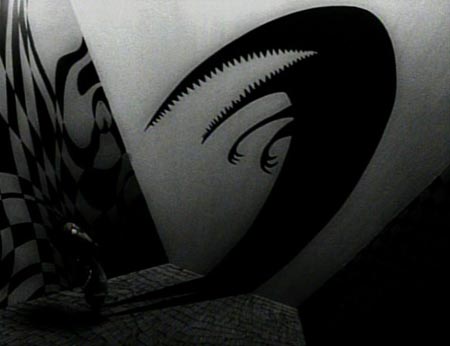
COMMENTSVincent is a 5 minute poem, narrated by the mellifluous Vincent Price, about a morbid boy (also named Vincent) obsessed with emulating the horror icon’s tormented screen persona.  It’s told in a singsong, storybook cadence and given a superlative reading by Price (who was so flattered by the tribute that he proclaimed it a greater honor than a star on Hollywood Boulevard).  There are some specific references to Price’s work for the actor’s fans, though the short prefers to evoke their general atmosphere than to cite specific movies. Young Vincent’s daydreams involve dipping his aunt in wax, turning his dog into a zombie, and slowly being driven mad by his guilt over his unspeakable crimes.  A representative stanza: “Such horrible news he could not survive/For his beautiful wife had been buried alive!/He dug out her grave to make sure she was dead/Unaware that her grave was his mother’s flower bed.”  Vincent is visually impressive, deliberately shot in luminous black and white and drawing on the gloomy Gothic style of the old Universal horror movies with a powerful dose of German Expressionism.  (Burton denied being directly influenced by The Cabinet of Dr. Caligari, but he’s the only one who doesn’t notice the similarity to the silent psychological horror classic in the geometrically warped sets).  The look and childishly ghastly tone bring to mind a lighter version of the macabre black and white lithographs of Edward Gorey (who once created a primer where each letter illustrates the death of a tot).  Burton’s visual sensibility is already fully formed here, and the elements of his classic style—his comic, cathartic synthesis of fresh childhood innocence and the must of the grave—are already in evidence.  In fact, there may be no better example in the director’s entire body of work of than this crisp five minute exhibition of his talent for mixing the chuckle with the shudder.

Disney has traditionally made Vincent and Burton’s other pre-fame short Frankenweenie as extras on all their editions of The Nightmare Before Christmas.  The film is also included on the anthology Cinema 16: American Short Films (buy) alongside  Maya Deren‘s “Meshes of the Afternoon” and works by Andy Warhol, Todd Solondz and Gus Van Sant, among others.

WHAT THE CRITICS SAY:

“…a pastiche of styles lifted from the writings of Dr. Seuss and Edgar Allen Poe, and a range of movies from B-horror films, German expressionist works and the films of Vincent Price.”–Michael Frierson, Animation World Magazine (DVD)

[(This movie was nominated for review by reader “Maxwell Stewart.” Suggest a weird movie of your own here.)]

62. ALTERED STATES (1980)

366 Weird Movies may earn commissions from purchases made through product links.

Recommended

“You don’t have to tell me how weird you are. I know how weird you are… Even sex is a mystical experience for you. You carry on like a flagellant, which can be very nice, but I sometimes wonder if it’s me that’s being made love to. I feel like I’m being harpooned by some raging monk in the act of receiving God.”–Blair Brown to William Hurt in Altered States

DIRECTED BY: Ken Russell

FEATURING: William Hurt, , Charles Haid, Bob Balaban

PLOT: Dr. Eddie Jessup is a Harvard physiologist who used to experience religious visions as a teenager and is now studying the phenomenon of hallucinations caused by sensory deprivation in isolation tanks.  His inquiries into the nature of consciousness eventually take him to an isolated tribe in Mexico who use a powerful psychedelic mushroom in ancient Toltec religious rituals.  When he combines the magic mushrooms and the isolation tank, he finds that the mixture causes him to regress to an earlier evolutionary state.

Still from Altered States (1980)

BACKGROUND:

  • The character of Dr. Jessup was based on the real life Dr. John Lilly, who invented the isolation tank and experimented with using hallucinogens in combination with it before moving on to research on communicating with dolphins.
  • Lilly tells the tale of a fellow researcher who took the drug ketamine and believed that he had turned into a “pre-hominid” and was being stalked by a leopard, which was presumably the kernel for the the idea of genetic regression.
  • This was William Hurt’s first starring role.
  • A young Drew Barrymore, in her film debut, briefly appears as one of Jessup’s children.
  • Paddy (Network) Chayefsky, the three-time Oscar winning screenwriter, adapted his own novel for the screen; he was so displeased with the final results that he had his name removed from the credits.  Chayefsky had originally written the story as a satire of the pretensions of the scientific community.  The original director, Arthur Penn, resigned after disputes with the writer.  Russell and Chayefsky reportedly argued on the set over the actors’ line readings and performances.  Chayefsky’s original novel is long out of print.
  • The seven-eyed lamb that appears in Jessup’s first vision comes straight from the Book of Revelations: “…in the midst of the elders, stood a Lamb as it had been slain, having seven horns and seven eyes…” (Rev 5:6).

INDELIBLE IMAGE:  One of the two major trip sequences (you can take your pick).  The crucified seven-eyed, seven-horned lamb from the first  is a popular favorite. In a sense, however, the quick-cut surrealistic montages play as a whole images that can’t be chopped up into constituent parts.

WHAT MAKES IT WEIRD: Ken Russell makes it weird. There’s no director more eager or better suited to make a science fiction movie about hallucinogenic drugs that bring about religious visions.  With its long, intense episodes of druggy delirium, Altered States may well be the greatest trip movie ever made (and it’s certainly the most expensive). Put it this way: you know the movie’s weird when the sight of a naked, simian William Hurt gnawing on a bloody gazelle is one of the film’s more humdrum visions.

Original trailer for Altered States

COMMENTS: There are fishes swimming in the sky behind William Hurt’s head.  He offers his Continue reading 62. ALTERED STATES (1980)