“…it seems to me that of all my books Steppenwolf is the one that was more often and more violently misunderstood than any other, and frequently it is actually the affirmative and enthusiastic readers, rather than those who rejected the book, who have reacted to it oddly…”–Hermann Hesse in the 1961 prologue to Steppenwolf
DIRECTED BY: Fred Haines
FEATURING: Max von Sydow, Dominique Sanda, Alfred Baillou
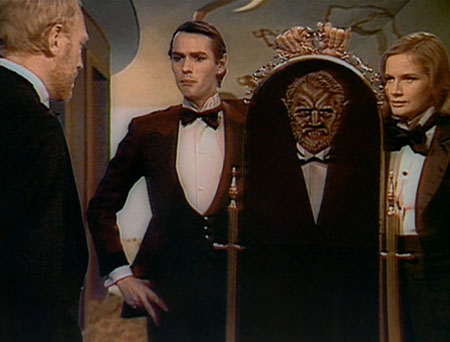
PLOT: Harry Haller is a world-weary writer and intellectual in the Weimar Republic who is considering committing suicide soon. One night he meets Hermine, a beautiful young woman, who shows unusual interest in him and makes him pledge obedience to her as she initiates him into the pleasures of the flesh, including jazz, drugs, and sex. Eventually Hermine leads Harry to the Magic Theater, where a delirious dream about some aspect of his personality lurks behind every door—including, perhaps, his homicidal side.
BACKGROUND:
- The movie was adapted from Nobel laureate Hermann Hesse’s classic 1927 novel Steppenwolf, which had been rediscovered and adopted by the 1960s counterculture because of its perceived revolutionary vision and apparent endorsement of free love and psychedelic drugs.
- Michelangelo Antonioni (Blowup) was offered the chance to direct but turned it down because he thought the book was unfilmable.
- This was the only film directed by Fred Haines. He had previously been co-nominated for an Oscar for Best Adapted Screenplay for Ulysses (1967).
- Co-producer and LSD-enthusiast Melvin Abner Fishman declared the Steppenwolf would be “the first Jungian film.”
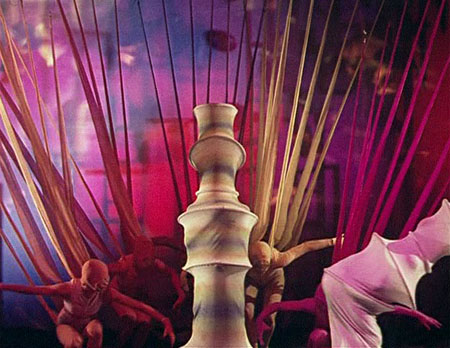
- The Czech artist Jaroslav Bradac created the wonderful animated sequence, “The Tractate on the Steppenwolf”; the artist Mati Klarwein (who was also responsible for classic album covers for Miles Davis and Santana) created the fascinating paintings that line the corridors of the Magic Theater.
INDELIBLE IMAGE: For a movie that is so deliberately visionary, there’s not one single image that sticks out far above the others. The most obvious choices are the images which show Harry simultaneously as a wolf and a man, a concept that is often chosen in numerous variations for covers of paperback editions of the novel.
WHAT MAKES IT WEIRD: The heavy symbolism and feverish imagery of Hesse’s masterpiece, written while Freud and Jung’s theories of the unconscious mind were still novel and revolutionary, present some weird scenarios (such as Harry entering into dream debates with the ghosts of Goethe and Mozart). When this material is adapted through a 1974 lens, an era when cinematographers hadn’t yet come down from the LSD-inspired visual experimentalism of the late 1960s, it becomes even weirder. From the Magic Theater sequence on, Steppenwolf is truly trippy stuff.
Original trailer for Steppenwolf (1974)
COMMENTS: There’s a difficulty in reviewing movie adaptations of novels, in that the Continue reading 15. STEPPENWOLF (1974)