Tag Archives: Mockumentary

CAPSULE: THE FARTISTE (1987)

DIRECTED BY: Mark Ruggio

FEATURING: Michael Pataki

PLOT: A fake documentary about the rise and fall of the (real life) “flatulist” performer Le Pétomane, who narrates his story from Purgatory.

Still from The Fartiste (1987)

WHY IT WON’T MAKE THE LIST: This long-unreleased one-hour mockumentary is a curiosity, nothing more.

COMMENTS: I’m going to hold my nose and resist the urge to say The Fartiste stinks. (To be fair, I’m not going to claim “it’s a gas!,” either). There’s a reason that The Fartiste was never released after being completed in 1987, and it’s not because the subject matter was too outrageous. The truth is that one hour, while too short for a feature presentation, is too long for an extended fart joke, leaving The Fartiste in no-man’s land. Despite the fact that the historical Le Pétomane (real name: Joseph Pujol) was able to pack audiences into the Moulin Rouge for his concerts in a pre-talkie era, today, audiences are able to sate their curiosity about his peculiar talents in a Facebook post (“a guy who used to pack audiences in to hear him fart? That’s awesome! Oooh, now there’s a baby goat on a trampoline, how cute!”) Stretching this material into an hour’s worth of entertainment proves beyond The Fartiste‘s abilities. With a Pepe le Pew accent and a stage mustache (which disappears in some scenes, replaced with greasepaint), character actor Michael Pataki is acceptable in the role, but never makes Le Pétomane into a truly funny presence. Basically, the movie follows a typical showbiz narrative trajectory, with too much early success leading Le Pétomane into vice and arrogance. Near the end there’s a somewhat amusing slapstick duel with a hotshot bowel jock who wants to unseat the Fartiste. Flirting with fatal flatulence, the combatants drink cabbage juice before the showdown—generic cabbage juice, for extra foulness. The duel is one of the few “action” sequences in The Fartiste, which mostly proceeds as a series of talking head interviews with people whose paths crossed Le Pétomane’s, including famous late 19th/early 20th century figures like Freud, Toulouse-Lautrec, and Enrico Caruso. (Some of this has a grain of a historical basis—for example, Freud was said to have attended a Fartiste performance, although he probably never diagnosed the Frenchman as being trapped in the anal stage). Given that much of Le Pétomane’s career overlapped the silent film era, we also see lots of faux-silent movie footage (especially at the beginning), supplemented by real movies from the public domain. There is a shot of the chandelier crash from Phantom of the Opera (in this alternate reality, the collapse is brought about by a vindictive Pétomane poot) and scenes from Nosferatu illustrate the Fartiste’s early life. The mix of archival footage and fake footage never looks convincing, but that doesn’t matter much—the movie, originally shot on 1980s era TV video and transferred from the sole surviving element, doesn’t look very good overall. Anyway, visuals aren’t the point of The Fartiste. The movie’s greatest asset may be it’s short running time; the whole thing is as light and airy as a whiff of methane. I was actually more impressed with the DVD’s bonus feature, a modern silent one-reeler starring “Harlem Hank” and “Flatbush Frank” entitled “That Voodoo You Do.” Set in a funeral parlor, it’s got cleavage jokes, an undead body, a voodoo priestess in drag, a barrelhouse piano score, mugging in pancake makeup, and it ends on a groaner—it’s a lot of fun, and even shorter than the feature!

The Fartiste (1987) is not to be confused with “The Fartiste,” an unrelated 2006 off-Broadway musical that is occasionally revived. played Joseph Pujol in a 1983 Italian biopic, and there was also a 1998 French documentary on le Pet.

WHAT THE CRITICS SAY:

“It’s short, sweet, stupid, and utterly bizarre…”–Mondo Digital

DISCLAIMER: A copy of this movie was provided by the distributor for review.

CAPSULE: THE WICK: DISPATCHES FROM THE ISLE OF WONDER (2013)

The Wick: Dispatches from the Isle of Wonder can be seen in its entirety (for free) at the movie’s home page.

DIRECTED BY: Tom Metcalfe, John Rowley

FEATURING: Tom Metcalfe, John Rowley

PLOT: A documentary on the London neighborhood of Hackey Wick, which claims to have a higher per capita concentration of artists than anyplace in the world (1 in 7 residents), and simultaneously a comic mockumentary about two bohemian filmmakers making a documentary about Hackney Wick.

Still from The Wick (2013)

WHY IT WON’T MAKE THE LIST: An odd and noble no-budget effort, but one of the weirdest movies ever? No, but nice try.

COMMENTS: John and Tom, the filmmakers behind The Wick, have a framed photograph of hanging on the wall of their dingy Wick flat. You might view that fact as either a hopeful sign of experimentation to come, or a warning of impeding narrative incoherence. Both guesses would be somewhat correct. This strangely conceived project, which somehow manages to come across as improvised and carefully planned-out at the same time, will appeal to a very narrow audience. It’s obviously aimed at the art crowd and most emphatically not at the mainstream. Viewers will lean something about the run-down neighborhood of Hackney Wick, its struggling artists, and the effect that the Olympics had on the area, although all of those subjects ultimately get slighted. John and Tom demonstrate the spirit of the Wick by doing rather than by telling, and the biggest audience for this film is anyone interested in DIY art, the creative process, or the pains and passions of microbudget filmmaking. There are two, or maybe even three or more, movies embedded in The Wick, and they don’t always play together nicely. It begins with a series of nearly silent sketches featuring John (the one with the handlebar mustache and occasional pipe) and Tom (full beard, long hair, umbrella) going about their daily routine in the Wick, which consists of sneaking onto a rooftop to listen to weather reports on a beat up radio. At night they sleep foot to head in a single bed; Tom reads a copy of Shakespeare’s “The Tempest” each night before turning in. They have a series of note cards pinned to the bedroom wall, the first of which reads “scene one” and the last “epilogue,” with a dozen or so blank cards in between. The two are waiting for inspiration to strike, which occurs after twenty minutes have passed when Tom has a dream of becoming a naked giant and striding across the urban sprawl. Mild pantomime comedy bits (e.g. the guys forget their keys and have to go back to the flat) relieve these early bits, but this overextended opening, unfortunately, is easily the weakest part of the movie. John and Tom finally decide to create a documentary on the Wick “in the framework of an avant-garde adaptation of Shakespeare’s ‘The Tempest.'” “John describes it as an attempt to undocument the documentary,” Tom explains in voiceover. “I’m not entirely sure what that means, but I believe it sounds suitably provocative.” Studies of a half-dozen residents of the Wick follow, including a photorealistic portraitist, several conceptual/performance art weirdo types, an author who gives historical background on the area, and a young Australian man who’s shipped over to work on Olympic security detail while seeing the world. There’s about thirty to forty minutes of documentary footage altogether. The final segment of the film consists mostly of short comic scenes of John and Tom camping out in a pup tent (they’ve rented out their flat to Olympic tourists), eating beans over a portable stove, editing the movie on a laptop, and even doing the Foley work for the feature. There are a few more ambitious and planned-out bits strewn about here and there, including a farcical audio tour of the Wick that provides the movie’s biggest chuckles (“once home to Percy Dalton’s peanut factory, Hackney Wick is an area steeped in history…”) and a running subplot about Tom’s desire to impress his mother with the movie (“pray be lenient mum, for we tried, and surely that counts for something.”) As for the “Tempest” references, they are indeed spread throughout the movie, although to what purpose is never exactly clear. The Wick itself is Shakespeare’s island, we can guess, and as the orchestrators of this mirage, John and Tom share duties as Prospero (although most of the time they act more like the comic relief characters Stephano and Trinculo). But where are Miranda, Ariel and Caliban, and who is it that’s shipwrecked upon the Wick? The “Tempest” conceit never really gets going, while the realistic documentary portions feel out of place, and the mockumentary sections are only sporadically funny. Still, even when it’s not quite working as entertainment, there’s an inherent likableness to the movie, mostly because John and Tom (their personalities aren’t that distinct, and they almost function as a single character) come across as the kind of mates you’d like to buy a pint for, just so you can listen to them talk about their love of movies. Barely speaking or even moving for much of the run time, they nonetheless radiate a passionate confidence and belief in their strange little work that is endearing and humorously self-deprecating. If you can get past the dry opening, you may find lots to like in The Wick, and even a little to wonder at.

“Isles of Wonder” was the name of the production of the 2012 Olympic opening ceremony.

WHAT THE CRITICS SAY:

“…without a doubt one of the oddest independent films I’ve watched, period. It’s also, in an acquired taste kind of way, quietly brilliant. And mad. And very, very odd.”–David Ollerton, The London Film Review

CAPSULE: THE HELLSTROM CHRONICLE (1971)

Must See

DIRECTED BY: Ed Spiegel (Hellstrom sequences), Walon Green (producer and principal photography), David L. Wolper (executive producer)

FEATURING: Lawrence Pressman

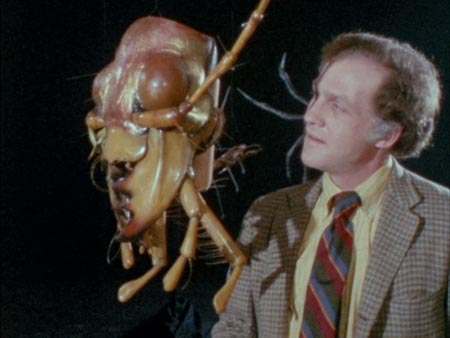
PLOT: The fictional Dr. Nils Hellstrom explains the evolutionary advantages of insects and

Still from The Hellstrom Chronicle (1971)

concludes they are biologically superior to humans, leading him to predict dire consequences for the future of our species.

WHY IT WON’T MAKE THE LIST: Documentaries don’t come much weirder than this, but even the orgies of insectoid sex and violence and Dr. Hellstrom’s flaky mad scientist rants about the inherent superiority of spiders, termites and centipedes can’t raise this to the level of the truly bizarre. Despite the fact that it doesn’t have the goods to rank among the weirdest movies of all times, however, it’s still a beautiful abnormality that’s well worth your attention.

COMMENTS: The Hellstrom Chronicle contains a lot of curiosities, but the heart of the movie are the amazing images captured through (then miraculous) micro-photography: a caterpillar developing from a fertilized cell to a larva in the space of a minute, a shot of beetles locked in a death struggle that widens and pans to show a human couple cuddling on the lawn, individual brightly-colored butterfly scales glowing in the sunlight like Lite Brites. As that last image suggests, there is a psychedelic character to much of this parade of fantastical bug-tography, one that the filmmakers play up as they segue from those super-closeups of wings to shaky cam scenes of fields of butterflies flying through a forest, as Lalo Schifrin’s electronic free-jazz symphony soars ecstatically. From sequences like this we realize why this documentary was so popular on college campuses in the 1970s; you can almost see the clouds of pot smoke rising up in front of the five-foot tall black beetles with their jutting horns silhouetted against the sunrise, and hear the low murmurs of “far out, man.”

With its dissonant sitars, electric pianos dithering over waves of cymbals, and waveform synthesizers wavering in the background, Schrifin’s remarkable score evokes not only midnight trips but also conventional sci-fi giant insect cues, which is appropriate because much of the Continue reading CAPSULE: THE HELLSTROM CHRONICLE (1971)

CAPSULE: TROLLHUNTER [TROLLJEGEREN] (2010)

DIRECTED BY: André Øvredal

FEATURING: Otto Jespersen, Glenn Erland Tosterud, Johanna Mørck, Tomas Alf Larsen, Urmila Berg-Domaas

PLOT: Three journalism students traipse about the Norwegian countryside following a

mysterious poacher, only to discover he is a government-funded troll hunter trying to contain an outbreak of monsters in the mountains.

WHY IT WON’T MAKE THE LIST: Though a troll-themed found footage horror/comedy sounds like a novel concept, for the most part TrollHunter is a straightforward and predictable—and enjoyable—horror flick.

COMMENTS: Building slowly up to its fantastical pay-off and composed of edited footage purportedly sent anonymously to a news station, TrollHunter begins with Thomas (the reporter), Johanna (the sound woman), and Kalle (the rarely-seen camera operator) driving through the Norwegian mountains after suspected bear poacher Hans. There’s something fishy going on with this guy, as evidenced by his strange, solitary habits and tricked-out hunting truck, and they aim to find out exactly what’s up.  When they finally catch up with him, they learn firsthand that he’s an honest-to-goodness troll hunter, employed by the government to protect humans from troll attacks.  An entire troll subculture is explored and explained matter-of-factly; they’re like a typical woodland animal species, only ten times bigger and wholly improbable.  They’ve been breaking out of their contained areas and wreaking havoc lately, so it’s up to Hans and his new camera crew to determine the cause.

Hans’s gruff and fed-up line deliveries coupled with the students’—especially Thomas’s—befuddled reactions make for much of the film’s cheeky comedy, but they rarely elicit big laughs, keeping an understated atmosphere for most of the running time.  Of course, when the actual trolls come into play, action and thrills take precedence.  Director Øvredal makes good use of unseen monsters and intense sound effects, injecting the affair with fear of the unknown more than anything else.  The trolls are well CGI-ed, kept primarily in dark lighting; the effects showcase several different monster designs.  The shaky-cam vérité style can be taxing at points, but overall the first-person camerawork is incorporated effectively.

TrollHunter is the kind of genre mash-up that doesn’t lean to any one side.  Many will think it should be much funnier, or much scarier, or both. Personally, I appreciated its low-key approach.  The story and characters are interesting enough to keep the momentum going, and the gorgeous Scandinavian scenery and multiple gruesome troll bouts are entertaining to the eye.  Some of the specifically Norwegian references are likely lost on outside viewers, but this look into Norwegian folklore is never abstruse or alienating.  For the most part, it’s just fun!

WHAT THE CRITICS SAY:

“With impressive technical credits, stunning fjord and forest locations and a winking ownership of its own absurdity, ‘Trollhunter’ manages to be at once spooky, satirical and endearing.” –Colin Covert, Minneapolis Star Tribune (contemporaneous)

READER RECOMMENDATION: BIG MAN JAPAN [DAI NIHONJIN] (2007)

Reader review by Rob Steele [AKA Mofo Rising]

DIRECTED BY:

FEATURING: Hitoshi Matsumoto

PLOT: Not-so-lovable loser transforms into significantly larger loser to battle some of the weirdest monsters to ever threaten Japan.

Still from Big Man Japan (2007)

WHY IT SHOULD MAKE THE LIST: On a purely visual level, Big Man Japan has a bizarre aesthetic that nobody else would rightly consider. Beyond that, the film’s humor is often so subtle that you don’t realize what strange territory you’ve stumbled into until it ends up battling it out on the screen in its underwear. This film is just weird.

COMMENTS: Did you ever watch Mike Myers defend the male nudity in Austin Powers by claiming that the naked male form has been a comedic stereotype in British humor for years, but you still got the sense that he just enjoyed running around naked? Well, Japanese comedian Hitoshi Matsumoto has taken Myer’s original intent and literally writ it large for the big screen. Prepare yourself for a loving CGI rendition of the male form, with every stray hair delineated and a paunch that could kill.

Matsumoto doesn’t stop there. His film, Big Man Japan, is as loving a tribute to pure loser-dom as you could hope to film. His character is the none-too-bright heir to monster fighters in an alternate-reality Japan where giant monsters attack on a regular basis. Unfortunately, while his monster-battlin’ grandfather was considered a hero, he is now a national joke, fighting inexplicably ridiculous monsters for increasingly little ratings. (His show now only airs in the wee hours of the morning.) As if being a national joke was not enough, our current Big Man manages to fail every time he is called up to bat.

Big Man Japan is a slow burn of a film. If you are familiar with celebration of wrong-headed intentions Christopher Guest has been putting out for years, you should be comfortable here. The majority or the film focuses on interviews with our loser as he is subtly confronted with his abject shame in society. Luckily for us, every twenty minutes or so, he must fight against a bizarre menagerie of monsters in CGI battles that are, to say the very least, uncomfortable.

This is an odd film. But before you throw it out, stick around for the ending. I’m not going to give it away here, and I’m not even sure I could if I tried. Suffice to say, I laughed like a maniac, probably to the consternation of all my friends.

Big Man Japan is nothing else other than Big Man Japan. Before you venture in, I recommend you watch the preview. If it looks at all interesting to you (you’re a small crowd), watch it. You may be unpleasantly surprised. Or the opposite. No real way to predict your fate with this film. Suffice to say, don’t expect to get out unscathed.

WHAT THE CRITICS SAY:

“Part character study, part media satire and, by its finale, altogether bizarre, ‘Big Man Japan’ plays a bit like a quieter, weirder version of ‘Hancock’… the most impressive special effect here is Mr. Matsumoto’s hilariously restrained performance, a tour de force of comedic concision in a movie bloated by increasingly surreal developments.”–Nathan Lee, The New York Times (contemporaneous)