Tag Archives: Mexican

LIST CANDIDATE: WE ARE THE FLESH (2016)

Tenemos la Carne

DIRECTED BY: Emiliano Rocha Minter

FEATURING: Noé Hernández, María Evoli, Diego Gamaliel

PLOT: A teenage brother and sister find their way to the lair of a hermit, who seduces them into acting out increasingly depraved, increasingly hallucinatory scenarios.

Still from We Are the Flesh (2016)

WHY IT MIGHT MAKE THE LIST: The overall project may seem to lack much purpose, but it’s intense and uncompromising—and weird—enough to merit a look.

COMMENTS: The new year is only a few weeks old, and already we have a contender for Weirdest Movie of 2017. A demonic hermit uses two disciples—one reluctant, one willing—to transform his habitat into a womblike space where he enacts bizarre, perverse fantasies eventually incorporating sadism, rape, orgies, murder, cannibalism, and more. As the ringmaster in this cavalcade of perversions, Noé Hernández is believably crazy. He looks like he stinks, and rants like a guy you’d cross the street to avoid meeting. He projects a very specific form of charisma: like a Mexican Manson, he has a gravity capable of capturing those irretrievably lost to themselves in his orbit. “People shy from certain thoughts. Their lives are a continuous distraction from their own perversion,” the wild-eyed messiah preaches to an improbably intrigued teenage girl, while flapping his arms like a bird in the void. “Solitude drags you, forces you to come face to face with your darkest fantasies. And when nothing happens, you stop being afraid of your most grotesque thoughts.”

With siblings and a perverted Svengali, the story goes exactly where you think it will; but, incest is only the beginning. Once they indulge that taboo, all the walls come crashing down—and the plot immediately hops onto whatever crazy train it can catch, going to places you can’t possibly predict. In fact, after the strangely beautiful incest montage, shot in psychedelic thermal imaging and scored to a romantic Spanish ballad, there can hardly be said to be a plot at all, only a series of deranged, escalating provocations. (One presumes that in Catholic Mexico, the movie’s blasphemous parody of Christ—both the resurrection and the Eucharist—is the most shocking element). On a literal level, you might try to explain it all as the result of an all-purpose drug the hermit keeps in an eyedropper, which is capable of producing intoxication, serving as an antidote to his own homebrewed poisons, and possibly preserving the brains of those he’s lobotomized. More likely, the hermit simply personifies  perverse desire, and the movie is a representation of the nightmare of a narcissistic world of pure desire without taboos or boundaries. The tumbling of moral walls allows the irrational to flood in.

As shock cinema goes, Flesh displays far more artistry than most. The lighting is extraordinary—purple-lit faces in front of glowing yellow portals that serve to block, rather than lead to, the opaque outside world. These touches elevate the minimalist set into a true dream space. The music is also well-deployed, with horror-standard rumblings alternating with ironically beautiful ballads and a Bach concerto. Flesh shows the imagination of , mixed with the despairing nihilism of , in a scenario reminiscent of Salo.

As for misgivings: I wonder if Flesh has enough substance to compensate us for its unpleasantness. Late in the film, it takes a stab at social relevance, with a subversive recital of the Mexican national anthem and a paradigm-shifting final scene. But these digressions come off as afterthoughts to a movie whose main interest is to indulge its own most grotesque thoughts. And there, I wonder if the film doesn’t pull its own perverse punch. A Clockwork Orange‘s Alex was deeply chilling because he made you feel the appeal and charm of evil; the hermit here does not. He’s too clearly insane, too cartoonish in his fleshy villainy. The ominous music and horror movie atmosphere also instruct you to be repulsed rather than aroused. Despite the madman’s advice, this movie does want you to be afraid of its most grotesque thoughts. But fans of extremity cinema will—pardon the pun—eat it up.

WHAT THE CRITICS SAY:

“We Are The Flesh is a bizarrely arresting treat from an exciting new talent. It’s also just about the strangest film you’ll see this year.”–Michael Coldwell, Starburst (contemporaneous)

261. THE EXTERMINATING ANGEL (1962)

El àngel exterminador

Must See

“People always want an explanation for everything. It is the consequence of centuries of bourgeois education. And for everything for which they cannot find an explanation, they resort in the last instance to God. But what is the use of that to them? Eventually they have to explain God.”–Luis Buñuel , “My Last Sigh”

“The best explanation of this film is that, from the standpoint of pure reason, there is no explanation.”–Opening epigram to The Exterminating Angel

DIRECTED BY:

FEATURING: Enrique Rambal, , , Lucy Gallardo, Augusto Benedico

PLOT: After an elaborate dinner, the many guests of Edmundo Nobile find themselves trapped inside a single room of the mansion; at first they stay under reasonable pretenses, but after sleeping over they become physically unable to pass the room’s threshold. As their high society ways break down from the proximity and lack of provisions, concerned police and citizens on the outside find it impossible to enter to help them. Things degenerate until they attempt a desperate gambit relying on a vision of one of the guests. Meanwhile, sheep and a bear wander around the house.

Still from The Exterminating Angel (1962)

BACKGROUND:

  • After briefly returning to his native Spain from his Mexican exile to direct Viridiana, Buñuel went back to Mexico to make The Exterminating Angel after the Vatican denounced the previous film and the Spanish banned it.
  •   Buñuel borrowed the title from a poet friend (José Bergamín) ostensibly for marketing purposes, remarking in his biography, “If I saw ‘The Exterminating Angel‘ on a marquee, I’d go see it on the spot.”
  • Despite its acclaim (both contemporaneous and otherwise), Buñuel often said he considered The Exterminating Angel a failure. Mostly, he regretted not being able to proceed along a more “cannibalistic” trajectory.
  • The dozens of repetitions found in the film greatly worried the cinematographer, Gabriel Figueroa, when he saw the final cut. It took Buñuel to calm him down, assuring Figueroa that it was a creative choice.
  • Won a “FIPRESCI” award at Cannes on its release.
  • While Russia at the time banned any number of films for any number of reasons, ironically, this Marxist movie rubbed Soviet officials the wrong way because the theme—not being able to leave a party—was considered anti-government.
  • The Exterminating Angel is a staple of “top films ever made” lists, including The New York Times‘ Best 1000 Movies Ever Made and Steven Jay Schneider’s 1001 Movies You Must See Before You Die.
  • Stephen Sondheim has a musical based on both The Exterminating Angel and Discreet Charm of the Bourgeoisie in the works. British composer Thomas Adès recently adapted the movie into an opera.

INDELIBLE IMAGE: Throughout The Exterminating Angel, the household’s domesticated (pet) bear herds a small clutch of sheep. Wandering around the place with impunity, a shot where the demi-flock scoot up the grand stairway, with the bear taking up the rear, sticks in the mind. The guests’ doom is mirrored by the sheep’s mindless wandering toward the great prison room, ensuring their barbaric destruction.

THREE WEIRD THINGS: Dead man’s hand; symbolic tasty sheep; a sacrificial host

WHAT MAKES IT WEIRD: A gaggle of bourgeois personages spend more and more time in close quarters with each other—they simply cannot leave the room. The strangeness of their prison is matched by the strangeness found outside: a society that at first doesn’t notice their absence, and then is unable to help them. Time skips like a scratched record, servants are uncannily eager to jump ship, a disembodied hand appears, and animal friends romp around a mansion, adding up to a fine Buñuelian omelet of social commentary and Surrealist comedy.

COMMENTS: Between his genre-establishing Un Chien Andalou up Continue reading 261. THE EXTERMINATING ANGEL (1962)

LIST CANDIDATE: FANDO Y LIS (1968)

Weirdest!

DIRECTED BY: Alejandro Jodorowsky

FEATURING: Sergio Kleiner, Diana Mariscal

PLOT: Fando carts and carries his paralyzed lover Lis across a ravaged landscape searching for the legendary city Tar.

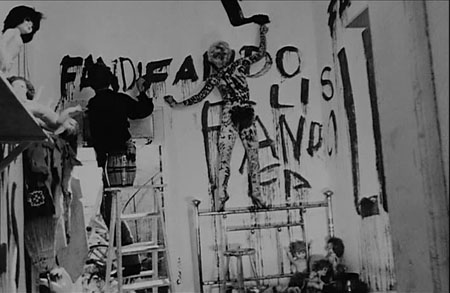
Still from Fando y Lis (1968)

WHY IT MIGHT MAKE THE LIST: If you’ve ever seen a Jodorowsky movie before, you know what to expect. Fando y Lis is a parade of fantastical, shocking imagery, including snakes that penetrate a baby doll and a man who begs for blood (he extracts a donation with a syringe and drinks it from a brandy snifter). That said, Fando & Lis is one of the least of Jodorwosky’s works, an early curiosity that is thoroughly weird, but not strongly conceived enough to make the List on the first ballot. (Plus, Jodo’s so well-represented here already we don’t feel at all bad about the possibility of leaving one movie off).

COMMENTS: Fando y Lis begins with a woman eating flowers while a siren wails. Later we will learn she is the paraplegic Lis, whose lover Fando will cart her across a bizarre post-apocalyptic landscape searching for the mystical city of Tar. Along the way they encounter a man playing a burning piano, mud zombies, a transvestite parade, and a gang of female bowlers led by a dominatrix, among other absurdities. There will also be flashbacks to both Fando and Lis’ childhoods, and unrelated fantasy sequences of the actors goofing around (posing in a graveyard, and painting their characters’ names on each other). And there’s quite a few more transgressions, both beautiful and clumsy, to be found in this rambling, overstuffed avant-garde experiment. Although Jodorowsky comes from an older bohemian tradition, at times Fando y Lis plays like something made by Mexican hippies, improvising scenes with random props in between hashish tokes.

The “spiritual journey” structure makes for an episodic film, but the ideas aren’t as stunningly realized or obsessively detailed as The Holy Mountain. Here, Jodorowsky has found, but not perfected, his unique voice: it’s as if he’s working with individual sentences, rather than complete paragraphs. It would have helped the movie feel more coherent and unified if the relationship between Fando and Lis was better done, but their dynamic is unpleasant. They unconvincingly profess eternal love for each other, but Fando is much better at conveying his irritation and annoyance at having to carry Lis everywhere, while her character is reduced to desperate, pathetic whining for most of the film.

In 1962 Jodorowsky, Fernando Arrabal and , feeling that Andre Breton and the old guard Surrealists had lost their edge and were no longer extreme enough in their embrace of absurdity, founded the Panic movement, which was mostly an experimental theater group. Fando & Lis was originally a play from this school, written by Arrabal and staged by Jodorowsky. This movie adaptation is not intended to be faithful; Jodorowsky instead described it as based on his memories of the play. When Fando y Lis premiered at the Acapulco Film Festival in 1968 it caused a riot (presumably due to its abundant nudity and mildly sacrilegious content) and was subsequently banned in Mexico. The film basically disappeared for years. Discovering Jodorowsky in the early 90s, when his films were only available in bootleg VHS versions, I was unaware that he had made a movie before El Topo; Fando wasn’t even a filmography entry. It wasn’t until 2003 that a DVD of this early work suddenly popped up.

WHAT THE CRITICS SAY:

“… pothead vaudeville all the way… A tumultuous cause celebre at festivals, it paved the way for the director’s rise from small-time poseur to big-time poseur with El Topo a few years later.”–Fernando F. Croce, Cinepassion

(This movie was nominated for review by “Zelenc” who called it a “must see film.” Suggest a weird movie of your own here.)

LIST CANDIDATE: VERA (2003)

Weirdest!

DIRECTED BY: Francisco Athié

FEATURING: Marco Antonio Arzate, Urara Kusanagi

PLOT: Trapped underground, a miner hallucinates, eventually encountering a green alien creature who leads him into the spirit world. Still from Vera (2003)

WHY IT MIGHT MAKE THE LIST: On sheer weirdness, this trip skirting the veil that separates life and death would make the List easily. A couple of faults hold it back from making it on the first ballot, however: it’s very slow to get started, and the imagination behind the visual effects greatly exceeds the budget’s capacity to realize them.

COMMENTS: With this production, I get the feeling that Francisco Athié saw the chance to make the dream visionary feature of a lifetime and decided to seize it, even though the necessary funding wasn’t there. When Vera‘s imagery is on, it’s mind-meltingly sublime, but there are too many times when the CGI isn’t up to the tasks Athié sets for it. The movie serves as a reminder of why you should always shell out the big bucks for the top-shelf peyote, and not save a few pesos buying the shriveled-up buttons on sale for half off.

Although the love that went into it is clear, Vera feels stretched out: there is probably forty-five minutes of good stuff, and fifteen minutes of amazing stuff, here, but it’s padded out to an eighty-minute feature. The first ten minutes wordlessly depict life in an isolated Mexican village, while the title character doesn’t show up until the movie is halfway over. The first hallucinatory moment introduces the trademark visual awkwardness: it’s meant to depict a bone-chilling wasteland, but it looks like the main character is suddenly playing a mime walking in a stiff wind in front of a green-screen snowstorm. After twenty-five minutes with very little of consequence occurring, you may feel like giving up on Vera, but if you stick around you will be rewarded, because things start cooking after the old man trapped in the mine adds urine and blood from his penis (ouch!) to a cauldron of boiling lead in order to conjure up a jade statue of a Mayan god. The miner simultaneously prays to the Christian God, and to “Lady Balam” and the Winds, and modern mythology is added to the Christian/pagan mix when he discovers a little green (wo)man who projects a stream of 0s and 1s from an orifice in her torso.

This creature, the mystical “Vera” of the title, is at times crudely computer-generated, with a bobbing head that makes it resemble a character in a Star Wars ripoff video game, while at other times the entity is portrayed by the mesmerizing Japanese dancer Urara Kusanagi. The two different embodiments of the character are certainly weird, but probably not in the way Athié intended. The main effect is to draw attention to the cheapness of the effects, and make you wish the CGI had been scrapped for more scenes with the graceful and mysterious Kusanagi. Marvelous mystical visions accompany the doomed man as Vera guides him to the afterlife: a child skeleton that dances with Vera, the Virgin Mary appearing in a stalactite, and the green-skinned guide fetching fruit off of an Eden-like tree. And if the visuals are at times sketchy, the music and sound design, which ranges from ambient drones to Amazonian percussion, is always on point setting the chthonic mood. The resulting concoction mixes the promiscuously mythological preoccupations of an with the deliberate pacing of an , but, unfortunately, as realized by the visual effects team behind a SyFy shark movie.

“Bright Lights Film Journal” supplies insight on the film’s title: “According to writer-editor-director Athié, Vera ‘means trust and faith in Cyrillic (Russian), the truth in Italian, the side of the road in Spanish, and it is a very beautiful feminine name. Therefore, in a way, it points to the faith and trust you need to follow a path that is true to your own perception of the otherworldly’.

WHAT THE CRITICS SAY:

“…a strange, hallucinatory film that reveals itself in a slow, ritualistic way.”–Marilyn Ferdinand, Ferdy on Films

(This movie was nominated for review by NGBoo, who described it as “a beautiful metaphysical fantasy, that explores the afterlife, inspired by Mayan and Christian religions.” Suggest a weird movie of your own here.)

LIST CANDIDATE: THE EXTERMINATING ANGEL (1962)

El Ángel Exterminador

Must See

DIRECTED BY: Luis Buñuel

FEATURING: , Enrique Rambal,

PLOT: The guests at an upper-class dinner-party are inexplicably unable to leave; their thin veneer of civility rapidly breaks down as conditions worsen.

Still from The Exterminating Angel (1962)

WHY IT MIGHT MAKE THE LIST: The predicament in which the protagonists find themselves is utterly irrational, and no explanation whatsoever is offered for it. Sheep and a bear roam the house for only marginally more rational reasons. And along the way we get an ambiguously hallucinatory sequence where a witch summons Satan, who manifests himself as a homicidal severed hand.

COMMENTS: Buñuel himself considered this film to be a failure because he didn’t go far enough—he later regretted not including cannibalism. But all the same, it’s the breakthrough film in which he finally understood that, if you give mainstream audiences a nice simple plot that they can understand with no trouble at all, the justification for that plot can be as weird as you like. And perhaps, as he so often was, he was joking when he publicly stated that it would have been a better film if they’d eaten each other, since ten years later he made The Discreet Charm of the Bourgeoisie, which is a kind of anti-remake that precisely inverts the basic plot of the earlier film (the twist double ending is also neatly reversed). And cannibalism doesn’t occur that time round either.

The shooting title was The Castaways of Providence Street, which Buñuel changed when a friend pointed out that he’d automatically see any film called The Exterminating Angel without stopping to find out what it was actually about. As with The Phantom of Liberty (1974), the titular supernatural being, if it even exists, makes no overt appearance whatsoever. The left-wing agenda is as blatant as it possibly could be. The servants, with the exception of a very faithful butler, are stricken with irrational fear and leave for the flimsiest of reasons or none at all, even if it means their dismissal. The impending punishment is meant for the upper-class scum alone!

And scum they are. The best of them try to be decent but are hopelessly weak. As for the rest… A window broken by a highly-strung guest is casually ascribed to “a passing Jew.” They laugh uproariously when a servant trips on a rug and falls over because they assume he’s been set up to do it for their amusement. They seriously discuss the alleged insensibility to pain of the lower classes by comparing them with animals. They are casually and cynically promiscuous, and explicitly describe sexual continence as a perversion. And even the best of them stimulate their jaded appetites with serious drugs. They deserve everything they get.

And get it they do! This is basically “Lord of the Flies” with adults. Trapped in one room for no reason at all, they suffer hunger, thirst, stench—a man who dies early on is stuffed into a cupboard and remains there for many days in warm weather—and sanitary facilities consisting of a closet full of antique vases (not an issue normally addressed in movies made this long ago). And in addition to all this, they’re horribly spoilt people who can’t possibly get along, and end up squabbling like the lowest guttersnipes: a situation which, towards the end, they temporarily defuse by getting spectacularly stoned, in a sequence which, though very low-budget indeed, is still extremely psychedelic for its time.

Along the way, we get black magic, a doctor who mysteriously confuses baldness with death, and a very, very strange crawling hand sequence with a curious backstory. In his autobiography, Buñuel claimed to have written the outline on which the 1946 movie The Beast With Five Fingers was based, though of course he wasn’t credited. That may or may not be true, but if it is, this scene is his not very oblique reference to it. As with almost all his best films, this is not modern Japanese-level in-your-face-and-all-over-the-place weirdness. But the oddness of it all builds perfectly throughout, culminating in a last-minute resolution that, as so often in Buñuel’s films, is a set-up for a merciless punchline in the epilogue. A classic, and highly recommended.

WHAT THE CRITICS SAY:

“…Buñuel stages this play with cumulating nervousness and occasional explosive ferocities. He whips up individual turmoils with the apt intensities of a uniformly able cast; and he throws in frequent surrealistic touches, such as a disembodied hand coasting across the floor, or a bear and a flock of sheep coming up from the kitchen, to give the viewer little hints of mental incongruities. But my feeling is that his canvas is too narrow and his social comment too plain to keep our interest fixed upon his people and their barren stewing for an hour and a half.”–Bosley Crowther, The New York Times (contemporaneous)