Tag Archives: Malcolm McDowell

CAPSULE: SILENT HILL: REVELATION (2012)

DIRECTED BY: Michael J. Bassett

FEATURING: Adelaide Clemens, , Kit Harington, Malcolm McDowell

PLOT: Six years after the events of the original Silent Hill, Sharon (now living under the alias “Heather”) returns to the mysterious ghost town to rescue her abducted father and face ancient evils left over from the last movie.

Still from Silent Hill: Revelation (2012)

WHY IT WON’T MAKE THE LIST: Christophe Gans’ original Silent Hill adaptation was a combination of campy confusion and apocalyptic atmosphere that hit all the right nightmare notes and was strange enough to worm its way onto the List of the 366 Best Weird Movies. Six years later, with a journeyman director at the helm and no new ideas to bring to the table other than a gimmicky 3D presentation, the novelty has abandoned the Silent Hill universe, at least in its cinematic incarnation. We’re left with characters we can barely bring ourselves to care about rambling through a progression of jump-scare set pieces.

COMMENTS: Some critics are complaining that Silent Hill: Revelation is “baffling,” incomprehensible” and “makes no sense.” They’re analyzing the issue backwards: it’s actually the parts of the movie that you can make heads or tails of that suck. Basically, this is the old story about a girl who’s having hallucinations, flashbacks or dreams inside of dreams every five minutes because she and her father are on the run from a cult imprisoned in an old mining town by a godlike spirit who is actually her evil twin. When her father gets kidnapped by the cult she must journey to the forbidden town so that a crazy old hag can warn her not to go inside to retrieve the other half of the Seal of Megatron (I swear that’s what it sounded like) from a crazy old coot (a slumming Malcolm McDowell). Seal of Megatron in hand, she’s now free to go to the abandoned amusement park so she can get on the carousel and hug her evil half to death before getting a prime seat to watch another character face off against another boss to defeat another ultimate evil. I suspect that this plot actually makes sense to someone who has played all the video games and performed a scene-by-scene analysis of the first movie, but even if you have a copies of all four Silent Hill Official Strategy Guides on your bookshelf and understand Pyramid Head’s nuanced role in this peculiar mythos, the movie has deeper problems than a confusing plot. Primary among these is the fact that Revelation never generates a real sense of danger for Heather/Sharon; the first third of the movie is filled with so many false scares and dream sequences that we quickly become immune to any threat to the girl’s safety. Her adversaries could easily kill her any time they want to, but simply need to lure her to the inner sanctum for the final showdown, which makes her passage through a world of grasping nightmare monsters an arbitrary journey. Given that lack of tension, other problems, like the risible, deadpan dialogue and the unnecessary and underdeveloped love interest fall by the wayside. A set of dual climaxes that simultaneously make you mutter “huh?” and “is that all there is?” cap off an uninspiring effort. Ho-hum 3D effects include severed fingers floating directly at the audience in slow motion; the movie will not suffer a bit on TV or computer screens from flattening the image. It’s not all bad; the movie does at least look like Silent Hill. The settings are atmospheric, if often clichéd (spooky evil clowns, anyone?). Australian actress Adelaide Clemens, who looks uncannily like Carey Mulligan’s younger sister, is appealing, and it’s always nice to see McDowell hamming it up—he seems to have entered that stage in his career where he’ll take any old role (Suck, Zombex, Suing the Devil) just because he loves working and is no longer afraid to look ridiculous. The main appeal is seeing the creepy Silent Hill monsters brought to life. Pyramid Head, a monster who is exactly what his name says he is, is a boogeyman who seems like he shouldn’t work, and yet he is almost inexplicably scary and cool. The busty faceless zombie nurses, also returning from the original movie, add an element of camp but remain frightening as they flail about blindly with scalpels. Revelation adds an arachnid who uses embalmed heads as eyes to the franchise’s effectively weird bestiary. Although Silent Hill: Revelation is nowhere in the neighborhood of a good movie, dedicated horror fans (and particularly dedicated fans of this franchise) will be able to wring a few drops of bloody entertainment from it.

At this writing Silent Hill: Revelation has an abysmal 5% positive critical rating at Rotten Tomatoes, but scores a respectable 6.7 rating on IMDB. This suggests that the film hit a sweet spot for franchise fans—but only for them. Although a few reviewers have prematurely proclaimed that this disaster will effectively kill off any burgeoning Silent Hill movie franchise, Revelation did manage to earn back almost half its budget in its opening week, despite hurricane Sandy shutting down East Coast theaters. It will almost certainly turn a profit, so we could see more of Pyramid Head in coming years.

WHAT THE CRITICS SAY:
“British helmer Bassett… shows no affinity for the grotesquely beautiful surrealism that distinguished the vidgame series and earlier feature.”–Dennis Harvey, Variety (contemporaneous)

CAPSULE: SUCK [2009]

DIRECTED BY: Rob Stefaniuk

FEATURING: Rob Stefaniuk, Jessica Pare, Malcolm McDowell, Dave Foley, Alice Cooper

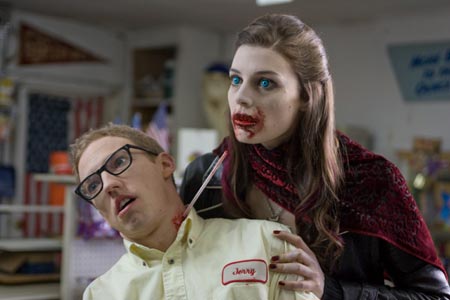
PLOT: A struggling Canadian rock band finds sudden success when their female

Still from Suck (2009)

bassist becomes a vampire.

WHY IT WON’T MAKE THE LIST: It’s a campy, tongue-in-cheek music movie with a horror/comedy flavor, but doesn’t do much we haven’t seen before.  It draws from other films and music videos to create a light parody of the music industry that’s enjoyable but ultimately forgettable.

COMMENTS:  The plot of Suck is oddly (and I assume unintentionally) reminiscent of Zombie Strippers: both feature a group of performers who willingly become a monstrous entity in order to boost their own popularity, and then climatically reap the consequences of their selfishness.  It gives a satirical bent to the overdone “fledgling musical group hits the big time but get more than they bargained for” premise, substituting blood addiction for drug addiction and topically tapping into society’s sudden Twilight-fueled obsession with vampires.  The concept of vampirism is handled in a very matter-of-fact way, resulting in a lot of unexpected jokes and straightforward humor.

Writer/director Rob Stefaniuk stars as Joey, the lead singer of “The Winners”, playing the straight man surrounded by ridiculous figures for most of the film.  Jessica Pare holds her own as the only female lead, funny and sexy as the hot bassist Jennifer, while Malcolm McDowell (always ready to bring the camp) is awesomely over-the-top as vampire hunter “Eddie” Van Helsing.  Appearances from an impressive bevy of old timer rock stars lend Suck an air of credibility as a rumination on modern-day rock and roll.  Iggy Pop is a wise rocker-turned-recording engineer, Alice Cooper is a creepy mind-reader who spouts unwanted advice, Henry Rollins is a goofy rock DJ, and Moby is a meat-loving frontman.  The highlight for any Kids in the Hall fan will of course be Dave Foley’s few scenes as the Winners’ incompetent manager, delivering the film’s best deadpan lines.

Suck incorporates a lot of different visual techniques that give it more variety than one might expect of a low-budget horror-comedy.  The use of stop-motion miniatures and blood-stained maps for transitions were a neat touch, and the frenetic cuts and dramatic lighting during many of the vampire-centric scenes cleverly reference contemporary music videos.  The music itself is catchy and fun, but doesn’t do much to set itself apart from any generic indie rock band’s output.  It’s not a true musical, saving most of its songs for stage performances except for one unexpected impromptu goth music video set at a vampire’s really pale party.

As a movie, this sits somewhere in the middle of funny and boring, smart and stupid, bold and underachieving, rocker and poser.  It’s got a good concept that blends several genres, but isn’t as effective as it could have been.  It needed to be funnier, scarier, more rockin’, or all three.  As it stands, it’s a cute film with some really enjoyable comedic bits and a few great performances, but not nearly humorous or weird enough to be memorably entertaining.

WHAT THE CRITICS SAY:

…Stefaniuk bites off more than he can chew in this star-studded rock ‘n’ roll fantasy vampire flick. Juggling conventions, skewering clichés and referencing genre cues, Stefaniuk packs the film with so many insider jokes that what could have been a wild ride simply isn’t.”–Barbara Goslawski, Box Office Magazine (festival screening)

55. O LUCKY MAN! (1973)

“Lindsay… was never into realism.  He wanted it real, but not realistic.”–Malcolm McDowell

O Lucky Man! is a film about the real world.  I think that everything in it is recognizable to people who look around with open eyes and can see the kind of world we’re living in.  But of course it makes it’s comment through comedy and through satire, because I think the world today is too complex and too mad and too bad for one to be able to make a straight, serious comment.”–Lindsay Anderson

Recommended

DIRECTED BY: Lindsay Anderson

FEATURING: Malcolm McDowell, , , Arthur Lowe, Alan Price, Lindsay Anderson

PLOT: Mick Travis is an eager, ambitious trainee at a coffee company who gets a big break when the firm’s top salesman in the Northeast territory goes missing under mysterious circumstances and he’s picked to replace him.  With his engaging smile and can-do attitude, his career begins promisingly, but soon a sting of unfortunate coincidences befall him. A plague of strange events drive him across the 1970s English landscape, as he is mistaken for a spy, volunteers for medical experiments, falls in with a touring rock band, becomes the personal assistant of a ruthless capitalist, goes to prison, and works at a soup kitchen.

Still from O Lucky Man! (1973)

BACKGROUND:

  • McDowell is Mick Travis in this film. He played a character of the same name in three of director Lindsay Anderson’s films, each completed in a different decade: if… (1968), O Lucky Man! (1973), and Britannia Hospital (1982). Other than sharing the same name, there is no evidence that Mick Travis is intended to be the same character at different stages of life.
  • McDowell came up with the core idea for the script, drawing on his own pre-fame experiences as a coffee salesman. McDowell worked on the script with screenwriter David Sherwin (If…).  In an interview, McDowell recalls that he was having trouble thinking of an ending and Anderson asked him how his real life adventures as a coffee salesman ended. “That’s your ending,” Anderson told him.
  • This was McDowell’s next project after completing A Clockwork Orange in 1971, cementing his position as the most important weird actor of the early 1970s.
  • Director Anderson had tried to make documentary about singer-songwriter Alan Price before he began O Lucky Man!, but could not obtain funding to license the songs. Anderson instead invited Price to write the songs for this movie and to appear as the leader of the touring band in the film.
  • Almost all of the actors in the film play multiple parts. Arthur Lowe won a BAFTA Best Supporting Actor Award for his triple-role as Mr. Duff, Charlie Johnson and Dr. Munda (in blackface).

INDELIBLE IMAGE: The final party scene, with the entire cast dancing to the theme song while balloons drop from the ceiling, although the shot of Dr. Millar’s medical experiments is unforgettable as well.

WHAT MAKES IT WEIRD: As if Mick Travis’ improbable class-trotting adventures across 1970s Britain weren’t strange enough, Lindsay Anderson sprinkles weirdness and non sequiturs throughout, including Kafkaesque interrogations, a half-man half-hog, and an unexpected breastfeeding scene. Any film in which a boarding-room neighbor inexplicably gives a young man a “golden” suit and sends him out into the world with the sage advice “try not to die like a dog,” is tipping to the weird end of the scale.

Original trailer for O Lucky Man!

COMMENTS: The standard line on O Lucky Man! is that it is a satire on the capitalist Continue reading 55. O LUCKY MAN! (1973)

CAPSULE: CAT PEOPLE (1982)

DIRECTED BY: Paul Schrader

FEATURING: Nastassja Kinski, Malcolm McDowell, John Heard, Annette O’Toole, Ruby Dee,

PLOT: A young woman struggles with an ancient family curse while pursuing the purrfect mate.

Still from Cat People (1982)

WHY IT WON’T MAKE THE LIST: Cat People, loosely based on the Val Lewton original, is a slightly atypical, high quality horror film.  It is a variation of the old werewolf theme, focused on felines rather than canines.  It is not quite unconventional enough to be weird, but it has a strange feel compared to other horror movies.

COMMENTS: Orphaned, beautiful Irena (Kinski) comes to live with her brother Alex (McDowell) in his creepy new Orleans home, after being separated from him for years by the mysterious death of their parents.  Alex is a pastor at an even creepier chapel and he carries the burden of some rather odd baggage.  It seems that he is taken to roaming and prowling at night, climbing trees, clawing things up, wolfing down prostitutes, and getting himself locked in zoo cages.  Worse, he unceremoniously demands sex from the mousy Irena, who isn’t exactly keen on the idea.  It never occurs to poor Alex to try sprinkling some catnip on his business areas and begging to have his tummy scratched.

Irena discovers that if she rubs up against anybody besides Alex, she will turn into a puma—a carnivorous puma with an insatiable lust for rich, red, raw human flesh.  To become human again herself, she must feast on the living.  This is of course, quite understandable.  Few things are as disappointing as a menu of Fancy Feast, when one could be munching on a delicious man like John Heard (C.H.U.D.) or his lusty girlfriend Annette O’Toole (Smile).  Heard’s zookeeper character certainly gives Irena aplenty to purr about.  Irena falls in love with Heard, but will she be able to resist his charms—and the savory goodness of his tender, meaty loins and chops?  Then there’s the matter of that pesky girlfriend with the hair like red yarn.  She caterwauls her concerns surrounding Irena, and Irena wishes a cat had her tongue.  Hopefully she’s nothing a hiss and a swat can’t take care of.

Irena explores the French Quarter and her blossoming desires, and experiences some very unsettling biological changes when she’s in heat.  She becomes embroiled in a murder case as her brother stalks her, she stalks the girlfriend, chases after Heard, and Alex plays cat and mouse with the police.  Meanwhile Heard is quickly beginning to realize that toying with the supernatural is not always the cat’s meow.

Cat People is a very arty film with a distinctive visual pawprint featuring Big Easy location cinematography and some striking, unusual shots. There are some interesting ultraviolet night sequences filmed from a werecat’s point of view that are innovative for the date of release, putting the simple thermal imaging used in Wolfen to shame.  An original score by David Bowie and Girogio Moroder (Midnight Express) compliments the avant-garde look and feel of the film.  Well acted, Cat People is a pleasing change of pace from mediocre, industry standard horror movies.  It boasts an unusual, well-structured plot and a bizarre ending which nicely balances out the heavy compliment of cat shots.  And by cat shots, I mean very solid thespianism on the part of a couple of beautiful and charming black leopards (in addition to all the of naked supple human breasts, and full frontal nude footage of the spectacular specimen of feline-esque femininity, Nastassja Kinski, captured in her prime. Rowwwr!)

WHAT THE CRITICS SAY:

“The obscure proceedings are often ludicrous (especially in the orange-colored primal-dream sequences), yet you don’t get to pass the time by laughing, because it’s all so queasy and so confusingly put together…”–Pauline Kael, The New Yorker (contemporaneous)

30. A CLOCKWORK ORANGE (1971)

“The story functions, of course, on several levels, political, sociological, philosophical and, what’s most important, on a dreamlike psychological-symbolic level.”–Stanley Kubrick

Must See

DIRECTED BY:

FEATURING: Malcolm McDowell, Patrick Magee

PLOT:  Alex is the leader of a small gang of violent, thrill-seeking youths in England sometime in the indefinite near future.  After a home invasion goes bad, his “droogs” betray him and his victim dies, and he is sent to prison.  The government selects him to undergo experimental Pavlovian conditioning that makes him violently ill when he becomes aggressive, then releases him onto the streets as a “reformed” criminal, only to find he is helpless to defend himself when he encounters his vengeful former victims.

Still from A Clockwork Orange (1971)

BACKGROUND:

  • A Clockwork Orange is an adaptation of the critically acclaimed 1962 novel by Anthony Burgess.  Burgess was ultimately unhappy with this treatment of his novel, because in his intended ending for the story, Alex voluntarily reformed.  This final chapter of redemption had been excluded from American prints of the novel—the version Kubrick worked worked from—at the request of the American publisher.  Kubrick’s version ends with evil triumphant.  Although Kubrick had not read the final chapter of the novel before beginning the film, he later stated in interviews that he would not have included the happy ending anyway because he thought it rang false.
  • The title—which is not explained in the movie, only glimpsed briefly as a line of text on a typewritten page—comes from an expression Burgess overheard in a bar, “as queer as a clockwork orange.”
  • Burgess created the elaborate fictional jargon Alex uses by mixing elements of Russian and Slavic languages with Cockney slang.  Much of his original dialogue found its way into the movie.
  • A Clockwork Orange was Stanley Kubrick’s next project after his previous weird masterpiece, 2001: A Space Odyssey (1968).  It was also young star Malcolm McDowell’s first feature role after starring in a 1968 weird film, Lindsay Anderson’s If…
  • A Clockwork Orange was the first movie to use Dolby sound.
  • The movie was released in the United States with an “X” rating, and was later cut slightly and re-released in 1973 with an “R” rating.
  • The film was blamed for several copycat crimes in Britain and Europe, notably, a gang rape in which the rapists sang “Singin’ in the Rain” during the assualt.  Kubrick, an American who lived in the United Kingdom, was also reportedly stalked by some deranged fans of the film.  For these reasons, Kubrick withdrew A Clockwork Orange from distribution in Britain, both from live screenings and on video.  The self-imposed ban lasted until Kubrick’s death.

INDELIBLE IMAGEA Clockwork Orange filled with as many iconic images as any film of the last fifty years.  Scenes like the one where Alex and his costumed droogs walk cockily through a deserted city in slow motion have consciously or unconsciously been copied many times (compare the similar slo-mo shot of the uniformed gangsters emerging from their breakfast meeting in Quentin Tarantino’s Reservoir Dogs).  Probably the most instantly recognizable image is the opening closeup of Alex’s sneering face, wearing a huge false eyelash one one eye only.  I selected another memorable Malcolm McDowell closeup, the one of Alex as he’s undergoing the Ludovico technique, with wires and transistors attached to his head and metal clamps forcibly holding his eyes open so he cannot look away from the violent images on the screen, because it works as a perfect ironic metaphor for a film we cannot tear our eyes away from.

WHAT MAKES IT WEIRD:  Although the plot is simple, and realistic in its own speculative way, Kubrick’s A Clockwork Orange is so hyper-stylized with its bizarre poetic language, sets, costumes, music, broadly exaggerated performances, and the improbable karmic symmetry of the plot that it seems to take place in a dream world or a subconscious realm.  The action, which takes the form of an ambiguous moral fable, occurs in an urban landscape that’s familiar, but fabulously twisted just beyond our expectations.


Original trailer for A Clockwork Orange

COMMENTSA Clockwork Orange did not have to be weird.  The story could have been Continue reading 30. A CLOCKWORK ORANGE (1971)