Tag Archives: Horror

CAPSULE: SCREAMPLAY (1985)

DIRECTED BY: Rufus B. Seder

FEATURING: Rufus B. Seder, , Katy Bolger

PLOT: Young Edgar Allen comes to Hollywood to make it as a screenwriter and settles in at a fleabag motel; he incorporates his revenge fantasies into his murder-mystery screenplay, but finds that the killings he writes about occur in real life.

Still from Screamplay (1985)

WHY IT WON’T MAKE THE LIST: It’s an oddball tongue-in-cheek horror melodrama, but there’s nothing tremendously weird about it.

COMMENTS: In his introduction to the DVD edition of Screamplay, calls Rufus B. Seder the “ of Tromaville.” While that’s more than a bit of a stretch, it’s true that this classic horror homage, distributed (but not made) by Troma just before they stumbled onto the lucrative Toxic Avenger formula, is extremely highbrow by the company’s gore-comedy standards. Aside from the minuscule budget, it’s unlike anything else in their catalog. It’s far enough outside the mainstream that George “Sins of the Fleshapoids” Kuchar took on a rare acting role outside of his own productions (he’s wonderfully sleazy here as the heavy).

The story is simple: a series of murders among the dregs of Hollywood—would-be writers, actresses, agents, and producers—holed up in a low-rent motel are linked to a script being churned out by an eager but naive young screenwriter. The style, however, is more impressive. Rufus B. Seder’s influences are obvious: from the Expressionistic shadows of Nosferatu to the cheap B-movies of the 30s and 40s that vainly but valiantly tried to exploit that atmosphere (there’s even a sly nod to Plan 9 from Outer Space when a cop absentmindedly scratches his face with his revolver). Most of the time Screamplay looks like a 30s period piece you might catch on the Late Late Show, complete with a scratchy public domain quality transfer, but there are moments that would not be out of place in a Guy Maddin movie—or an early draft of Barton Fink as done by a poverty row studio. Seder’s performance seems to be at least partially modeled on Bill Woods’ wild-eyed mugging in Maniac—his innocent expression darkens and his eyes turn insane at the drop of a plot point. The ganja-inspired hallucination with a pair of murderous hands appearing in a cloud of pot-smoke also recalls ‘s maniacal epic.

The sets are very basic, but with overdramatic lighting, they achieve a melodramatic budget Expressionism. The blocky motel stairs leading to nowhere reach a minimalist sort of Surrealism, as does the police station set—basically just a raised podium reading “Hollywood Police Dept.,” flanked by Greek pillars with light bulbs on top. The story is set in no time in particular; the style recalls the 1930s, naturally, but occasional anachronisms like a roller-skating transvestite mugger add another layer of absurdity. Overall, it’s an impressive triumph of style over budget. Still, unless you’re obsessed with 20s and 30s horror, I wouldn’t recommend rushing out and trying to find Screamplay; but, if you do, I’d be willing to bet you won’t be disappointed.

Rufus B. Seder never made another movie after this one; he went into the production of holographic murals instead (examples of his work are included as a special feature on the DVD). It’s a shame, because Seder has clear talent and may have been able to make a truly great weird movie down the line had he stuck with it. He seems to have gotten movies out of his system with this project, but at least he found a niche for his creative impulses.

WHAT THE CRITICS SAY:

“…possibly the best Troma movie you’ve never heard of… with very few exceptions, [it] would feel right at home on a double bill with the classics from the twenties, thirties, and forties it so lovingly homages.”–James Lasome, Horrorfreak News (DVD)

(This movie was nominated for review by “ShaneWreck,” who characterized it as “[a] bizarre, expressionistic satire on Hollywood.” Suggest a weird movie of your own here.)
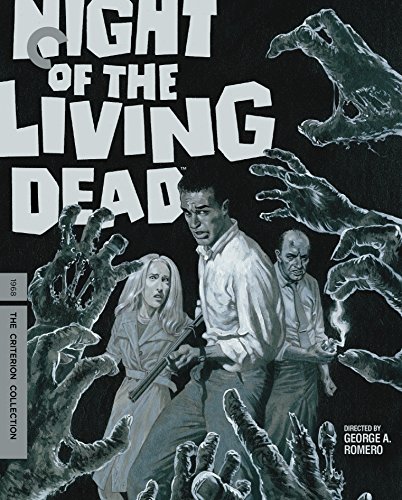
1968 EXPLOITATION TRIPLE FEATURE: NIGHT OF THE LIVING DEAD, THE DEVIL RIDES OUT, AND SPIRITS OF THE DEAD

366 Weird Movies may earn commissions from purchases made through product links.

In 1968 released one of the most relentlessly frightening movies ever made in Night of the Living Dead, but it took a couple of years for the midnight movie crowd to make it into an epic cult phenomenon. Seen today, it holds up effectively, even with our sensibilities jaded from countless hack imitations. Its grainy black, white, and gray palette serves its otherworldliness well during a late night viewing on big screen, which I how I first encountered it. Even Romero could never quite match it, although he continued to try for forty years.

The argument can be made that Romero’s best post-Night of the Living Dead films were outside the zombie genre (The Crazies, Martin, NightRiders, and Creepshow). Still, no one does zombies like Romero (as proved with his 1990 NotLD remake), and the movie closest to the impact of the original was its immediate sequel, Dawn of the Dead (1978), which was a shock satire on Western consumerism, brutalizing in its late 70s comic book colors and deliberate plays on banality. Some claim Dawn is Romero’s masterpiece, although it lacks the original’s reinventing-the-wheel, rough-edged freshness. In 2004, Dawn was remade by who completely missed Romero’s acerbic wit. The underrated Day of the Dead (1985) was the third in Romero’s original zombie trilogy, but did not attain the cult status of its predecessors. Its financial disappointment seemed to render it a finale to Romero’s zombie oeuvre. However, Romero, who has always been a sporadic filmmaker, returned with The Land of the Dead in 2005, which was followed by Diary of the Dead (2007) and what looks to be his last film, Survival of the Dead (2009). Each of Romero’s zombie sequels has its equal share of fans and critics, but at the very least, he has tried to say something new with each entry.

Still from Night of the Living Dead (1968)None have attained the compact rawness of that 1968 yardstick, however. Duane Jones became a cult icon as the doomed protagonist Ben. Previously an English professor, Jones was the first African-American to have a starring role in a horror feature (the script does not specify Ben’s ethnicity). Judith O’Dea, as Barbara, is the eternal victim ( in Savini’s remake, the character is recast as a feminist femme fatale). Together, they hole up in a farmhouse and fight off the marching dead, but are inevitably at the mercy of hayseeds with guns. The shot-on-the-cheap crudeness and novice acting actually add to the mundane horror. It was riveting enough to create an entirely new genre, but predictably, its unique qualities have eluded pale imitations.

Elsewhere in 1968, AIP’s Wild in the Streets (directed by ) Continue reading 1968 EXPLOITATION TRIPLE FEATURE: NIGHT OF THE LIVING DEAD, THE DEVIL RIDES OUT, AND SPIRITS OF THE DEAD →

1967 EXPLOITATION TRIPLE FEATURE: CORRUPTION, QUATERMASS AND THE PIT, AND THE FEARLESS VAMPIRE KILLERS

We start our 1967 genre survey with a considerable amount of barrel-bottom scraping with two of ‘ most execrable efforts: The Gruesome Twosome and Something Weird. He also made the somewhat better A Taste of Blood the same year. With a bigger budget and longer running time (118 minutes), Lewis referred to Blood as his “Gone With The Wind” masterpiece.  Actually, it’s modeled more after than . Lacking the excess of Lewis’ previous films and featuring a “classic” monster in Dracula, it’s mostly seen as a noble misfire by Lewis’ cult.

Elsewhere in 1967, , a director on par with the likes of Lewis, , , or , produced a pair of jaw-dropping bombs in Mars Needs Women and Creature of Destruction. Jean Yarbrough, who had previously helmed such masterpieces as The Devil Bat (1940), directed Basil Rathbone, Joi Lansing, John Carradine and . in Hillbillies in a Haunted House. Rathbone died shortly after filming and was spared embarrassment from a film so wretched that it’s virtually unwatchable. His surviving co-stars and director weren’t as fortunate. Nazis-on-ice figure prominently in Herbert Leader’s The Frozen Dead, which at least has some unintentional humor going for it. went Beserk for director Jim O’Connell. The film’s a paltry effort, but Joan is a humdinger channeling her inner Mommie Dearest.

A blind got whupped by in Cauldron of Blood, but the on-his-last-leg genre icon fared considerably better in ‘ excellent cult classic, The Sorcerers. Harald Reini did few favors when directing the actor for The Torture Chamber of Dr. Sadism.  likewise missed the mark in Hammer’s The Mummy’s Shroud. Away from Hammer Studios, was out of his element in his final sci-fi opus ((Fisher’s first two entries in the genre were 1965’s The Earth Dies Screaming and 1966’s Island Of Terror.)) , Island of the Burning Damned, starring Lee and . By his own admission, Fisher had no enthusiasm for science fiction and went back to his Hammer Horror niche later in 1967 with Frankenstein Created Woman.

Poster for Corruption (1967) Fisher favorite Peter Cushing made a sharp departure from his typical acerbic-but-classy screen persona by dipping into pure sleaze for Corruption (directed by Robert Hartford-Davis). Although most sources give the release date as 1968, it’s also listed as a 1967 production. Most likely it’s the later date, but since we have that year already filled up, we’ll cheat a tad in placing it here. A sordid hybrid of The Corpse Vanishes (1942) and Eyes Without a Face (1960), Corruption can be summed up by the Blu-ray cover art image of a middle-aged Cushing taking a knife to the throat of a scantily clad buxom blonde. He plays Continue reading 1967 EXPLOITATION TRIPLE FEATURE: CORRUPTION, QUATERMASS AND THE PIT, AND THE FEARLESS VAMPIRE KILLERS →

LIST CANDIDATE: WE ARE THE FLESH (2016)

Tenemos la Carne

DIRECTED BY: Emiliano Rocha Minter

FEATURING: Noé Hernández, María Evoli, Diego Gamaliel

PLOT: A teenage brother and sister find their way to the lair of a hermit, who seduces them into acting out increasingly depraved, increasingly hallucinatory scenarios.

Still from We Are the Flesh (2016)

WHY IT MIGHT MAKE THE LIST: The overall project may seem to lack much purpose, but it’s intense and uncompromising—and weird—enough to merit a look.

COMMENTS: The new year is only a few weeks old, and already we have a contender for Weirdest Movie of 2017. A demonic hermit uses two disciples—one reluctant, one willing—to transform his habitat into a womblike space where he enacts bizarre, perverse fantasies eventually incorporating sadism, rape, orgies, murder, cannibalism, and more. As the ringmaster in this cavalcade of perversions, Noé Hernández is believably crazy. He looks like he stinks, and rants like a guy you’d cross the street to avoid meeting. He projects a very specific form of charisma: like a Mexican Manson, he has a gravity capable of capturing those irretrievably lost to themselves in his orbit. “People shy from certain thoughts. Their lives are a continuous distraction from their own perversion,” the wild-eyed messiah preaches to an improbably intrigued teenage girl, while flapping his arms like a bird in the void. “Solitude drags you, forces you to come face to face with your darkest fantasies. And when nothing happens, you stop being afraid of your most grotesque thoughts.”

With siblings and a perverted Svengali, the story goes exactly where you think it will; but, incest is only the beginning. Once they indulge that taboo, all the walls come crashing down—and the plot immediately hops onto whatever crazy train it can catch, going to places you can’t possibly predict. In fact, after the strangely beautiful incest montage, shot in psychedelic thermal imaging and scored to a romantic Spanish ballad, there can hardly be said to be a plot at all, only a series of deranged, escalating provocations. (One presumes that in Catholic Mexico, the movie’s blasphemous parody of Christ—both the resurrection and the Eucharist—is the most shocking element). On a literal level, you might try to explain it all as the result of an all-purpose drug the hermit keeps in an eyedropper, which is capable of producing intoxication, serving as an antidote to his own homebrewed poisons, and possibly preserving the brains of those he’s lobotomized. More likely, the hermit simply personifies  perverse desire, and the movie is a representation of the nightmare of a narcissistic world of pure desire without taboos or boundaries. The tumbling of moral walls allows the irrational to flood in.

As shock cinema goes, Flesh displays far more artistry than most. The lighting is extraordinary—purple-lit faces in front of glowing yellow portals that serve to block, rather than lead to, the opaque outside world. These touches elevate the minimalist set into a true dream space. The music is also well-deployed, with horror-standard rumblings alternating with ironically beautiful ballads and a Bach concerto. Flesh shows the imagination of , mixed with the despairing nihilism of , in a scenario reminiscent of Salo.

As for misgivings: I wonder if Flesh has enough substance to compensate us for its unpleasantness. Late in the film, it takes a stab at social relevance, with a subversive recital of the Mexican national anthem and a paradigm-shifting final scene. But these digressions come off as afterthoughts to a movie whose main interest is to indulge its own most grotesque thoughts. And there, I wonder if the film doesn’t pull its own perverse punch. A Clockwork Orange‘s Alex was deeply chilling because he made you feel the appeal and charm of evil; the hermit here does not. He’s too clearly insane, too cartoonish in his fleshy villainy. The ominous music and horror movie atmosphere also instruct you to be repulsed rather than aroused. Despite the madman’s advice, this movie does want you to be afraid of its most grotesque thoughts. But fans of extremity cinema will—pardon the pun—eat it up.

WHAT THE CRITICS SAY:

“We Are The Flesh is a bizarrely arresting treat from an exciting new talent. It’s also just about the strangest film you’ll see this year.”–Michael Coldwell, Starburst (contemporaneous)

1965 EXPLOITATION TRIPLE FEATURE: DIE MONSTER DIE, MONSTER A GO-GO, AND INCUBUS

After the bonanzas of 1963 and 1964, 1965 was a comparatively lackluster year for horror and exploitation flicks, with a few exceptions at both ends of the spectrum. , Nick Adams, Suzan Farmer, and Freda Jackson starred in Die, Monster, Die, directed by Daniel Haller, which was one of the first big screen attempts at an adaptation. Released by AIP for the drive-in double feature circuit along with ‘s cult fave, Planet of the Vampires, Die, Monster, Die has more kinship to that studio’s product than to Lovecraft. It also has a distant relationship to : Jackson previously appeared in Brides of Dracula, and Farmer went on to do both Dracula, Prince of Darkness and Rasputin, the Mad Monk for the studio the following year. Additionally, elements of Die, Monster Die are clearly related to Universal’s Man-Made Monster (1941) and Columbia’s mad doctor series. With Universal horror icon Karloff and Rebel Without a Cause heartthrob Adams as the two leading men, Die, Monster, Die feels like a queer hybrid. The aged Karloff, suffering the effects of emphysema, is wheelchair bound (and will be for the rest of his career and life), but he evokes formidable English mystery from his blanket and chair. In sharp contrast is all that pent-up, pushy, youthful American angst from Adams, who is aptly vulgar and a standout in his Jersey accent.

Still from Die, Monster, Die (1965)Stephen Reinhart  goes to visit Susan Witley at her parents’ home in the English village of Arkham. Stephen had met Susan at the college they attended together in the States, but when he stops at a local pub, he discovers the entire village paralyzed with fear in regards to the Witley estate (calling to mind ‘s daffily delivered dialogue from 1955’s Bride of the Monster, “stay away from the old Willow’s place!”) Poor Stephen can’t get anyone to give him transportation and is forced to walk. Upon finally arriving at the Witley estate, he discovers that the surrounding plant life has all mysteriously died. He is greeted with hostility by Susan’s crippled father, Nahum (Karloff), who demands that Stephen leave at once. Nahum is interrupted by a beaming Susan and introduced to her mother, Letitia (Jackson), who is bedridden and hidden behind a veil. Letitia intercedes for Stephen and asks him to take Susan away from this charnel house. A short while later, Nahum’s servant, Merwyn (Terence De Marney) collapses and dies. After Merwyn’s late night burial, followed by a phantom-like figure appearing at the window, Stephen and Susan make their way into Nahum’s greenhouse and discover abnormally enlarged plant life and mutated critters. “It looks like a zoo on hell,” declares Stephen. After some Sherlock Holmes/Watson sleuthing, he and Susan unlock the dreadful secret: Nahum has been “experimenting” with radioactivity from a meteorite. Hoping to undo an ancestor’s evil deeds (whatever those were) Nahum plans to help feed the world with mutated plant life! Of course, things go awry and everyone who worked in the greenhouse has been either mutated or killed. The phantom figure turns Continue reading 1965 EXPLOITATION TRIPLE FEATURE: DIE MONSTER DIE, MONSTER A GO-GO, AND INCUBUS →