Alfred is not a fan of his new brother, Remus. (Or of the Easter Bunny.)
Content warning: Not for kids, contains obscene gesture and non-explicit but disturbing breastfeeding

Alfred is not a fan of his new brother, Remus. (Or of the Easter Bunny.)
Content warning: Not for kids, contains obscene gesture and non-explicit but disturbing breastfeeding
366 Weird Movies may earn commissions from purchases made through product links.

DIRECTED BY: Justin Tipping
FEATURING: Tyriq Withers, Marlon Wayans
PLOT: After suffering a traumatic injury just before the draft, a star college football player attends a remote retreat to be mentored by his idol, who years ago suffered a similar setback before making an unlikely comeback.

COMMENTS:
Behold, the Lord God will come with strong hand, and his arm shall rule for him: behold, his reward is with him, and his work before him.
Stamina, speed, and sacrifice: three elements you need to become the GOAT. Especially sacrifice. Football must be what drives you. Forget family, forget God. Everything for the game. Isaiah understands this—it’s why he ushered his team, The Saviors, to victory in eight Super Bowl championships. But Isaiah has grown old, and new blood must take the helm. Does this young rising star have what it takes?
And it shall be said in that day, Lo, this is our God; we have waited for him, and he will save us: this is the Lord; we have waited for him, we will be glad and rejoice in his salvation.
The parallel backgrounds of Isaiah (Marlon Wayons) and Cam (Tyriq Withers) are slammed on the screen, sports news-style, showboating the talent and lite psychosis of the fanatical athlete mind. Growing up, Cam watched Isaiah dominate the field, all under the relentless pressure from his own father to become HIM, to become the GOAT. Cycle forward a decade-and-a-half, and Cam is on the cusp of his first professional draft. Then one night, after practice, he ends up brained by a warhammer-wielding team mascot.
And said unto me, Thou art my servant, O Israel, in whom I will be glorified.
The bulk of the story unfolds within Isaiah’s remote compound, chronicling a week of Cam’s trials as he recovers from his injury while attempting to gain his idol’s favor. During that time things become strange—borderline weird, in fact. Mystical overtones abut sports satire: Isaiah’s wife is a cryptic marvel heading up a cavalcade of followers, enablers, psychos, and fools. HIM (all capitals, mind you) has smash-style to spare, and as it ratchets up the intensity, so it also ratchets a primordial kind of evil. I shall say no more on that point, save my observation that I’m not sure whether the finale went too far, or not far enough. Regardless, the talents behind HIM rise to the difficult challenge of providing me a third sports movie I can wholeheartedly recommend.
For the LORD is our judge, the LORD is our lawgiver, the LORD is our king; he will save us.
WHAT THE CRITICS SAY:

Párvulos: Hijos del Apocalipsis; AKA Párvulos: Children of the Apocalypse
366 Weird Movies may earn commissions from purchases made through product links.
Parvulos is currently available for purchase or rental on video-on-demand.
DIRECTED BY: Isaac Ezban
FEATURING: Carla Adell, Mateo Ortega Carsillas, Leonardo Cervantes
PLOT: Three brothers struggle to survive in a post-apocalyptic world while caring for two zombies caged in their basement.

COMMENTS: A tale about family in times of extreme change. Isaac Izban, the Mexican auteur of films like the mind-bending and space-bending Incident (2014) or the deeply-layered Similars (2015), known for its political undertones, returns with a slightly more conventional, yet still eccentric combination of family drama and zombie apocalypse. But let’s take things from the start.
We follow three brothers—two kids and their older teen brother—struggling to survive in a world where the rules have changed dramatically. Everything seems typical to post-apocalypse fans, at first. A pandemic has decimated the population, while a not-fully-tested vaccine had serious side effects, creating hordes of zombies. Parallels with the recent Covid pandemic haunt the story, but there is no explicit analogy, just a new take on common tropes of the genre.
The twist brings something new to the table. In their basement the boys are hiding two zombies, scavenging and collecting food for them. Who could they be? When the youngest brother Benjamin discovers they are his parents, the boys begin an effort to tame the dead and remind them who they are.
The film could develop as a parable on toxic family dynamics, with the parents being wild zombies, but it doesn’t want to go there. It remains, even at its grossest moments, a wholesome combination of family drama and post-apocalyptic themes, targeted at a teen audience of the main protagonist’s age. There’s nothing wrong with this approach, but it’s not as deeply layered or rich in allegory as Ezban’s earlier works.
Parvulos is formally inventive. The faded color palette, resembling black-and-white photography, gives an eerie and melancholic tone. Wide shots along with distorted audio underline some of the tensest moments. There soundtrack is rich: composers Edy Lan and Camilla Uboldi, close collaborators of director, creates a wide range of tones, from ominous orchestral music to uplifting beats with lyrics in English.
The story continues through a series of encounters of the boys with other survivors. A picture of the new state of the world gradually emerges, with deadly cults roaming around (another common trope of apocalyptic fiction). But the tale remains fresh by keeping the family dynamic between the kids and their zombie parents at its heart. It is an intriguing premise, and there are even some WTF moments here, as when the zombies have sex or, chained to their seats, attend a festive Christmas dinner.
WHAT THE CRITICS SAY:
366 Weird Movies may earn commissions from purchases made through product links.
DIRECTED BY: Christophe Gans
FEATURING: Jeremy Irvine, Hannah Emily Anderson
PLOT: A painter’s drunken dreams and a mysterious note lead him to the ghost town of Silent Hill, where he searches for his lost ex-lover amidst the eternally smoldering ruins.

COMMENTS: Aficionados will tell you that “Silent Hill 2” is one of the greatest video game stories ever told. I trust them, but this adaptation by Christophe Gans, returning to the Silent Hill series after a highly disappointing middle installment from another director, does nothing to support their claim. (Evidence of it faithfully recapturing the look of the game, on the other hand, is much stronger.) What we get here is a gilded but mediocre psychological horror that never explains why it needs to be set in the rapidly deteriorating “Silent Hill” universe—except for the fact that it’s a spooky locale.
And indeed, the film is at its best when it’s merely prowling about the town, encountering swarms of beetle-like insects, headless zombies squirting acid from a torso orifice, and spider-like corpses. It’s fun just sightseeing: the ashy gray streets and the eerie hallways of the town’s dilapidated tenements have a bleak beauty. But even Silent Hill’s essential hauntedness is starting to have diminishing returns. The series’ signature monster, Pyramid Head, is scary—terrifying, in fact—the first time you see him. Three movies in, he doesn’t have the same impact. Unlike in a game, this lumbering behemoth is never a threat to catch a protagonist.
Irvine and Anderson are competent leads whose main virtue is that they’re easy on the eyes. The supporting cast does not stand out, and it seems that most of their characters have been cut for time (Eddie serves no purpose in this plot, and could have been left out entirely). Akira Yamaoka’s evocative music again features. The star, such as it is, is the production design and visual effects.
The plot is the biggest issue. Yes, the movie will get weird, but only in that tired “the borders between reality and hallucination start to blur” approach that now seems to animate 5-10% of low and mid-budget horrors. The info drops explaining James and Mary’s generic love affair hardly create a strong emotional rooting interest, and the backstory of the mysterious cult isn’t developed enough to create a meaningful plot engine. In a nod to the video game’s multiple possible resolutions, the movie has conflicting, contradictory endings. The technique doesn’t work at all in the context of a movie adaptation, particularly for people who’ve never played the game. Don’t Return to Silent Hill in theaters. If you do, don’t say you weren’t warned.
Walkout note: the only other people in my theater, a couple, walked out with fifteen minutes left to go.
WHAT THE CRITICS SAY:
366 Weird Movies may earn commissions from purchases made through product links.
DIRECTED BY: Carlton J. Albright
FEATURING: Edward Terry, Joan Roth, Stacy Haiduk
PLOT: Imprisoned as a juvenile for a murder spree, Luther is released on parole and terrorizes a family in a remote Illinois farmhouse.

COMMENTS: What is the goal of imprisonment? Some argue deterrence. Others rehabilitation. A few would make the case for vengeance. Or perhaps it’s some combination of these. Carlton J. Albright and his team put these socio-philosophical concerns aside in their chronicle of Luther the Geek: a madman who began as a mad lad, murdering three people after a formative encounter with a circus performer who ripped open the necks of chickens for the amusement of the crowds (and to earn his much-needed liquor).
Amongst that crowd, Young Luther is thrown to the floor in a scuffle—smashing out his front teeth in the process. Fast-forward twenty years (all of them in prison), and his parole is reviewed by five prison officials, among them a “bleeding-heart” female who notes Luther’s commendable behavior prison, his lack of speech notwithstanding. Luther, you see, merely clucks. By a vote of three-to-two, he’s set loose, and the inevitable ensues.
Albright lucked out finding a performer like Edward Terry, since to whatever degree it may be argued that Luther the Geek works, it could not work without Terry’s all-in performance. His Luther is not fit for society, and quickly murders again. An hour or so of this eighty-minute movie takes place in an out of the way farm, during which—through a series of commendably paced, shot, and edited chase, scuffle & violence set-pieces—various victims are bloodily dispatched by the titular geek.
Why are we here, though? The pay-offs will interest slasher fans. Titillation seekers get their thrills from the buxom daughter. The rest of us may find Luther the Geek an oddity (if not a weird-ity) worth checking out. Through much of the dialogue-free performance from Terry, I was reminded of 183’s Angst. Luther the Geek sort of plays out like that German film’s American hick cousin. Indeed, one weakness I found in Angst is not present in Luther: there is no inner monologue. We have no real idea why this nut is doing what he’s doing; and Luther is all the more terrible and, perhaps, sympathetic for this lack of elucidation. As a violence picture that goes for the throat, there’s a strange undercurrent of pathos—and a remarkable finale that doesn’t chicken out.
WHAT THE CRITICS SAY:
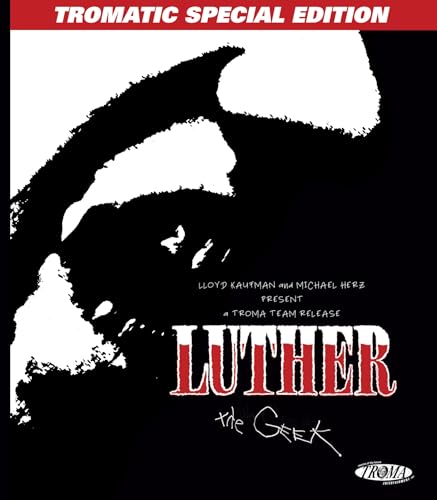
Luther The Geek (Tromatic Special Edition)
List Price :
Offer: 9.99 $
Go to Amazon