Tag Archives: Horror

CAPSULE: DRAG ME TO HELL (2009)

366 Weird Movies may earn commissions from purchases made through product links.

Recommended

DIRECTED BY:  Sam Raimi

FEATURING: , Lorna Raver

PLOT: Seeking a promotion, a cute and kind-hearted loan officer decides to get tough with the wrong customer, denying a mortgage extension to an elderly gypsy woman who curses her with a demon that will torment her for three days before dragging her to hell.

Drag Me to Hell (2009) still

WHY IT WON’T MAKE THE LIST:  Because too much weirdness would have jeopardized Sam’s chance to direct the next Spiderman installment.

COMMENTS: On the surface, Drag Me to Hell‘s blend of spurting body fluids, horror, and absurd slapstick bring to mind director Sam Raimi’s celebrated The Evil Dead 2. Drag Me, however, isn’t nearly as anarchic or over-the-top with its carnage; and more importantly, it lacks the cabin-fever dream feel of Raimi’s weird wonderwork, substituting a standard ticking-clock suspense trope. Rather than being comically unhinged, Drag Me to Hell instead feels tightly controlled, at times even micromanaged: a PG-13 Evil Dead for the cineplexes. Not that that’s entirely a bad thing: the movie is exactly what it’s intended to be, a spook-house carnival ride with abundant jump scares and grossout scenes to thrill the teenyboppers, along with plenty of black humor homages offered as a sop to fans of 1980s drive-in horror/comedy classics (such as the eyeball-related callback to Evil Dead II, and the gleefully excessive catfight between a hottie and grannie using office supplies as weapons).  The diabolic plot is reminiscent of ‘s 1957 classic Night of the Demon, retooled to focus on action and effects instead of oppressive ambiance. Simultaneously satisfying the longing for classic Gothic atmosphere, the high spectacle quota demanded of blockbusters, and the nostalgia of longtime Raimi fans for those abandoned hip horror trips, Drag Me to Hell is a well-constructed, well-placed and welcome addition to Hollywood’s summer lineup.

Although it’s an entertaining movie, the enormously positive critical and audience reaction probably relates more to the relative crapiness of Hollywood’s recent efforts in the horror genre than to the inherent quality of this film. After reviewing a seemingly endless parade of gory slaughterfest “reboots” of Halloween, Dawn of the Dead, Friday the 13th, ad nauseum, critics are eager to encourage an original supernatural script that doesn’t cynically depend on a massive bloody body count for effect. Audiences whose taste in old-fashioned spooky stories have been ignored in recent years are just thrilled to see anything arcane on the big screen.

WHAT THE CRITICS SAY:

“…Raimi temporarily shrugs off the A-list status the Spider-Man movies earned him and returns to his disrespectable Evil Dead ways. The blood and guts may have been tamped way, way down, but the manic intensity and delirious mayhem of those earlier zombie romps remain intact.”–Rene Rodriguez, Miami Herald

CAPSULE: ONE MISSED CALL [CHAKUSHIN ARI] (2003)

DIRECTED BY:  Takashi Miike

FEATURING: ,

PLOT:  Students begin receiving phone calls from their own cell phones, dated three days in the future; the message is their own voice screaming, and they all end up dead at the appointed time.

Still from One Missed Call [Chakushin Ari] (2003)

WHY IT WON’T MAKE THE LIST:  Weird director Miike adds a few surreal style points at the end, but it’s too little, too late. For most of the way, this is standard J-horror territory, and a bit dull to boot.

COMMENTS: One Missed Call begins by ripping off a riff from Ringu (1998), with cell phones replacing videocassettes as the technological bogeyman. Heaping unoriginality on unoriginality, Miike adds recycled ideas from his own Audition (1999), including a slowly revealed child-abuse backstory and multiple false endings. It all eventual ends up as a standard entry in the supernatural Japanese horror (“J-horror”) genre. The setup is fine, with the students discovering the mysterious, deadly calls from the future, then figuring out that the spirit that makes the calls selects a new target from the last victim’s stored phone numbers, putting them all at risk—even if they’re on the “Do Not Call” registry. Anytime a ring tone sounds in the movie thereafter, it could be someone’s death sentence. After the premise is established, however, the movie bogs down into talky exposition. The next target, psychology student Yumi, and man whose sister was one of the first victims try to trace the calls back to their source, where they presume they’ll find the ghost responsible for all this cellular slaughter. Along the way there is an effective mixture of suspense and satire when a sensationalist television show broadcasts a live exorcism for one of the doomed souls at exactly the time the killer is supposed to strike, as well as a spooky trip through a haunted hospital. But the needlessly confusing ending, where Miike suddenly decides to burn his personal weird brand onto a generic piece of genre livestock, is unsatisfying and even frustrating. By the end—despite heaps and heaps of exposition along the way—the supernatural antagonist’s motives, origins, and perhaps even identity are left unclear.

In a time honored tradition of Japanese horror hit adaptations that stretches back all the way to 2003, One Missed Call was remade as a Hollywood flop (with Ed Burns and Shannyn Sossamon) in 2008. This is a rare J-Horror the Americans could have actually improved with tighter editing and a streamlined storyline, but critical evidence (an amazing 0% rating on Rotten Tomatoes tomatometer!) indicates otherwise.

WHAT THE CRITICS SAY:

“…in the final act, when the scene shifts to an abandoned hospital and evil comes out of its closet (or rather oozes out of its vat), we are suddenly in ‘Miike World’… Rationality takes a holiday as Miike sends the film hurling into a surreal universe. For Miike fans, all this will be familiar. For those expecting a generic horror flick, Miike’s imagination may be too out-there for comfort — or understanding.”–Mark Shilling, The Japan Times

CAPSULE: VIY [Вий] (1967)

366 Weird Movies may earn commissions from purchases made through product links.

Must See

AKA Viy, Spirit of Evil; Vij

DIRECTED BY:  Georgi Kropachyov & Konstantin Yershov

FEATURING: Leonid Kuravlyov, Natalya Varley

PLOT:  In medieval Ukraine, a seminarian must spend three nights praying over the corpse of a witch.

viy

WHY IT WON’T MAKE THE LIST:  This faithful adaptation of Nikolai Gogol’s 1835 short story is a classic of world horror, deserving a place alongside the quintessential Universal fright films.  Like the works of Gogol’s contemporary, Edgar Allen Poe, Viy may have been regarded as a “weird” tale on its original publication, but today it seems a relatively straightforward ghost story, demonstrating how what was once weird may be subsumed into the mainstream over time.  It’s still unconditionally recommended, especially for fans of sublime supernatural horror storytelling that relies on atmosphere and foreboding rather than blood and guts.

COMMENTS: Viy is an unusual and exotic experience for Western viewers, for whom witches are not the prototypical supernatural villain, but most will quickly feel comfortable inside the film’s recognizable folk tale structure.  The story is impeccably told; Kuravlyov’s seminarian, who begins with a mischievous frat-boy brashness but ends up bullied and harried by both Cossacks and witches, is an eminently fallible but very likable comic-turned-tragic hero.  Varley’s nameless and mostly mute witch is eerily pretty, and manages to create a tremendous sense of menace simply by grasping blindly at the seminarian while he’s hidden from her view inside the holy circle he has drawn on the chapel floor with chalk.  The special effects aren’t always seamless (although you may wonder how some were achieved), but they are always artful and elegant, and their artificiality is an asset, creating a universe that’s far more otherworldly than it otherwise might be.  (Think of the difference between Willis O’Brien’s dreamlike and iconic stop-motion animated King Kong and Peter Jackson’s photorealistic but forgettable ape).  The gibbering gray demons that threaten to swarm over the hero in the exhilarating climax are as unforgettable an assortment of ogres as you are likely to see on film.

Mario Bava’s classic Black Sunday [La Maschera del Demonio] [1960] was also inspired by Viy, but that story veers so far from Gogol’s tale it can hardly be considered an adaptation.  Foolishly, a Russian remake of Viy is currently in the works.  The original was done perfectly, and CGI graphics cannot improve upon the stylish charm of the 1967 production.  The Russico DVD contains abundant extras, including lengthy excerpts from three silent Russian horror films: Queen of Spades, Satan Exultant, and The Portrait.

WHAT THE CRITICS SAY:

“Basically a folk tale at heart, this adaptation by Konstantin Yershov and Georgi Kropachyov follows the main story beats, but it’s completely schizophrenic in balancing satire, low humour, and horror… Karen Khachaturyan’s score is equally uneven, although he may have been following the filmmakers’ weird blend of comedy and horror.”–KQEK.com

(This movie was nominated for review by reader “Natalia.” Suggest a weird movie of your own here.)

TOD BROWNING’S ‘DRACULA’ (1931): CHALLENGING THE REVISIONISTS

Guest review by Alfred Eaker

Tod Browning’s Dracula is often compared to Murnau’s unauthorized Nosferatu. It is an unfair comparison:the two are very different films, which merely happen to share the same literary inspiration.  (Neither are mere adaptations.  The only film to fairly compare to Murnau’s would be Herzog’s remake with Kinski and, indeed, it compares very favorably).  The vampire of Murnau and Schreck is an accursed, repulsive animal, the carrier of a dreaded plague and the beast fights fiercely to sustain its life, like a rodent in its death throes.  The Dracula of Browning and Lugosi is an outsider, a mesmerizing and intensely austere intruder, who comes to nourish on the aristocratic London Society, who he, paradoxically, yearns to to join (fittingly, for a genuine outsider, it is to no avail of course; he makes rather pronounced overtures and goes to extraordinary lengths to fulfill his ambition there).

Dwight Frye’s pre-bitten Renfield is nearly as strange an outcast as he is after his transformation, albeit in a far dracula1different light. Renfield is a bizarre, urban effeminate in an old meat, potatoes and superstition land. The villagers are outcasts too, but among them, Renfield is the doomed jester, misguidedly blinded by his foolhardy feeling of superiority over them and stubbornly oblivious to the peasants’ warnings.
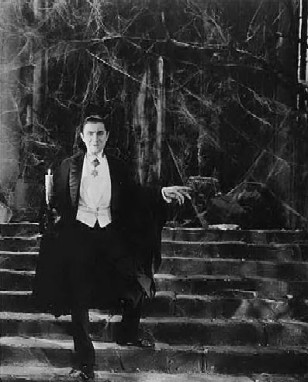
The introduction to the inhabitants of Castle Dracula is among the most discussed in the annuls of Universal Horror and, to many viewers, it is also most perplexing. This is quintessential Browning. The static silence is punctuated with genuine dread, surreal humor, and the unnerving whimpers of a opossum. Karl Freund’s camera pans over a decidedly unreal set. The vampire brides slowly emerge as a bee scampers out of its little coffin. An opossum seems to be ducking for cover in its dilapidated coffin and its cries are the only living sounds we hear as we are introduced to Lugosi’s Count staring directly at the camera.

Renfield’s journey to Castle Dracula perfectly captures the sensory view of a crepuscular world. Indeed, no other Universal horror film would convey it as vividly and attempts to do so in later films proved pale imitations.

Renfield’s arrival to the castle, and state of confusion, is juxtaposed against the awkward but pertinacious emergence of Dracula. Lugosi’s emergence seems to partake of a genuine struggle and this echoes the delivery of his greeting which follows. This emergence sharply contrasts with the startling and confused appearance of armadillos scurrying in the ruins below, which also heightens Renfield’s confused state.

Critics have unfavorably compared this scene to Melford’s much more fluid shot of Villar’s Count appearance atop the stairwell in Dracula (The Spanish Version). Continue reading TOD BROWNING’S ‘DRACULA’ (1931): CHALLENGING THE REVISIONISTS →

16. CARNIVAL OF SOULS (1962)

“We hoped for the look of a Bergman film and the feel of Cocteau.”–variously attributed to screenwriter John Clifford or director Herk Harvey

Must See

DIRECTED BY: Herk Harvey

FEATURING: Candace Hilligoss, Sidney Berger

PLOT:  Mary Henry, a church organist, is the lone survivor of an accident when the car she’s riding in plunges over the side of an old wooden bridge.  Looking to start over, she takes a job as an organist at a new church in a town where she knows no one.  She finds herself haunted by the sight of a pale grinning man who appears to her when she is alone, and fascinated by an old abandoned carnival pavilion visible from the window of her boarding house that she senses hold a mysterious significance.

carnival_of_souls
BACKGROUND:

  • Carnival of Souls was made in three weeks for less than $100,000 (figures on the budget vary, but some place it as low as $33,000).  The film was a flop on its initial release, but gained a cult following through late night television showings.  The film was restored and re-released in 1989 to overwhelmingly positive reviews.
  • Director Herk Harvey, screenwriter John Clifford and composer Gene Moore worked together at Centron Corporation, an industrial film company, creating short safety documentaries such as Shake Hands with Danger and high-school propaganda/hygiene films such as What About Juvenile Delinquency? None were ever involved with a feature film again.
  • Mesmerizing star Candace Hilligoss acted in only one other feature film, 1964’s The Curse of the Living Corpse, before retiring to raise a family.
  • The movie has been very influential on other films, particularly low-budget horror films.  Director George Romero has said that the ghostly figures in Carnival of Souls inspired the look and feel of the zombies in The Night of the Living Dead (1968).  Other writers see a Carnival of Souls influence on films such as Eraserhead (in regards to its ability to evoke the nightmarish quality of everyday objects), Repulsion (disintegration of the mind of a sexually repressed woman), and even Apocalypse Now (the shot of Martin Sheen rising from the water mimics a similar scene involving The Man–thanks to Matthew Dessem of “The Criterion Collection” for the catch).
  • Carnival of Souls was “remade” in 1998, although the plot (about a clown killer and rapist) shared nothing with the original except the name and the final twist.  Wes Craven produced.  The remake went direct to DVD and was savaged by critics and audiences alike.

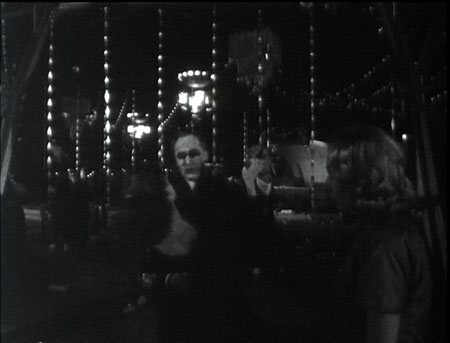
INDELIBLE IMAGE: What else, but the titular carnival? Ghostly figures waltz to an eerie, deranged organ score on what appears to be an old merry-go-round at the abandoned amusement park. The tableau recurs twice in the film: once clearly in a dream, and once near the end as a scene that may also be a dream, but may be another state of being entirely.

WHAT MAKES IT WEIRD: Carnival of Souls is set in the ordinary, everyday world, but as seen through the eyes of an alienated, frightened woman. The world the film depicts is familiar, but made maddeningly strange, and its the subtle, grubby touches rather than ghostly apparitions that allow this creepy low-budget wonder to seep deep under your skin.


Trailer for Carnival of Souls

COMMENTS: Carnival of Souls is a minor film miracle. There was little reason to suspect Continue reading 16. CARNIVAL OF SOULS (1962) →