Two teen boys get jobs at a pizza boys delivery service to raise some extra cash, but all is not as it seems in… the Realm Beyond Reason!
Happy Halloween!

Two teen boys get jobs at a pizza boys delivery service to raise some extra cash, but all is not as it seems in… the Realm Beyond Reason!
Happy Halloween!
366 Weird Movies may earn commissions from purchases made through product links.
DIRECTED BY: Hiroshi Nagahama, Yûji Moriyama
FEATURING: Uki Satake, Shin’ichirô Miki; Abby Trott, Robbie Daymond (English dub)
PLOT: Residents of a small Japanese town are increasingly haunted by spirals.

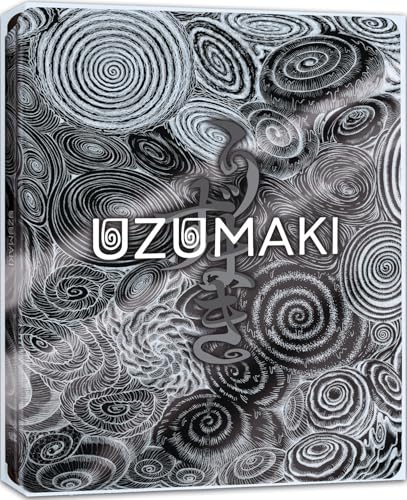
COMMENTS: Most horror story monsters are inspired by symbols of death, disease, and predation, not unthreatening geometric shapes like the humble spiral. Leave it to eerie manga star Junjo Ito to choose the spiral as his avatar of evil. Uzumaki (which had previously been adapted as a live-action feature) plumbs every possible devious iteration of the humble coil; it shows up in the story as whirlwinds, whirlpools, DNA, snail’s shells, hair curls, staircases, mosquito swarms, corkscrews, springs, and the twisted, intertwined bodies of snakes (and people). Watch with disquietude as everyday objects in the town gradually get twisted as the story spirals towards its grim conclusion.
The bizarre antagonist is not the only weird element here. The originally-serialized story lurches forward as a series of vignettes, with a threatening new spiral form dominating each mini-arc. In between episodes, normality resets. After the first girl’s head dissolves into a spiral, we would think the two high school protagonists would flee town; instead, the incident is never mentioned again. After the first kid turns into a human-snail hybrid, you would think the town would panic; instead, they accept it as the new normal, building a pen for the newly-minted escargot boy to live in. The commonsense idea of fleeing the town doesn’t even arise until the second episode, when one pair of aspiring refugees are frustrated in their attempt—but our main characters never even attempt to leave until the final episode, when the narrative finally proffers an explanation for their inability to escape. A particularly intense, vampire-adjacent incident dominates the third episode, but again, after a jarring edit, this horror is entirely forgotten. The characters’ incapacity—and their resigned unwillingness—to escape their situation lends the story an especially irrational, nightmarish quality. In fact, Uzuamki‘s entire structure, oscillating between grotesque visions and uneasy pseudo-normality, suggests madness; perhaps our main characters are actually trapped inside their own obsessive delusions, imagining spirals everywhere.
The art style is done entirely in black and white and imitates the intricate linework of Ito’s original drawings, sometimes recreating particularly bizarre panels. When animated, the absurdity of some of Ito’s visions—a dramatically curling tongue, a pair of eyeballs rotating independently—can be as weirdly comic as they are frightening. But the artwork is almost always strange and affecting, no matter the overall emotional effect. Much was made in anime fandom of the fact that the animation quality declines as the series progresses (probably due to budgetary mismanagement). By the final episode, the directors and producers aren’t even credited. I think that this complaint is mostly overstated, at least for the average viewer. I noted the decline in the cartoon’s fluidity and detail with each new episode, but it wasn’t as drastic as I feared; if I hadn’t been forewarned, I’m not sure how much I would have noticed. Perhaps I benefited from having my expectations lowered; perhaps you will, too. Although Uzumaki hobbles a bit on the way to the finish line, it eventually crosses it. It’s not the wall-to-wall masterpiece the first episode promised, but I wouldn’t say it exactly circles the drain, either.
WHAT THE CRITICS SAY:
Mina ni ko are
366 Weird Movies may earn commissions from purchases made through product links.
Best Wishes to All is currently available for purchase or rental on video-on-demand.

DIRECTED BY: Yûta Shimotsu
FEATURING: Kotone Furukawa, Masashi Arifuku, Yoshiko Inuyama
PLOT: A nursing student returns from Tokyo to visit her grandparents remote village, where she finds they are acting oddly.

COMMENTS: We first meet the nameless young star of Best Wishes to All as a kindly nursing student who, based on sinister musical cues and subtle expressions, seems nervous to travel back to the village she grew up in to visit her aging grandparents. Part of her reluctance may be the family’s obsession with happiness. Since she was a young girl, they have been asking her “are you happy?”; her affirmative replies ring uncomfortably insincere. Dim, disturbing memories from childhood centered around bumps in the night and a perpetually locked door in the upper level of the house also give her pause. And perhaps she also foresees her outwardly pleasant grandparents’ odd behavior, such as their tendency to snort like pigs when eating pork.
In fact, their strange habits are accelerating, to the point where the heroine wonders if they might be experiencing dementia. But her own reactions become equally strange as the movie goes on. Relatively early on, the true horror of the situation is revealed; and while, at first, our heroine reacts as expected, then the movie shifts into a more dreamlike register. Beginning with an absurd automotive accident, the semi-logical horror story dissolves into a more impressionistic and nightmarish experience. It goes from ominously eccentric to full-on surreal, ending up in blood, betrayal, and, somehow, a middle aged man dancing in his underwear.
The village nonchalantly accepts the unnatural brutality of the movie’s premise, and the heroine is pressured into believing that this is just the way of the world. The happiness of the lion is the misery of the gazelle. Best Wishes to All posits the logically questionable but metaphorically sound proposition, “does the happiness of one person require the misery of another?” Although the thesis, taken literally, is absurd, the hypothetical is provocative. Who makes the smartphones, coffee, chocolate, diamonds, pornography, and food that you enjoy in your daily life? Wouldn’t you be happier if you didn’t know? Or, at least, if you could pretend that you don’t?
WHAT THE CRITICS SAY:
Morris apologizes for being late to his brother’s baby shower.
366 Weird Movies may earn commissions from purchases made through product links.
DIRECTED BY: Don Dohler
FEATURING: Don Leifert, Richard Nelson, Elaine White, George Stover, Greg Dohler
PLOT: A “fiend”—an evil spirit that takes possession of a corpse and absorbs the life energy of humans-–moves into the quiet suburb of Kingsville, where a concerned neighbor immediately suspects a connection between the new resident and an unsolved killing spree.

COMMENTS: God bless the Don Dohlers of the world. They don’t have a lot of resources, they don’t have a lot of talent, but by gum they love movies, they’ve got determination, can-do spirit, and just enough cash and friends and family to put together a chiller. You don’t go into a Don Dohler movie with the hope that it will be very good, but it’s a whole lot of fun watching him in there giving it the ol’ college try.
Shot after his debut feature The Alien Factor, Fiend finds Dohler a more experienced filmmaker, but also working with an even thinner budget of a mere $6,000 to continue his bid to become the Roger Corman of Maryland. So he develops a story around an original monster–the title character, a kind of free-floating, body-possessing demonic entity–to sit alongside vampires, zombies, and werewolves. We get an impressively economical introduction to our star villain: after a shapeless red cloud plunges into the grave of a recently deceased man, the reanimated body rises and, within the course of the next 6 minutes, strangles a conveniently located woman in the cemetery, moves into a split-level ranch in the Baltimore suburbs (what was the house closing like?), and chokes another woman while she walks the five miles through the woods from her carpool stop to her home.
This kind of efficiency is typical of Fiend, which does not waste a lot of time with details. In the space of a few months, the monster takes on the name Longfellow, acquires a cat and a lucrative career teaching music, hires an accountant-cum-Renfield to manage his extensive operations, and builds a combination music studio/shrine to Satan in his basement where he keeps an ample supply of professional headshots of his prospective victims. So it’s only fair that the only force powerful enough to stop him will be equally lucky. Gary is a persnickety neighbor who has it in for Longfellow from the start (supposedly because of the noise, but more likely because the newcomer has an even more impressive mustache). But he should play the ponies, because he immediately pegs Longfellow as the local serial strangler through intuition alone, with not a scrap of evidence to back him up—much to the frustration of his unduly patient wife. Fortunately, a visit to Longellow’s subterranean lair provides all the proof he needs, and the battle of wits commences.
The usual hallmarks of bad-moviedom are here. The acting is wooden and mannered, the score-by-Casio is repetitive and intrusive, and the script is driven by incredible coincidence. (Does the cemetery groundskeeper carry copies of the obituary for every corpse in the place?) But you can tell that Dohler is a deeply earnest storyteller. Compelled to shoot his scenes of mayhem in broad daylight, he makes the killer’s audacity add to the overall sense of unease. Recognizing the convention of secondary horror characters whose ignorance does them in, Dohler crafts a pretty decent action scene in which a bystander attempts to come to the aid of a potential victim, complicating the villain’s plans. Most intriguingly, he hands the hero’s mantle to the abrasive Gary. It’s almost charming to watch Gary barrel around, insisting that something suspicious is going on and bitterly rejecting his wife’s insistence that he lighten up. It puts an intriguing twist on the fact that he’s right about everything.
On a side note, here’s a mystery for you: where the hell are Gary and Marsha’s kids? There’s no shortage of children in the film, including Dohler’s own son; one of those youngsters even ends up at the wrong end of Longfellow’s glowing hands. We’re certainly supposed to believe the Kenders have kids, because they talk a lot about their filmmaking project for Scouts (an opportunity for Dohler to drop the name and the address of his real-life bookshop), but we never see them, not once. Is this a scenario borrowed from Who’s Afraid of Virginia Woolf? It’s truly bizarre.
Fiend is not a good movie. Crucially, it’s not a scary or suspenseful movie. But it benefits strongly from a second viewing, when you can set aside all the film’s ineptitude and appreciate the purity of the effort. Viewed in the right circumstances, it’s a goofy piece of fun, and the world of cinema can always use a goofy piece of fun. That’s a legacy to remember Don Dohler by, long after both he and the Fantasy Kingdom Bookstore at 704 Market Street have left the mortal plane.
WHAT THE CRITICS SAY:
(This movie was nominated for review by Joe. Suggest a weird movie of your own here.)
![Fiend (Special Collectors Edition) [DVD]](https://m.media-amazon.com/images/I/51HixmiYJOL._SL500_.jpg)