Tag Archives: Hollywood

THE ISLAND OF LOST SOULS (1932) CRITERION RELEASE

1932’s The Island of Lost Souls is the first of three cinematic adaptations of H.G. Wells “The Island of Dr.Moreau.” It is easily the best, although the 1997 attempt with Marlon Brando was not the disaster some critics claimed, and in fact was considerably better than the static, unimaginative 1977 version with Burt Lancaster.

The 1932 Island, directed by Erle C. Kenton, is rightly considered a classic, enough so that it has received the Criterion treatment for a 2011 release. This is Kenton’s sole classic.  Although he was a prolific director, he was essentially a journeyman, taking whatever was handed to him and usually injecting little style.  His other horror films for Universal were The Ghost Of Frankenstein (1942), The House Of Frankenstein (1944), and The House Of Dracula (1945), and they are all second rate, at best.

Island of Lost Souls deviates from the original story (which, predictably, prompted H.G. Wells to voice his disapproval), but the film is simply told.  Like 1932’s Dr. Jekyll and Mr. Hyde, Island  is a pre-Hayes code film, and it shows.  Of course, both films were taken from  literary sources, and that too is apparent.  Lost Souls‘ literacy is due to screenwriter Philip Wylie, who also adapted Wells for ‘s The Invisible Man (1933).  The inimitable , one of the great classic screen actors, plays Dr. Moreua with a classicist’s relish.  Laughton is one of the major reasons for this film’s success, and as director Kenton shows atypical subtlety. These factors, combined with well-crafted sets and make-up, add up to a striking milieu.

Still from The Island of Lost Souls (1932)Island is almost an old-dark-house genre film, except that the stranded visitor, Edward Parker (Richard Arlen) ends up in a sort of kinky, contemporary Eden.  God is present in the symbolic persona of Dr. Moreau and although he is the antagonist, he is a three-dimensional one.  He is intelligent, crafty, and that naughty twinkle in the divine eye is ever present.  God is creating again, although this time he’s attempting to correct his previous mistake by making man from the image of Eden’s animals.  Eve (a Wylie addition) appears in the exotic Lota (Kathleen Burke, who notably showed up in the following year’s pre-Code Murders in the Zoo).  Lota, AKA Panther Girl, alternately projects innocence and unbridled sexuality, and she is utilized by Moreau to usher forth a new Adamic age, with Parker as the new Adam.  Of course, in every Eden there’s a rotten apple or two, and here it’s Parker’s abroad girlfriend (, from Freaks) and the Beast Men, Moreau’s ungrateful children who hold a grudge against their creator for little things like torture, brutality, and vivisection.  The Beast Men are led by the Sayer of the Law (, who is well-directed). The Sayer calls the creator out for hypocrisy and original sin.  The Beast Men are well sketched here, which is a sharp contrast to the mere animalistic portraits drawn in subsequent versions.  The finale is natural jolt, so much so that no other celluloid interpretation of the tale can match it.  This lucidly told imaginative spin on Dr. Frankenstein’s Eden still holds up remarkably well.

As for the Criterion treatment, most welcome authoritative commentary is given by historians Gregory Mank and David J. Skall, along with filmmaker (the original director of the 1997 version, who was replaced by John Frankenheimer).  Stanley offers entertaining, honest insight.  A little less welcome are reflections by John Landis and Devo.  Production stills and the theatrical trailer are excellent supplements.  This is a superb release that is essential for classic film lovers.

CAPSULE: THE RUM DIARY (2011)

DIRECTED BY:

FEATURING: Johnny Depp, , Amber Heard, Michael Rispoli, Giovanni Ribisi

PLOT: An alcoholic journalist goes to Puerto Rico where he encounters unscrupulous capitalists and bottomless mini-bars.

WHY IT WON’T MAKE THE LIST: The confluence of three offbeat talents—-seldom seen cult auteur (How to Get Ahead in Advertising) directing quirk king Johnny Depp in an adaptation of a semi-autobiographical novel by gonzo godfather —produces a movie that’s far more conventional than you might have guessed.

Still from The Rum Diary (2011)

COMMENTS: For better or worse, it’s impossible to avoid comparing Rum Diary (unfavorably) with Fear and Loathing in Las Vegas. The film’s producers can’t complain the comparison is unfair, because they cut a trailer that’s obviously aimed at hooking Loathing fans: it’s filled with boozy shenanigans, a bowling ball knocking down ten pin rum bottles, and Johnny Depp promising, in his best deadpan Hunter S. Thompson drawl, “all of this might sound like some crazed hallucination…” Diary even contains a mild LSD trip sequence that sees Michael Rispoli’s tongue extend six feet in the air “like an accusatory giblet”; of course, this sixty seconds of psychedelics occupies a prime place in the marketing scheme. There’s also a scene with a voodoo priestess who coughs up frogs—and that’s about it on the weirdness front. The rest of the movie is a series of drunken war stories in which part-time journalist, full-time imbiber and would-be novelist Paul Kemp (Thompson’s alter-ego, played by Depp as a less manic and assured Raoul Duke) worries about “finding his voice” and flirts with joining up with the “Bastards.” Why the Bastards (represented by real-estate developer Aaron Eckhart) are so keen to recruit horoscope writer Kemp into their venal cabal isn’t clear; corrupting idealists is what makes them Bastards, I guess. Also not clear is what’s so darn evil about their plan to build a hotel that would supply thousands of jobs for the local populace on land previously only used for the noble purpose of naval test bombing. Their marketing plan, which would involve Kemp slipping some favorable words into his columns, is unethical, sure, but hardly a screaming headline, page one outrage. But the scheme’s investors smoke cigars and complain about Negros and Communists, so they are pretty clearly villainous. Despite their wickedness, though, the only moral objections Kemp actually raises have to do with the way Eckhart treats his flighty, arm-candy lover (Amber Heard, who looks fabulous in a bikini but disappears from the movie like a neglected girlfriend). Joining Depp, Eckhart and Heard are Rispoli and Giovanni Ribisi as a couple of colorful drinking buddies (Rispoli plays his photographer role like a 1940s New York City cabbie, while Nazi-obsessed basket case Ribisi affects an annoying whine). The trio’s wandering adventures build to a remarkable anticlimax. None of the plot lines dangled off this tropical pier snag a catch, but Kemp/Thompson does eventually find his literary voice—too bad for us it only happens after he’s finished narrating this tale. It’s pleasant to see Depp reprise his role as Thompson, and there are memorable lines of dialogue and set pieces (all of which find their way into the trailer). But the movie sips at drunken insanity rather than gulping it down; it never goes four-sheets-to-the-wind crazy. The tone of muted madness here doesn’t do justice to Thompson’s gonzo spirit. Call it “Mild Concern and Dislike in San Juan.”

“The Rum Diary” was written by Thompson some time in the late 1950s or early 1960s but was rejected by several publishers. Johnny Depp reportedly discovered the manuscript in Thompson’s basement while he was researching the writer’s mannerisms in preparation for his role in Fear and Loathing. Depp encouraged Thompson to revise the lost novel; it was published in 1998. The actor also served as executive producer for this adaptation.

WHAT THE CRITICS SAY:

“…has no mighty gonzo wind… it leaves our freak flag limp.”–David Edelstein, New York Magazine (contemporaneous)

96. THE SADDEST MUSIC IN THE WORLD (2003)

366 Weird Movies may earn commissions from purchases made through product links.

“I’m actually trying for something a little bit different this time. I’ve always used, as a safety net, dreamlike delirium, confusion among the characters. On this I don’t really have a safety net. It feels good to remove the safety net…  I really need to tell a story the way my idols had to tell a story. Still, it will, perhaps, I hope, strike people as ‘different’ than most of the other pictures made today.”–Guy Maddin on The Saddest Music in the World

Recommended

DIRECTED BY: Guy Maddin

FEATURING: Mark McKinney, , , Ross McMillan, David Fox

PLOT: During the Great Depression Lady Port-Huntley, a legless beer baroness from Winnipeg, organizes a contest to discover which nation produces the saddest music in the world, offering a $25,000 prize.  Musicians from across the globe descend upon the city, including three members of a Canadian family: a father (representing Canada) and two brothers (one a Broadway producer representing America, the other an expatriate cello virtuoso playing for the honor of Serbia).  It turns out that the family has a twisted history with each other, and with the contest organizer, involving amnesia, medical malpractice, broken hearts, betrayals, and beer.

Still from The Saddest Music in the World (2003)

BACKGROUND:

  • The Saddest Music in the World was based on a screenplay by novelist (The Remains of the Day, Never Let Me Go), but was extensively rewritten by Guy Maddin and his writing partner George Toles (for one thing, the setting was moved from 1980s London to Canada in the Great Depression).
  • With a budget of 3.5 million Canadian dollars, this was the largest budget Maddin had ever worked with.  Unfortunately, the film made back less than $1 million at the box office.
  • Maddin sent Rossellini copies of the “legless” performances of in West of Zanzibar and The Penalty to watch in preparation for the role of Lady Port-Huntley.
  • The Saddest Music in the World was the second Maddin feature released in a busy and amazing 2003; Cowards Bend the Knee (also Certified Weird) debuted at the Rotterdam Film Festival in January, while the relatively more mainstream Music was first shown in August at the Venice Film Festival.

INDELIBLE IMAGE: Isabella Rossellini’s bubbly new gams, which she proudly displays while dressed as Lady Liberty as dancing girls dressed as Eskimos lie on their backs kicking their heels in the air, all set to the heartbreaking strains of the melancholy ballad “California, Here We Come!”

WHAT MAKES IT WEIRD:  Guy Maddin’s promiscuous mix of retro-film techniques, including iris lenses and a primitive two-strip Technicolor process, that drops us into an artificial, alternate movie world that never really existed.  These visuals illustrate a preposterous plot packed with the delightfully absurd coincidences that were the coin of early melodrama—everyone of importance in the movie has a dark, hidden history with everyone else—all interrupted by screwball one-liners and absurd Busby Berkeley-style production numbers.  It’s as if random selection of melodramas and musicals made between 1915 and 1935 had been carelessly stacked on top of each other, and over the years the degenerating nitrate gradually melted into a single filmstrip.


Original trailer for The Saddest Music in the World

COMMENTS: The Saddest Music in the World is the strangest, and funniest, movie about Continue reading 96. THE SADDEST MUSIC IN THE WORLD (2003)

LIST CANDIDATE: PRIVATE PARTS (1972)

366 Weird Movies may earn commissions from purchases made through product links.

Recommended

DIRECTED BY:

FEATURING: Ayn Ruymen, Lucille Benson, John Ventantonio

PLOT: A sexually curious teenage runaway negotiates the deviant scumbags in her crazy aunt’s creaky boarding house.

Still from Private Parts (1972)
WHY IT MIGHT MAKE THE LIST:  It might make the List thanks to the atmosphere of sleazy psychosexual depravity that’s slathered on thicker than the blue eye shadow teenage Cheryl cakes on to try to make herself look like a woman.

COMMENTS: Private Parts is a haunted house movie, except that the ghosts bedeviling the heroine are the bizarre, boozy boarders at her aunt’s decrepit hotel, and she’s not nearly as wary of them as she needs to be. This is a movie full of creaking floorboards, turning doorknobs, and unseen men peeping through knotholes in a dusty old hotel. Adding to the atmosphere is a wonderfully overwrought Bernard Hermann-inspired soundtrack that’s with us so constantly that it actually creates tension when it disappears for a moment to allow the characters to speak. Not that what this collection of skid-row oddballs has to say would be particularly reassuring. We have the Reverend, who at one point suggests he should slip out of his clerical vestments into something more comfortable; the spooky old hag who calls young Cheryl “Alice” after a resident who disappeared a long time ago under suspicious circumstances; and there’s the hotelier herself, Aunt Martha, who loves funerals, hates painted women and believes “the body is a prison.” There’s also George, the silent young photographer with the darkroom in the basement and the creepy stare that focuses on pubescent Cheryl whenever she’s in the room. Each of these weirdos has deeper secrets in their closets, which Cheryl will uncover when she starts snooping around their rooms against her Aunt’s orders (hint to future runaways: you should never trust a guy who owns a customized carrying case for his personal syringe). Obviously, this is no place for a naïf like Cheryl, but she’s not oblivious to the degeneracy—she’s actively drawn to it. Curious about sex but totally inexperienced, she enjoys the feel of a grown man’s eyes on her developing body, without understanding the difference between healthy lust and sick perversion. All she knows is, after receiving presents of erotica and spiderweb lingerie from a secret admirer, boys her own age suddenly seem boring. Although the movie sports a body count, the tension comes from hoping Cheryl will somehow escape what seems to be her inevitable seduction and corruption. If IMDB is to be believed, Ayn Ruymen was 25 years old when she played the part, but you may have a hard time believing the actress is a day over 16. Not only does she have an adolescent build, she plays the part with a wonderful mix of innocent naughtiness; she mischievously snoops and pranks the boarders, but still sleeps with a teddy bear and isn’t half as sophisticated as she thinks.  The bits with a bizarre, customizable “blow up” doll are unforgettably creepy. After playing as straight psychohorror through most of the running time, Private Parts takes a strange detour into black comedy territory for the conclusion with the arrival of a couple of ludicrously blasé cops, and throws out a couple of scarcely believable twists at the very end as the weird capper. All told, Private Parts a deliciously depraved debut from oddball Paul Bartel.

Private Parts is a should-be cult movie that’s still searching for its cult forty years after release. For some reason, MGM picked the movie up for distribution, then apparently balked at the pseudo-pedophiliac subject matter and buried the movie. The flick has been consistently overlooked since; those who caught it in its brief theatrical run or stumbled upon its unheralded VHS or DVD releases remember it, but word of mouth has never made it a hit, despite its midnight movie feel and pleasing perversity. Ironically, director Paul Bartel received more exposure making films like Death Race 2000 for (Roger’s brother Gene was producer on Private Parts) than he with this Hollywood debut.

WHAT THE CRITICS SAY:

“…for pure excess and surreal humor, it’s something of a minor pop art masterpiece; a careful blending of the eccentric and the sleazy, very much akin to other midnight revival mainstays like Beyond the Valley of the Dolls and the ’70s films of John Waters, with a wickedly unique take on repressed desire and secret shame.”–Paul Corupe, DVD Verdict (DVD)

(This movie was nominated for review by “Gerby” who called it “a strange one!” Suggest a weird movie of your own here.)

90. BLACK SWAN (2010)

“It’s a Polanski movie, and then it becomes a Dario Argento movie. And maybe a little bit of David Cronenberg too.”–Vincent Cassell

Must See

DIRECTED BY: Darren Aronofsky

FEATURING: Natalie Portman, Mila Kunis, , Barbara Hershey, Winona Ryder

PLOT: Nina, a goody two-shoes ballerina, wants to dance the lead role in a production of “Swan Lake,” but although she’s perfect for the role of the White Swan, she lacks the seductiveness to portray the Black Swan. Lily, a sexy, irresponsible dancer newly arrived from a San Francisco troupe, becomes her primary competition for the part, but also helps her loosen up by talking her out on the town for a night of drinking and meeting guys. Nina starts physically break down and hallucinate as the stress of preparing for the role takes its toll; by opening night, she can’t distinguish reality from the story she dances of the princess trapped in the body of a swan who takes her own life.

Still from Black Swan (2010)

BACKGROUND:

  • Natalie Portman danced many of her own parts, and actually dislocated a rib while dancing during the shoot. More difficult moves were performed by professional ballerinas, and for two sequences Portman’s face was digitally superimposed on dancer Sarah Lane’s body. There was a minor controversy over how much of the dancing Portman actually did herself and how much was performed by doubles; Aronofsky estimated that the actress executed more than 80% of the dance moves that appear onscreen.
  • Portman won the 2010 Best Actress Oscar for her role as Nina. The film was also nominated for Best Picture, Director, Cinematography and Editing.
  • Aronofsky received “The Understudy,” the original script that became Black Swan, while he was making Requiem for a Dream (2000). He described the script as Dostoevsky’s “The Double” meets All About Eve. Aronofsky combined that script, which was set in an off-Broadway production, with an idea he had to shoot a movie in the New York ballet world to create Black Swan.
  • Aronofsky and Portman had discussed doing a ballet movie together 8 years prior to shooting.
  • Made on a relatively small budget of about $12 million, Black Swan has grossed more than $300 million worldwide as of this writing.

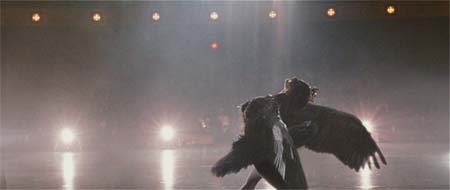
INDELIBLE IMAGE: Nina’s “triumphant” onstage transformation into the Black Swan: as she pirouettes, feathers sprout from her arms, thickening with every swirl, until her limbs have been replaced by wings.

WHAT MAKES IT WEIRD:  Up until opening night, Black Swan is a backstage melodrama about backstabbing ballerinas, with an exaggerated, lurid psychopathology that’s thrust even further over-the-top by lesbian love scenes, hints of horror, and mirrors, mirrors, mirrors.  When the curtain rises on the big night, we experience the performance through the subjective perspective of an overworked, paranoid, demented dancer, whose psychology has been shattered by the film’s sledgehammer symbolism.  No avant-grade choreographer could stage as disorienting a “Swan Lake” as the one she hallucinates for us through her obsessed eyes.

Promotional Music Video for Black Swan

COMMENTS: Black Swan is the weirdest movie ever to win a major Academy Award (Natalie Continue reading 90. BLACK SWAN (2010)