Tag Archives: Hollywood

42ND STREET (1933)

366 Weird Movies may earn commissions from purchases made through product links.

42nd Street is the film that really made choreographer Busy Berkeley a star; and that, in itself, is telling. Although directed by Lloyd Bacon (a 1930’s version of a Ron Howard-type assembly line director), it was Berkeley who rightfully grabbed the honors.

The musical, it seemed, had already run its course when Warner Brothers released 42nd Street. Al Jolson’s The Jazz Singer (1927) had been the ground-breaker, ushering in the advent of sound. But, in the six short years between The Jazz Singer and 42nd Street, the genre had already grown stale. Warner, on the verge of bankruptcy, took a huge gamble (studios used to do that) and brought in the innovative Berkeley, teamed him with the competent helmsman Bacon, an unknown (fresh) cast, and the expert songwriting team of Al Dubin and Harry Warren (who make a cameo in the film).

The plot is hackneyed, and would set the pattern for what constitutes a “Berkeley” film. It’s a backstage story about the struggles of a Broadway musical production (who really thought 1980’s Fame had an ounce of originality?) with an overly intense, self-destructive director (Warner Baxter, an archetype later taken to the extreme in Roy Scheider’s portrayal of Joe Gideon in 1979’s All That Jazz) and an understudy (Ruby Keeler) who, at the last moment, fills in for the injured star (Bebe Daniels) and becomes a star herself.

Still from 42nd Street (1933)Of far more interest, plot-wise, is the nuanced filler material. Virginal Keeler and her leading fellar, golly-gee-wiz swell guy Dick Powell have limited charm and register as flat and clunky next to the wisecracking chorus girl  (already projecting star quality) and the dirty old rich lecher Guy Kibbee. This is the Depression era and there is talk aplenty about the desperate struggle for money and success, which gives the film moments of sweaty substance. Star Daniels, no fluff actress, is clearly an occupant of Kibbee’s casting couch, even if she is in love with George Continue reading 42ND STREET (1933)

CAPSULE: FREAKED (1993)

DIRECTED BY: Tom Stern, Alex Winter

FEATURING: Alex Winter, , Megan Ward, Michael Stoyanov, William Sadler, Brooke Shields, Bobcat Goldthwait, Morgan Fairchild, Mr. T,  (uncredited), Larry “Bud” Melman

PLOT: A sleazy Hollywood actor is hired by an evil corporation to go to South America where he is immediately kidnapped by a freak show owner who transforms him and his friends into Hideous Mutant Freekz.

Still from Freaked (1993)

WHY IT WON’T MAKE THE LIST: While Freaked is a very weird movie, its weirdness stems more from the “anything goes” school of gonzo comedy. It’s like Harvey Kurtzman’s Mad Magazine come to life with the aesthetic sensibility of a Robert Williams painting. Heck, maybe it should make the List.

COMMENTS: Freaked is a fine example of a small wave of bizarre films that made their way into theaters in the early 1990s. Too strange for the mainstream and too unpolished for the art houses, most of these movies were dumped into a few theaters with no fanfare and only found later life on VHS, cable or DVD, if even then. Other examples include Rubin and Ed (1991) and the Certified Weird The Dark Backward (1991).

Originally titled “Hideous Mutant Freekz,” Freaked was the brainchild of directors Tom Stern and Alex Winter, who were then coming off their short-lived sketch comedy show The Idiot Box. Winter, who is still most well known as being half of the duo Bill & Ted, also stars as the lead, Ricky Coogin.

That this is a ’90s affair should be immediately obvious from the opening, which features some of the most eye-blistering claymation you will ever see, set to the tune of a Henry Rollins song. From there we jump right into the plot, which involves ex-teen heartthrob Ricky Coogin being romanced by the evil EES Corporation (“Everything Except Shoes”) to act as their spokesperson in South America for their product Zygrot 24. After a few gags and character introductions, the movie finds itself in the freak show fun by Elijah C. Skuggs (Randy Quaid). Skuggs immediately kidnaps our protagonists and transforms them into monstrosities by using (surprise!) Zygrot 24.

The freak show camp is really the heart of the film. In fact, the sequence introducing the freaks may give you the best sense of the movie: it’s done using the set-up for the game show Hollywood Squares, complete with the skeleton of Paul Lynde as center square. Other freaks include the Worm, Sockhead (who has a sock-puppet for a head), Mr. T as the Bearded Lady, and so on.

What separates this film from other mile-a-minute comedies, and makes it most memorable as weird, is the density and bizarreness of its gags. Like a comic book, every frame of the film is packed with jokes that may go completely unnoticed upon first viewing. On top of that, the gags are just strange piled upon strange. For example, Coogin’s first escape attempt, which involves a milkman and a turd shaped like a naked Kim Basinger, is thwarted by a pair of giant Rastafarian eyeballs with machine-guns. Why? Because that’s always funny.

At this point I should mention the entire movie is told in flashback during a talk show hosted by none other than Brooke Shields.

This is a pretty great movie, and of the funniest unknown movies to make its way out of the ‘90s. It’s a shame that it died an ignoble and unsupported death, but it’s not clear that a wider release would have enabled the film to find an audience either. Freaked clearly isn’t for everybody. However, for those whom it is for (“Mad” Magazine-addicts, kids who grew up with “Big Daddy” Roth model kits, C-list celebrity fans), it’s a love letter in animatronic clothing. If you can find it, it’s worth picking up.

WHAT THE CRITICS SAY:

“I suppose there could be some sort of subversive angle to all the madness on display here, but I suspect it’s just what happens when you get a bunch of hipsters too weird for their own good in a room together and ask them to come up with something funny.”–Keith Breese, AMC filmcritic.com (DVD)

CAPSULE: JESUS CHRIST SUPERSTAR (1973)

DIRECTED BY: Norman Jewison

FEATURING: Ted Neeley, Carl Anderson, Yvonne Elliman

PLOT: The last days of Jesus Christ, including the Last Supper, his betrayal by Judas, and his crucifixion, sung to a propulsive rock score composed by Andrew Lloyd Webber.

Still from Jesus Christ Superstar (1973)

WHY IT WON’T MAKE THE LIST: Though the very premise – a rock ‘n’ roll passion play – is inherently offbeat, and this particular version is laced with anachronisms and unusual characterizations, this is at heart a straightforward, earnest account of the story.

COMMENTS: When Superstar debuted on the Broadway stage in 1971, the very notion of a rock-n-roll passion play must have carried an unmistakable air of sacrilege. (Although another pop-oriented take on the story, “Godspell,” premiered off-Broadway the same year, and a film of that musical also came out in 1973.) But the show struck a chord with audiences; spawned from a concept album that had sold millions of copies, the musical ran for nearly two years on Broadway and spent eight years on the London stage, closing as the longest-running show in British history. A film version was probably inevitable; that the adaptaion would be placed in the hands of the director of In the Heat of the Night and The Thomas Crown Affair might not have been.

To Norman Jewison’s credit (the screenplay is credited to him and British broadcaster Melvyn Bragg), the movie faithfully retains the show’s determination to treat its characters as human beings, rather than the religious icons they have become. Lyricist Tim Rice sparked some controversy by suggesting that he and partner Andrew Lloyd Webber simply wanted to portray Jesus as a man, but they doggedly stuck to that vision, and the results are intriguing: Jesus is beleaguered and plagued by doubts. Judas is a buzzkill true believer, hectoring Jesus for being insufficiently pious and ultimately betraying the man he idolizes out of a sense of moral outrage. Pilate is the most reasonable man in Judea, Mary Magdalene is hopelessly confused, and the apostles are shiftless hippies. It’s probably not the version taught in Sunday school, but it lends the events a greater dramatic heft.

If Jesus Christ Superstar is controversial, it’s because it doesn’t traffic in the more mystical Continue reading CAPSULE: JESUS CHRIST SUPERSTAR (1973)

CAPSULE: LABYRINTH (1986)

Recommended

DIRECTED BY:

FEATURING: ,

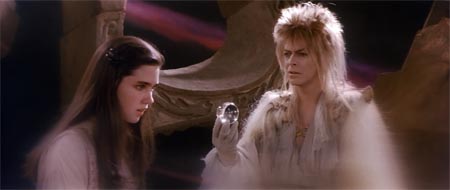
PLOT: A dreamy teenage girl must rescue her kidnapped baby brother by journeying to the Goblin City at the center of a bizarre labyrinth.

Still from Labyrinth (1986)
WHY IT WON’T MAKE THE LIST: Despite the MC Escher-inspired set-design, the unexpected sexual tension between teenaged Connelly and fruitily-dressed goblin king Bowie, and a devout cult following, Labryinth is ultimately just too close to a mainstream Muppet fantasy to place on a List of the 366 Weirdest movies. We’ve passed over slightly stranger movies in this genre—the visually similar Henson-directed The Dark Crystal and the thematically similar Henson-produced MirrorMask—and, although I think Labyrinth is a better film than either of those, it’s difficult to justify certifying this one when its companion films don’t even get to sniff the List.

COMMENTS: In The Wizard of Oz, Judy Garland’s breasts were famously flattened out with tape so the 16-year old could play a pre-pubescent girl. Labyrinth takes a different strategy: 14-old Jennifer Connelly plays exactly her age, portraying a hormonally testy girl-woman caught at the stage where her attention starts to shift from stuffed animals to the well-stuffed pants of strutting rock stars. That shot of rising estrogen distinguishes Labyrinth from other Oz/Alice in Wonderland fairy tale variations, giving it a subtext that goes over the heads of the tots in the audience but leaves adults with additional nuggets to ponder (and no, that’s not another reference to Bowie’s stretch pants).

There’s an impressive amount of imagination on display here, starting with Henson’s puppets, who reveal an almost limitless variety (each individual goblin looks like a representative of its own species) and a nearly human expressiveness (to be honest, the puppets out-act both Connelly and Bowie). The girl’s three companions—the cowardly dwarf Hoggle, the bestial Ludo, and Sir Didymus, the comic relief knight/terrier—are all worthy additions to Henson’s Muppet menagerie, and there is a zoo full of eccentric Wonderland-esque supporting creatures, including walking playing cards, Continue reading CAPSULE: LABYRINTH (1986)

101. SKIDOO (1968)

366 Weird Movies may earn commissions from purchases made through product links.

“It is the gassiest, grooviest, swingingest, trippiest movie you’ve ever seen… Anybody that don’t like that, daddy, don’t like chicken on Sunday.”–Sammy Davis, Jr. recommending Skidoo to the younger generation in the film’s trailer

DIRECTED BY: Otto Preminger

FEATURING: Jackie Gleason, , , Alexandra Hay, , Austin Pendleton, Frankie Avalon, , , , , Mickey Rooney, Peter Lawford, George Raft, , Harry Nilsson

PLOT: Tony is a retired mobster living in the suburbs with wife Flo and daughter Darlene, who has an unwelcome (to Tony) interest in dating hippies. A crime kingpin known as “God” pressures the ex-hit man into doing one last job—going undercover in Alcatraz to assassinate a stool pigeon.  When Tony accidentally ingests LSD in the pen, his entire worldview is flipped and he decides to ditch the hit and break out of the clink; meanwhile, Flo and Darlene have taken it upon themselves to track down God with the help of a band of flower children.

Still from Skidoo (1968)

BACKGROUND:

  • Director Otto Preminger had been nominated as Best Director for two Academy Awards (for Laura and The Cardinal).  Known for pushing the envelope on taboo topics, Preminger was instrumental in breaking the back of the Hollywood Production Code by releasing The Man with the Golden Arm (1955), which dealt with the then-forbidden topic of heroin addiction, without MPAA approval.
  • Skidoo was a giant flop sandwiched between two other Preminger flops, Hurry Sundown (1967) and Tell Me That You Love Me, Junie Moon (1970).  Despite its notorious reputation, Skidoo was part of a series of failed films and was not solely responsible for Preminger’s fall from grace.
  • Two years after Skidoo, screenwriter Doran William Cannon penned the exceedingly weird Brewster McCloud (1970).
  • This was Groucho Marx’s final film.  He dropped LSD (with writer Paul Krassner) in preparation for the role.
  • Preminger also took LSD, supposedly under the guidance of none other than Timothy Leary (who promoted the film in the trailer).  Preminger had originally been slated to make an anti-acid movie, but had decided that he should experience the drug before condemning it.  After his trip he decided to make Skidoo instead.
  • Frank Gorshin, Burgess Meredith, and Cesar Romero, who all have cameo bits in Skidoo, had also appeared together in the same movie just two years before: as the Riddler, the Penguin, and the Joker in Batman: The Movie (1966).  Director Otto Preminger had a rare acting role as Mr. Freeze in two episodes of the “Batman” TV show in 1966.
  • After flopping in 1968, Skidoo became virtually a lost film—not because it was suppressed or the prints were unavailable, but because no one seemed interested in exhibiting it.  A Turner Classic Movies screening in 2008 was the first opportunity most people had to view the movie since its release.

INDELIBLE IMAGE: Jackie Gleason’s acid trip is one for the ages, particularly when he sees Groucho Marx’s cigar-puffing head affixed atop a rotating wood screw.  His response to the apparition, naturally, is to say “Oh no, I’m not playing your game… go ahead, drop,” at which point the screwball vision slips down the prison sink drain.

WHAT MAKES IT WEIRD: Like an onion soaked in high-grade acid, Skidoo contains layers upon layers of weirdness. In 1968 it was not that far out for a movie to take us on a swirly psychedelic journey to check out that purple haze all in our brains. What was freaky was for establishment icons Otto Preminger, Jackie Gleason, Carol Channing and Groucho Marx to serve as our tour guides. Add to that the fact that the film is a notorious flop full of painfully strained attempts at comedy, jaw-dropping left-field musical numbers, scattershot satire, and Harry Nilsson singing the closing credits, and you have a singular pro-drug oddity that mines rare camp.


Screenwriter Larry Karaszewski discussing the trailer for Skidoo (1968)

COMMENTS: Watching Otto Preminger’s Skidoo is like listening to a cover version of the Doors’ Continue reading 101. SKIDOO (1968)