Tag Archives: Hollywood

CAPSULE: WATCHMEN (2009)

Recommended

DIRECTED BY: Zach Snyder

FEATURING:, Jackie Earle Haley, Jeffery Dean Morgan

PLOT: As the film opens in an alternate past in 1985, Richard Nixon has been re-elected to a fifth presidential term as the Cold War rages on, costumed superheroes are integrated into the national security defense framework, the nuclear Doomsday Clock has ticked forward to five minutes to midnight, and ex-Watchman “the Comedian” has just been thrown through the window of his Manhattan high rise.

watchmen

WHY IT WON’T MAKE THE LIST:  Not weird enough.  Watchmen is about as weird as big-budget major studio releases will ever be allowed to get, which weirdness explains why Watchmen was released as a Spring rather than a Summer blockbuster.  All the oddness, however, resides in the scenario.  Once the rules of this alternate universe are laid out—superheroes are real, they have tawdry affairs and abuse their power in bursts of sociopathic violence—Watchmen goes about its business with strict action-movie realism.

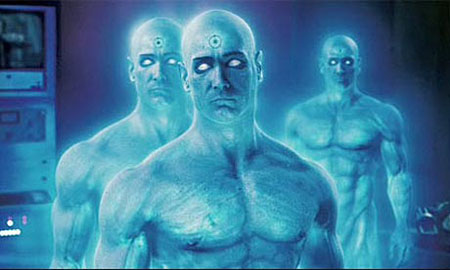
COMMENTS: The brilliant montage over the opening credits is a distillation of “all-too-human” vignettes in which we see four decades of masked avengers interact on a fictionalized American history stage, to the strains of Bob Dylan’s “The Times They Are a Changin’.” A costumed moth-man is dragged off to an insane asylum, and a glowing blue man in a three piece suit shakes hands with a grateful JFK, and Andy Warhol paints pop portraits of caped crusaders. The opening captures what is good about Watchmen: the setting is so original that the film relocates you into its own peculiar universe, which is what escapist entertainment is supposed to do.  And this one has just enough of a veneer of philosophical and political depth (“who watches the Watchmen?”) to give adults an intellectual justification to sit back and enjoy a comic book on film.  The flawed superheroes are briefly sketched, but their slightly twisted archetypes capture our interest.  The noirish Rorschach has an inflexible vigilante code of justice and ever-shifting inkblot mask; atomic superman Dr. Manhattan deploys his colossal blue CGI penis as unashamedly as he does his godlike power to create special effects, all the while suffering existential detachment as his contemplation of quantum realities alienates him from human ones. The script weights the amount of time devoted to each of the intertwining stories and backstories well, supplying a rich context without becoming confusing.  The film’s nihilism ultimately appears as little more than a tonal choice, much like a decision to film in black and white instead of Technicolor. The setting is absorbing enough to make most overlook the films more than occasional gaffes, from the excessively visceral, bone-cracking and blood-spurting violence meant to deglamorize the heroes to a laughably glamorous moonlight lovemaking scene in a hovering owlcraft.

From the standpoint of someone who hasn’t read the beloved comic book graphic novel from which the movie was adapted, it’s amusing to observe Internet kvetching over the movie’s supposedly superhuman power to drain the source work of it’s magic.  Even reviews by professional critics often devolve into column-length comparisons of the literate merits of the original to the relatively pedestrian film version.   But, coming to the film not expecting it to have the intellectual depth and characterization of a novel, I found the movie Watchmen to be an excellent advertisement for the source material.

WHAT THE CRITICS SAY:

“‘Watchmen’ is… going to be the ultimate tough sell: there will be those who view the film as a bewildering mishmash of underexplored themes, thinly sketched characters and noisy, excessive violence… And yet, there’s something admirable about the entire enterprise: its ungainly size, its unrelenting weirdness, its willful, challenging intensity.”–Tom Huddleston, Time Out London (contemporaneous)

CAPSULE: ADAPTATION (2002)

Recommended

DIRECTED BY: Spike Jonze

FEATURING: , , Chris Columbus

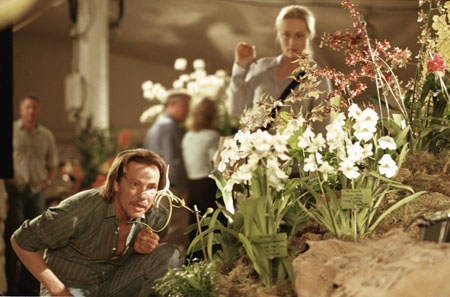
PLOTAdaptation tells two stories: in one, a “New Yorker” journalist (Meryl Streep) becomes obsessed with the subject of her nonfiction book, a trashy but passionate collector of orchids (Chris Cooper); in the other, a depressed screenwriter (Nicolas Cage) struggles to adapt her book “The Orchid Thief” into a movie, while fending off his chipper and vapid twin brother (also played by Cage), himself an ersatz screenwriter.

adaptation

WHY IT’S ON THE BORDERLINEAdaptation is a metamovie, the filmed equivalent of metafiction (a literary style where the real subject of the work is not the ostensible plot, but the process of creating of the work itself).  In Adaptation, screenwriter Charlie Kaufman (Being John Malkovich) inserts a fictionalized version of himself into the script, writing and rewriting the story as the movie progresses.  Adaptation may appear unusual, and even weird to those who aren’t used to this kind of recursive style, but it’s a purely intellectual exercise about the creative process, and the mysteries presented in the movie have a purely logical explanation when considered in their literary context.

COMMENTSAdaptation sports perhaps the smartest script written in this young millennium, a story which twists and turns back upon itself with sly wit and playful intelligence.  (The screenplay was nominated by the Academy for “Best Adapted Screenplay”; maybe it would have won if it had been properly nominated in the “Best Original Screenplay” category).  In addition, the acting by the three principals—toothless and trashy Chris Cooper as the orchid thief, Meryl Streep as a jaded, intellectual journalist drained of passion, and Nick Cage as the twins, Charlie and Donald Kaufman—shows three veterans at the very peak of their games.   All three were nominated for Oscars, and Cooper won for “Best Supporting Actor.”   As good as Cooper was, it’s Cage’s magical performance as the writer paralyzed by artistic ambition and self-doubt, and also as his clueless doppelganger with a maddening Midas touch, that carries the film.  This is easily Cage’s best performance in an uneven career.

Despite the superlative script and performances, Adaptation falls just short of being an unqualified classic.  The problem is that the secondary plot—despite such welcome spectacles as Meryl Streep trying to imitate a dial tone while tripping balls—pales beside the more intriguing internal struggle of poor Charlie Kaufman.  When Streep and Cooper are on screen, we are always anxious to get back to Cage throwing barbs at himself.  Adaptation is geared towards a specialized audience—mainly writers, movie reviewers and other highly creative types—but will also appeal to fanatical film fans and industry insiders and would-be insiders who want to have a good wicked laugh at the cutthroat compromises required to bring a screenplay to life in Hollywood.

WHAT THE CRITICS SAY:

“…an occasionally maddening and sometimes brilliant motion picture that varies between being insightfully sharp and insufferably self-indulgent…  I can’t imagine Adaptation having much mainstream appeal, but, for those who look for something genuinely off-the-wall in a motion picture, this will unquestionably strike a nerve.”  -James Berardinelli, Reel Views