Tag Archives: Fantasy

CAPSULE: DEATH NOTE [Desu nôto] (2006)

Recommended

DIRECTED BY: Shusuke Kaneko

FEATURING: Tatsuya Fujiwara, Ken’ichi Matsuyama

PLOT:  A law student finds a notebook (deliberately dropped by the God of Death) that

Still from Death Note (2006)

allows him to kill anyone whose name he writes in it; soon, criminals across the world start dropping dead, while, with the aid of super-detective “L,” the police race to stop the mysterious vigilante.

WHY IT WON’T MAKE THE LIST: Death Note has a unique premise and execution, particularly in the way it mixes the fantasy and detective genres, and has potential as a cult film even beyond its existing magna/anime fanbase.  The presence of apple-munching Ryuuk, a lurking angel of death whose motives for making Light his emissary are never explained, gives this film a small tinge of weirdness, but other than that it abides by its own internal rules with such rigid consistency that it registers no more than an “offbeat” on the Weirdometer.

COMMENTSDeath Note begins with a potentially interesting premise, but spends most of its first reel setting up that premise in such a routine way that I feared it was going to be just another uninspiring Ringu variation.  Studying the law with the intention of becoming a district attorney, young Light magically gets the power to dispense capital punishment.  He targets only the vilest unrepentant criminals who have escaped justice.  The anonymous vigilante who slays with a stroke of the pen is anointed “Kira” and is applauded by legions of Internet groupies.  For a while it looks like we’re headed towards a depressingly obvious morality tale, with Light destined to fall from grace, abuse his power and accidentally execute an innocent man.  The first twist comes when we meet Ryuuk, a god of death and the source of Light’s new-found power; his motives are unknown and he proclaims himself neutral as to whether Light uses the Death Note or not.  Ryuuk constantly hangs around Light, apparently because he’s fallen hard for the earthly pleasure of the humble apple and Light has become his produce pusher.  The angel of death is an interesting character, but his idiosyncrasies take a while to unfold, and he’s a disappointment on other terms: he looks like an artist’s black and white rendering of Heath Ledger’s joker with bat wings attached, badly animated for a cheap video game.  He even moves like a game character, hovering slightly in the air with a stock expression until the game cursor hovers over him, at which point he jerks back his head and delivers his dialogue with a cartoonish cackle.  It’s to the script’s credit that despite the cheap animation, Ryuuk’s role is interesting enough that we eventually get used to him and forget about his distracting appearance.

The second wrinkle comes with the arrival of another oddball character, the anonymous sleuth “L,” who first appears as nothing more than a voice on a laptop.  Faced with a worldwide pandemic of accused murderers dropping dead from heart attacks after juries acquit them, the baffled police turn to the techno-detective, who cleverly narrows down the list of suspects from the entire population of the world to a small pool of Japanese students using pure deduction.  But the story doesn’t really take off until the halfway point, when Light turns his attentions from criminals to those tracking him down and new rules are introduced for the Death Note allowing him to write out elaborate scenarios to cause his victim’s demise, rather than unceremoniously dropping dead of a heart attack as they had previously.  Light needs his victim’s name in order to off him, and the anonymous L, driven by his own amoral sense of sport, seeks to discover Light’s identity as well.  The cat-and-mouse games between the two masterminds turn complicated, clever and thrilling, with L playing the part of a high-tech Sherlock while Light becomes a mystical Moriarty.  The story is spread over two feature films; this picture wraps up one story arc, but ends with Light and L at a stalemate to be broken in Death Note: The Last Name (2006).

Death Note has become a small franchise: based on a popular magna, it had previously been adapted as an anime series, it has spawned not only the of-a-piece sequel but a spin-off movie featuring L.  It’s also destined for a horribly uninteresting Hollywood remake.

WHAT THE CRITICS SAY:

Light’s goaded into his kill spree by the God of Death; a lolloping CGI ghoul in rock star clothes, who appears out of nowhere and offers advice while munching on apples. Weird, huh?”–Jamie Russell, BBC (contemporaneous)

CAPSULE: ARMY OF DARKNESS (1992)

Recommended

DIRECTED BYSam Raimi

FEATURING:  Bruce Campbell

PLOT:  Following the events of Evil Dead II, Ash finds himself flung backwards in time into a medieval land, where his failure to retrieve the Book of the Dead enables evil forces to muster a massive army of stop-motion animated skeletons.

Army of Darkness

WHY IT WON’T MAKE THE LISTEvil Dead II struggled mightily to obtain its weird credentials, and just barely qualified for its weird badge thanks to the “cabin fever” sequence in the middle portion of the film.  In the third entry of the “Evil Dead” trilogy, director Sam Raimi distills what he thinks is the popular essence of Evil Dead II, emerging with a concentrated dose mixing ghoulish comedy with a stiff shot of badass working class hero Ash.  Weirdness was discarded as a waste product, although traces remain.

COMMENTS:  The beginning of Army of Darkness rewrites the tale of how Ash came to be recognized as the “Chosen One” at the end of Evil Dead II, but consistent storytelling (along with respect for the laws of physics) has never been a high priority in this series.   Since the  midpoint of the second film, Raimi’s Evil Dead emphasis for the trilogy has been comedy, and Army of Darkness is tongue-in-cheek from start to finish.  As an action/comedy/fantasy/horror hybrid, Army of Darkness pulls in too many directions to hang together as a story, much less integrate itself with the rest of the series, but the manic energy is a lot of fun, and the film does work on a scene-by-scene basis.  The flick dips into the Three Stooges tribute well even more than Evil Dead II did; in one funny scene, every orifice on Ash’s face is invaded by skeletal fingers from still buried corpses, despite his best defensive maneuvers (our hero never learned from Curly’s mistakes—don’t introduce your tongue as a new target by sticking it out in triumph after successfully blocking the dual finger eye poke).  Gags aside, the comic momentum overwhelming comes from Bruce Campbell’s Ash, who has transformed from a much abused punching-bag for macabre forces into an arrogant, wisecracking hero.  Campbell adopts just the right campy, parodic tone when reprising hit action catchphrases like “Groovy” or fresh favorites like “Just me, baby.”   Ash’s overweening, usually unjustified bravado is the comic binding that keeps the scattershot script from blowing away in the wind.  For fans of weirdness, the best bits are the hallucinatory scenes after Ash takes refuge from a shakycam assault inside a windmill: for unexplained reasons, he ends up by menaced by a gang of tiny Ashes in a “Gulliver’s Travels” parody, then sprouts an Evil Ash from his shoulder.  These scenes take place at approximately the same stage in the movie as the “cabin fever” sequences did in Evil Dead II, and may have been intended as one of the many, many nods to the previous film.  Another high point is the army of stop motion animated skeletons (a tribute to Ray Harryhausen).  Each member of the bony horde is brilliantly individualized and detailed; particularly striking is the martial band, beating drums made from skulls and playing flutes fashioned from arm bones.   Overall, Army of Darkness is a worthy, if commodified and popularized, sequel, and a solid roller coaster for fans of fantastic film who aren’t hung up on logic.

Army of Darkness was the transitional film for Raimi between campy experimental films like Crimewave and Evil Dead II and purely commercial fare such as the Spider-Man series.  The large scale battle and professional action scenes in Army seem almost like audition reels for making a Major Motion Picture.

WHAT THE CRITICS SAY:

“…a goofy, hyperventilated send-up of horror films and medieval warfare, so action-packed it sometimes seems less like a movie than like a cardiovascular workout for its stars.”–Roger Ebert, Chicago Sun-Times (contemporaneous)

29. THE CITY OF LOST CHILDREN [La cité des enfants perdus] (1995)

“…someone who didn’t dream but, just the same, lived very well, yet would want to see, in dreams, a greater dimension of the imagination. For us, someone who is deprived of that is condemned to die. That’s part of what we wanted to say…  If one cannot dream and imagine things, and if one is sentenced to the everyday, to reality, it’s awful.”–Jean-Pierre Jeunet

Must See

DIRECTED BY: Marc Caro, Jean-Pierre Jeunet

FEATURING: Ron Perlman, Judith Vittet, Dominique Pinon,

PLOT: A mad genius living on an abandoned oil rig, who is growing prematurely old because he cannot dream, abducts children from a nearby port city and tries to steal their dreams. His minions seize the adopted little brother of One, a foreigner and former sailor who now works in a carnival as a strongman. One teams up with a streetwise orphan girl in the nameless, magical city to track down his little brother’s location.

City of Lost Children

BACKGROUND:

  • This was the second and final collaboration between Marc Caro and Jean-Pierre Jeunet, after the black comedy Delicatessan (1991). Caro focused on the art direction, and Jeunet worked with the actors.
  • Caro and Jeunet conceived the idea for the film fourteen years before it was completed.
  • This visual effects spectacular, incorporating early CGI technology, was reportedly the most expensive film yet produced in France at that time.
  • La cité des enfants perdus was the opening film at the Cannes film festival in 1995 and was in competition for the Palme D’or (losing to ‘s Underground).

INDELIBLE IMAGEThe City of Lost Children is a film that’s built around images: a CGI flea using its proboscis to insert a hypnotic drug into a man’s head, a disembodied brain in a fish tank, and a horde of frightening Santas all compete for honors—not to mention the city itself, a tottering port made up of rambling stairs, arches, balconies and alleys, which resembles Venice re-imagined as a Victorian junkyard.  The most iconic image, however, is gaunt old Krank in his gleaming lab hooked up to his dream stealing machine, a multi-tentacled headdress stolen from the laboratory of an avant-garde Dr. Frankenstien.

WHAT MAKES IT WEIRD: The City of Lost Children takes place in a magical city that could not exist except in the imagination, in dreams. It’s a fairy tale, but from the first scene—a child’s Christmas Eve dream that turns unsettlingly weird—it’s clear that this is no standard fantasy world that sets out a few simple deviations from our own, but instead a world of childlike wonder where the imagination is unleashed without respect for the possible.

Short theatrical trailer for City of Lost Children

COMMENTS: There’s a scene early on in The City of Lost Children where a dozing Continue reading 29. THE CITY OF LOST CHILDREN [La cité des enfants perdus] (1995)

17. TIDELAND (2005)

“[Producer] Jeremy [Thomas] knew [raising money to make Tideland] would be difficult, particularly because the film is very, very weird.”–Terry Gilliam

Recommended

DIRECTED BY: Terry Gilliam

FEATURING: Jodelle Ferland, Brendan Fletcher,

PLOT: Jeliza-Rose is a nine year old girl with an active imagination who is being raised by a pair of junkies. When her father spirits her away to a lonely, dilapidated farmhouse, then takes an extended “vacation” on heroin, Jeliza-Rose is left to her own devices. She retreats into an intricate fantasy world where her four doll’s heads are her closest companions, but reality is scarcely less bizarre than her imagination: her neighbors are a witch-like one-eyed woman with an unhealthy interest in taxidermy and a childlike mentally retarded man who also lives in his own fantasy world.

tideland


BACKGROUND:

  • Tideland was adapted from a critically praised novel by Mitch Cullin; ironically, this faithful movie adaptation was critically panned.
  • Gilliam made Tideland while on a six month hiatus from directing the big-budget commercial fantasy, The Brothers Grimm (2005).
  • Tideland was a commercial disaster, earning less than $100,000 in its initial domestic run.
  • According to Gilliam, the French distributor did not want to screen this film at Cannes because there is a scene involving farting, which the French find objectionable.

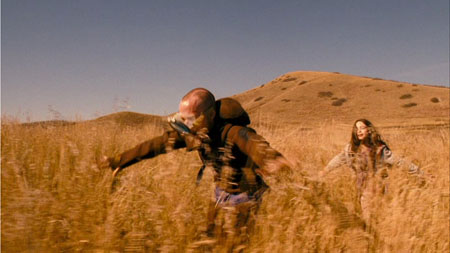
INDELIBLE IMAGE:  Many will remember Jeliza-Rose’s doll’s heads, who make memorably fantastic appearances in an underwater house and flying about inside a man’s ribcage.  But the more indelible image, because it’s repeated so many times, is the view of the broken down farmhouse in front of amber waves of grain.  The look was inspired by the Andrew Wyeth paining “Christina’s World,” and, though unacknowleged, also from the 1990 film The Reflecting Skin (which had an almost identical look as well as an eerily similarly child protagonist). Gilliam often emphasizes the tall gold grass towering over tiny Jeliza-Rose’s head, as if it were surf and she was living in an undersea world.  This ubiquitous aquatic imagery helps to explain the title “Tideland“.

WHAT MAKES IT WEIRD:  Gilliam has described the movie as a cross between “Alice in Wonderland” and Psycho, which sounds weird enough on its own terms. He pushes the envelope of weirdness even further with his trademark visual flair for phantasmagorical set pieces, for example, with a gloriously imaginative sequences of Jeliza-Rose falling down a rabbit hole full of tumbling syringes. But even if the audience wasn’t planted firmly inside the skull of the 9-year-old heroine, peering out onto this grotesque world through her child’s eyes, the scenario would have been weird, as the world of Tideland is peopled by grossly exaggerated lowlifes who live out their lives on the lonely fringes of plausibility.


Original trailer for Tideland

COMMENTS: Tideland is a misunderstood film, which is not automatically the same thing Continue reading 17. TIDELAND (2005)

13. KUNG FU HUSTLE (2004)

AKA Kung Fu, Kung Fu-sion

“It’s good to go over the line.  It’ll be boring if it doesn’t.  Following reality is not refreshing for me.”–Yuen Woo-ping, fight choreographer for Kung Fu Hustle

Recommended

DIRECTED BY: Stephen Chow

FEATURING: Stephen Chow, Qui Yuen, Wah Yuen, Siu-Lung Leung

PLOT: The Axe Gang, hatchet-wielding hooligans garbed in black-tie evening wear, terrorizes Shanghai in the 1930s. Only the poorest areas avoid falling under their thumb—neighborhoods like Pig Sty Alley, a tenement building where every other resident seems to have one-in-a-million kung fu powers.  When an incompetent ersatz gangster tries to extort protection money from the residents of Pig Sty Alley, he accidentally sets in motion a series of events that brings the Axe Gang into conflict with the poor fighters, with explosive results.
Still from Kung Fu Hustle (2004)

BACKGROUND:

  • Director Stephen Chow worked his way up from the trenches of the Hong Kong film industry, starting in television (including a stint as a children’s TV host). He became one of Hong Kong’s most popular comedians, specializing in a verbal style of comedy called “mo lie tau” (roughly, “nonsense”), which relies heavily on puns, wordplay, incongruities and non sequiturs. He began directing in 1994.
  • Chow’s previous film, Shaolin Soccer (2001), was supposed to be his breakthrough film in the West, but distribution was botched by Miramax and the picture became only a small cult hit on DVD.
  • Chow coaxed many older actors from the kung fu’s heyday out of retirement to star in major roles in Kung Fu Hustle. Qui Yuen (who played the part of “Landlady”) was one of the few female martial arts stars of the 1970s and had a small non-speaking role in the Bond film The Man with the Golden Gun. Wah Yuen (“Landlord”) has over one hundred acting credits, mostly from the late 1970s and early 1980s, and was at one time Bruce Lee’s stunt double. Siu-lung Leung (“The Beast”) was at one time considered third only to Bruce Lee and Jackie Chan as a martial arts star, and had been retired from the film business since 1988.
  • Kung Fu Hustle was the most profitable feature in Hong Kong cinema history. In its US theatrical run it opened as the #5 movie in the country and became the highest grossing foreign language film of 2005.

INDELIBLE IMAGE: There are so many memorable images in Kung Fu Hustle that it’s impossible to determine a consensus favorite.  The vision of two harpist assassins who strum their instruments to summon swords and warriors is a strong candidate, because their poetic menace draws a strong contrast to the lighter and less serious tone of the rest of the film.  Other contenders include the Axe Gang’s Broadway dance number, the Landlady’s whirling Road Runner legs, and a beatific Buddha in the clouds.

WHAT MAKES IT WEIRD: Kung Fu Hustle begins with a brutal and atypically realistic gangland slaughter on the neon-washed streets of Shanghai, and to celebrate gaining control of the city, the Axe Gang breaks into a carefully choreographed Busby Berkeley style fox trot, waving their tomahawks in the air. From this moment, the viewer realizes that they are in the hands of a maestro for whom reality is almost infinitely malleable, and who’s willing to switch cinematic styles at the drop of a hatchet to produce the effect he needs. Chow’s direction drives the movie through numerous stylistic incarnations, from absurd visual comedy through a ballet of breathtakingly beautiful and unreal violence, while quoting everything from Wong Kar Wai to The Shining and The Untouchables to Warner Brothers’ “Looney Tunes,” yet never loses its grip on the story or alienates the viewer with its madcap diversions.

U.S. release trailer for Kung Fu Hustle

COMMENTS:Kung Fu Hustle is likely to be the most commercially successful, mainstream Continue reading 13. KUNG FU HUSTLE (2004)