Tag Archives: Dubbed

CAPSULE: SAMURAI PRINCESS [SAMURAI PURINSESU: GEDÔ-HIME] (2009)

DIRECTED BY: Kengo Kaji

FEATURING: Aino Kishi, Dai Mizuno

PLOT:  In a timeless mystical forest, a rape survivor takes on the souls of her eleven

Still from Samurai Princess (2009)

dead sisters and becomes a cyborg to avenge them.

WHY IT WON’T MAKE THE LIST: Samurai Princess is a relatively unambitious attempt to cash in on the biohorror/splatterpunk formula established in Meatball Machine (2005); fans of this stuff will be probably be reasonably entertained, but newcomers would be better off checking out the aforementioned Meatball Machine or Tokyo Gore Police instead.

COMMENTS: In a few short years, the works of an incestuous group of Japanese writers/directors/FX gurus have created a new Japanese splatterpunk formula focusing on slim but fantastic storylines; extreme, absurd gore effects; and the modification of body parts into bioweapons.  This phenomenon is only five years old, but it’s already reminiscent of what happened with Troma: the studio had a hit, and spent the rest of its existence remaking The Toxic Avenger over and over under different names.  Samurai Princess is a lesser entry in this new genre, and at times it feels like the square peg of the splaterpunk formula is being forced into the round hole of a gentler, more reflective fantasy.  The idea of a justice-seeking living vessel infused with the souls of eleven raped virgins feels like an old Japanese legend, but making that instrument of vengeance a cyborg with detachable boob-bombs is a faddish approach that doesn’t click.  The movie’s setting—a primeval forest haunted by brigands, loners and mad scientists, a place that’s even “out of Buddha’s jurisdiction”—is promising.  It’s a place out of time; the kimonos and katanas suggest feudal Japan, but there are plenty of anachronisms like chainsaws, cameras, and novelty sunglasses with blinking Christmas lights on the frame.  The cast that romps through the forest is nicely bizarre: besides the main character (who’s neither a samurai nor a princess), there’s one mad doctor who collects body parts to build “mechas,” a rival cyborg-building maniac with a pair of female sidekicks who speak in unison, a Buddhist nun with Continue reading CAPSULE: SAMURAI PRINCESS [SAMURAI PURINSESU: GEDÔ-HIME] (2009)

59. THE BEAST OF YUCCA FLATS (1961)

“There’s a rare kind of perfection in The Beast of Yucca Flats — the perverse perfection of a piece wherein everything is as false and farcically far-out as can be imagined.”–Tom Weaver, in his introduction to his Astounding B Monster interview with Tony Cardoza

Beware

DIRECTED BY: Coleman Francis

FEATURING: Tor Johnson

PLOT: Joseph Javorsky, noted scientist, defects to the United States, carrying with him a briefcase full of Soviet state secrets about the moon. Fleeing KGB assassins, he runs onto a nuclear testing range just as an atom bomb explodes. The blast of radiation turns him into an unthinking Beast who strangles vacationers who wander into the Yucca Flats region.

Still from The Beast of Yucca Flats (1961)

BACKGROUND:

  • The Beast of Yucca Flats can always be found somewhere on the IMDB’s “Bottom 100” list (at the time the review was composed, it occupied slot #21).
  • All three of the films Coleman Francis directed were spoofed on “Mystery Science Theater 3000“.
  • Tor Johnson was a retired Swedish wrestler who appeared in several Ed Wood, Jr. movies. Despite the fact that none of the movies he appeared in were hits, his bestial face became so iconic that it was immortalized as a children’s Halloween mask.
  • All sound was added in post-production. Voice-overs occur when the characters are at a distance or when their faces are obscured so that the voice actors won’t have to match the characters lips. Some have speculated that the soundtrack was somehow lost and the narration added later, but shooting without synchronized sound was a not-unheard-of low-budget practice at the time (see The Creeping Terror, Monster A-Go-Go and the early filmography of ). Internal and external evidence both suggest that the film was deliberately shot silent.
  • Director Coleman Francis is the narrator and appears as a gas station owner.
  • Per actor/producer Tony Cardoza, the rabbit that appears in the final scene was a wild animal that wandered onto the set during filming. It appears that the feral bunny is rummaging through Tor’s shirt pocket looking for food, however.
  • Cardoza, a close friend of Francis, suggests that the actor/director may have committed suicide in 1973 by placing a plastic bag over his head and inhaling the fumes from his station wagon through a tube, although arteriosclerosis was listed as the official cause of death.
  • The film opens with a topless scene that lasts for only a few seconds; it’s frequently clipped off prints of the film.
  • The Beast of Yucca Flats is believed to be in the public domain and can be legally viewed and downloaded at The Internet Archive, among other sources.

INDELIBLE IMAGE: Tor Johnson, in all his manifestations, whether noted scientist or irradiated Beast; but especially when he cuddles and kisses a cute bunny as he lies dying.

WHAT MAKES IT WEIRD: Coleman Francis made three movies in his lifetime, all of which were set in a reality known only to Coleman Francis. His other two films (The Skydivers and Night Train to Mundo Fine [AKA Red Zone Cuba]) were grim and incoherent stories of despairing men and women in desolate desert towns who drank coffee, flew light aircraft, and killed off odd-looking extras without finding any satisfaction in the act. Though his entire oeuvre was more than a bit bent by his joyless outlook on life, his natural affinity for the grotesque, and his utter lack of attention to filmic detail, this Luddite tale of an obese scientist turned into a ravening atomic Beast survives as his weirdest anti-achievement.


Trailer for The Beast of Yucca Flats with commentary from director Joe Dante (Trailers from Hell)

COMMENTS:  Touch a button on the DVD player. Things happen onscreen. A movie Continue reading 59. THE BEAST OF YUCCA FLATS (1961)

CAPSULE: FRANKENSTEINS BLOODY NIGHTMARE (2006)

DIRECTED BY:

FEATURING: John R. Hand, Amy Olivastro

PLOT: A scientist—or perhaps his monster, it’s never quite clear—kills women to harvest their body parts so the doctor can resurrect his dead love.

Still from Frankensteins Bloody Nightmare (2006)

WHY IT WON’T MAKE THE LIST: Missing apostrophe aside, there’s lots to admire about Frankensteins Bloody Nightmare, though not as much to love. Director Hand shows a remarkable technical ability to create unique visual and auditory environments inspired by the 1970s trash movies of , , and , but with their cheap, desperate Super-8 stylistics exaggerated to surreal levels. The problem is that, for all its technical ingenuity, the movie has no story to tell, which will cause the average viewer to lose interest quickly.

COMMENTS: Frankensteins flesh may be recycled out of various parts snatched from grindhouse graveyards, but its heart was taken straight from the arthouse. One man show John R. Hand (writer/director/editor/composer/star) obviously watched a lot of 1970s horror cheapies growing up, and (like us) he was clearly more impressed by the mysterious artificial ambiances created by grainy film stock and heavy use of theremins, oscillators and other weird sci-fi audio effects than he was by the nudity and gore those drive-in auteurs depended on to sell tickets. Nightmare strips away the exploitation elements from these flicks (bloody it ain’t), adopting only the bare outline of a mad scientist story. It then seizes the distressed visuals and shaky audio that remains, and amplifies these leftovers to psychedelic levels. Hand himself is too boyish looking to convey the soul of a tortured scientist, and his acting is no better than the rest of the amateurs in the film. Given the intent is to mimic an exploitation film, this might not detract too much from the atmosphere, had there just been enough story and action to keep the viewer engaged. Dialogue is sometimes muffled and inaudible, making a difficult-to-follow story nearly impossible. It’s a bizarre experience to feel lost inside a the plot of a movie where almost nothing is happening onscreen.

Stylistically, on the other hand, there’s always something going on. The opening mixes grainy home-video style footage with bright, solarized footage depicting a pitchfork assault; strange whines, moans, blips, and electronic drones assault our ears, building to a dissonant crescendo. The film changes style every five minutes or so, as we tour Hand’s portfolio of foggy lenses, overexposed film, desaturated colors, psychedelic color filters, thermal imaging, a  psycho-sexual dream sequence, all accompanied by a disquieting soundtrack of distorted Moog organs and overdubbed tape effects. The penultimate scene in the film contains an absolutely beautiful effect where the autumn landscape, then an actress’ face, magically and organically melt into abstract blobs of orange and gold and purple (the director’s commentary reveals the cheap and ingenious method by which it was achieved: household bleach on still photographs).

Overall, Nightmare is a worthy experiment that’s successful in short stretches, but could have used a lot more story. A few bare boobs and a pint or two of gooey stage blood, the key elements this film’s inspirations never would have left out, would also have livened things up.

I can see why would give Frankensteins Bloody Nightmare an honorable mention on his top 10 weird movies list. Depending as it does on discount techniques for creating striking moods, this is a movie that can almost serve as a textbook to Hand’s fellow micro-budget filmmakers.

WHAT THE CRITICS SAY:

“…a wild cocktail of nightmarish sensibilities; its death nerve twitches to a disquieting mish-mash of strange images and even stranger sounds… The story is bootleg but Hand’s head-trippy dissolving of consciousness is something fierce, inviting repeat viewings with a joint in hand.”–Ed Gonzalez, Slant Magazine (contemporaneous)

CAPSULE: CITY NINJA [TOU QING KE] (1985)

AKA Ninja Holocaust; Rocky’s Love Affairs

DIRECTED BY: Yeung Chuen Bong or Liu Li Shen

FEATURING: Cassanova Wong, Chen Wei Man, Chia Che Fu?

PLOT:  Two men, one a boxing champion and one a destitute but talented up-and-comer, seek two necklaces, each with half of a Swiss bank account number engraved on it, for two different criminal organizations.

City Ninja

WHY IT WON’T MAKE THE LIST:  This is one crazy chopsocky, but “over-the-top,” “shamelessly exploitative” and “incoherent” are more accurate adjectives to describe it than “weird.”

COMMENTS: From the opening scene where a wandering farmer fights off a horde of ninjas who randomly disappear or explode when defeated, you can be sure that this is a movie that places action and violence far above coherence and logic. You may have seen that coming, but what might surprise you is how much sex gets thrown into the mix. Both of the dual heroes gets several sweaty couplings with his main or subsidiary squeeze, and the flick even throws in a gratuitous Caucasian stripper groupie hired for her cultural willingness to show skin (the Asian girls demurely cover their naughty bits behind a frosted shower stall, soaking wet kimono, or a lover’s flailing limbs). The sex scenes are extra steamy for this type of movie, and even lead to some soap-opera style histrionics when one of the fighters is confronted by the girlfriend he dumped in front of the Other Woman; she pulls a gun on him while informing him she’s pregnant. The director views plot as a necessary evil that gets in the way of fight and sex scenes, yet he tackles a complicated story with two different strands and many moving parts. The result is that he rushes from fight scene to sex scene and back, and fits in exposition when he has a spare moment; there are several times when the viewer gets totally lost because the movie fails to establish which plotline it’s exploring at the moment.

Though the sex makes it stand out from the pack, chopsockies rely on flying boots, not heaving breasts, and City Ninja delivers memorable melees in spades. The combatants are lightning fast, the fight choreography is excellent, there’s comedy that actually works, and the mini-scenarios can be delightfully absurd. Best is a brilliant billiard room brawl with a kabuki-faced acrobat/poolshark that morphs into a mud-wrestling match; there’s also a remarkably executed scene where a boxer fights off attackers by manipulating his girlfriend’s stockinged legs as she sits on his shoulders. It’s far from high art, but it’s crazy and fun, and you have to admire the pure devotion to exploitation movie principles.

The IMDB credits Godfrey Ho as writer of Ninja Holocaust. Godfrey may or may not have been involved, but it certainly has that convoluted Ho vibe. The plot description and reviews make it clear that City Ninja and Ninja Holocaust are substantially the same movie, but the listed credits for the two films differ. I don’t feel particularly compelled to do the detective work necessary to straighten the credits out. Though it has two different heroes and can be difficult to follow, City Ninja does not appear to be spliced together from two different movies, as some assume based on it’s rumored association with cut-n-paste master Ho.

WHAT THE CRITICS SAY:

“…this movie is dumber than a box of dog biscuits, but it’s also a lot of fun. You never have to wait for something ridiculous to happen and the flick is never boring.”–Mitch, The Video Vacuum (DVD)

10. ARCHANGEL (1990)

“And we are here as on a darkling plain

Swept with confused alarms of struggle and flight,

Where ignorant armies clash by night.”

Matthew Arnold, “Dover Beach” (quote originally intended to introduce Archangel)

Recommended

DIRECTED BY: Guy Maddin

FEATURING: , Kathy Marykuca

PLOT: In 1919, one-legged Canadian airman Lt. John Boles finds his way to the Russian port of Archangel in the endless night of Arctic winter. There, he meets Veronkha, whom he believes to be the reincarnation of Iris, his dead love. Veronkha has problems of her own, in the form of an amnesiac husband who wakes up every day believing this is the day they are to be wed, but Boles tries to woo her nevertheless as Archangel’s ragtag militia battles the Germans and the Bolsheviks without realizing that both World War I and the Russian Revolution are over.

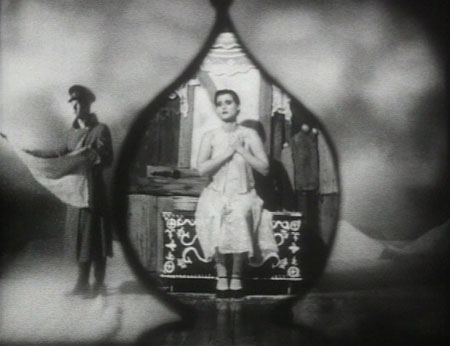
archangel

BACKGROUND:

  • The city of Archangel was the port of entry for Allied soldiers during World War I; therefore, soldiers from America, Canada, and the European allies might very well have been found gathered there (although probably not East Indians and Congolese, as depicted in the film). Many Allied soldiers were sent to Russia, partially to help assist the Imperial (White) Russians against the Bolshevik Communist rebels (Reds).
  • Some reports say that the version presented on the “Guy Maddin Collection” DVD is a different cut from the theatrical and original VHS version, with tinting and intertitles added. I haven’t been able to confirm whether differences exist.

INDELIBLE IMAGE:  As his dying act, a lifelong coward strangles a bestial Bolshevik with a length of his own intestine (which is obviously a sausage link).

WHAT MAKES IT WEIRD: The tale of an obsessive, grieving soldier who thinks he’s found the reincarnation of his lost love in a benighted Russian city where the citizens continue to fight a war that is over would be weird enough if told straight. Director Guy Maddin exaggerates the already dreamlike quality of this tale by clothing it in the archaic period dress of an early sound film, complete with intertitles describing the action, dubbed voices that are occasionally slightly out of sync, and casually disorienting jumps/glitches in the film. He pushes this inherently confusing story of terminally confused characters further into strange realms with deliberately surreal elements, such as women warriors going to the front dressed in elegant evening headwear, and even odder sights.

Short clip from Archangel (French subtitles not in original)

COMMENTS: The city of Archangel seems the perfect place to dream.  Isolated from the Continue reading 10. ARCHANGEL (1990)