Tag Archives: Drama

CAPSULE: SIBERIA (2019)

366 Weird Movies may earn commissions from purchases made through product links.

DIRECTED BY: Abel Ferrara

FEATURING: Willem Dafoe

PLOT: The owner of an outpost on the snowy outskirts of nowhere journeys through the countryside and his memories alongside his team of dogs.

COMMENTS: Were I to pitch this disingenuously, I could make the case that this movie is weird. There’s the chanting dwarf woman in her wheelchair, in a cave. Willem Dafoe dances around a maypole with a dozen or so children. And at one point a dead fish in a metal dish utters some cryptic remarks. Cryptic, now, that’s something that Siberia has in a spades. Once again, Abel Ferrara is working with Willem Dafoe, who seems to keep the actor in his pocket for any art-house forays. And once again, Ferrara plumbs intensely personal depths, this latter-day habit depicted on-screen when Dafoe’s character falls down a chasm that appears in the basement of his Siberian tavern.

Clint (Willem Dafoe) tends bar and is intermittently attacked by demons—of the metaphorical variety, alas. He appears to be friends with a native (not a local Slavic Russian, but a Native native), without understanding a word of the hunter/trapper’s language. Clint also seems to know no Russian, as evidenced during a visit from a babushka, her daughter, and, indirectly, the third generation of that family: the unborn child in the daughter’s womb. This encounter is the first of a series of odd, possibly meaningful scenes involving Clint kneeling before a bare-breasted woman and then having sex with her.

Stylistically, Ferrara is a lingerer. He will keep his shot going until he’s satisfied, regardless how awkward it may make the viewer feel. There are obvious overtones of lust and fertility in the Clint/breast scenes, but they are executed in such a way that appreciation seems to morph into supplication, itself morphing into something less definable (but bordering on creepy). His gaze is not just salacious, however: it is filled with pathos. The graceful lines of Dafoe’s gaunt face shift in severity between awe and dismay and surprise, as in one moment he observes a sunrise in a subterranean lake, then witnesses a congregation of tormented ghosts in the cave, and the next moment listens to his dead father outline a fishing trip. This segment includes one of the film’s incongruous bursts of comedy as the two men (both played by Dafoe) converse: “Dad, don’t you remember what the doctor said?” asks Clint, “What was that?” responds the father. “He said you’re dead.”

There is a reliable floor to the quality of any Abel Ferrara film, going all the way back to his pseudonymously directed debut. He knows technique, form, dialogue, timing, all that. However, he’s going through a bit of a navel-gazing stage in his career. Some brief research gave no indication that Clint’s memories are the director’s own (though considering he wrote the screenplay, I have my suspicions); but regardless of whom Clint is based upon, Siberia is little more than a modestly surreal, moderately compelling, and much too cryptic slice of an old man’s mind.

WHAT THE CRITICS SAY:
“This sort of visceral movie is about the experience, not the logic. Graphic nudity and violence ensure that scenes literally bleed from one to another. Along the way, the passages weave an odd and surreal continuity, with moments of quiet boredom that segue swiftly into ferocious visual jolts.” -Thomas Tunstall, Irish Film Critic (Blu-ray)

19*. MIRROR (1975)

Zerkalo

366 Weird Movies may earn commissions from purchases made through product links.

“For Proust the concept of time is more important than time itself. For Russians that’s not an issue. We Russians have to plead our case against time. With authors who wrote prose based on childhood memories, like Tolstoy, Garshin, and many others, it’s always an attempt to atone for the past, always a form of repentance.” –Andrei Tarkovsky

DIRECTED BY:

FEATURING: Margarita Terekhova, Ignat Daniltsev, Filipp Yankovskiy, voices of Innokentiy Smoktunovskiy and Arseny Tarkovsky

PLOT: Alexei’s life story is told through jumbled flashbacks and dreams that mainly involve his mother. Abandoned by his father, he spent his youth in a remote cabin with his mother and siblings. He grows up to have a child of his own, but his relationship with the boy’s mother is only cordial, and he’s grown apart from his own mother.

Still from Mirror [Zerkalo] (1975)

BACKGROUND:

  • Originally conceiving the film as a memoir about his own childhood memories of WWII, but gradually adding in elements from his later life, Tarkovsky began work on this story as early as 1964.
  • The poetry heard in the film is written and read by Arseny Tarkovsky, Andrei’s father. Andrei’s mother appears as herself in the film.
  • Tarkovsky reportedly made 32 edits of the film, complaining that none of them worked, before settling on this as the definitive version.
  • The Soviet authorities refused to allow Mirror to screen at Cannes.
  • Mirror ranked #19 in Sight & Sound‘s Critics’ Poll and #9 in the Director’s Poll in 2012.

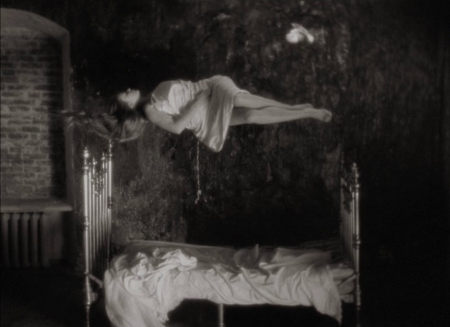
INDELIBLE IMAGE: Maria floating in a dream while a dove flutters above her.

TWO WEIRD THINGS: Apparition history lesson; levitating mom

WHAT MAKES IT WEIRD: Mirror is an intensely personal, extremely diffused meditation on the meaning of life from one of cinema’s greatest artists. Although insanely difficult, many cinephiles find it intensely moving as an accumulation of individual images that flow like finely crafted verses of surrealistic poetry.


Restoration trailer for Mirror [Zerkalo]

COMMENTS: If you enjoy being confused, jump into Mirror with no Continue reading 19*. MIRROR (1975) →

FANTASIA FILM FESTIVAL 2021: STANLEYVILLE (2021)

366 Weird Movies may earn commissions from purchases made through product links.

Recommended

DIRECTED BY: Maxwell McCabe-Lokos

FEATURING: Susanne Wuest, , Cara Ricketts, Christian Serritiello, George Tchortov, Adam Brown

PLOT: Maria is selected for a contest that promises to “probe the very essence of your mind-body articulation”—and to present the winner with a brand new SUV.

WHY IT MIGHT JOIN THE APOCRYPHA: Stanleyville‘s DIY-feel is paralleled within the narrative as candidates partake in a series of increasingly unhinged, but always ramshackle, challenges (two favorites: “Lobe of Ear” and “Diogenes Nose-Peg”). Trapping five bizarre specimens of humanity in a pavilion, McCabe-Lokos lets his unwieldy absurdist-reality-chamber-drama creak and crash as it lurches toward a gracefully symbolic climax.

COMMENTS: Until watching Stanleyville, I had never heard a ravenously pro-capitalistic screed in folk song form. This was among a number of “firsts” for me, as a pentad of archetypes squared off against one-another over the course of two days. This group is gathered together by an out-of-sync master of ceremonies named Homonculus, and “the heat heats up” as irregular time intervals count down, minds get stretched to snapping point, and bodies pile up in the food pantry.

Stanleyville‘s framework is not ground-breaking: apply pressure to some weirdos in a confined space and see what happens. Marat/Sade did it way back in the 1960s. (In fact, Stanleyville‘s setup makes me wonder if this was a stage play; and if not, when can I expect it to be?) The ingredients are fresh, however, particularly the mysteriously European (and Europeanly mysterious) Homonculus, who finds our heroine Maria sitting in a shopping mall massage chair and promises to change her life. She’s recently finished a shift at her dead-end job, left her dead-end home life, and discarded her purse, along with its contents, in a trash can. An earlier encounter at the office, witnessing a majestic, soaring bird unceremoniously thwack into her window, has left her aware that something is missing in life. She eagerly accepts Homonculus’ offer; not for the brand new habañero-orange compact SUV (a prize description mentioned often, with quiet enthusiasm), but because she feels that fate may have finally gotten up off its ass to give her some purpose.

Her contest competitors are a hyper-affable beefcake who’s neck-deep in a protein-powder Ponzi scheme; a jaded nihilist who incongruously lusts after the SUV; a hedge fund fellow sitting atop a mountain of privilege and self-loathing; and an actor/junkie/musician who never found a failure he didn’t have an excuse for. The four ancillary stereotypes lack depth (as is their wont), but they are merely background distraction (ironic, being the loudest characters in the piece), pushing Maria and her pensive wonderment to the fore.

The fourth stage of the contest (after the balloon-blowing, item sequencing, and the “write a national anthem for everybody everywhere through all time” trials) is when Stanleyville slips from ominously silly into philosophical. If I asked you, “Who is Xiphosura?”, you might not guess an entity who transmits crypticisms through a conch shell —but that’s as much as we learn about him. This is the kind of mystery found in Stanleyville; just enough is explained to keep you going, right up through the (off-screen) final event. Like Homonculus, Maxwell McCabe-Lokos may seem like he’s just making it up as he’s going along. He isn’t; he’s deliberately constructed the pathway toward new modes of mind-body articulation.

WHAT THE CRITICS SAY:

“The persistent failure, however, to conceive of connective tissue between the elements it engages with (either through some development of narrative or in formal playfulness) ensures that the thematically derivative interests and pedestrian existential angsts of Stanleyville on the whole amount to little more than nothing at all…”–Zachary Goldkind, In Review Online (festival screening)


FANTASIA FESTIVAL 2021: GIVING BIRTH TO A BUTTERFLY (2021)

366 Weird Movies may earn commissions from purchases made through product links.

Giving Birth to a Butterfly is currently available for VOD rental or purchase.

DIRECTED BY: Theodore Schaefer

FEATURING: Annie Parisse, Gus Birney, Constance Shulman

PLOT: A suburban mother and her son’s pregnant girlfriend take a surreal road trip to try to fix a financial mistake.

Still from Giving Birth to a Butterfly (2021)

COMMENTS: Diana is the matriarch of an average suburban family who’s made an embarassing mistake. Her husband Daryl hates his job and has dreams of opening a restaurant. Daughter Danielle is assisting in the school play. Son Andrew has a pregnant (though not with a butterfly) girlfriend, Marlene. Marlene’s mother is delusional, believing herself a famous but forgotten actress about to be rediscovered.

Giving Birth to a Butterfly starts out as a domestic drama, but one with a very dry sense of absurdity. Marlene reads off eye-catching headlines from a tabloid magazine: “Child Sings in the Womb,” “Dead Couple Wed at Their Funeral,” that sort of thing.  Diana’s co-workers have confusingly similar names and appearances. Characters drift into improbably poetic monologues. And Marlene’s mom is totally bonkers, a good excuse for the movie to cut loose from some of its subtlety. But although the dialogue is sometimes ridiculous, the dynamics between the characters are believable: Diana and Daryl share a low-grade, polite hostility. Dad wants to impose his dreams on the whole family. The children either try to defuse family tensions or are absorbed in their own worlds. Marlene, the reluctant interloper, wants to ingratiate herself into her boyfriend’s family.

In the beginning, at least, we learn more about Diana from her relations with others than from herself, which may be the key to her character. The first act sets up the characters. When Diana and Marlene embark on a journey, Diana slowly comes more into focus. When the pair arrive at the home of a couple of old ladies who are both spooky and wise, the movie launches into full surrealist mode, as Diana’s dreams become her reality.

Giving Birth to a Butterfly is a short movie, only 75 minutes long. But like a particularly dense poem, its brevity belies an entire world of thematic and intertextual references. The title is taken from a 1917 poem by Mina Loy (the relevant stanza of which is read over the credits) and there are references to Homer. The characters monologues are draped in metaphor. A number of motifs recur: naming people, twins, trains and journeys, damaged artworks. The dreamlike ending is not explicitly explained, but these themes give you a lot to think about. Enigma is the dominant tone. It’s an intelligent, and even poetic debut film from Theodore Schaefer, but it’s not always an engaging one. But its short runtime may make it worth a gamble if you find the idea of a Sundance-style dramedy with a surreal twist at the end appealing.

WHAT THE CRITICS SAY:

“…a dream-like experience with relatable themes, but the surrealist drama plays more like a philosophy lecture than a film. Feeling like a co-production between Kelly Reichardt and David Lynch, Schaefer’s directorial debut shows promise as a filmmaker, but the film never concretely comes together.”–Jon Medelsohn, CBR.com (festival screening)

Short promotional clip from Giving Birth to a Butterfly (2021)

FANTASIA FESTIVAL 2021: AGNES (2021)

366 Weird Movies may earn commissions from purchases made through product links.

Recommended

DIRECTED BY:

FEATURING: Molly C. Quinn, , , Hayley McFarland, Sean Gunn

PLOT: A demon possesses a sister at a conservative Carmelite nunnery, causing a crisis of faith for one of the nuns.

Still from Agnes (2021)

COMMENTS: Perhaps it would be better to go into Agnes knowing nothing about it beforehand; I won’t give major spoilers, but if you’d prefer to be surprised, stop reading now. OK, for the rest of you, all I will really say is: be prepared for a drastic tonal shift around the middle of the film. Agnes‘ most important characters will not be those you initially assume, and some questions may go unanswered. What appears to be a rambunctious exorcism spoof evolves into something far more thoughtful. Agnes gets crazier and crazier, then gets less and less crazy, until it ends on a note of pure emotional earnestness. Although it flows from a single incident, the film is split into two parts; this procedure will frustrate some. But I found looking at the connections between the two halves, and thinking of reasons why the material might be handled with such stylistic polarity, to be a fascinating exercise.

With that said, I think it’s safer to describe the film’s “fun” first half, and leave the viewer to experience the more serious back nine on their own—except to advise you to stick with it all the way to the final scene. The first thing to note is that, although it plays its humor pretty close to the vest, Agnes is never really a scary demonic possession movie; it’s a comic take on the genre. The Church here is so riddled with clichés—hints of pedophilia, scheming monsignors concerned with public relations, an institution embarrassed by its own exorcism rites, a crusty old priest undergoing a crisis of faith contrasted with a pious young initiate, a sexually repressed nunnery—-that Agnes could almost function as a satire of movies about Catholicism. Then there are the plentiful campy bits sprinkled throughout: too-thick horror music cues at inappropriate times. An action-movie style montage of determined priests and nuns marching to exorcism. A nun named Sister Honey (!) It all seems to be heading into territory with a renegade cowboy priest who comes complete with a chain-smoking groupie in a beehive hairdo and too much bronzer. And then… well, I leave it for you to discover the rest for yourself.

Agnes is so unique, I can’t really decide if it’s firmly within the weird genre, or not. The film’s hemispheres are aimed at different audiences: the first half at a savvy genre crowd, the second at the arthouse set. It will probably appeal most to those with a religious mindset. I don’t mean people of any particular faith—I believe atheists can get as much out of it as devout Christians—but people who are concerned with and interested in the questions that religion seeks to address, questions about meaning and suffering. Seen in that light, the movie’s movement from ironic caricature to clear-headed sincerity feels like a legitimate spiritual journey. Agnes is justified by faith.

Giles Edwards adds: Agnes makes a promise to go full Ken Russell on the viewer, as Greg remarks. Of particular note is the rogue exorcist, one of those mystifying characters that I hope is based on a real-life person, but is more likely a bold combination of the Dude from The Big Lebowski and Bobby Peru from Wild at Heart. The sleek cinematographical maneuverings of the first act could have built into something wonderfully nuthouse, but the thrill of exploitation gets cut off at the bite of the face and an almost mystical exhalation of smoke. The second act—very nearly its own second movie—is slowly paced, and dwells on kitchen-table dramatic musings of identity, financial solvency, and relationship power dynamics. The bombast of the foundation kept me on the edge of a chuckle throughout, with its repressed mother superior, sketchy-swain mentor priest, and the excommunicated demon specialist; the melodrama built on that foundation wasn’t nearly as entertaining in my view, but it was much more respectable as a cinematic outing. It’s as if the director had designed a bondage fun-house basement and felt oddly compelled to hide it from the world with a factory line split-level ranch above ground level.

WHAT THE CRITICS SAY:

“…as specific as it is almost uncategorizable… while the first half of Agnes takes place in the hermetic, often bizarrely humorous world of the convent, it’s the second half that gives the film its resonance.”–Matt Lynch, In Review Online (festival screening)