Tag Archives: Comedy

LIST CANDIDATE: PLAY TIME (1967)

Playtime has been promoted onto the List of the 366 Best Weird Movies of All Time. Please read the Certified Weird entry. Comments are closed on this post.

DIRECTED BY: Jacques Tati

FEATURING: Jacques Tati, Barbara Dennek

PLOT: Monsieur Hulot gets lost on his way to an appointment and wanders around a nearly unrecognizable, technologically transformed Paris.

Still from Play Time (1967)

WHY IT SHOULD MAKE THE LIST: Play Time is about the alienating, isolating influence technology has on human beings. It’s not the standard elements of plot, narrative, character development or dialogue that pulls an equally alienated audience into this unfurling drama, but the careful choreography of hapless humans navigating a barely recognizable hypermodern Paris.  Play Time is sort of an anti-Brazil.

COMMENTS: Do you remember when watching “Tom and Jerry” on television, there would occasionally be a cartoon showing off a humorous version of cars or homes of the future? There would be no main character, just a narrator describing some startling innovation, and then there would be a sight-gag or funny noise to produce a laugh, and it would move on to the next futuristic comedic set-piece. Play Time is a feature film based on a very similar premise, with two differences:  there is a strong undertone of humanity and history struggling against technology, and there is no narrator to help guide you from one farcical gag to another.

The main characters are French everyman M. Hulot (Tati) and American tourist Barbara, who wander through the modern marvel that Paris has become and are continually obstructed by the technology that is supposed to make their lives easier. Hulot spends a long scene searching haplessly through a (then bizarre-looking but now surprisingly familiar) cube farm to find a businessman with whom he has an appointment. Barbara struggles to take a picture of something uniquely French, not just because pedestrians keep walking between her and the florist she fancies, but also because huge steel and glass buildings have almost completely obscured romantic Paris (the same city Cole Porter lovingly described in 1953, a mere six years before this film was released). With little meaningful dialogue and a tendency to abandon characters to their fates, it is difficult for the audience to make a coherent narrative out of the stark, gleaming, geometric scenes that linger slowly and deliberately on the screen. Particularly during Play Time‘s first half, the series of clever slapstick events that pepper the film supply the only human connection. They allow us to sympathize not only with Hulot and Barbara, but also with innocent cushions that blurt obscenely when sat upon and a broiled fish that is repeatedly heated, spiced, and basted, never to be served.

If discomfort and silly humor were the only features of Play Time, the result would be just like those “Tom and Jerry” cartoons, only bleaker and more disturbing. Fortunately, Tati allows humanity to win over technology, or at least stand on even footing. The citizens of super-Paris do eventually begin to connect with each other. Some of these connections are obvious: Hulot does eventually find his businessman, but he also bumps into several friends from the army, and he also meets Barbara. Some of the connections, though, are subtle, surprising, and hilarious, as when two families engrossed in programs showing on the television sets fixed to the wall dividing their apartments appear to be reacting to the events in the other family’s home. The movie culminates in a riotous party scene—possibly the best I’ve ever watched—at a restaurant slowly falling apart around the revelers due to shoddy construction. Here, technology does its absolute best to ruin the partygoers’ night, but they hardly notice; or if they do, they improvise on the destruction to the advantage of a good time. Meanwhile, a number of seemingly forgotten incidental characters from earlier in the movie—an obnoxious American, a portly sloven, a precise English businessman—come back and become much more alive and interesting amid the chaos. The movie’s weirdness never goes away, but it softens until it gently lands at the conclusion of 24 hours of hectic hypermodernity.

WHAT THE CRITICS SAY:

“Hulot on the loose in a surreal, scarcely recognisable Paris… a hallucinatory comic vision on the verge of abstraction.”–Time Out Film Guide

107. HEDWIG AND THE ANGRY INCH (2001)

“I fear that in the speech which I am about to make, instead of others laughing with me, which is to the manner born of our muse and would be all the better, I shall only be laughed at by them… the original human nature was not like the present, but different. The sexes were not two as they are now, but originally three in number; there was man, woman, and the union of the two, having a name corresponding to this double nature, which had once a real existence, but is now lost, and the word ‘Androgynous’ is only preserved as a term of reproach.”–Aristophanes in Plato’s “Symposium”

Must See

DIRECTED BY: John Cameron Mitchell

FEATURING: John Cameron Mitchell, Michael Pitt, Miriam Shor, Andrea Martin

PLOT: We first meet Hedwig as she and her band the Angry Inch are performing at a seafood buffet in Kansas City. In flashback, and in music videos, we learn that she was born a boy named Hans in East Berlin, and underwent a (botched) sex change operation so she could marry an American G.I. and leave for the West. Now, she and her band are shadowing the cross-country tour of Tommy Gnosis, Hedwig’s ex-boyfriend turned arena rock star, whom she accuses of having stolen her songs.

Still from Hedwig and the Angry Inch (2001)

BACKGROUND:

  • John Cameron Mitchell, then a professional stage actor, debuted the character of Hedwig in 1994 at a drag show at a punk nightclub in New York City. With the help of songwriter Stephen Trask, he built an off-Broadway play—originally staged in the ballroom of a fleabag hotel in Manhattan’s meat packing district—around the androgynous chanteuse.
  • In the early drafts of the play Tommy was the main character and Hedwig a supporting player.
  • Mitchell’s father was U.S. Army Major General John Mitchell, and the younger Mitchell spent much of his childhood in Berlin where his father was stationed during the later part of the Cold War.

INDELIBLE IMAGE: Is it Hedwig’s androgynous Aryan visage, half-hidden under a pound of glittery makeup and a sculpted blond wig big enough to double the diameter of her head? Or is it the animated retelling of Aristophanes fable in “The Origin of Love,” with a squiggly line drawing of Zeus cutting the legs off whales? Fortunately, thanks to split-screen technology, we don’t have to choose; we can get Hedwig’s glacial glam mug on the left and a severed half-moon face yearning to swallow her up on the right together in one still.

WHAT MAKES IT WEIRD:  Well, it does feature a rock star who’s the victim of a botched sex


Original trailer for Hedwig and the Angry Inch

change searching for love and vengeance and telling her life story through song while playing on a tour of discount seafood restaurants with her band of Eastern European refugee musicians, which is a plot you don’t see everyday. If that’s not enough to satisfy your weird desires, however, stick with it until the end, when it drifts into a dreamlike series of music videos that see characters swapping sexes and changing into other characters.

COMMENTS: He may not be widely acknowledged as the West’s weirdest philosopher, but Continue reading 107. HEDWIG AND THE ANGRY INCH (2001) →

CAPSULE: SHOCK TREATMENT (1981)

DIRECTED BY:

FEATURING: , Cliff De Young, Barry Humphries, , Charles Gray, Ruby Wax,

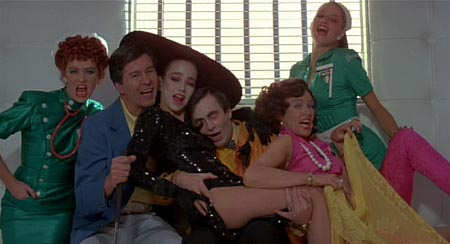
PLOT: A young married couple end up in a town that’s actually a giant television network; Janet is groomed as a celebrity, while Brad becomes a mental patient in a hospital show.

Still from Shock Treatment (1981)

WHY IT WON’T MAKE THE LIST: Shock Treatment is a cult film even among the tiny subset of cult film enthusiasts. This “sequel” was rejected as a confounding disappointment by most fans of The Rocky Horror Picture Show, but is still vehemently defended by a segment of that fan base. It’s a peculiar exercise in wacky musical satire, for sure, but it lacks the kind of résumé necessary to place it among the most significantly weird movies of all time.

COMMENTS: What would you get if you took The Rocky Horror Picture Show and stripped out Tim Curry‘s domineering performance as the mad scientist transvestite dominatrix, leaving behind only the theater-rock musical numbers and campy supporting players? (On the off-chance you don’t see where I’m going yet, the answer is Shock Treatment). Whereas Rocky Horror was a theatrical flop that organically grew into a cult movie, Shock Treatment was pitched as a deliberate cult movie, but became an instant flop. This delayed follow-up is full of amped-up ideas and energy, but it comes off as cocksure; it’s so convinced its madness is entrancing that it forgets to ground us in its quirky universe. The (confusingly executed) idea is that the entire town of Denton, U.S.A. is a TV studio, with the audience as regular citizens, the stars and staff as sorts of metro officials, and the sponsors as big-money villains manipulating studio politics behind the scenes. The movie throws so many colorful eccentrics at us that every character turns into a minor character, even the leads. Janet (not necessarily the Janet Susan Sarandon played in the previous movie) and Brad (again, a character with the same name but little connection to the original) enter the town’s audience, for unclear reasons, and wind up on a marriage counseling show run by a blind Austrian in an orange thrift-store tuxedo. He hands Brad off to a brother/sister pair of psychiatrists (writer Richard O’Brien, wearing uncomfortable- Continue reading CAPSULE: SHOCK TREATMENT (1981) →

LIST CANDIDATE: SCHIZOPOLIS (1996)

Schizopolis has been promoted onto the List of the 366 Weirdest Movies Ever Made. Comments on this post are closed. Please visit Schizopolis‘ official Certified Weird entry.

DIRECTED BY: Steven Soderbergh

FEATURING: Steven Soderbergh, Betsy Brantley, David Jensen, Mike Malone

PLOT: A series of absurdist sketches and nonsense dialogues linked together by a thin plot

Still from Shcizopolis (1996)

about an office worker struggling with an assignment to write a major speech for a cultlike motivational speaker obviously based on L. Ron Hubbard.

WHY IT MIGHT MAKE THE LIST: Hilarious witticism characterizing film’s oddness. Cautious disclaimer suggesting uneven satire undermines enjoyability, but granting nobility of purpose and peculiar appeal. Self-aggrandizing non sequitur.

COMMENTS: After Schizopolis bombed at Cannes, writer/director/star Steven Soderbergh appended a prologue where he stood on a stage and introduced the film. “In the event that you find certain sequences or ideas confusing, please bear in mind that this is your fault, not ours,” he advised. “You will need to see the picture again and again until you understand everything.” We are then thrown into the story of Fletcher Munson, a chronic office masturbator suffering from writer’s block as he attempts to pen a speech for “Eventualism” founder T. Azimuth Switters. A third of the way through the movie he meets (and sort of becomes) his exact double, an amorous dentist named Korchek who happens to be having an affair with Munson’s wife, but Korchek (or is it Munson inhabiting Korchek’s body?) falls in love with Munson’s wife’s doppelgänger, Attractive Woman #2. Then, in the movies final act we see the same scenes replayed from the perspective of Mrs. Munson. Interspersed with all of this are bits involving a pantsless old man running away from a pair of orderlies, news reports suggesting Rhode Island has been sold to a consortium of investors who want to turn it into a shopping mall, and a shot of a sign posted on a tree reading “idea missing.” Oh, and there’s also an exterminator who speaks gibberish and seduces local housewives. What’s there to possibly be confused about? Sorerbergh, who started his career with Sex, Lies and Videotape, the movie that launched the indie filmmaking revolution, made Schziopolis as a palette-cleanser after his big budget flop Underneath left a bad taste in his mouth (a fan cleverly described this as Soderbergh’s “second first film“). Working with his friends on a budget of only $250,000, it’s a loose, breezy, seemingly Continue reading LIST CANDIDATE: SCHIZOPOLIS (1996) →