
Charlie Chaplin‘s The Circus (1928) has long been considered something akin to Beethoven’s 4th Symphony, which composer Robert Schumann referred to as “a Greek maiden between two Norse gods (the Eroica and the Fifth).” The Circus is the the maiden between two certifiable Chaplin masterpieces: The Gold Rush (1925) and City Lights (1931). Yet, Beethoven’s Fourth, seen without Schumann’s assessing lens, has, on occasion, proven to be a maiden unleashed, as in Carlos Kleiber’s live, mercurial Munich version (on DVD) and Herbert Von Karajan’s devastatingly sensuous 1963 performance with the BPO.
Like Beethoven’s 4th, The Circus is an underrated opus. Seen without the preconceived assessment of historians, it is an interesting gem. Oddly, it is the one film of Chaplin’s that was recognized for a “special” Academy Award. Despite that, it is an infrequently revived (and discussed) film.
The filmmaker himself did not help the cause for The Circus. Chaplin’s autobiography is interesting primarily as a career record. Private, painful details are omitted. Quite tellingly, Chaplin never once mentioned this film in that autobiography. Clearly, he avoided it because this film was made while he was going through a highly embarrassing divorce from one of his child brides (Lita Grey) at the time. Intimate details from Chaplin’s sex life were exposed to the public. According to Kenneth Anger‘s “Hollywood Babylon,” Chaplin went through such an ordeal that during the divorce trial, the star’s hair literally turned prematurely white.
Often, assessment of Chaplin’s films include the biographical. A good example of this is Roger Ebert’s review of The Circus. Ebert takes the often-traveled road of comparing Chaplin to Buster Keaton:
Chaplin was a considerable artist, brave and gifted, but I am in a minority in placing him second to Keaton among the silent clowns. My reasons for that are admittedly impulsive: I sense Keaton was the better man. Chaplin was so famous, so rich, so powerful when so young that there is a kind of conceit in the Tramp, a reverse noblesse oblige. Yes, he had a miserable childhood, and in his films, he often plays the friend of waifs, but there’s an air of back-patting about it. The Buster Keaton character has his feet on the ground. He would be embarrassed to parade his goodness. He uses ingenuity rather than divinity. Chaplin’s untidy love life suggests he felt he deserved whomever he wanted; Keaton in private life seems to have been melancholic because of alcoholism, but a decent enough sort with women.
 The problem with Ebert’s assessment of Chaplin is his objection to Chaplin’s enormous success and his bullet point details of Chaplin’s post-stardom biography. This view reduces Chaplin’s films to the anecdotal. While remnants of personal history cannot be completely excluded in approaching Chaplin’s art, his films, inevitably, transcend biography.
To be fair, Ebert is certainly correct in his comparison of the contrasting silent clown screen personas; Keaton’s Stone Face never asked for audience sympathy in the obvious way that Chaplin’s Tramp did. However, nor can Keaton identify with the everyman on Chaplin’s level. The Tramp’s poverty, which has nothing to do with the success of the actor playing the character, imbues him with an intimate personality that Keaton lacked. Out of all Chaplin’s contemporaries, only Harry Langdon emerged with a comparable persona.
Ebert also makes a comparative notation regarding the amorous nature of the two clowns. To me, both Chaplin and Keaton are sexless, at least when filtered through a contemporary perspective. Chaplin’s celibacy is that of the adolescent, as a people’s priest. Keaton’s character, while more intelligent and ambitious, is too phlegmatic for us to imagine him as anything Continue reading CHAPLIN’S THE CIRCUS (1928)
 The world of Paul Beaumont comes crashing down when Regnard presents Beaumont’s work, as his own, to the Academy. Beaumont tries, in vain, to convince the Academy of the theft, but they take the side of the affluent Regnard as opposed to the unknown, poverty stricken Beaumont. Beaumont is belittled by his patron’s betrayal, by the mocking laughter of the academy, by the discovery of his wife’s infidelity, and, finally, by Regnard’s humiliating slap to his face. It is a slap which Beaumont now obsessively echoes in repetition every night. On the
  Alex de la Iglesia bolsters his already fine cult film résumé (Acción Mutante, The Day of the Beast) with this b-movie styled action/melodrama that’s also an allegory for the Spanish Civil War. The movie’s best sequence is the prologue, where the Republican army conscripts a circus troupe into emergency action (“a clown with a machete—you’ll scare the s**t out of them”!) Flash forward to 1973, when the embittered son of one of the Shanghaied carnies embarks upon a career as a “Sad Clown,” but is immediately smitten by a beautiful trapeze artist. Unfortunately for him, the acrobat Natalia is the personal property of the “Happy Clown,” a psychotic, drunken woman-beater who just happens to be great with kids. The two mountebanks’ working relationship quickly turns sour as they take turns beating the greasepaint off each other in a brutal rivalry that eventually leaves both of them mutilated and insane. Which mad harlequin will Natalia choose? The Spanish Civil War angle is simplistic and neither adds nor subtracts from the narrative, which starts as a tawdry carnival melodrama and morphs into an action movie with a high-flying, clown-mauling showdown atop a giant cross. A few Sad Clown dream sequences–he keeps seeing his dead father and archival footage of Spanish pop singer Raphael singing a vintage ballad in clownface—add nominal weirdness, but these touches aren’t pervasive enough to raise the film above the level of aggressively offbeat. Still, there are those who are going to want to check out any film where an insane jester uses lye, an iron, and some clerical vestments to improvise his own clown costume, then steals a cache of automatic weapons and walks the streets of Madrid armed to the teeth with homicidal gleam in his eye. One final note: my movie-going companion was disappointed in the lack of variety in the clown-on-clown violence; he had been hoping to see a wide variety of Bozos brutalizing each other in an all-out melee. So be forewarned—if you consider two killer clowns too few, this Circus is not for you.
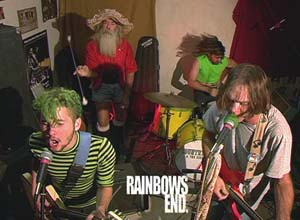 If The Last Circus is edgy, Rainbows End occupies the opposite end of the offbeat spectrum—it’s whimsical. Ostensibly a documentary about six east Texas eccentrics on a road trip to California to pursue a motley assortment of dreams, it’s also one of the funniest movies yours truly has had the privilege of checking out in 2011. It’s the characters who drive the bus in this episodic feature—and in this case that bus needs a push start, leaks radiator fluid, and at times is literally held together with duct tape.
