
A man’s food addiction becomes his undoing. Decades later, Hunger‘s message is as relevant as ever. This cartoon by Peter Foldès was nominated for an Oscar in the “Best Animated Short” category. A mild warning: the film does contain brief, artistic nudity.
Tag Archives: Canadian
CAPSULE: PONTYPOOL (2008)
DIRECTED BY: Bruce McDonald
FEATURING: Stephen McHattie, Lisa Houle, Georgina Reilly
PLOT: Zombies who aren’t really zombies wreak havoc upon the peaceful (i.e. dull) Canadian town of Pontypool. We’re taken through the terror through the perspective of a local FM Zoo Crew DJ and his associates as more and more reports come into the station describing unnaturally violent tendencies in a growing minority of residents possibly infected with some kind of virus.

WHY IT WON’T MAKE THE LIST: Pontypool is merely a zombie movie with a twist. While it’s an admittedly interesting twist, I can’t help but feel that there’s not really a weird sensibility behind this project. It’s original at times, strikingly original, and the writing is crisper than this little project merited, so it’s definitely a “good ‘un,” but it doesn’t stand out as freaky as much as it does slightly ahead of the curve in the horror genre.
COMMENTS: Pontypool exists at that strange nether region between genius and camp that had me at “Sunshine Chopper.” It’s a film that’s joyously in love with itself and the creativity that spawned it. What’s so special about it? Well, besides the ingenious FM radio motif that anyone who’s ever been stuck in a commute will appreciate, it’s a film about the power of the spoken word. Here, it’s English. You see, what’s affecting these violent people is what can best be described as a virus affecting our collective language. The people infected aren’t trying to kill other people as much as they are wanting to bite the words out of someone else’s mouth. They’re stricken with a severe communications breakdown, and the mental anguish this inflicts upon said victim causes them to lash out violently. It’s a really wicked concept, and I’m really quite impressed with the wit and cleverness involved with such an idea. In the end, it’s really just a zombie movie, and it certainly has its limitations as far as the execution goes. The soundtrack by Claude Foisy is weak and rather placid, the camerawork is hardly what anyone would call dynamic, and the actors are pretty green with the notable exception of the always-reliable Stephen McHattie. But it’s definitely worth a shot if you’re a fan of the zombie film; as far as that niche goes, this blows about 65% of its peers out of the water and onto the shore for them to writhe uncontrollably, as is a zombie’s wont. But as a weird movie, it has a long way to go in the grand scheme of things.
WHAT THE CRITICS SAY:
39. COWARDS BEND THE KNEE, OR, THE BLUE HANDS (2003)
“I only include things that are psychologically true in my stories, no matter how bizarre, stupid, silly or gratuitous the episodes in them may seem… I can only hope that the spectacle of me trying to inflict pain on hard-to-reach places on my own body is amusing to some people.”–Guy Maddin


DIRECTED BY: Guy Maddin
FEATURING: Darcy Fehr, Melissa Dionisio, Amy Stewart
PLOT: Amateur hockey player Guy Maddin falls in love with the proprietor’s daughter when he takes his current girlfriend to a hair salon/brothel for an abortion. The daughter, Meta, will not give herself to a man until her father’s death at the hands of her mother is avenged. To accomplish this, she wants to transplant her dead father’s hands onto Guy, so that it will be her father’s hands that strangle her mother.

BACKGROUND:
- Commissioned by the Power Plant Art Gallery of Toronto.
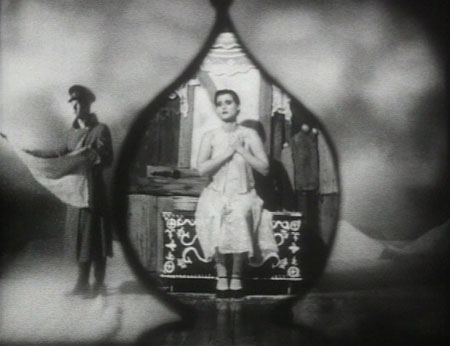
- On its debut at the International Film Festival in Rotterdam, viewers watched the ten chapters of Cowards Bend the Knee through ten peepholes in a wall. Spectators had to kneel to put the peepholes at eye level.
- Maddin issued a companion book to Cowards Bend the Knee (now a collector’s item) containing an expanded screenplay of the film and an interview with Maddin where he discusses Coward‘s autobiographical elements and gives his personal interpretations of the film.
- Autobiographical elements abound in Cowards Bend the Knee. Maddin’s real life Aunt Lil owned a beauty parlor similar to the one that appears in the film. Maddin’s father coached the Winnipeg Maroons, a pre-NHL professional hockey team; the actual Allan Cup championship ring his father won appears in the film.
- Maddin’s mother, Herdis, a non-actress, played Meta’s grandmother in the film.
INDELIBLE IMAGE: As Veronica lies on the operating table undergoing a clandestine abortion, the blood streaming between her legs forms itself into a Canadian maple leaf.
WHAT MAKES IT WEIRD: Cowards features Maddin’s trademark in-your-face style (a mix of silent film artifacts and glitchy hypermodern editing); crazed, dreamlike narrative (incorporating hockey matches, beauty salons, murder, infidelity, ghosts, and a hand transplant); and a wildly veering, yet somehow coherent tone that moves from melodrama to slapstick to absurdist vintage pornography to Greek tragedy in the space of a few frames. If that’s not enough, there’s the fact that the entire story is observed by a scientist, who witnesses it being played out while looking through a microscope at a dab of semen on a slide. Weird enough for you?
[wposflv src=http://366weirdmovies.com/wp-content/uploads/2009/10/Cowards-Bend-the-Knee.flv width=480 height=360 previewimage=http://366weirdmovies.com/wp-content/uploads/2009/10/cowards-bend-the-knee-still.jpg title=”Cowards Bend the Knee clip”]
Clip from Cowards Bend the Knee
COMMENTS: Maddin’s Cowards Bend the Knee is a dream, and like all dreams it is at the Continue reading 39. COWARDS BEND THE KNEE, OR, THE BLUE HANDS (2003)
18. NAKED LUNCH (1991)
“It’s impossible to make a movie out of ‘Naked Lunch.’ A literal translation just wouldn’t work. It would cost $400 million to make and would be banned in every country of the world.” –David Cronenberg
DIRECTED BY: David Cronenberg
FEATURING: Peter Weller, Judy Davis, Julian Sands
PLOT: Bill Lee is a writer/exterminator in New York City whose wife begins mainlining the bug powder he uses to kill roaches, and convinces him to try it as well. He becomes addicted to the powder, and one night shoots his wife dead while playing “William Tell.” Lee goes on the lam and lands in Interzone, an exotic free zone reminiscent of Tangier or Casablanca (but which may exist only in his mind), where he begins taking ever more powerful drugs and typing out “reports” partially dictated to him by his living, insectoid typewriter.

BACKGROUND:
- William S. Burroughs’s original novel Naked Lunch was selected as one of the 100 best English language novels written after 1923 by Time magazine.
- The novel was held not to be obscene by the Massachusetts Supreme Court in 1966. This was the final obscenity prosecution of a literary work in the United States; there would be no subsequent censorship of the written word (standing alone).
- Several directors had considered filming the novel before David Cronenberg got the project. Avant-garde director Anthony Balch wanted to adapt it as a musical (with Burroughs’s blessing), and actually got as far as storyboarding the project and getting a commitment from Mick Jagger (who later backed out) to star. Among others briefly interested in adapting the novel in some form were Terry Southern, John Huston, Frank Zappa, and Terry Gilliam.
- Because the novel was essentially a plotless series of hallucinatory vignettes (what Burroughs called “routines’), David Cronenberg chose to make the movie a thinly veiled tale about Burroughs’s writing of the novel, incorporating only a few of the actual characters and incidents from the book. Actors in the film portray real-life writers and Burroughs associates Jack Kerouac, Allen Ginsberg, and Paul and Jane Bowles.
- The episode in the film where Lee accidentally shoots his wife while performing the “William Tell routine” is taken from Burroughs real life: he actually shot his common law wife while performing a similar trick in a Mexican bar. Burroughs felt tremendous guilt through his life for the accident and has said “I would have never become a writer but for Joan’s death.”
- Naked Lunch won seven awards at the Genie Awards (the Canadian equivalent of the Oscars), including Best Movie and Best Director.
- Producer Jeremy Thomas has somewhat specialized in bringing weird and unusual fare to the largest possible audience, producing not only Naked Lunch but also Cronenberg’s Crash (1996) and Tideland (2005).
- Following a definite theme for the year, Judy Davis also played an author’s muse and lover in another surrealistic 1991 movie about a tortured writer, Barton Fink.
INDELIBLE IMAGE: Clark Nova, Lee’s territorial, talking typewriter, who alternately guides and torments the writer. He’s a beetle who has somehow evolved a QWERTY keyboard as an organ. When he speaks, he lifts his wings to reveal a sphincter through which he dictates his directives.
WHAT MAKES IT WEIRD: It begins with an exterminator who does his rounds wearing a three piece suit and fedora. His philosophy is to “exterminate all rational thought.” His wife steals his insecticide and injects it into her breast to get high, and gets him hooked on the bug power, too. A pair of cops question him on suspicion of possessing dangerous narcotics, and leave him alone in the interrogation room with a huge talking “caseworker” bug who explains that his wife is an agent of Interzone, Incorporated, and is not even human. And this is just the setup, before the film turns really weird.
Original trailer for Naked Lunch
COMMENTS: Make no mistake: Naked Lunch is clearly David Cronenberg’s movie, not Continue reading 18. NAKED LUNCH (1991)
10. ARCHANGEL (1990)
“And we are here as on a darkling plain
Swept with confused alarms of struggle and flight,
Where ignorant armies clash by night.”
—Matthew Arnold, “Dover Beach” (quote originally intended to introduce Archangel)

DIRECTED BY: Guy Maddin
FEATURING: Kyle McCulloch, Kathy Marykuca
PLOT: In 1919, one-legged Canadian airman Lt. John Boles finds his way to the Russian port of Archangel in the endless night of Arctic winter. There, he meets Veronkha, whom he believes to be the reincarnation of Iris, his dead love. Veronkha has problems of her own, in the form of an amnesiac husband who wakes up every day believing this is the day they are to be wed, but Boles tries to woo her nevertheless as Archangel’s ragtag militia battles the Germans and the Bolsheviks without realizing that both World War I and the Russian Revolution are over.
BACKGROUND:
- The city of Archangel was the port of entry for Allied soldiers during World War I; therefore, soldiers from America, Canada, and the European allies might very well have been found gathered there (although probably not East Indians and Congolese, as depicted in the film). Many Allied soldiers were sent to Russia, partially to help assist the Imperial (White) Russians against the Bolshevik Communist rebels (Reds).
- Some reports say that the version presented on the “Guy Maddin Collection” DVD is a different cut from the theatrical and original VHS version, with tinting and intertitles added. I haven’t been able to confirm whether differences exist.
INDELIBLE IMAGE: As his dying act, a lifelong coward strangles a bestial Bolshevik with a length of his own intestine (which is obviously a sausage link).
WHAT MAKES IT WEIRD: The tale of an obsessive, grieving soldier who thinks he’s found the reincarnation of his lost love in a benighted Russian city where the citizens continue to fight a war that is over would be weird enough if told straight. Director Guy Maddin exaggerates the already dreamlike quality of this tale by clothing it in the archaic period dress of an early sound film, complete with intertitles describing the action, dubbed voices that are occasionally slightly out of sync, and casually disorienting jumps/glitches in the film. He pushes this inherently confusing story of terminally confused characters further into strange realms with deliberately surreal elements, such as women warriors going to the front dressed in elegant evening headwear, and even odder sights.
Short clip from Archangel (French subtitles not in original)
COMMENTS: The city of Archangel seems the perfect place to dream. Isolated from the Continue reading 10. ARCHANGEL (1990)