Tag Archives: Black and White

SHORT: VINCENT (1982)

Recommended

DIRECTED BY: Tim Burton

FEATURING: Vincent Price

PLOT: A seven year old boy wishes he could be just like the Vincent Price he sees in old movies.

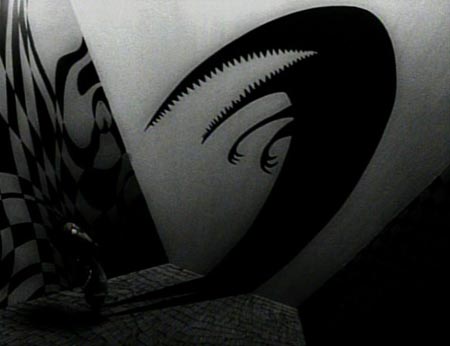
Still from Vincent (1982)

WHAT MAKES IT WEIRD:  It’s not quite weird; more mildly macabre.  But it sure is cool.

COMMENTSVincent is a 5 minute poem, narrated by the mellifluous Vincent Price, about a morbid boy (also named Vincent) obsessed with emulating the horror icon’s tormented screen persona.  It’s told in a singsong, storybook cadence and given a superlative reading by Price (who was so flattered by the tribute that he proclaimed it a greater honor than a star on Hollywood Boulevard).  There are some specific references to Price’s work for the actor’s fans, though the short prefers to evoke their general atmosphere than to cite specific movies. Young Vincent’s daydreams involve dipping his aunt in wax, turning his dog into a zombie, and slowly being driven mad by his guilt over his unspeakable crimes.  A representative stanza: “Such horrible news he could not survive/For his beautiful wife had been buried alive!/He dug out her grave to make sure she was dead/Unaware that her grave was his mother’s flower bed.”  Vincent is visually impressive, deliberately shot in luminous black and white and drawing on the gloomy Gothic style of the old Universal horror movies with a powerful dose of German Expressionism.  (Burton denied being directly influenced by The Cabinet of Dr. Caligari, but he’s the only one who doesn’t notice the similarity to the silent psychological horror classic in the geometrically warped sets).  The look and childishly ghastly tone bring to mind a lighter version of the macabre black and white lithographs of Edward Gorey (who once created a primer where each letter illustrates the death of a tot).  Burton’s visual sensibility is already fully formed here, and the elements of his classic style—his comic, cathartic synthesis of fresh childhood innocence and the must of the grave—are already in evidence.  In fact, there may be no better example in the director’s entire body of work of than this crisp five minute exhibition of his talent for mixing the chuckle with the shudder.

Disney has traditionally made Vincent and Burton’s other pre-fame short Frankenweenie as extras on all their editions of The Nightmare Before Christmas.  The film is also included on the anthology Cinema 16: American Short Films (buy) alongside  Maya Deren‘s “Meshes of the Afternoon” and works by Andy Warhol, Todd Solondz and Gus Van Sant, among others.

WHAT THE CRITICS SAY:

“…a pastiche of styles lifted from the writings of Dr. Seuss and Edgar Allen Poe, and a range of movies from B-horror films, German expressionist works and the films of Vincent Price.”–Michael Frierson, Animation World Magazine (DVD)

[(This movie was nominated for review by reader “Maxwell Stewart.” Suggest a weird movie of your own here.)]

HELL’S HINGES (1916)

To many contemporary viewers the idea of a silent western is as bizarre as a silent musical or silent Shakespeare.  To counteract that, one could easily point to the popcorn pleasures of many a Tom Mix western, such as The Great K & A Train Robbery (1926) or Just Tony (1922).  However, dipping back a mere ten years before Great K & A we find William S. Hart’s Hell’s Hinges (1916) to prove just how bizarre the silent western could get.

Hart was the direct opposite of Mix, yet both actors had an authentic western past.  Where Mix’s film were flashy, over the top, stunt-oriented, dime-store pulp western family fare, Hart offered up a gritty, dusty realism.  Yet, Hart’s “realism” was also mixed (often uncomfortably) with a heavy-laden, dated pathos that could compete with Charlie Chaplin at his soggiest (Limelight).

“Hell’s Hinges” is, perhaps, the quintessential example of  one of these uncomfortably strange William S. Hart hybrids mixing sentimentality with violence.  Both qualities are presented with all the subtlety of a pair of brass knuckles wrapped in a tear-drenched handkerchief.

Hart , who co-directed with Charles Swickard, plays Blaze Tracey, the meanest hombre in the town of Hell’s Hinges, a rowdy town similar to Chaplin’s “Easy Street.”  The titles amusingly describe Hell’s Hinges as a “gun-fighting, man-killing, devil’s den of iniquity.” Hart’s Blaze lords over Hell’s Hinges, much like Eric Campbell lorded over Easy Street.  Blaze has vowed that neither law nor religion shall ever come to Hell’s Hinges. Enter, on cue, Reverend Robert (Jack Standing) and his pure as the driven snow sister, Faith (Clara Williams), who have been assigned to pastor over the local church. Hart’s partner in crime, the beautifully named Silk Miller (Alfred Hollingsworth), informs Blaze that the new preacher has arrived.  Blaze departs the saloon to “welcome” the new intruder.”

Still from Hell's Hinges (1916)Greeting the town, Rev. Robert beams a big smile (that smile must have been excruciatingly difficult, and painful, to maintain), but the good reverend clearly becomes  nervous as he discovers what he and Faith are up against.

Blaze is ready, willing and able to deliver an old west comeuppance to the whippersnapper preacher—that is, until he spots Faith in her Sunday bonnet. Suddenly, upon seeing this lovely maiden, Continue reading HELL’S HINGES (1916)

63. BRANDED TO KILL (1967)

Koroshi No Rakuin

“Showing these incomprehensible and thus bad films would disgrace the company.” –Nikkatsu studio representative’s explanation for refusing to authorize a 1968 Seijun Suzuki retrospective, immediately after the studio fired the director (presumably for making Branded to Kill)

Must See

DIRECTED BY:

FEATURING: , Annu Mari, Kôji Nanbara, Mariko Ogawa

PLOT: As the film begins, Hanada, an assassin with a yen for the smell of fresh boiled rice, is the Organization’s #3 killer.  He falls in love with a beautiful but suicidal woman whom he meets on a job, then botches a hit when a butterfly lands on his gun barrel and throws off his aim.  By slaying an innocent bystander by mistake, Hanada inadvertently breaks his killer’s code and becomes a wanted man, and finds himself hunted down by none other than the Organization’s mysterious #1 killer.

Still from Branded to Kill (1967)

BACKGROUND:

  • The story of Branded to Kill is a notorious example of film studio’s shortsightedness in valuing conformity over artistic innovation.  Suzuki was hired as a journeyman action director for the Nikkatsu studio, directing moderately successful B-movies in the yakuza (gangster) genre.  As the director’s career developed he gradually began adding absurd and surreal elements to his pictures; the studio chastised Suzuki for his artistic tendencies and tried to reign in his flamboyance by cutting his budgets.  Heedless of Nikkatsu’s demands, Suzuki delivered the phantasmagorical Tokyo Drifter (1966); as punishment, he was restricted to making black and white films.  Called in to salvage a faltering production called Branded to Kill, Suzuki rewrote the script to create his most surreal movie to date.  Nikkastsu responded by firing Suzuki on the grounds that the films he produced for them were “incomprehensible.”  Suzuki sued the company for breach of contract and eventually settled out of court, but was blacklisted by the Japanese film industry and did not make another movie for ten years.
  • Nikkatsu and Suzuki later made up.  Suzuki directed Pistol Opera, a loose sequel to Branded to Kill, for a revamped Nikkatsu company in 2001.
  • The script is credited to Hachiro Guryu, a pen name often used by Suzuki and seven collaborators (known informally as “the Group of Eight”).
  • Star Joe Shishido underwent “cheek augmentation” surgery in 1957 to gain his distinctive, chipmunk-like look.  This film was intended by the studio to be his first vehicle as a leading man after playing heavies.
  • Annu Mari has said that she was drawn to the part of Misako because she herself was experiencing suicidal thoughts at the time of filming.
  • Jim Jarmusch, a Suzuki admirer, lifted two famous scenes from Branded to Kill for his film Ghost Dog: The Way of the Samurai: the shot where the assassin kills a man by shooting up a water pipe and the image of the butterfly landing on the killer’s rifle.  The Limits of Control also shows a strong Suzuki influence in the way it attempts to deconstruct and mythologize the spy genre in approximately the same way Branded to Kill splinters yakuza films into their basic story elements.

INDELIBLE IMAGE: The repeated cardboard cutout butterflies and birds that unexpectedly swarm the screen as a confused and despondent Hanada leaves his latest attempted sex/murder assignation with Misako counts as a bizarre film’s strangest video, but it’s the simple image of Annu Mari’s alluring face impossibly materializing from a rain shower has stuck with me for a decade.  Misako is repeatedly associated with motifs of rain, birds and butterflies, and movie’s most bewitching images all revolve around her.

WHAT MAKES IT WEIRD:  Seijun Suzuki scrambled a standard yakuza script into a stylized hash; in doing so, he existentialized the material, lifting it into the realm of the mysterious, mystical and mythic.  Branded to Kill‘s B-movie skeleton—made up of shootouts, gratuitous sex and macho showdowns—gives the movie its shape.  But the new flesh that hangs off the recognizable frame is strange, unsettling, and beautiful.


Japanese trailer for Branded to Kill

COMMENTSBranded to Kill is traditionally branded as “incomprehensible,” an inapt adjective.  Any one of the following would be a Continue reading 63. BRANDED TO KILL (1967)

SHORT: SOME FOLKS CALL IT A SLING BLADE (1994)

DIRECTED BY:  George Hickenlooper

FEATURING Billy Bob Thornton, J.T. Walsh, , Jefferson Mays, Suzanne Cryer

PLOT: A peek inside an asylum for the criminally insane as a mentally retarded double

murderer chats with a diabolical fellow inmate before being interviewed by a newspaper reporter on the day of his release.

WHY IT WON’T MAKE THE LIST: Some Folks Call It a Sling Blade is a short film with unusual subject matter.  The viewer is treated to a vignette portrait of a murderer in an insane asylum.  There is a glimpse of his twisted companion, and a look at the sorts of confused, eccentric bureaucrats who run the place.  All of this is presented against the backdrop of the controversy of social attitudes about the patients.  The piece is strangely cemented together with the premise of a newspaper reporter trying to get an interview with the murderer on the day his sentence expires.  Odd as the setting and premise are, Some Folks Call It a Sling Blade is really just a demo-clip.  The idea was to get the concept of Billy Bob Thornton’s ability to portray Karl Childers out into the greater film community in order to locate backers and pitch a full-length movie.  It worked, and the mainstream picture Sling Blade was the result.  Most of  Some Folks Call It A Sling Blade is filler, the premise with the reporter being used to make the film longer than a screen test.  As such, the film lacks the substance and quality to be a truly weird movie.

COMMENTS:  In this short film predecessor to Sling Blade we observe a day in the life of a criminal mental patient who is on the verge of social repatriation.  Karl Childers (Thornton) chats with a fellow inmate in an institutional day-room.  Meanwhile, reporter Teresa Tatum (Ringwold) is waiting to interview Childers.

Tatum, who is working on a feature exploring the controversies of releasing criminal patients back into society, pontificates frivolously at long length with a companion (Cryer), then spars with a hesitant and quirky chief hospital administrator (Mays).  Eventually, we are allowed to see Thornton’s skillful performance as Childers when he explains to the reporter the circumstances of his crime.  The interim would be dreadfully uninteresting time filler were it not interspersed with several astounding segments in which J.T. Walsh plays the part of a funny, congenial, but very scary psychotic killer.

The annoying Molly Ringwold, an actress of very modest proportions, puts us to sleep with a Continue reading SHORT: SOME FOLKS CALL IT A SLING BLADE (1994)

LONG PANTS (1927)

Long Pants is the film in which that annoying breed known as “slapstick lovers” start their bitching crusade against the “weird” Harry Langdon. Long Pants is also the film that the collaboration between Langdon and Frank Capra came to a crashing halt, due to aesthetic differences which involved the development of Langdon’s character. Langdon and writer Arthur Ripley wanted to take the character into darker territory. Capra vehemently objected and was fired by Langdon, with Langdon anonymously finishing up directorial duties.

Slapstick, as an art form, dates badly and frequently induces more groans than laughs today. Chaplin‘s more ambitious efforts, with (balanced) pathos and dramatic story, telling are of far more interest than his earlier straight-up slapstick efforts for Sennett. Keaton‘s inventiveness and occasional forays into surrealism hold up as his best work and can, up to a point, prove fuel for those arguing for his superiority. Seen today, Langdon was right in his endeavor to make his on-screen characterization darker, more idiosyncratic, more unique, even if naive critics whine that Langdon simply “ceased to be funny” and just “got weird.” It is Langdon’s weirdness that set him apart from the beginning and, while I would probably not, overall, place him in the ranks of a Chaplin or Keaton, I would argue that Langdon etched an influential persona that secures his position as one of the great silent clowns and defies the “forgotten” label often attached to him.

Contemporary audiences, unable to relate to 1927 mores and customs, will certainly find the initial premise of Long Pants unintentionally bizarre in itself. Harry’s father (Alan Roscoe) feels it is time for his boy to grow up and buys him his first pair of long pants, initiating Harry into manhood. Harry’s mother (Gladys Brockwell) is very weepy eyed over the prospect, feeling her little Harry is far too young for long pants and wearing them will only bring trouble. She is correct, as Harry is, psychologically, still a boy. Once Harry loses his short pants (and stockings—an amusingly ‘creepy’ image) and then dons his long pants, he spies a beautiful, exotic woman in a broken down car outside. Mother’s predicted “big trouble” begins its course.

Actually, this is a bad boy habit already formed in Harry, even before his initiation into long Continue reading LONG PANTS (1927)