Tag Archives: Black and White

GUY MADDIN’S DRACULA: PAGES FROM A VIRGIN’S DIARY (2002)

“Dracula” is a very old story. The first (and probably best) cinematic adaptation of Bram Stoker’s tale was ‘s Nosferatu (1922) with Max Schreck. Under ‘s direction, Hungarian actor personified Hollywood’s vision of the character in Dracula (1931). George Melford made what has become known as the “Spanish” Dracula (1931), which was more fluid than Browning’s version, but saddled with an absurdly inept vampire in Carlos Villarías. , as Alucard (spell it backward), a Count who needs to watch his carbs, seemed to have effectively staked the character for good in Son Of Dracula (1943). However, John Carradine made Dracula as a supporting character in the mediocre monster mash, House of Frankenstein (1944) and the even worse House of Dracula (1945).

By the mid-1940s, Bram Stoker’s vampire seemed as hokey, outdated, and timid as his penny dreadful precursor “Varney the Vampire.” The genuine horrors of the Second World War, Fascism, and death camps rendered a nightly bloodsucker toothless. Dracula (Lugosi for the second and last time) was resurrected, for laughs, in Abbott and Costello Meet Frankenstein (1948), which by then seemed apt. Since then, celluloid incarnations of Dracula resurface with occasional, albeit brief vitality.

‘s animalistic performance highlighted ‘s spirited takes on the character for the Dracula franchise (1958-1974). However, under other directors, Lee was the only redeeming quality in increasingly unimaginative films. By the time the series petered out, Lee wasn’t even that. and  succeeded with a remake of Nosferatu (1979) that can stand with the Murnau original. In 1992, and delivered a uniquely opulent interpretation, which, despite flaws, inspired an entire school of makeup and costume design. However, these were rare exceptions, and the bulk of films produced on the subject of Dracula (and vampires in general) only confirmed how dull, silly, and repetitive the mythology had become.

Just when it would seem that nothing new could be done with the character, along came ‘s Dracula: Pages From A Virgin’s Diary (2002). For those familiar with Maddin’s work, it should come as no surprise that his approach is completely revolutionary or that his postmodern originality springs from antiquated classicist art forms: silent film and the ballet.

Browning actually made an eccentric choice to use excerpts from Tchaikovsky’s ballet “Swan Lake” as incidental music in his Dracula. Forgoing actual ballet music, Maddin utilizes Mark Godden’s choreography (performed by the Royal Winnipeg Ballet), which instead utilizes excerpts from Gustav Mahler’s First and Second Symphonies. Not surprisingly, Mahler’s Freudian baggage is an asset. Set to the often violent and macabre dancing, Mahler’s music here seems more related to Bela Bartok’s perverse ballet  “Miraculous Mandarin” than to his own “Resurrection” Symphony.

Still from Dracula Pages from a Virgin's Diary (2002)Maddin is aware that silent cinema at its best is a stylishly erotic, poetic art form, awash in an otherworldly Art Noveau milieu. The theatrical makeup, lack of dialogue, and overwrought choreography transports us to a plane separate from reality. Maddin, dialed into rudimentary cinema, often invites television-fed audiences to question the validity of his art as a “real“ movie. Dracula is as much fugue as it is moving picture, akin to a theater of the absurd homage to silent film.

Maddin concentrates on the vampire’s seduction, with the first half devoted primarily to Lucy (Tara Birtwhistle). Dracula (dancer Zhang Wei-Qiang) is Asian, lusty, vulnerable, and agile. In the first part, Mina and Jonathan Harker are relegated to minor characters (we don’t miss them). Dr. Van Helsing (David Moroni) is, as usual, apt to spoil the fun. It has been said that all literature is about sex, death, and God. Maddin’s Dracula likens blood to semen, which of course inspires much melodramatic Christian apprehension in the chaste, xenophobic doctor. There’s plenty of symbolism, too, about lust for money, the hypocrisy of Christian capitalism, celibacy, and martyrdom.

Despite its familiar source, Maddin’s Dracula, crepuscular and icy, is as startling as the productions of Murnau and Herzog, and perhaps even more so. It is paradoxically the coldest and most fiery interpretation of Bram Stoker to date. Knowing our familiarity with the narrative, Maddin wisely does not set out to spin yet another retelling; rather, it’s all about the aesthetics, baby. Primarily black and white (mixed with blood red and various tints) and filmed on super 8mm, and 16mm, Dracula is a director’s film, employing every fetishistic gimmick from the Expressionist bag. The choppiness is intentional and frantic, much in the same vein as Maddin’s justifiably famous Heart of the World (2000—probably his best film). The dull naysayers and vampire fans are actually right about one thing: Dracula is not a moving picture as much as it an overtly erotic icon.

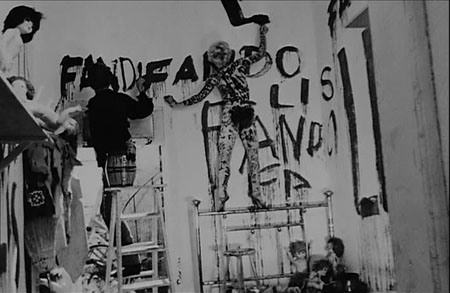
LIST CANDIDATE: FANDO Y LIS (1968)

Weirdest!

DIRECTED BY: Alejandro Jodorowsky

FEATURING: Sergio Kleiner, Diana Mariscal

PLOT: Fando carts and carries his paralyzed lover Lis across a ravaged landscape searching for the legendary city Tar.

Still from Fando y Lis (1968)

WHY IT MIGHT MAKE THE LIST: If you’ve ever seen a Jodorowsky movie before, you know what to expect. Fando y Lis is a parade of fantastical, shocking imagery, including snakes that penetrate a baby doll and a man who begs for blood (he extracts a donation with a syringe and drinks it from a brandy snifter). That said, Fando & Lis is one of the least of Jodorwosky’s works, an early curiosity that is thoroughly weird, but not strongly conceived enough to make the List on the first ballot. (Plus, Jodo’s so well-represented here already we don’t feel at all bad about the possibility of leaving one movie off).

COMMENTS: Fando y Lis begins with a woman eating flowers while a siren wails. Later we will learn she is the paraplegic Lis, whose lover Fando will cart her across a bizarre post-apocalyptic landscape searching for the mystical city of Tar. Along the way they encounter a man playing a burning piano, mud zombies, a transvestite parade, and a gang of female bowlers led by a dominatrix, among other absurdities. There will also be flashbacks to both Fando and Lis’ childhoods, and unrelated fantasy sequences of the actors goofing around (posing in a graveyard, and painting their characters’ names on each other). And there’s quite a few more transgressions, both beautiful and clumsy, to be found in this rambling, overstuffed avant-garde experiment. Although Jodorowsky comes from an older bohemian tradition, at times Fando y Lis plays like something made by Mexican hippies, improvising scenes with random props in between hashish tokes.

The “spiritual journey” structure makes for an episodic film, but the ideas aren’t as stunningly realized or obsessively detailed as The Holy Mountain. Here, Jodorowsky has found, but not perfected, his unique voice: it’s as if he’s working with individual sentences, rather than complete paragraphs. It would have helped the movie feel more coherent and unified if the relationship between Fando and Lis was better done, but their dynamic is unpleasant. They unconvincingly profess eternal love for each other, but Fando is much better at conveying his irritation and annoyance at having to carry Lis everywhere, while her character is reduced to desperate, pathetic whining for most of the film.

In 1962 Jodorowsky, Fernando Arrabal and , feeling that Andre Breton and the old guard Surrealists had lost their edge and were no longer extreme enough in their embrace of absurdity, founded the Panic movement, which was mostly an experimental theater group. Fando & Lis was originally a play from this school, written by Arrabal and staged by Jodorowsky. This movie adaptation is not intended to be faithful; Jodorowsky instead described it as based on his memories of the play. When Fando y Lis premiered at the Acapulco Film Festival in 1968 it caused a riot (presumably due to its abundant nudity and mildly sacrilegious content) and was subsequently banned in Mexico. The film basically disappeared for years. Discovering Jodorowsky in the early 90s, when his films were only available in bootleg VHS versions, I was unaware that he had made a movie before El Topo; Fando wasn’t even a filmography entry. It wasn’t until 2003 that a DVD of this early work suddenly popped up.

WHAT THE CRITICS SAY:

“… pothead vaudeville all the way… A tumultuous cause celebre at festivals, it paved the way for the director’s rise from small-time poseur to big-time poseur with El Topo a few years later.”–Fernando F. Croce, Cinepassion

(This movie was nominated for review by “Zelenc” who called it a “must see film.” Suggest a weird movie of your own here.)

READER RECOMMENDATION: PHILOSOPHY OF A KNIFE (2008)

Reader recommendation by Simon Hyslop

DIRECTED BY: Andrey Iskanov

FEATURING: Tetsuro Sakagami, Yukari Fujimoto, Manoush, Elena Probatova

PLOT: War prisoners are subjected to various horrifying experiments in the Japanese Imperial Army’s infamous Unit 731 facility.

Still from Philosophy of a Knife (2008)

WHY IT SHOULD MAKE THE LIST: Between the dreamlike cinematography, the unconventional, fractious narrative, and the bizarre attempts to blend a documentary with an arthouse film, this is definitely among the least conventional works of World War II cinema.

COMMENTS: A few short years before the outbreak of World War II, one General Shiro Ishii of the Japanese Imperial Army—a man who possessed a fatal combination of power, patriotism, intelligence and absolutely no regard for human life—oversaw the construction of a military facility in the Chinese province of Manchuria. Officially registered as a water purification plant, this facility—Unit 731, as it would come to be known—housed not only military personnel, but several thousand Chinese and Soviet prisoners, and a team of some of Japan’s top scientists. Over the next few years, these prisoners would be subjected to a series of horrifying, inhumane experiments in the name of helping the Japanese war effort. Prisoners were infected with deadly diseases, exposed to bomb blasts, and amputated and dissected without anesthetic.

And thanks to vested Cold War interests on the part of the USA, most of the perpetrators of these atrocities would walk away unpunished, and go on to enjoy prosperous careers.

This is the story that 2008’s Philosophy of a Knife—from one of modern Russia’s resident oddball directors, Andrey Iskanov—tells. Or, at least, purports to tell.

There’s a lot that needs to be said about Philosophy of a Knife, mostly because there’s so much of it. The film clocks in at over four hours; and while, admittedly, there are instances when it’s acceptable for a film to do that, I’m not convinced that Knife is one of them.

If there’s a key mistake this film makes, it’s in its genre. The film, it seems, is making a bold attempt to blend an art film with a documentary, combining stock footage, interviews and voiceover with heavily stylized reenactments of the experiments conducted at Unit 731. And while this is a debatable issue, I can’t see that blend as other than doomed to failure, since those genres are, in my opinion, irrevocably opposed. After all, any documentary worth its salt is going to try and be objective; while art, in any form—in my opinion— is inherently subjective. At least, until we’ve invented painting robots.

But even a viewer who disagrees with that particular perspective will probably agree that, as a documentary, Philosophy of a Knife‘s efforts are half-hearted at best. The voiceover segments—narrated by what sounds like a castrated Robbie Williams—cover only the most Continue reading READER RECOMMENDATION: PHILOSOPHY OF A KNIFE (2008) →

RUSS MEYER’S FASTER PUSSYCAT, KILL! KILL! (1965)

366 Weird Movies may earn commissions from purchases made through product links.

Russ Meyer has been criminally underrepresented here on 366 Weird Movies.  We will pay penance by covering one of his earliest and biggest cult films.

Faster Pussycat, Kill! Kill! (1965) comes by its cult reputation honestly. once proclaimed it “the greatest movie ever made.”  Like most of Meyer’s films, it was initially dismissed as cheap sexpolitation, but there is always more to Meyer than surface, fetish, or cleavage. It stars the statuesque half-Japanese/half-Apache Tura Satana as a black leather clad dominatrix Varla, who left such an impression that a hard rock band took its name from the movie.

In addition to buxom wrasslin’ babes, go-go-dancers, and desert hot rod racing, FPKK is imbued with Meyer’s trademark, frenetic precision editing, sharp and superior black and white photography by Walter Schenk, an aptly kitsch score from the psychotronic lounge by Paul Sawtell and Bert Shefter that echoes the dusty terrain, and good sound: all of which are rarities for shoestring-budgeted indies.  Meyer self-distributed his pictures, so his body of work has been well preserved.

Faster, Pussycat! Kill! Kill! (1965)

Naturally, with all the bouncing cleavage, obligatory catfights, jeans that probably had to be sewed on, and discreet peek-a-boo shots of bathing Amazonians, Meyer has been accused of blatant sexism. Yet, it is the women who are empowered. Varla’s first victim is a bland goody two-shoes, straight out of Pleasantville, Tommy (Ray Barlow), who is stupid enough to challenge her in a drag race.  When Varla suddenly snaps Tommy’s spine in two, we cave in and start rooting for her in spite of ourselves (as we always do with in the John Waters films). Along with Rosie () and Billie (Lori Williams), Varla lassos, drugs, and kidnaps Tommy’s bright-eyed gal pal Linda (Sue Bernard, looking like a reject from “Gilligan’s Island”).

After some hot-rodding on the dunes (“alright chicks, let’s see who’s chicken”), the foursome stop at a gas station whose attendant Mickey (Michael Finn) would fit right in with Goober and Gomer in Mayberry.

Mickey: “The thrill of the open road! New places, new people, new sights of interest. That’s what I believe in, seeing America first.”

Varla (reacting to his looking down her top as he pumps her gas): “You won’t find it down there, Columbus.”

Trying to score points, Mickey tells the women of an inheritance awaiting at a desert ranch, which leads them to a crippled right-wing hayseed Old Man (), his dumb ox of a son Vegetable (Dennis Busch), and second son Kirk (Paul Trinka). “Women! They let Continue reading RUSS MEYER’S FASTER PUSSYCAT, KILL! KILL! (1965) →