Tag Archives: Black and White

APOCRYPHA CANDIDATE: OBEX (2025)

366 Weird Movies may earn commissions from purchases made through product links.

Recommended

DIRECTED BY: Albert Birney

FEATURING: Albert Birney, ,

PLOT: Conor, a gentle shut-in, must navigate the dangerous world of a computer game when it kidnaps his dog.

Still from Obex (2025)

WHY IT MIGHT JOIN THE APOCRYPHA: Strange cicadan adversaries, point-and-click logic, and a celebratory eccentricity make OBEX an obvious odd-ball. Bonus points for being wholesome in its weirdness.

COMMENTS: 1987 was a year for cicadas. Billions of them globally, and who knows how many thousands emerging from their slumber to provide Baltimore a whirring, chirping Summer soundtrack. Reason enough to stay indoors—though left to his own device, Conor would do so anyway: he is a shut-in. For reasons only hinted at during Albert Birney’s low-key adventure film, OBEX, Conor only leaves his property when his dog Sandy is stolen by the the demon Ixaroth and spirited away to the mysterious land of Obex.

“Spirited away” may not be the correct phrase. Birney’s film exists at a strange intersection between (period) technology and classical fantasy, and Sandy’s plight is revealed through the monitor of ye olde Macintosh computer. Conor’s life, quiet and regular, relies on (then) state of the art home computers. His income is earned via text art portraits—lines and lines of punctuation forming a Pointalist-style image—and he ends the day with one or more machines running with midi-ambient or midi-karaoke music before bedtime. He lives alone with his dog, and his computers, and his stack of three cathode-ray televisions which, except on movie nights, all play different channels in the background. And every night he dreams about aimlessly driving his deceased mother in her old car.

The coziness of Conor’s space couldn’t be more different than the vast fields and forests of Obex, which our determined hero explores in the film’s second half. He encounters human-sized bug monsters, a kindly shopkeeper (a hold-over from his corporeal life, Maria, who does Conor’s grocery shopping every Wednesday), and makes a new friend out of an old one: an RCA Victor Model 14S774G—but call him “Victor.” His travels with Victor bring him to an automobile incongruously parked in the middle of an open stretch of greenery, its keys tucked in the visor, just like where Conor’s mother stored them. Other connections connect as well, and while we’re fairly sure we’re in the benighted land of Obex, we are almost certainly somewhere more allegorical as well.

From his small home to the wilds of Obex and into the heart of Ixaroth’s nightmare realm, Birney recounts Conor’s Quest (complete with a hat lifted, I swear, from King’s Quest) with heart, flourish, and more than a few sound-and-sight jests. And the film is more than just nostalgia, although there is plenty of that. OBEX is an unlikely adventure, an eccentric character study, and, to borrow another director’s observation, an unexpectedly gentle film. Capturing its combination of mirth, melancholy, innocence, and self-awareness in words is difficult—though perhaps the complimentary side of “quaint” might do. Cinematographer (and script co-writer) captures the television-feel to a T, and having seen OBEX first on the big screen and recently on my laptop, it felt “right” in both sizes.

That’s what this is: a big adventure that fits right in your pocket, ready for when the whirring and chirping swarm of humdrum life is poised to overwhelm you.

WHAT THE CRITICS SAY:

“Shades of David Lynch and Wes Craven merged with Birney’s own idiosyncratic Baltimore sensibilities…  Better still, for as decidedly weird as OBEX intends to be, there’s a rational, coherent center to it all.”–Chad Collins, Dread Central (festival screening)

CAPUSLE: RETURN TO REASON: FOUR FILMS BY MAN RAY (1923-1929/2023)

DIRECTED BY: Man Ray

FEATURING: Alice Prin, Robert Desnos, Jacques Rigaut, Man Ray

PLOT: Four experimental films form Man Ray shown in rhythmic sequence, set to a partially-improvised score by ‘s band SQÜRL.

Still from "Les Mystères du Château du dé" (1929)

COMMENTS: Though May Ray considered himself a painter, he experimented with photography for decades. In the 1920s, as part of his explorations, he decided to try his hand at making motion pictures. Paradoxically, he cut strips of film into their individual frames, dusted them with salt and pepper, covered them with tacks and pins, exposed them to light according to his Rayograph process, then spliced the images back together. La retour à la raison/Return to Reason (1923) was his first result, two minutes of visual chaos in which random objects and detritus dance across the screen.

Ray had originally planned to screen Retour with a performance by George Antheil, but the enfant terrible of avant-garde music failed to appear. Antheil’s atonal sound remains associated with Ray’s films (Kino Lorber previously released Return to Reason with an Antheil score, as part of the collection “The Silent Avant Garde,” in 2022). This latest release by the Criterion Collection provides a moodier, atmospheric take on Ray’s imagery, through SQÜRL’s signature feedback-laden guitars, electronic tones, and resonant drums. The score’s dirge-like cadences slow things down, encouraging the viewer to notice each intricate detail in every frame while falling under their spell.

Jarmusch, familiar to readers of this site as the director of Dead Man, is also a guitarist, and has written scores for many of his films together with musician Carter Logan. The duo’s sound, at times reminiscent of late ’90s-era Sonic Youth, wraps the listener in a sonic net woven of reverb and ambient drones. Electronic blips and beeps rise out of the static, like distant signals from sonar equipment; deep resonant tones echo like the moan of foghorns. A sudden metallic tinkling, like a forgotten wind chime on the porch of an abandoned house caught by a stray breeze, heightens the uncanny atmosphere.

The disc presents the films in rhythmic, rather than chronological order. The first, L’Étoile de Mer/The Starfish (1928), inspired by Robert Desnos’ poem, has the most coherent plot of the four. A man falls in love with a beautiful woman who gifts him a starfish in a jar. Filmed as though through a pane of rain-streaked glass, or from behind an aquarium wall, the impressionistic visuals come into focus only at key moments. The intertitles feature lines of the poem, but unlike in many silent films where the title cards explain the action, here text and image juxtapose each other in surrealistic fashion; for example, the phrase “women’s teeth are such beautiful objects” precedes a shot of the female character (portrayed by the famous Kiki de Montparnasse), lifting her skirt to adjust her stocking garter.

Emak Bakia (1926) follows. With financing from stockbroker Arthur Wheeler, and featuring his wife driving her Mercedes around Biarritz, Ray created another, longer experimental film (22 min.) in Continue reading CAPUSLE: RETURN TO REASON: FOUR FILMS BY MAN RAY (1923-1929/2023)

CHANNEL 366: UZUMAKI (2024)

366 Weird Movies may earn commissions from purchases made through product links.

DIRECTED BY: Hiroshi Nagahama, Yûji Moriyama

FEATURING: Uki Satake, Shin’ichirô Miki; Abby Trott, Robbie Daymond (English dub)

PLOT: Residents of a small Japanese town are increasingly haunted by spirals.

Still from Uzumaki (2024)

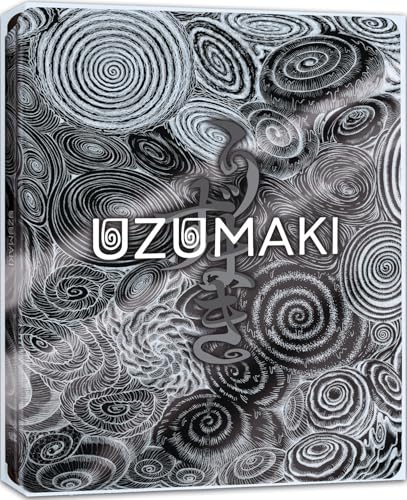
COMMENTS: Most horror story monsters are inspired by symbols of death, disease, and predation, not unthreatening geometric shapes like the humble spiral. Leave it to eerie manga star Junjo Ito to choose the spiral as his avatar of evil. Uzumaki (which had previously been adapted as a live-action feature) plumbs every possible devious iteration of the humble coil; it shows up in the story as whirlwinds, whirlpools, DNA, snail’s shells, hair curls, staircases, mosquito swarms, corkscrews, springs, and the twisted, intertwined bodies of snakes (and people). Watch with disquietude as everyday objects in the town gradually get twisted as the story spirals towards its grim conclusion.

The bizarre antagonist is not the only weird element here. The originally-serialized story lurches forward as a series of vignettes, with a threatening new spiral form dominating each mini-arc. In between episodes, normality resets. After the first girl’s head dissolves into a spiral, we would think the two high school protagonists would flee town; instead, the incident is never mentioned again. After the first kid turns into a human-snail hybrid, you would think the town would panic; instead, they accept it as the new normal, building a pen for the newly-minted escargot boy to live in. The commonsense idea of fleeing the town doesn’t even arise until the second episode, when one pair of aspiring refugees are frustrated in their attempt—but our main characters never even attempt to leave until the final episode, when the narrative finally proffers an explanation for their inability to escape. A particularly intense, vampire-adjacent incident dominates the third episode, but again, after a jarring edit, this horror is entirely forgotten. The characters’ incapacity—and their resigned unwillingness—to escape their situation lends the story an especially irrational, nightmarish quality. In fact, Uzuamki‘s entire structure, oscillating between grotesque visions and uneasy pseudo-normality, suggests madness; perhaps our main characters are actually trapped inside their own obsessive delusions, imagining spirals everywhere.

The art style is done entirely in black and white and imitates the intricate linework of Ito’s original drawings, sometimes recreating particularly bizarre panels. When animated, the absurdity of some of Ito’s visions—a dramatically curling tongue, a pair of eyeballs rotating independently—can be as weirdly comic as they are frightening. But the artwork is almost always strange and affecting, no matter the overall emotional effect. Much was made in anime fandom of the fact that the animation quality declines as the series progresses (probably due to budgetary mismanagement). By the final episode, the directors and producers aren’t even credited. I think that this complaint is mostly overstated, at least for the average viewer. I noted the decline in the cartoon’s fluidity and detail with each new episode, but it wasn’t as drastic as I feared; if I hadn’t been forewarned, I’m not sure how much I would have noticed. Perhaps I benefited from having my expectations lowered; perhaps you will, too. Although Uzumaki hobbles a bit on the way to the finish line, it eventually crosses it. It’s not the wall-to-wall masterpiece the first episode promised, but I wouldn’t say it exactly circles the drain, either.

WHAT THE CRITICS SAY:

“…this work is very much playing in the realm of weird fiction, a sub-genre focused on the unknown and inexplicable… macabre, strange, and utterly unique, even if some of its characters feel a bit thin at times.”–Elijah Gonzalez, Paste (episode 1)