
Jarring music from Lisokot is fittingly paired with the animation of Sasha Svirsky. It seems complete, despite no available English translation.
Tag Archives: 2016
CAPSULE: RUPTURE (2016)
366 Weird Movies may earn commissions from purchases made through product links.
DIRECTED BY: Steven Shainberg
FEATURING: Noomi Rapace, Michael Chiklis, Kerry Bishe, Lesley Manville, Andrew Moodie, Ari Millen, Jean Yoon, Jonathan Potts, Peter Stormare
PLOT: Young mother Renee Morgan (Rapace) is abducted by a strange group and endures tests and tortures designed to elicit some response they refer to as a “rupture”- but what exactly is that?

WHY IT WON’T MAKE THE LIST: It’s not that weird, though there are some aspects here and there. But it’s certainly odd—those expecting a straightforward piece of “capture/torture porn” will not be pleased. There’s a lot to be intrigued by, if you can run with a variation on the genre.
COMMENTS: Looking at most of the reviews, and the current mainstream arbiter of good and bad films, Rotten Tomatoes, Rupture doesn’t fare well. Fair enough. For this type of thriller, it doesn’t truly deliver in terms of shocks, it’s not nearly as gory as most of its brethren, and most of the events are standard tropes in its genre niche. That said, I think that most of those negative reviewers overlook the interesting aspects of this film, which tips its hand fairly early that it’s not going to be the usual capture/torture story.
For one thing, there’s a subtle humor running throughout the film in the lighting and art direction. There’s Suspiria-style lighting throughout the facility, and one room referencing Kubrick’s The Shining. In the performances, Renee’s captors/tormentors are surprisingly polite and deferential, if extremely focused. There’s also the lack of over-the-top graphicness and the growing realization that despite the fearful goings on, very little of the film orients towards horror. It’s not quite a subversion of the torture/capture scenario, but it’s certainly a side path.
Rupture is a much less graphic Martyrs, with a touch of Invasion of the Body Snatchers as things play out. You can call it a social satire, if you consider current events as having some influence in interpreting and enjoying the arts. Those factors, plus an ending which leaves things open to continue the story, makes it understandable why audiences expecting a taut thriller would be slightly disappointed.
Rupture can currently be viewed on the Cinemax networks and on DVD
WHAT THE CRITICS SAY:

CAPSULE: AMERICAN FABLE (2016)
DIRECTED BY: Anne Hamilton
FEATURING: Peyton Kennedy, Richard Schiff, Kip Pardue, Zuleikha Robinson
PLOT: A 11-year old girl in Reagan-era America wrestles with her conscience when she discovers a man being held hostage on her farm.

WHY IT WON’T MAKE THE LIST: Although the film pays lip service to magical realism and utilizes some striking imagery, there’s nothing especially weird about American Fable, although it does signal some interesting new voices.
COMMENTS: American Fable lays all its cards out on the table before the movie even begins. After all, the name of the movie is American Fable. Our tale will be fantastical, but highly moral, and with the particular shadings of fierce independence and bull-headed determination that flourishes in the United States. Titles, after all, are important.
They certainly nail the “American” part right away, opening on a family farm in Wisconsin in the early 1980s, where a father reads a story to his daughter while Ronald Reagan’s “Morning in America” commercial plays in the background. As that combination would suggest, times are tough, with small farmers struggling to fight off the banks and predatory land barons, with increasingly dire results. Indeed, the family of our hero will eventually turn to crime in an effort to buy their way out of the hole.
The “fable” part, on the other hand, is a longer walk. That father is reading tales of princesses and monsters to his daughter, Gitty, and while she is on the cusp of learning harder truths about the world, she still has a childlike attraction to the trappings of fairy tales. As she learns more about her family’s situation, she is inclined to view them through the lens of fantasy.
This isn’t a “Walter Mitty” scenario, though. Aside from a couple dream visions that portray one of her father’s associates as a fantastical witch queen, the elements of fable come through more as tropes played straight. A lonely farm girl with only a chicken for a friend, the discovery of a man in an abandoned tower, a handsome young man who is revealed to be thoroughly wicked: these would be perfectly at home in a Disney feature, but American Fable never winks at them.
The line this film walks is a tricky one. If you take the story seriously, then the plot immediately falls apart. If you insist that it’s merely an ancient tale transplanted to more recent times, then it’s lacking in any real mystery or magic. Director Hamilton tries to help her own script with a genuine knack for visuals. She has a painterly eye, artfully composing every shot and transforming rural Illinois (standing in for Wisconsin) into a setting worthy of the Impressionists. But her story tries to have it both ways, and never really succeeds at either.
Working in the film’s favor is uniformly strong acting, selling situations and characters that don’t hold up under close scrutiny. In particular, Schiff is expectedly reliable as a man by turns wistful and desperate about his circumstances. But the whole enterprise rests on the shoulders of Kennedy, who succeeds completely. Not an inexperienced actor (I encountered her previously in another weird setting as the irascible doctor on the educational quirkfest Odd Squad), she is completely believable, naïve but not stupid, reacting in the best way she knows how to situations beyond her understanding, and torn when she finds herself on both sides of a moral dilemma. American Fable ultimately doesn’t succeed as either the raw drama or the mystical metaphor that it wants to be. As a showcase for its director and star, however, it’s an outstanding calling card.
WHAT THE CRITICS SAY:
CAPSULE: MIMOSAS (2016)
DIRECTED BY: Oliver Laxe
FEATURING: Ahmed Hammoud, Shakib Ben Omar
PLOT: A traveler accepts a mission to escort a dying sheik through a mountain pass, assisted by a mysterious younger man sent to help him by unknown benefactors.

WHY IT WON’T MAKE THE LIST: Every year, a handful of slow-paced, low-budget surreal features (usually European, sometimes from emerging markets) screen at film festivals, and quickly disappear from view and memory. This is one of them. Ultra-minimalist and lacking much visual texture beyond the glorious landscapes, its obscure basis in Sufi mysticism makes Mimosas unique, but not enough to overcome its baggage.
COMMENTS: There are two worlds in Mimosas. In one, a caravan of horses makes its way through Morocco’s snow-capped Atlas mountains, seeking to bury a sheik’s body in his homeland. These characters could have stepped out of an apocryphal chapter of the Old Testament or the Quran. The other is a modern world of junky taxis idling in a desert town, where scores of drivers jostle for rare fares. The mediator between these two worlds is young Shakib, a junior driver who we first see mocked by his fellow workers for messing up the details of the story of Iblis and Adam (when corrected, he responds, “let me finish my story, and interpret it as you want”). To his foreman’s amazement, Shakib is selected for a job; which, unaccountably, is to guide two roguish companions of the sheik on the quest to find his home town—no one knows exactly where it’s located—and put him at rest among his fathers.
Though Shakib may be inexperienced as a guide, he has one crucial trait: an unshakable faith, which shames the increasingly reluctant Ahmed into persevering through the rocks and snow, despite the fact that the city they are seeking seems to have vanished from all maps. Most of the movie is nothing more than a small team walking through the scenic landscape, with Shakib pressing Ahmed for his lack of faith; but the ending goes full-wacko, with the two worlds colliding, and Shakhib and Ahmed undertaking a new quest that crosses barriers of time and space.
With chapter titles taken from Sufi prayer positions and not a hint of blasphemy, there is little reason to doubt that the film’s attitude towards religion is sincere, which makes it more interesting. It has the shape of a religious parable, although the meaning is opaque. The Islamic influence makes it novel and exotic and gives the film a cultural leg up on similar projects; the unique perspective made it more intriguing to me than the superficially similar spiritual wilderness journey depicted in the The Ornithologist. Although it’s not a faith we Westerners generally associate with narrative subversion, there may be a future for Muslim surrealism.
Footage from the filming of Mimosas can be seen in Ben Rivers’ The Sky Trembles and the Earth Is Afraid and the Two Eyes Are Not Brothers, which stars director Oliver Laxe as a director who abandons the project he is filming (which is, in fact, Mimosas). Mimosas won the Critics Week Grand Prize at the Cannes Film Festival. It’s not currently on DVD, but you can find it for digital rental at distributor Grasshopper Film‘s site.
WHAT THE CRITICS SAY:
LIST CANDIDATE: THE ORNITHOLOGIST (2016)
O Ornitólogo
366 Weird Movies may earn commissions from purchases made through product links.
DIRECTED BY: João Pedro Rodrigues
CAST: Paul Hamy, Xelo Cagiao Teijo, Han Wuen, Chan Suan
PLOT: After being swept away by rapids, Fernando, an ornithologist looking for black storks, finds himself in a mysterious forest where he’ll undergo a transformative spiritual journey mirroring the life of Saint Anthony of Padua.
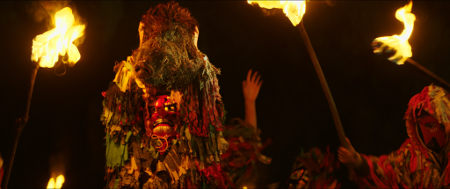
WHY IT SHOULD MAKE THE LIST: The Ornithologist is the allegorical tale of an atheist ornithologist’s conversion through a succession of increasingly bizarre occurrences. Given that these moments vary from slightly odd to truly surreal, the film plays the weirdness card, although the limited number of remaining slots in the List make its inclusion uncertain.
COMMENTS: The first shots of The Ornithologist, after an introductory quote by Saint Anthony, depict a dark, calm river with a bird and plant life, accompanied by the ambient sounds of nature. After the film’s weird notes kick in, the atmosphere remains remarkably the same: quiet and naturalistic, persistently treating the strange sights of Fernando’s mystical journey as perfectly normal. The stunningly shot setting, a Portuguese forest that director João Pedro Rodrigues populates with strange images and figures, also persists for the entirety of the movie (save for the very last, and very weird, scene).
After he crashes his kayak, the titular protagonist is rescued by two female Chinese pilgrims, on their way to Santiago de Compostela, with whom he spends the night. This moment marks the film’s first foray into Fernando’s symbolic journey, as well as a turn to a darker tone. When a menacing sound is heard, the frightened pilgrims assume it’s a demonic entity just as quickly as Fernando casually rebuts their belief, claiming there’s no God or Devil. Shocked by his lack of faith, they oblige him to sleep outside of their tent, and the next morning finds him tied to a tree.
From that point on, the steps on the ornithologist’s conversion grow progressively surreal; some are blatant in their symbolism (such as the appearance of the Holy Spirit as a white dove), others more obscure (naked amazons shooting him with a rifle, only to have a quick chat with him after he revives). Most are blasphemous and/or contain homoerotic undertones. They include Fernando’s baptism in urine (!), sex with a mute shepherd named Jesus (!!!), and the appearance of what appear to be embalmed animals in the woods, among other outrageous stops in his mystical-existential self-discovery arc.
These episodes are consistently engaging and reveal Rodrigues’ fascination with Christian iconography, mysticism and eroticism (a potently heretical mix), as well as his intention to filter universal religious symbols through his personal sensibilities. The “enlightenment quest” narrative will likely remind weirdophiles of Alejandro Jodorowsky’s El Topo or The Holy Mountain, but the film is stylistically much closer to Apichatpong Weerasethakul’s Uncle Boonmee Who Can Recall His Past Lives. Like that film, The Ornithologist‘s bizarre and phantasmagorical apparitions seamlessly blend in the environment as if they were no less natural than a tree or a bird. Accordingly, our main character remains stoic throughout his adventure. Speaking only when needed (that is, sparsely), his language, like the film’s, is mostly non-verbal. Actor Paul Hamy subtly conveys feelings of confusion and curiosity; interestingly, he has explained in interviews that he likes physical expression, comparing himself to a sculpture that the director shapes in front of the camera. The Ornithologist displays this particularly well, as Hamy’s character is aloof and his metamorphosis occurs internally, manifesting itself mostly in his careful physicality and expressions.
Even if you have difficulty relating to Fernando, it’s apparent that this is a very personal affair for Rodrigues. At one point near the end, the director himself literally steps into the shoes of the main actor. The character’s name changes to António (another reference to Saint Anthony), signalling that his transformation is complete. Fernando is not meant to be an avatar of the audience but, rather, of his creator; as a result, viewers without familiarity or investment in the narrative of Saint Anthony may find themselves estranged. The story is clearly very important to Rodrigues, and ultimately asserts itself as vaguely autobiographical. This is not to say, however, that its deeper meaning is impenetrable. Surely, watching The Ornithologist is, above all, an experience, and the beautiful cinematography and pervading atmosphere, languid and sometimes sinister, will please the adventurous viewer. But I believe exploring the film’s symbolism is a rewarding enhancement. Like Fernando, we feel shipwrecked and disoriented in such a strange environment, but by the end, we’ll probably have changed.
WHAT THE CRITICS SAY: