Tag Archives: 1973

55. O LUCKY MAN! (1973)

“Lindsay… was never into realism.  He wanted it real, but not realistic.”–Malcolm McDowell

“O Lucky Man! is a film about the real world.  I think that everything in it is recognizable to people who look around with open eyes and can see the kind of world we’re living in.  But of course it makes it’s comment through comedy and through satire, because I think the world today is too complex and too mad and too bad for one to be able to make a straight, serious comment.”–Lindsay Anderson

Recommended

DIRECTED BY: Lindsay Anderson

FEATURING: Malcolm McDowell, , , Arthur Lowe, Alan Price, Lindsay Anderson

PLOT: Mick Travis is an eager, ambitious trainee at a coffee company who gets a big break when the firm’s top salesman in the Northeast territory goes missing under mysterious circumstances and he’s picked to replace him.  With his engaging smile and can-do attitude, his career begins promisingly, but soon a sting of unfortunate coincidences befall him. A plague of strange events drive him across the 1970s English landscape, as he is mistaken for a spy, volunteers for medical experiments, falls in with a touring rock band, becomes the personal assistant of a ruthless capitalist, goes to prison, and works at a soup kitchen.

Still from O Lucky Man! (1973)

BACKGROUND:

  • McDowell is Mick Travis in this film. He played a character of the same name in three of director Lindsay Anderson’s films, each completed in a different decade: if… (1968), O Lucky Man! (1973), and Britannia Hospital (1982). Other than sharing the same name, there is no evidence that Mick Travis is intended to be the same character at different stages of life.
  • McDowell came up with the core idea for the script, drawing on his own pre-fame experiences as a coffee salesman. McDowell worked on the script with screenwriter David Sherwin (If…).  In an interview, McDowell recalls that he was having trouble thinking of an ending and Anderson asked him how his real life adventures as a coffee salesman ended. “That’s your ending,” Anderson told him.
  • This was McDowell’s next project after completing A Clockwork Orange in 1971, cementing his position as the most important weird actor of the early 1970s.
  • Director Anderson had tried to make documentary about singer-songwriter Alan Price before he began O Lucky Man!, but could not obtain funding to license the songs. Anderson instead invited Price to write the songs for this movie and to appear as the leader of the touring band in the film.
  • Almost all of the actors in the film play multiple parts. Arthur Lowe won a BAFTA Best Supporting Actor Award for his triple-role as Mr. Duff, Charlie Johnson and Dr. Munda (in blackface).

INDELIBLE IMAGE: The final party scene, with the entire cast dancing to the theme song while balloons drop from the ceiling, although the shot of Dr. Millar’s medical experiments is unforgettable as well.

WHAT MAKES IT WEIRD: As if Mick Travis’ improbable class-trotting adventures across 1970s Britain weren’t strange enough, Lindsay Anderson sprinkles weirdness and non sequiturs throughout, including Kafkaesque interrogations, a half-man half-hog, and an unexpected breastfeeding scene. Any film in which a boarding-room neighbor inexplicably gives a young man a “golden” suit and sends him out into the world with the sage advice “try not to die like a dog,” is tipping to the weird end of the scale.

Original trailer for O Lucky Man!

COMMENTS: The standard line on O Lucky Man! is that it is a satire on the capitalist Continue reading 55. O LUCKY MAN! (1973) →

21. THE WICKER MAN (1973)

“I think it is a film fantastique in a way… a film fantastique can have almost anything in it, it’s based on facts but it can take flights of fancy which are still rooted to the truth, to the reality of the story, so the imagination can roam.”–Robin Hardy

Must See

DIRECTED BY: Robin Hardy

FEATURING:  Edward Woodward, Christopher Lee, Diane Cilento, Britt Ekland,

PLOT:  A devout Christian policeman flies to the isolated island of Summerisle off the coast of Scotland to investigate a report of a missing girl.  When he gets there, everyone denies knowledge of the girl, but he notices with increasing disgust that the entire island is practicing old pagan rituals and licentious sex.  As his investigation continues, he uncovers evidence suggesting that the missing girl was a resident of the island, and may have met a horrible fate.

the_wicker_man_1973

BACKGROUND:

  • Screenwriter Anthony Shaffer was a hot property in 1973 after adapting his own successful mystery play Sleuth into a 1972 hit movie with Laurence Olivier and Michael Caine, and penning the screenplay for Frenzy (1972) for Alfred Hitchcock.  His clout was so great that this film was released under the official title Anthony Shaffer’s The Wicker Man.  He later adapted Agatha Christie novels such as Murder on the Orient Express (1974) for the big screen.
  • Director Robin Hardy, despite doing an excellent job on this film, did not direct a feature film again until 1986’s Wicker Man variation, The Fantasist.
  • Christopher Lee, who had just come to the end of his run as Hammer’s Dracula, donated his acting services to the production.  He was quoted in 1977 as saying, “It’s the best part I’ve ever had.  Unquestionably.”
  • The “wicker man” was a historically accurate feature of Druidic religions that was first described to the world by Julius Caesar in his “Commentary on the Gallic Wars.”
  • In Britain the film was released on the bottom half of a double bill with Don’t Look Now, perhaps the most impressive psychological horror double feature in history.
  • Shaffer and Hardy published a novelization of the film in 1976.
  • “Cinefastique” devoted an entire 1977 issue to the film, calling it “the Citizen Kane of horror movies.”
  • In 2001, an additional 12 minutes of deleted scenes were added to create a “Director’s Cut” version.
  • Some of the original footage is believed to be lost forever, including part of the scene where Sgt. Howie first meets Lord Summerisle.  The original negative was accidentally thrown away when original producer British Lion Films went under and cleaned out its vaults.
  • The climax was voted #45 in Bravo’s list of the “100 Scariest Movie Moments.”
  • The 2006 Neil LaBute remake starring Nicolas Cage had as little as possible to do with the original story, was universally reviled, and was even accused of being misogynistic.  Some argue that it is so poorly conceived and made that it has significant camp value.
  • Hardy released a “spiritual sequel,” The Wicker Tree, in 2011.

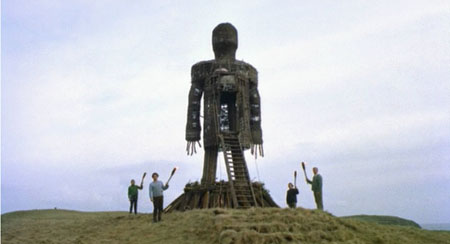
INDELIBLE IMAGE:  The wicker man itself (although, for those of a certain gender, Britt Ekland’s nude dance may be even harder to forget).

WHAT MAKES IT WEIRD:  Hardy and Shaffer create an atmosphere like no other; it’s an encounter of civilized man with strange, primeval beliefs.  Select scenes are subtly surreal—observe how the villagers break into an impossibly well-choreographed bawdy song about the innkeeper’s daughter preternaturally designed to discomfit their sexually repressed guest.  Other weird incidents are more outrageously in the viewer’s face: the vision of a woman breastfeeding a child in a graveyard while delicately holding an egg in her outstretched hand.  Almost invisible details such as the children’s lessons scribbled on the classroom blackboard (“the toadstone protects the newly born from the weird woman”) saturate the film and reveal how painstakingly its makers constructed a haunting alternate world of simultaneously fascinating and repulsive pagan beliefs.  The rituals Sergeant Howie witnesses don’t always make sense (and when they do, their significance is repulsive to him), but they tap into a deep, buried vein of myth.  The viewer himself undergoes a dread confrontation with Old Gods who are at the same time familiar and terrifyingly strange.

Original trailer for The Wicker Man

COMMENTS: CONFESSION: The version reviewed here–horrors!–is the 88 minute theatrical Continue reading 21. THE WICKER MAN (1973) →

1. DON’T LOOK NOW (1973)

AKA A Venezia… un dicembre rosso shocking
Recommended

DIRECTED BY:  Nicolas Roeg

FEATURING:  Donald Sutherland,

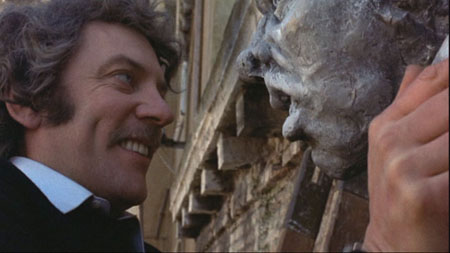
PLOT: John and Laura Baxter (Donald Sutherland and Julie Christie) lose their daughter in a freak drowning accident. Life goes on, however, and they travel to Venice as planned, where John is directing the restoration of a Gothic cathedral. While there, they meet a blind psychic woman who tells them she can see their daughter, and John begins to catch glimpses out of the corner of his eye of a red-hooded figure that looks suspiciously like his drowned daughter.

=

BACKGROUND:

  • This was director Nicolas Roeg’s third film, after Performance (1970) and Walkabout (1971). The movie was adapted from a short story by the British novelist Daphne du Maurier, whose works also inspired Rebecca and The Birds.
  • The love scene between Julie Christie and Donald Sutherland was so graphic for the time that (unverified) rumors persisted that they had actually had intercourse on the set.  Roeg has since dismissed the rumors.
  • Some of the style of the film may have been influenced by Italian giallos of the period, though this connection has been exaggerated simply because of the Venetian setting.
  • Don’t Look Now is #8 on the British Film Institute’s list of the all-time great British films.

INDELIBLE IMAGE : The color red. (More would constitute a spoiler).

WHAT MAKES IT WEIRD:  Don’t Look Now is subtly unnerving—perhaps toos ubtly—throughout. But the last 20 minutes are a truly unsettling, nightmarish experience, capped by a shocking, largely unexplained resolution that leaves it to the viewer to solve the film’s mystery. By the end, the city of Venice has turned into a strangely deserted, Gothic labyrinth that may haunt your nightmares.


Trailer for Don’t Look Now narrated by John Landis

COMMENTS: Near the opening of Don’t Look Now is a fast-moving montage in which key Continue reading 1. DON’T LOOK NOW (1973) →