CAPSULE: CHINGASO THE CLOWN (2006)

“Chingaso the Clown” runs for 15 minutes (12 minutes without credits) and can be viewed on YouTube in its entirety by clicking this link. The film is mildly Not Safe for Work (NSFW) and would likely be rated R for language and violence.

DIRECTED BY: Elias Matar

FEATURING: Quinn Larson, David Hyatt, Roberta Orlandi

PLOT: A man paints his face and heads off to seek revenge on crime kingpin Bastard the Clown and his Clown Army.

Still from Chingaso the Clown (2006)

WHY IT WON’T MAKE THE LIST: Ending on a cliffhanger, “Chingaso the Clown” not really a full length standalone film; it’s a pitch for a feature that was never made. It’s not bad, but even at full length this action movie parody wouldn’t be weird enough to qualify for the List solely because its chief combatants wear greasepaint and crack bad puns.

COMMENTS: We at 366 Weird Movies pledge that we’ll give any movie a hearing, so long as it meets a basic minimum level of weirdness and quality. “Chingaso the Clown” is proof of that promise. However, we don’t promise that we’ll get to it promptly. The short film “Chingaso the Clown” was made in 2006, and we were asked to review it in 2010; at that point, director Elias Matar was still hoping to expand the short into a feature. He’s since made a different feature film (Ashes, a about a doctor who accidentally creates a zombie virus) and let the chingasotheclown.com domain expire, which suggests the project has been abandoned. Which is a bit of a shame, because “Chingaso the Clown,” the short, isn’t half bad, and almost certainly could have been turned into a viable feature ( has released much worse full length films, some of which were probably completed for less than it cost to make the short version “Chingaso”). The premise—an alternate universe in which unscrupulous clowns run the world’s crime cartels—is high concept enough, although the mime vs. clown rivalry angle is lifted from 1991’s Shakes the Clown. The acting is much higher quality than is usually seen in this level of filmmaking: as vengeful Chingaso, Quinn Larson has only one note but nails it; David Hyatt is suitably Joker-esque in the most difficult role as the villain; and former Miss Italy (and sometime television actress) Roberta Orlandi adds a touch of Hollywood glamor that legitimizes the project. The direction is also competent: angles and lighting are interesting, visual effects are inexpensive but judiciously used, and the film shows good attention to detail with no obvious continuity problems. The fight scene choreography could be improved but isn’t off-putting, and the script is mildly amusing throughout, with one, maybe two decent belly laughs. Is it weird? Not so very, but the B-movie spoof crowd would have eaten this up, if it was served to them cheaply enough (they’re a miserly crowd). Unfortunately, ‘s impressive The Last Circus was released in 2010 and pretty much stole the thunder from any subsequent clown vs. clown slugfests. Sorry we didn’t get to the review before that, but even a glowing review from us wasn’t likely to make the difference between funding “Chingaso” and letting the poor guy hang up his floppy shoes for good.

More important than the fate of “Chingaso the Clown” itself is what the movie says about the state of the low-budget film industry today. Two decades ago, before cheap digital cameras and the proliferation of broadband internet, the skill required to make a film like “Chingaso” would be in high demand. Today, however, competition is cutthroat: anyone can make a short movie, and most people who do are giving them away for free on YouTube. We, the entertainment consumers, are drowning in a sea of product, and at this moment in time it’s not good enough for a producer to be skilled. You’ve got to be lucky, too, and even going viral only gives you Andy Warhol’s fifteen minutes to exploit your popularity.

WHAT THE CRITICS SAY:

“…the film is so wonderful that it’s a shame the feature-length version has yet to be made… the excess of violence achieves a unique balance between the hilarious and the grotesque.”–Phil Hall, Film Threat (festival screening)

(This movie was nominated for review by “zinotchka.”  Suggest a weird movie of your own here.)

Watch “Chingaso the Clown” on Youtube

CAPSULE: SLACKER (1991)

Recommended

DIRECTED BY:

FEATURING: The citizens of Austin, Texas

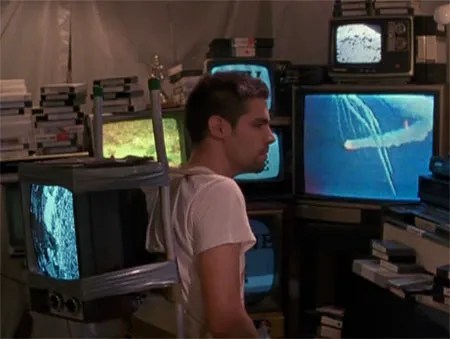
PLOT: Slacker spies on the aimless exploits of the slackers of Austin, TX; the camera follows one character for a few minutes, then veers off to chase another through a series of comical, philosophical, and absurd vignettes involving hit-and-run drivers, elderly anarchists and video fetishists.

Still from Slacker (1991)

WHY IT WON’T MAKE THE LIST: Slacker is a seminal, interesting, and at times incisive storytelling experiment, but it’s of interest to weirdophiles mainly as the spiritual prequel to Waking Life, which is virtually Slacker remade as a dream.

COMMENTS: The batty cast list—credited characters include “Dostoevsky Wannabe,” “Recluse in Bathrobe” and “Hit Up for Cigarettes”—accurately reflects the mix of mundanity and eccentricity on display in writer/director Richard Linklater’s slice-of-life tour of the coffee shops and crash-pads and on the fringes of Austin, Texas in 1991. Slacker is a character study of the subculture of bright but unambitious dropouts and unemployed postgrads bent on extending their undergrad lifestyles that exists in every college town. At the time of its release it was seen as emblematic of “Generation X”‘s alienation and withdrawal from mainstream culture, but in reality this Bohemian substrata of unmotivated aesthetes and anti-establishment hedonists has always been with us under various names (if the movie had been made in 1291 in Saint-Rémy-de-Provence it would have been entitled Goliard). For this peripatetic essay Linklater borrows the elegant but seldom used narrative device invented by Luis Buñuel for The Phantom of Liberty: two characters walk down the street discussing whether they should leave the country, then the cameraman suddenly gets bored and starts following a man who enters a coffee shop where an insane woman advises him that he should “never traumatize a woman sexually,” then decides instead to see where the guy who just entered the shop wearing a bathrobe is headed to, and so on. The result is a series of vignettes which are occasionally funny, occasionally disturbing, and often repetitive, but which capture a peculiar, laid-back, mad energy of a particular place at a particular point in time. Still, as the film’s oldest character rhapsodizes when remembering Charles Whitman, “this town has always had its share of crazies—I wouldn’t want to live anywhere else.” Memorable characters range from the UFO enthusiast who accosts passersby to explain his theory that we’ve been on the moon since the 1950s to the tomboy who’s looking to fence stolen celebrity gynecology artifacts, cheap. Linklater, who delivers the first of the film’s many discursive monologues himself in the role of “Should Have Stayed at the Bus Stop,” shows an attitude of fond disdain for a town where everyone sleeps in late and is working on an unfinished novel or playing in an unsigned band. The director may have arisen out of the Austin milieu, but if he’s a slacker, then he’s a type-A personality slacker; he’s obviously a much harder worker than the guy who earnestly muses “who’s ever written a great work about the tremendous effort required not to create?” over a cup of cappuccino.

If Slacker has one downside (besides excusably spotty acting by the amateur cast), it’s that the movie turns repetitive and arguably outstays its welcome. Somewhere between twenty and forty-five minutes in we start to get the picture; although the UFO guy and the JFK guy have totally different obsessions, ultimately they’re both just proselytizers with a passion for explaining stuff we don’t care about to us in ridiculous detail. The overall portrait Linklater manages to paint is still very impressive; Slacker may be the most passionate and invigorating movie about doing nothing ever made.

On a personal note, I was lucky enough to see Slacker in Austin, TX in 1991 in a theater in a strip mall (I lived in Dallas at the time but had a friend attending UT with a couch I could crash on). The movie, which was playing nowhere else in the country, had been held over for a second week, and the afternoon matinee showing was standing room only; everyone in the audience but me probably had a friend or two who was an extra in it. I had an aisle seat; a middle-aged woman came in late and stood next to me during the entire show, shooting me nasty looks as she shifted from foot to foot. I recall thinking it ironic that the Austinite had to stand through the whole performance simply because she had slacked off on getting to the show on time.

WHAT THE CRITICS SAY:

“…funny, surreal and weird… Linklater traces the dehumanized weirding of America — as collectively defined by David Lynch, Errol Morris, Jim Jarmusch and others. But he does it with a detached, yet sympathetic sense of irony.”–Desson Howe, The Washington Post (contemporaneous)

(This movie was nominated for review by nicolas, who suggested that all of Linklater’s films were “pretty weird and deep with one or two exceptions.” Suggest a weird movie of your own here.)
WEIRD HORIZON FOR THE WEEK OF 3/15/2013

Our weekly look at what’s weird in theaters, on hot-off-the-presses DVDs, and on more distant horizons…

Trailers of new release movies are generally available on the official site links.

IN THEATERS (LIMITED RELEASE):

K-11 (2012): A record producer wakes up after a night of partying and finds himself imprisoned in Los Angeles Prisons K-11 unit—that’s where they send the homosexuals and transgendered folk. Directed by Kristen Stewart’s mom Jules (a veteran Hollywood script supervisor), it currently scores a 0% positive on Rotten Tomatoes, though on the plus side the Hollywood Reporter called it “like a deranged John Waters remake of The Shawshank Redemption.” K-11 official site.

Reality (2012): A fishmonger becomes so obsessed with appearing on the Italian version of the “Big Brother” reality TV show that he loses touch with reality. This satire appears to have some surreal moments and is earning a lot of comparisons to the works of . Reality official site.

Spring Breakers (2012): ‘s new movie—which looks like a return to the exploitation roots of his first screenplay, the juvenile delinquency shocker Kids—features ex-Disney starlets Selena Gomez and Vanessa Hudgens and is being pumped by MTV. It looks like it could be Korine’s first ever non-weird directorial effort, but we’re sure he’ll slip something strange in there. Spring Breakers official site.

Upside Down (2013): A Romeo/Juliet romance in a bizarre setting: twin planets with opposing gravity, one sitting on top of the other. Surely there’s nothing weird here besides the high concept and the visuals, but those are strange enough to at least earn this movie a mention. Upside Down official site.

Vanishing Waves (2012): A therapist becomes erotically involved with a patient in a coma when he uses an experimental technique to enter her sleeping consciousness. A Lithuanian movie being distributed in the US by exciting newcomer Artsploitation Films, it will play New York this week with Chicago and LA dates to follow. Vanishing Waves official site.

SCREENINGS – (Portland,OR, Tues. Mar. 19):

Maximum Shame (2010): Read our capsule review! ‘ “apocalyptic fetish horror musical chess sci-fi weird feature movie” gets a rare US screening for lucky Portlanders. The Hollywood Theater must be a pretty weird venue if this is what they show on a Tuesday. Maximum Shame at Hollywood Theater, Portland, OR.

FILM FESTIVALS – 51st Annual Ann Arbor Film Festival (Ann Arbor, MI, Mar. 19-24):

Let’s face it: with over 200 experimental films (mostly shorts) screening, most of them from directors so obscure even we’ve never heard of them, writing even a short guide to the 2012 AAFF is too daunting a task for us to take on. Two of the highlights we noticed: “Psychedelic Visions and Expanded Consciousness – Los Angeles in the ’60s and ’70s” (March 20) and a retrospective (split into two sessions, March 21 & 23, it covers essentially all of Pitt’s surreal animations, and she’ll be on hand to answer questions). Wander into any random screening at Ann Arbor and chances are what you see would qualify as “weird.” This one features the most disturbing Film Festival trailer we’ve yet to see. Ann Arbor Film Festival homepage.

NEW ON DVD:

Alice in Wonderland (1966): This black and white, minimally staged version of the famous story, made for British television, features Peter Sellers as the King of Hearts and Sir John Gielgud as the Mock Turtle. Curious that this should show up now, as the BBC released an elaborate, extras-laden edition of this title in 2010. Buy Alice in Wonderland.

Alice Through the Looking Glass (1973): Luckless (or lucky) Alice finds herself stuck in yet another magical realm of nonsense, where she meets characters like Tweedledee and Tweedledum and Humpty Dumpty. This belated followup to the BBC’s 1966 hit TV movie doesn’t feature the star power of Wonderland, and to our knowledge it has never been released on Region 1 DVD before now. Buy Alice Through the Looking Glass.

Cirque du Soleil: Worlds Away (2012): A woman is enticed to enter a strange circus tent and finds herself traveling through multiple carnivalesque dimensions, each of which just happens to be based on a separate Cirque du Soleil production. This “movie” is little more than a sampler/ad for CdS’s semi-surreal live shows, but it is cheaper than dropping a C-note to get into one of their Vegas showrooms. Buy Cirque Du Soleil: Worlds Away.

Free Radicals: A History of Experimental Cinema (2012): The title tells all; this is an 80 minute survey of 20th century experimental film, highlighted by the final recorded interview of pioneer Stan Brakhage. This doc takes its name from a five minute animated short by Len Lye, which is included in its entirety. Buy Free Radicals: A History of Experimental Cinema.

This Must Be the Place (2011): Here’s a truly odd premise for a comedy: a retired goth-rock star hunts the Nazi who persecuted his father at Auschwitz.  Starring Sean Penn, of all people, as the laconic, androgynous angel of vengeance. Buy This Must Be the Place.

NEW ON BLU-RAY:

Cirque du Soleil: Worlds Away [Limited 3D Edition] (2012): See description in DVD above. This set includes a Blu-ray, Blu-ray 3D and DVD copy. Buy Cirque Du Soleil: Worlds Away [Blu-ray].

This Must Be the Place (2011): See description in DVD above. Buy This Must Be the Place [Blu-ray].

Tristana (1970): A respectable old man with one weakness—women—seduces a younger woman put into his charge; she escapes him, but later returns after she loses her leg. From the Cohen Film Collection, this restored version includes an alternate ending to Luis Buñuel‘s psychosexual classic. Buy Tristana [Blu-ray].

FREE (LEGITIMATE RELEASE) MOVIES ON YOUTUBE:

Zontar, the Thing from Venus (1966): Zontar (the three-eyed thing from Venus) comes to Earth and starts enslaving people using his monster bat minions, but one scientist is convinced he’s a good guy who’s just misunderstood. This made-for-TV remake of ‘s It Conquered the World was so bad, it embarrassed even director Larry (Mars Needs Women) Buchanan.

What are you looking forward to? If you have any weird movie leads that I have overlooked, feel free to leave them in the COMMENTS section.

SATANTANGO (1994)

Bela Tarr’s Satantango (1994) is a seven and half hour long, glacially paced, acerbic adaptation of László Krasznahorkai’s novel. It is the second of four films in which Tarr has collaborated with Krasznahraki as writer, beginning with Damnation (1988) and most recently The Turin Horse (2011).

Tarr is frequently and aptly compared to . Like Tarkovsky, Tarr’s films require intelligence and patience. At this length, Tarkovsky may seem hyperkinetic, particularly to Western viewers. Yet, patience reaps a rich spiritual reward. Indeed, Tarr may be the most spiritually intuitive filmmaker since Tarkvosky, Bresson, and Dreyer.

In certain ways Satantango is comparable to composer Morton Feldman’s six-hour string quartet. Dissonance, pauses, and silence, mixed with humor and desolation cast a shimmering, hypnotic spell. The monochromatic humor of Satantango lingers on in the consciousness, demanding viewer concentration. Despite, and because of, its challenges, it is best viewed in a single setting.

The opening is akin to a prolonged overture: a ten minute, continuous tracking shot of cows wandering aimlessly through a barren village, setting the bleak, avant tone. The film is broken down into twelve episodic movements: the twelve steps of a tango. Savage canines, unrelenting rain, wretched peasants and magnetic charlatans are the town’s muddy occupants. Never has mud seemed so simultaneously visceral and ethereal. Never has a tango been presented as so relentlessly static.

Still from Satantango (1994)In one of most unsettling moments in the entirety of cinema, a young girl (Eirka Bok) torments and poisons her cat (yes, it was staged) before she samples the poison herself. Architectural facades and soaked, dilapidated concrete slabs adorn the film like mildew from relics of Christmases past.

Much of Satantango is filmed in long, continuous takes in real-time. A five-minute tracking shot follows two characters besmirched with trash from a blowing wind. Tarr’s camera envelops seven sleeping characters while the narrator describes their dreams. The devil’s tango is “plodding, plodding, plodding” like a hysterical, whimsical apocalypse homing in on the dying breaths of Hungarian communism. Its denizens face their slide into oblivion with an inebriated stupor, moving like the overture’s lethargic herd. Tarr’s camera details “the logic of life” with gorgeous precision, memorializing the villagers’ moribund aimlessness. They will go down scheming, defiantly mocking western capitalism’s attention deficit disorder.

There is tension aplenty in the arrival of a resurrected messiah, and so the film is indeed as much about its duration as it is about narration. Thankfully, Tarr keeps his narrative structure diaphanous. Opacity would have rendered it lifeless. Everything is caught in Tarr’s courageously mundane odyssey: buzzing flies, raspy coughs, and repetitively ticking clocks are beautifully preserved in celluloid amber. The Jonah-like prophet (Mihaly Vig) proves to be as dubious a hope as the political systems Tarr so mercilessly parodies.

The final shot, of the doctor boarding up a window, methodically removing every vestige of light, is replete with multifarious meanings. Satantango has an innovative texture. It is experiential rather than narrative. It is also startlingly visionary and postmodern, reminding us that the medium of film is a relatively young one with boundless potential.

Celebrating the cinematically surreal, bizarre, cult, oddball, fantastique, strange, psychedelic, and the just plain WEIRD!